
How Much Does a Miniature Highland Cow Cost?
Updated on | Written by Alec Pow
This article was researched using 17 sources. See our methodology and corrections policy.
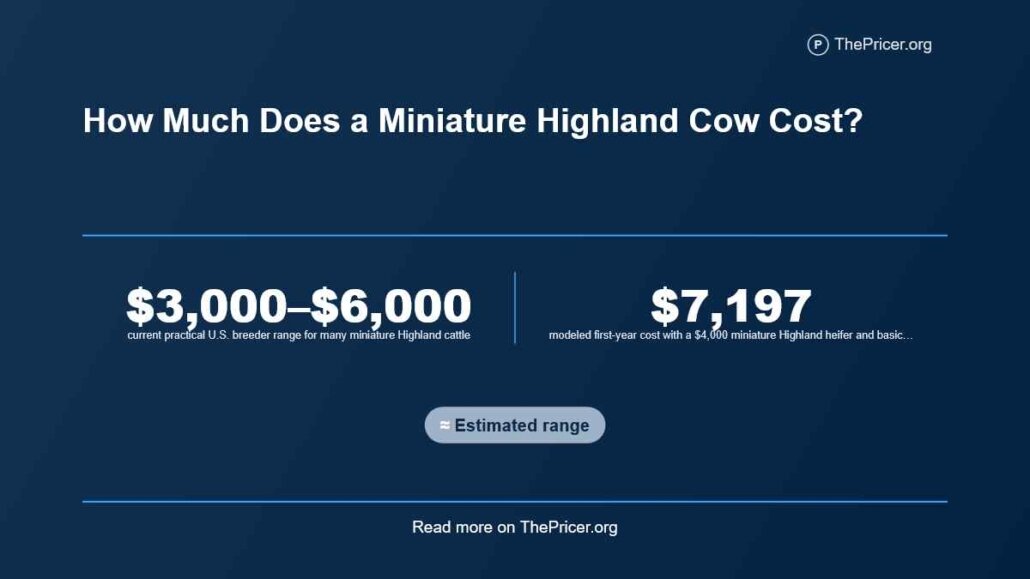
A miniature Highland cow currently costs about $3,000 to $6,000 in the mainstream U.S. breeder examples reviewed for this update. Specialty calves marketed around very small stature, unusual color, or chondrodysplasia status can be far higher, with current listings reaching $9,500 to $16,500. These are observed asking prices, not a national average.
The purchase price is only the first layer. A miniature Highland is still cattle, not a house pet. The buyer needs livestock fencing, forage, water, shelter, veterinary access, handling space, transport planning, and a clear answer on pedigree and genetics. The most expensive mistake is paying a miniature premium without knowing whether the animal is a registered fullblood Highland, a Highland cross, or a smaller animal carrying a dwarfing variant.
Article Highlights
Jump to sections
- Current mainstream breeder examples place many miniature Highlands around $3,000 to $6,000 per head.
- Current specialty listings can reach $9,500 to $16,500 for heavily marketed miniature calves.
- The American Highland Cattle Association does not create a separate miniature Highland breed within its fullblood herdbook.
- A modeled first-year small-property budget using a $4,000 heifer reaches about $7,197 before major emergencies or new handling equipment.
- A 700-pound cattle scenario needs about 1.4 tons of hay across a 150-day winter after a 10% waste allowance, costing roughly $251 at a May 2026 U.S. all-hay benchmark.
- Breeding buyers should verify pedigree, mature parent size, and the exact genetic test behind any “chondro” claim.
How Much Does a Miniature Highland Cow Cost?
Live 2026 breeder pages show a market well above the old $1,000 to $2,000 estimate. Mini High Ranch currently lists a $3,000 black mini Highland bull calf, a $4,000 dun heifer, and a breeding pair at $5,000. Simmers Family Farm has several miniature Highlands at $4,000 to $6,000, including non-chondro heifers and bulls as well as cattle sold with stated chondro status.
The premium end is much higher. Fluffy Feather Farm currently advertises miniature calves from $9,500 to $16,500, with several listings marked chondro positive. Those figures show what sellers are asking in one high-priced specialty program. They should not be converted into the normal price of every miniature Highland.
| Current listing type | Observed asking price | Pricing context |
|---|---|---|
| Mini bull calf | $3,000 | Current Mini High Ranch listing |
| Mini heifer | $4,000 | Current Mini High Ranch listing |
| Miniature Highland examples | $4,000 to $6,000 | Current Simmers listings with genetic-status details |
| Premium specialty calves | $9,500 to $16,500 | Current Fluffy Feather listings, several marked chondro positive |
A practical buyer budget of $3,000 to $6,000 fits the mainstream live breeder examples reviewed here. Animals with pregnancy, proven breeding history, unusual size claims, rare-color marketing, extensive handling, or premium pedigrees can move outside that band.
What Miniature Highland Means
Highland cattle are an old Scottish beef breed known for a long double coat, horns, forage ability, hardiness, maternal traits, and longevity. The American Highland Cattle Association breed profile places mature standard Highland cows around 900 to 1,200 pounds and bulls around 1,500 to 1,800 pounds. The association maintains a pedigree-based Highland registry, but “miniature Highland” is not a separate fullblood breed inside that herdbook.
In the specialty market, miniature usually describes cattle bred for shorter mature height. Sellers may use terms such as mini, micro mini, midsize, HighPark, or miniature Highland cross. Those labels are not interchangeable. A fluffy coat and Highland-looking horns do not establish pedigree. The coat does not prove pedigree.
A smaller fullblood Highland selected over generations is different from a Highland crossed with another small breed. Both are also different from cattle whose reduced stature is linked to a chondrodysplasia variant. Buyers should ask for the animal’s registration status, exact breed composition, birth date, current height, mature sire and dam heights, and the age when those parent measurements were taken. Height claims are far more useful after the parents have reached mature size.
The same distinction affects price. A pet steer, an open heifer, a bred female, a breeding bull, and an unusually small calf are different products. Comparing them as though “mini Highland” were one standardized item creates a false market average.
What Changes the Price
Sex and reproductive status matter. A steer bought as a companion or pasture animal does not carry the same breeding value as a heifer, bred cow, or bull. A confirmed bred female may command more because another owner has already carried part of the development and breeding cost.
Registration needs careful reading. The AHCA fullblood herdbook verifies Highland pedigree under its rules, while private miniature-cattle registries may use different standards. A seller calling an animal registered should identify the registry and provide the record. A Highland cross can still be useful, but crossbred status and fullblood AHCA registration are not the same.
Size can add a large premium because the miniature market rewards short mature cattle. A young calf measurement alone is weak evidence. Parent heights, age at measurement, pedigree, and genetics carry more weight. Color can move asking prices too, even though traditional Highlands occur in several colors.
Show and auction animals need separate context. The AHCA National Sale records show registered Highlands selling for many thousands of dollars, but those results are not miniature-cow averages. Auction does not mean poor quality, and private treaty does not prove quality.
First-Year Ownership Bill
The purchase can be little more than half of first-year cash outlay on a small property. Start with a $4,000 miniature heifer. Add a chosen $500 allowance for hauling and movement paperwork, then $1,500 as the animal’s share of fencing, gates, water equipment, shelter improvements, feeders, and basic handling needs.
For recurring care, add a chosen $600 pasture-use allowance, the calculated $251 winter-hay scenario below, about $46 for one year of the mineral example, and a $300 veterinary, parasite-control, and hoof-care allowance. The property and veterinary figures are planning assumptions.
The resulting first-year scenario is $7,197. The $4,000 animal represents about 56% of that total, leaving $3,197 outside the purchase price. A property with cattle fencing, water, pasture, a trailer, feeders, and handling equipment can spend less on setup. A new hobby farm may spend far more.
Oklahoma State University reports a recent annual cow-cost benchmark near $1,551 from Kansas farm-management data. It comes from commercial beef operations rather than miniature hobby cattle. Small herds can face higher per-head fixed costs because the same gate, water system, trailer, or chute serves fewer animals.
Feed, Land and Fencing
Highlands are efficient grazers and browsers, but feed is not free. Oklahoma State’s beef-cow intake guidance puts dry-matter intake around 1.8% to 2.9% of body weight depending on forage quality and production stage. A modeled 700-pound dry female at 2.2% consumes about 15.4 pounds of dry matter daily.
If hay is modeled at 90% dry matter, that becomes about 17.1 pounds as fed. Across 150 winter days, the animal needs about 2,565 pounds. Adding a chosen 10% waste allowance raises purchased hay to about 2,822 pounds, or 1.41 tons. USDA reported a May 2026 U.S. all-hay price of $178 per ton. At that benchmark, the modeled winter hay bill is about $251. Local hay can differ sharply by region, quality, bale size, freight, storage and weather.
Mineral belongs in the plan too. One current all-purpose cattle mineral sells for $24.99 per 50-pound bag and carries a 4-ounce-per-head daily feeding direction. At that rate, one animal consumes about 91 pounds per year, or roughly $46 at the posted price.
Acreage cannot be reduced to one national “mini cow per acre” rule. Carrying capacity changes with rainfall, soil, forage, season, animal weight and management. The current cow-feed cost research explains why pasture, hay and supplementation need separate budgets. Smaller stature reduces forage demand, not the need for livestock fencing and water.
Genetics and Health
The miniature market creates a genetics question that does not appear in the same form when buying ordinary commercial cattle. UC Davis Veterinary Genetics Laboratory lists BD1 and BD2 bulldog-dwarfism testing for several cattle types, including Miniature Highland. For BD1 and BD2, a carrier mated to another carrier has a 25% chance of an affected fetus under the documented recessive inheritance pattern.
A veterinary case report has documented lethal BD1-associated chondrodysplasia in miniature Scottish Highland cattle. “Chondro positive” should not be treated as a cosmetic price feature. A breeding buyer needs the exact test result, mutation tested, and a mating plan that accounts for the genetics.
Merck’s beef-cattle nutrition guidance says cattle need balanced energy, protein, vitamins and minerals. Most feeds already contain enough iron, and deficiency is rare outside problems such as blood loss or heavy parasite burden. Excess iron can interfere with copper and manganese absorption.
Hardiness also should not be confused with disease immunity. Highlands are hardy cattle, but USDA lists cattle among the species susceptible to foot-and-mouth disease. The old claim that Highlands resist FMD, BSE, or bovine leukemia virus should be removed. A livestock veterinarian should build the herd-health, vaccination, parasite, reproductive, and biosecurity plan for the property.
Transport and Resale
Buying several states away can make an attractive listing more expensive. USDA APHIS notes that interstate cattle movement may require official identification, a Certificate of Veterinary Inspection, and destination-state compliance. State rules can add testing, permits or documentation.
Freight depends on mileage, route, trailer capacity and pickup access. A distant $3,500 heifer is not automatically cheaper than a nearby $4,000 heifer once hauling and paperwork enter the comparison. Get the transport quote before paying a nonrefundable deposit.
Resale also works by cattle class rather than one age rule. A seller may market a weaned calf, steer, open heifer, breeding-age heifer, exposed heifer, confirmed bred female, cow-calf pair, mature bull, or proven herd sire. Each class carries different information and value. Waiting until exactly two years old is not a universal requirement.
Standard Highland cattle remain a recognized beef breed. The Livestock Conservancy breed profile lists beef as the primary use and describes Highlands as hardy, docile and long-lived. Miniature hobby-market animals may be purchased for breeding, grazing or companionship, but they are still livestock. Buyers comparing commercial cattle economics can also use the current Black Angus cattle cost page as a separate market benchmark.
Is the Property Ready?
A miniature Highland can fit a smaller acreage better than a 1,500-pound cow, but “miniature” does not remove cattle infrastructure. The animal still needs secure fencing, water, forage, weather protection, a way to restrain it for veterinary work, and livestock veterinary access. Horned cattle also need suitable gates and handling space.
The purchase decision should start with the property and the animal’s documented identity. A low calf price is not a bargain if the buyer must build an entire cattle setup after delivery. A premium miniature price also has little value if the seller cannot document pedigree, mature parent size, or the genetic claims used to justify it.
Makes sense if
- You already have suitable livestock fencing, water, forage and handling access.
- The seller can document registration or disclose crossbred status.
- You can verify mature parent size and relevant genetic-test results.
- Your budget includes transport, winter forage, minerals and veterinary care after the purchase.
Does not make sense if
- You plan to keep the animal inside a residence or ordinary suburban backyard.
- You are paying a miniature premium from a young calf photo without parent measurements.
- The seller uses “registered” without naming the registry or supplying records.
- The $3,000 to $6,000 purchase would leave no budget for livestock infrastructure or annual care.
Verification checks
- Checked the 2026 AHCA sale results and found high-value registered cattle sold through auction.
- Confirmed a published Miniature Highland case linking BD1 carrier parents with a lethal chondrodysplastic calf.
- Cross-referenced hardiness and longevity in the AHCA breeder guide.
Answers to Common Questions
How much does a miniature Highland cow cost?
Many current mainstream breeder examples reviewed fall around $3,000 to $6,000 per head. Specialty miniature listings can reach $9,500 to $16,500.
How big does a miniature Highland cow get?
There is no single AHCA miniature size standard. Mature size depends on lineage, crossbreeding and genetics, so buyers should request mature parent measurements rather than relying on a calf’s current height.
Can a miniature Highland cow live in a backyard?
Only a property set up for livestock should be considered. The animal needs secure cattle fencing, water, forage, weather protection, manure management and veterinary access. An ordinary residential backyard is not suitable cattle housing.
How much does it cost to feed a miniature Highland?
The bill depends on body weight, pasture, forage quality, winter length and local hay prices. The defined 700-pound winter scenario uses about 1.4 tons of purchased hay after waste and costs about $251 at the cited May 2026 national hay benchmark.
Are miniature Highlands a separate breed?
No separate miniature Highland breed exists within the AHCA fullblood herdbook. Animals sold under miniature labels may be smaller fullblood Highlands, crosses, or cattle with other size-related genetics, so registration and pedigree should be checked directly.
Disclosure: Educational content, not medical advice. Pricing varies by provider, location, and insurance. Confirm eligibility, coverage, and out-of-pocket costs with a licensed clinician and your insurer. See our methodology and corrections policy.