ThePricer Media
  • Latest: The Cost to Cool an AI Data Center
  • Cost Guides
  • News & Investigations
  • Daily Price Puzzle (60s)
  • Methodology
  • Press & Mentions
  • Contact
  • Click to open the search input field Click to open the search input field Search
  • Menu Menu
Family & Lifestyle, Cooking & Eating

How Much Does a Black Angus Cow Cost?

Updated on July 22, 2026 | Written by Alec Pow
This article was researched using 9 sources. See our methodology and corrections policy.

A Black Angus cow costs about $2,500 to $4,500 in the current commercial market, while bred heifers and cow-calf pairs often cost $3,500 to $6,500 or more. Registered Angus females commonly sell above $6,000, and registered breeding bulls frequently cost $6,000 to $12,000. Elite seedstock with high-value pedigrees, genomic data, donor potential, or show credentials can sell for $15,000 to well above $50,000. Feeder calves are usually priced by live hundredweight, written as cwt, rather than by one national price per animal.

The purchase price depends on whether the animal is an unweaned calf, feeder heifer, open replacement heifer, bred heifer, mature cow, cow-calf pair, commercial bull, or registered herd sire. Weight matters for feeder cattle, while pregnancy stage, age, fertility, feet, udder condition, disposition, registration, expected progeny differences, health records, and breeding history matter more for breeding stock. Freight, auction commissions, veterinary paperwork, official identification, pasture, hay, mineral, fencing, water, handling facilities, and breeding costs can add thousands of dollars after the winning bid.

Black Angus cattle are black-hided beef cattle associated with Angus genetics, but a black coat alone does not prove registration, genetic merit, fertility, or carcass quality. Commercial Angus-influenced cattle and registered American Angus Association animals belong in different price categories.

Article Highlights

Jump to sections
  • Does a Black Angus Cow Cost?
  • Calves Are Sold by CWT
  • Bred Females Cost More
  • What Angus Bulls Cost
  • Registered or Commercial Angus
  • The First-Year Ownership Bill
  • First-Year Math
  • Commercial Black Angus cows commonly cost $2,500 to $4,500 (at $30 per hour, earning that amount would take about 2.1 to 3.8 full-time workweeks, before taxes).
  • Bred heifers and cow-calf pairs can cost $3,500 to $6,500 or more.
  • A 500-pound steer calf valued at $480.48 per cwt equals $2,402.40 per head.
  • The reported 2025 Angus bull average was about $8,445.
  • Registered Angus sale averages can exceed $12,000 per female and $18,000 per bull.
  • Annual cow costs can exceed $1,500 per head before the purchase price is recovered.
  • Interstate purchases may require official identification, a veterinary inspection certificate, and destination-state compliance.
Angus Cow Cost

How Much Does a Black Angus Cow Cost?

Animal Class Current Planning Price Main Pricing Unit
400 to 600-pound feeder calf $1,900 to $3,000+ (about 1.6 to 2.5 full-time workweeks at $30 per hour) Live weight priced per cwt
Commercial open heifer $2,000 to $3,500 Per head or live cwt
Commercial bred heifer $3,500 to $6,500+ Per head
Commercial mature cow $2,500 to $4,500 Per head
Cow-calf pair $4,000 to $7,000+ Per pair
Commercial breeding bull $4,500 to $8,000+ Per head
Registered Angus bull $6,000 to $12,000+ Per head at private treaty or auction
Registered Angus female $6,000 to $15,000+ Per head at production sale
Elite donor or herd-sire prospect $15,000 to $50,000+ Pedigree, genetics, production, and sale demand

Current feeder-calf prices show why the old $600 to $800 Angus calf estimate no longer works. Oklahoma State University reported that 500-pound steer calves ended 2025 at $480.48 per cwt. Multiply $480.48 by five hundredweight and the animal is worth $2,402.40. An 800-pound feeder steer at the reported $349.89 per cwt equals $2,799.12. These are Oklahoma auction benchmarks for specified weight classes, not fixed Black Angus prices across every state.

Cattle markets entered 2026 with limited supplies. The U.S. beef cow herd stood at 27.6 million head on January 1, 2026, down about 1% from one year earlier. Oklahoma State also reported that the 2025 calf crop was the smallest since 1941. Fewer available calves and slow herd rebuilding support prices well above the figures that were common several years ago.

Related guides

  • How Much Does Venison Cost Per Pound?
  • How Much Do Walmart Party Platters Cost?
  • How Much Does Mahi Mahi Cost?

Calves Are Sold by CWT

Feeder cattle are often quoted in dollars per hundred pounds of live weight. A seller may describe a 500-pound Angus-influenced steer at $480 (about 2 full-time workdays at $30 per hour) per cwt, not at a flat $2,400. The buyer multiplies the cwt price by the animal’s weight divided by 100. The calculation matters because two calves sold at the same quoted rate can have different per-head costs.

A 450-pound calf at $480.48 per cwt costs $2,162.16. A 550-pound calf at the same rate costs $2,642.64. The second animal is only 100 pounds heavier, but requires another $480.48 in purchase cash. Sex, weaning status, health program, lot size, frame, flesh, horns, genetics, location, and uniformity can create premiums or discounts around the quoted market level.

Do not compare a feeder calf’s live cwt price with the price of a bred female. The calf is valued for future gain and resale or finishing potential. A bred heifer is also carrying reproductive value, future calves, and the risk that she may fail to conceive again, lose a calf, develop an udder problem, or leave the herd earlier than planned.

Bred Females Cost More

Bred heifers now require far more capital than the old $1,500 to $1,900 range suggests. Oklahoma State reported that 550-pound weaned heifer calves were selling for well above $2,000 per head during 2025. That animal still needs feed, pasture, breeding, health care, labor, and roughly two years before she weans her first calf when development proceeds as planned.

A bred heifer commands a higher price because another operation has already carried much of that development cost and reproductive risk. The quote should state expected calving date, service sire, pregnancy-check date, breeding method, vaccination history, disposition, weight, frame, feet, pelvic or calving information where available, and whether the animal is registered. “Bred” does not guarantee a live calf or future conception.

Registered Angus production sales occupy another price tier. Gardiner Angus Ranch reported 150 commercial bred heifers averaging $6,735, while 154 registered bred heifers averaged $13,217. Those sale results represent a known seedstock program and should not be presented as the price of every commercial Angus heifer. They show how registration, pedigree, mating, reputation, and buyer demand can double the sale average.

What Angus Bulls Cost

Registered Angus bulls now commonly sell above the old $2,700 to $5,400 range. American Angus Association reporting placed the 2025 Angus bull average at $8,445, up 73% from $4,884 in 2020. Individual production sales can average much more. Schaff Angus Valley reported 361 registered bulls averaging $14,815, while Gardiner Angus Ranch reported 399 registered bulls averaging $18,104.

A bull’s sale price reflects more than body weight. Buyers evaluate calving ease, birth weight, weaning and yearling growth, maternal traits, mature cow size, docility, feet, marbling, ribeye area, genomic data, pedigree, actual performance, scrotal measurement, soundness, and breeding-season readiness. A cheaper bull can become expensive if he breeds few cows, produces difficult calves, breaks down early, or fails a breeding soundness examination.

American Angus Association analysis placed the economic worth of a good 2026 bull at $12,000 to $17,175 for a commercial cow-calf operation under its assumptions. That figure is an estimated production value, not a required auction bid. The buyer still needs a ceiling based on herd size, calf value, expected years of service, salvage value, and breeding objectives.

Registered or Commercial Angus

A commercial black cow may be Angus-influenced without being registered. Registration connects an animal to a recorded pedigree and permits the buyer to inspect association data. It does not guarantee fertility, sound feet, calm behavior, easy calving, or profitability. The animal still needs a physical examination and records that match the sale description.

Expected progeny differences estimate genetic differences in future offspring when animals are compared within the breed. The American Angus Association publishes breed-average EPD data for traits such as calving ease, growth, milk, carcass merit, mature size, and foot scores. Its dollar-value indexes compare projected progeny economics under defined assumptions. They are selection tools, not promises that one animal will produce a fixed dollar return.

A commercial cow may be the better purchase when the goal is producing market calves at a controlled cost and the buyer does not need registration papers. Registered animals make more sense for seedstock production, documented mating programs, replacement-female sales, embryo work, or buyers targeting defined genetic traits. Paying a pedigree premium without a plan to use or market that value can make the purchase poor economics.

The First-Year Ownership Bill

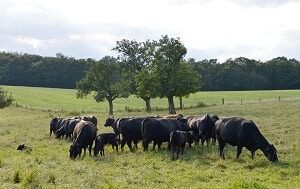
Black Angus cows grazing on pasture

The purchase price is only the entry cost. Oklahoma State cites 2024 Kansas Farm Management Association data placing the annual cost of running a cow near $1,551, with pasture and feed accounting for $684. Earlier national economic estimates ranged from $910 per cow on operations with 500 or more cows to $2,099 for operations with 20 to 49 cows, showing how strongly herd size affects unit cost.

Feed cannot be estimated from one claim that every cow eats 40 pounds daily at $65 per ton. Intake changes with body weight, pregnancy, lactation, forage quality, weather, pasture availability, dry matter, waste, and supplementation. Current hay bale prices also vary by forage, bale weight, grade, freight, storage, and region. A $100 round bale is not a fixed quantity, and weather loss can raise the cost of usable feed.

Fencing and handling costs hit small herds hardest because the same gate, waterer, energizer, corral, trailer, and working facility serve fewer cows. A new owner may need barbed-wire livestock fencing, electric cross-fencing, a mineral feeder, freeze-protected water, a loading area, and access to a chute before the first animal arrives. Those costs should not be hidden inside a vague annual maintenance allowance.

First-Year Math

ThePricer’s modeled first-year scenario starts with a commercial bred Angus heifer priced at $4,500. Add $350 for freight, inspection, identification, and paperwork, $850 for pasture and winter forage, $175 for mineral and supplementation, $225 for veterinary and breeding expenses, and $400 as the animal’s share of fencing, water, and handling costs. The first-year total reaches $6,500.

In that scenario, the heifer’s purchase price represents 69.2% of first-year cost. The remaining $2,000 is easy to miss because it arrives through separate transactions. A buyer who budgets only the winning bid understates first-year spending by 44.4% relative to the $4,500 purchase amount. The non-purchase inputs are modeled planning figures, while the ownership-cost structure is supported by current extension budgets.

The economics become harder for a one-cow or five-cow property. Oklahoma State reports annual costs of about $1,551 per cow in recent Kansas data and documents lower per-cow costs as herd size increases. A small owner who lacks pasture, fencing, a trailer, and handling equipment may spend much more than the scenario. Buying one cow is not the same as adding one cow to an established ranch.

Bull Cost per Calf

A bull’s useful cost should be spread across the females bred and calves sired rather than judged by purchase price alone. Suppose a registered bull costs $8,445, matching the reported 2025 Angus average. He breeds 25 cows per year for four years, producing 100 cow exposures. Purchase price alone equals $84.45 per cow exposed.

Now add $800 per year for feed, pasture, veterinary work, fertility testing, and allocated care across four years, producing another $3,200. Assume the bull later sells for a modeled $3,000 salvage value. Net ownership cost becomes $8,645, or $86.45 per cow exposed. If only 80 live calves are produced from those exposures, the same net cost becomes $108.06 per calf.

Death, injury, infertility, low conception, a short service life, and a small cow herd can push that number higher. Oklahoma State provides a bull investment calculator because purchase price alone cannot answer whether owning, leasing, or using artificial insemination is cheaper for a specific herd.

Freight and Paperwork

A cow priced attractively several states away may cost more than a local animal after freight. The buyer may face a minimum livestock-hauler charge, loaded-mile rate, fuel surcharge, overnight delay, auction commission, insurance, loading fee, veterinary inspection, official tag, brand inspection, or destination-state test. Group purchases divide freight across more animals but require more cash and adequate receiving facilities.

USDA APHIS states that sexually intact beef cattle aged 18 months or older moving interstate usually require official identification and an accompanying Certificate of Veterinary Inspection, subject to listed exemptions and state rules. Show and exhibition cattle can face identification requirements regardless of age. Buyers should check the destination state before transport because sale papers alone may not satisfy movement rules.

The registration tattoo, electronic identification, sale lot number, pregnancy description, health certificate, and registration certificate should refer to the same animal. Confirm who pays for testing and paperwork, when title and registration transfer, whether freight is insured, and what happens if the animal is rejected at loading or fails to meet the written description.

Live Cattle Are Not Beef

A live breeding cow, a slaughter animal, hanging-weight beef, and packaged meat are different products. A bred cow’s price includes reproductive value and future calf production. A feeder calf is valued for growth. Hanging weight describes a carcass before deboning, trimming, aging loss, and processing. Retail meat reflects cutting, packaging, cold storage, freight, merchandising, and the value of individual cuts.

Dividing a $4,000 cow by a 1,300-pound live weight gives $3.08 per live pound, but that calculation does not mean the buyer receives 1,300 pounds of beef worth $3.08 per pound. Hide, blood, organs, bone, moisture loss, fat trimming, and processing reduce the packaged yield. A clearer explanation of the carcass and take-home distinction appears in the cost of buying a side of beef.

Retail cuts also carry different values. The price of ribeye steak reflects a small high-demand portion of the carcass, while ground beef, roast, and trim sell at different rates. Do not use the store price of one premium steak to estimate the value of a live Angus cow.

When Angus Makes Sense

Makes sense if:

  • The animal’s class, weight, reproductive status, and registration are verified.
  • The buyer has pasture, fencing, water, handling equipment, and a herd-health plan.
  • The EPD profile and mature size fit the forage and marketing program.
  • Freight and first-year carrying costs are included before bidding.
  • A registered premium can be used through breeding or documented calf sales.

Does not make sense if:

  • The black hide is being treated as proof of registered Angus genetics.
  • The buyer has budgeted for the animal but not winter feed or facilities.
  • The bred female lacks a pregnancy date, service-sire record, or health documentation.
  • The bull price cannot be supported by expected cow exposure and calf value.
  • A distant bargain becomes expensive after freight and movement compliance.

What We Verified

  • Checked: Oklahoma 500-pound steer calves ended 2025 at $480.48 per cwt, equal to $2,402.40 per head.
  • Confirmed: The U.S. beef cow herd stood at 27.6 million head on January 1, 2026.
  • Cross-referenced: The reported Angus bull average reached $8,445 during 2025.
  • Verified: A major Angus sale reported commercial bred heifers averaging $6,735 and registered bred heifers averaging $13,217.
  • Checked: Recent Kansas data placed annual cow cost near $1,551, including $684 for pasture and feed.
  • Confirmed: Interstate movement rules can require official identification and veterinary movement documentation.

Answers to Common Questions

How much is a Black Angus calf?

A feeder calf commonly costs $1,900 to $3,000 or more in the current market. The exact amount depends on weight, sex, weaning, health, genetics, lot size, and the local cwt price.

How much is a bred Angus heifer?

Commercial bred heifers commonly cost $3,500 to $6,500 or more. Registered females from established seedstock programs can sell above $10,000.

How much does an Angus bull cost?

A commercial breeding bull may cost $4,500 to $8,000 or more. Registered Angus bulls commonly sell for $6,000 to $12,000, with elite prospects far above that range.

How much does it cost to keep one Angus cow per year?

Current enterprise data supports annual costs near $1,500 per cow, but a small property without existing pasture, fencing, water, and equipment may spend much more.

Does a black cow qualify as registered Angus?

No. Coat color alone does not prove registration or pedigree. Verify the registration certificate, tattoo or official identification, and association record.

Disclosure: Educational content, not financial advice. Prices reflect public information as of the dates cited and can change. Confirm current rates, fees, taxes, and terms with official sources before purchasing. See our methodology and corrections policy.

by Alec Pow
ThePricer cost research Independent price research used by media, universities and public institutions.

We research provider pricing, market examples, buyer reports, hidden fees and public records.

Methodology · Citations · Newsroom
© 2014 - 2026 - ThePricer Media, LLC, 4 Grove Street, New York, NY, 10014, Phone: (212) 431-2441
We don’t use affiliate links or paid placements. All sources are cited only for verification.
  • Link to X
  • Link to LinkedIn
  • Link to Facebook
  • Link to Instagram
  • Link to Pinterest
  • Link to Youtube
  • Contact Us
  • About Us
  • Press & Mentions
  • Careers
  • Meet the Founder
  • Privacy Policy
  • Editorial Ethics
  • Methodology
  • Corrections
  • Disclosure
  • Terms and Conditions
Scroll to top Scroll to top Scroll to top