
How Much Does a Monogram Cost?
Updated on | Written by Alec Pow
This article was researched using 9 sources. See our methodology and corrections policy.
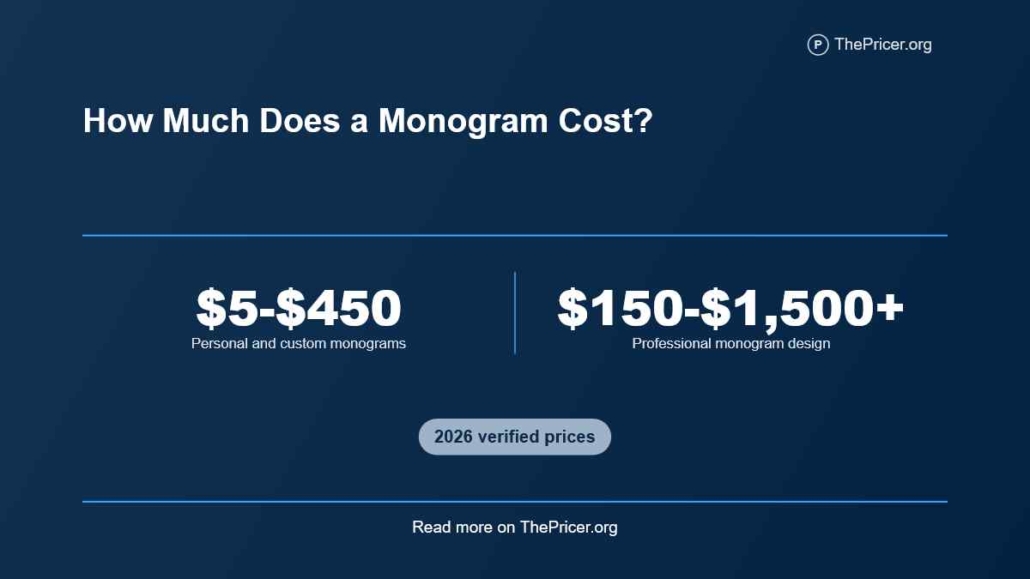
A custom monogram costs anywhere from about $5 to $50 for a simple personalized digital design to roughly $150 to $1,500 for professional custom design. Specialized monogram studios often charge around $65 to $450, while a complete business identity built around a monogram can cost $1,500 to $5,000 or more.
The huge range exists because the word “monogram” describes very different products. A $10 seller may insert your initials into an existing design, while a professional designer may create original lettering, test several concepts, prepare scalable files, establish color rules, and license the finished artwork for commercial use. For most personal projects, you will not need the expensive end of that range.
Article Highlights
Jump to sections
- Simple personalized digital monograms commonly cost $5 to $50 (at $30 per hour, earning that amount would take about 0.2 to 1.7 hours of work, before taxes).
- Specialist custom monograms generally cost about $65 to $450.
- Professional logo-quality monogram design typically runs $150 to $1,500.
- A larger brand identity system can reach $1,500 to $5,000+.
- Commercial rights, extra revisions, vector preparation, embroidery digitizing, and other production requirements can raise the final bill.
- A low-cost template is often enough for gifts or events, while a business may need original artwork and clearly defined usage rights.
How Much Does a Monogram Cost?
The first question to answer is whether you need a personalized template or an original design. Those may look similar when finished, but the amount of design work and the price are very different.
| Monogram Type | Typical Price | Best For |
|---|---|---|
| Simple digital template | $5-$30 (about 0.2 to 1 hours of work at $30 per hour) | Crafts, gifts, personal projects |
| Customized marketplace design | $20-$100 | Weddings, invitations, home use |
| Specialist custom monogram | $65-$450 | Events, stationery, personal branding |
| Professional monogram logo | $150-$1,500 | Businesses and commercial projects |
| Full brand identity | $1,500-$5,000+ | Companies needing a complete visual system |
At the low end, freelance marketplaces contain many inexpensive monogram offers because designers can start from an established style and customize the initials. Current monogram design listings demonstrate this marketplace model, where relatively simple jobs can be purchased separately from larger branding engagements.
Specialist pricing gives us a better benchmark for a genuinely customized personal monogram. current custom packages from Shuler Studio list a two-letter Signature Monogram at $65, a three-letter version at $165, a four-letter version at $215, and its higher-end Exclusive Monogram at $450.
That also means two prices previously quoted in this article had become outdated. The three-letter and four-letter packages are now $165 and $215 rather than the older $145 and $195 figures.
Professional Design
A monogram intended to function as a company logo belongs in a different price category. At that point, you are not simply paying someone to arrange initials attractively. The designer may need to develop original concepts, make the mark work at many sizes, create print and digital versions, and deliver files that can be reused across packaging, signs, clothing, websites, and advertising.
Current professional logo pricing from Upwork places a simple logo project at approximately $150 to $500 (about 0.6 to 2.1 full-time workdays at $30 per hour). A fuller logo package with several initial concepts, revisions, secondary marks, and complete print and digital files is estimated at about $500 to $1,500. A broader brand identity system is estimated at $1,500 to $5,000.
Another benchmark comes from fixed logo-design packages at 99designs. Current contest prices range from $249 for Bronze to $1,050 for Platinum. These are considerably more expensive than a personalized template because the buyer is commissioning competing design concepts rather than selecting initials from an existing arrangement.
The gap widens further when a business needs more than the monogram itself. Current brand identity pricing starts at $599 and reaches $2,499 for its fixed contest packages. These projects can include supporting identity materials rather than only a standalone logo.
For a wedding invitation or embroidered towel, spending at that level would normally make little sense. For a business expecting to use the same monogram on thousands of products for years, however, the economics are quite different.
What Changes Cost?
Originality is one of the largest price drivers. Replacing initials inside a prepared layout takes far less time than drawing original intertwined letterforms. The difference is similar to customizing an existing invitation and commissioning an illustrator to create something from scratch.
Revisions also matter. A cheap package may give you one concept and limited changes. More expensive work can involve several initial directions followed by rounds of refinement. The extra cost buys design exploration as much as it buys the final file.
Designer experience changes the quote. Someone building a portfolio may charge a fraction of the fee requested by a specialist whose work is already used by established brands. That does not automatically make the expensive designer the better purchase for every buyer. The required level of expertise depends on what the monogram will ultimately do.
File requirements are another important difference. A small JPG may be sufficient for a digital invitation but is a poor master file for a business logo. Adobe explains that vector artwork can scale without losing resolution, which is why formats such as AI, SVG, EPS, and vector PDF are commonly used for logos and other graphics that must work at very different sizes.
A buyer who expects to use the monogram for business cards, uniforms, storefront signs, product labels, and a website should therefore confirm which editable and vector files are included before comparing two quotes solely on price.
Personal or Business?
The cheapest route makes the most sense when the monogram is primarily decorative. Someone preparing wedding invitations, personalized napkins, a family gift, or home décor may get everything needed from a $20 to $100 design. Paying a branding agency several thousand dollars would provide little extra economic value in that situation.
A commercial buyer has more to consider. The artwork may need to survive years of use, work in black and white as well as color, remain readable when reduced to a tiny label, and reproduce correctly when enlarged for signage.
Rights also become more important. The U.S. Copyright Office explains that the person who creates original visual artwork is generally its initial copyright owner unless ownership changes under an applicable agreement or work-made-for-hire arrangement. Simply paying an artist to create something should therefore not be treated as proof that every conceivable right has automatically transferred to the buyer.
For a personal design that appears on a few towels, that distinction may have little practical effect. For a monogram that will appear on merchandise sold nationally, it becomes much more important to know what commercial use the contract actually permits.
The Hidden Price
The advertised design fee is not always the entire cost. A buyer may also encounter charges for additional revisions, alternate layouts, rush delivery, commercial licensing, source files, stationery layouts, embroidery preparation, trademark work, or physical production.
Embroidery is a particularly good example. Designing a logo and turning it into instructions that an embroidery machine can stitch are separate jobs. That means someone purchasing a monogram for polo shirts, hats, robes, towels, or uniforms may pay for both the artwork and digitization. Our guide to the cost of embroidery explains the production side in more detail.
The same principle applies to sewn patches and branded apparel. Buyers planning to put the monogram onto merchandise should consider the separate costs of having patches sewn on or the broader cost of making a shirt.
Commercial buyers may also want to investigate trademark protection. The USPTO defines a trademark as a word, phrase, symbol, design, or combination that identifies the source of goods or services. A stylized monogram used as a company’s identifying mark can therefore raise trademark questions that do not apply to a decorative family monogram.
Copyright and trademark protection are not interchangeable. The U.S. Copyright Office notes that extremely simple designs or stylized word logos may not contain enough original authorship for copyright protection, while trademark law can potentially protect a symbol or design used to identify commercial goods or services.
Worked Example
Suppose a small clothing company commissions a professional two-letter monogram for $500. It then needs $150 worth of alternate layouts and brand variations plus $75 of embroidery preparation. Its real design-preparation cost becomes $725, or 45% more than the headline $500 design fee.
If the company eventually uses that same artwork on 5,000 products, however, the $725 preparation bill works out to only about $0.15 per product. In that situation, paying more for reusable professional artwork may make economic sense.
Compare that with someone ordering one personalized wedding monogram for $50. Even an extra $100 of design refinement would triple the project’s price, yet the design might only be used on one set of invitations and event decorations. The same additional design work therefore has very different value for the two buyers.
There is also a useful time-to-money comparison. At earnings of $30 per hour, a $150 monogram represents five hours of gross earnings. A $450 specialist design equals 15 hours, while a $1,500 professional package equals 50 hours. A $5,000 identity project represents about 167 hours of gross earnings at the same rate.
Those figures do not tell you what to spend, but they do make the jump between a decorative monogram and a complete professional identity much easier to visualize.
Choosing a Designer
Start by matching the designer to the intended use rather than choosing solely by portfolio appearance. If you simply want initials for stationery, inspect examples that show the exact monogram styles available and confirm how many revisions are included. If you are creating a business mark, look for work that demonstrates how the designer handles logos across websites, packaging, signage, print, and merchandise.
Ask exactly what the quoted price includes. Important details include the number of initial concepts, revision rounds, color variations, black-and-white versions, vector files, raster files, commercial-use terms, and delivery schedule.
For commercial work, it is also worth checking whether the final mark can actually be used and protected the way you expect. The USPTO distinguishes between standard-character and special-form trademarks, with stylized designs and logos falling into the special-form category. That makes the exact visual form of a business monogram potentially significant if trademark registration becomes part of the plan.
Do not automatically pay for extras you will never use. Someone ordering a monogram for a single wedding does not need an elaborate corporate standards manual. Likewise, a business that expects its mark to appear everywhere from a favicon to a storefront should probably not settle for only a 1,000-pixel PNG.

What We Verified
We checked current specialist monogram prices against broader professional logo and branding markets. Current evidence supports three distinct price levels rather than one broad estimate: inexpensive personalized designs, specialist custom monograms, and professional commercial identity work. We also verified that the older three-letter and four-letter Shuler Studio prices in this article were no longer current.
We cross-referenced file requirements and intellectual-property issues with Adobe, the U.S. Copyright Office, and the USPTO. Vector files are important when a design needs to scale across physical and digital applications, while commercial buyers should separately understand copyright ownership, permitted use, and potential trademark considerations.
Answers to Common Questions
How much should I pay for a custom monogram?
For a personal monogram, a practical budget is generally $20 to $200. More specialized original work can cost $200 to $450 or more. If the monogram will serve as a commercial logo, professional projects commonly move into the $150 to $1,500 range.
Why can one monogram cost $10 and another cost $500?
A $10 design is often based on an existing style in which the seller substitutes your initials. A $500 project can involve original concept development, custom lettering, several revisions, vector preparation, and broader usage requirements. They are not directly comparable products even though both are called monograms.
Do I need a vector version of my monogram?
You should strongly consider one if the monogram will be printed at different sizes, embroidered, engraved, cut into signage, placed on clothing, or used as a business logo. Vector graphics can be resized without the pixelation that occurs when a small raster image is enlarged.
Can I use a custom monogram as a business logo?
Yes, but check the designer’s commercial-use and ownership terms first. A company should also make sure the mark works at different sizes and investigate whether similar marks are already used in its market before treating it as a long-term brand asset.
Disclosure: Educational content, not financial advice. Prices reflect public information as of the dates cited and can change. Confirm current rates, fees, taxes, and terms with official sources before purchasing. See our methodology and corrections policy.