
How Much Does a Rehearsal Dinner Cost?
Updated on | Researched and reviewed by Alec Pow, Founder & Pricing Investigator
Prices, claims, and calculations checked against 10 cited sources. See our research methodology and corrections policy.
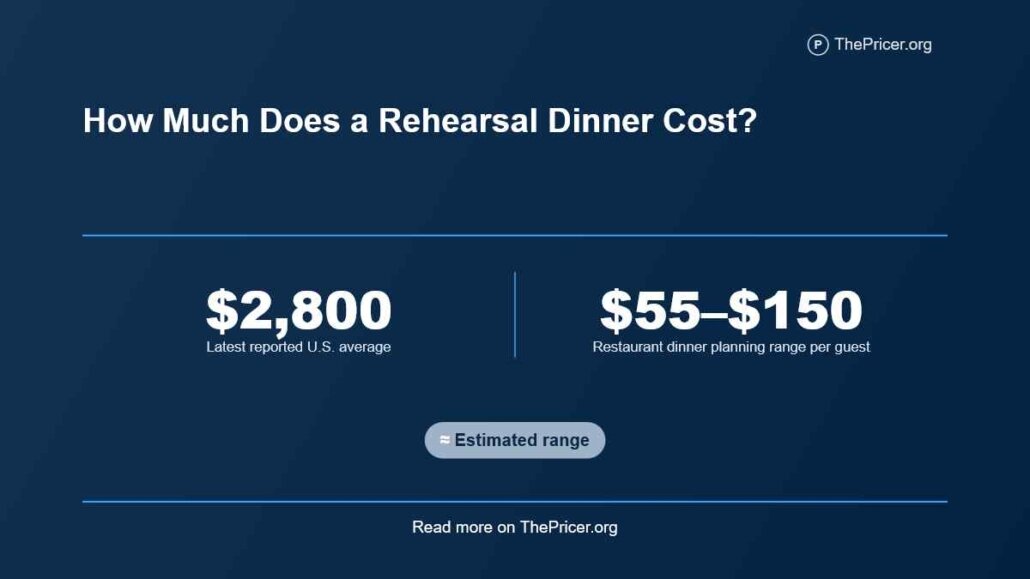
A rehearsal dinner costs an average of $2,800 in the United States, according to The Knot’s 2026 Real Weddings Study of couples married in 2025. For an upcoming event, a useful restaurant-dinner planning range is approximately $55 to $150 per guest, although a casual catered meal may cost considerably less. A 30-person restaurant dinner could therefore require approximately $1,650 to $4,500, depending on what the quoted rate includes.
Guest count, location, food, beverages, and private-room requirements have the greatest influence on the bill. Restaurants may charge a room fee or require minimum food-and-beverage spending, while taxes, service charges, gratuities, and decorations can add expenses beyond the advertised menu. Couples comparing venues should calculate the completed event cost rather than relying on the price per plate.
Article Highlights
Jump to sections
- The latest reported national average is $2,800 for rehearsal dinners associated with 2025 weddings.
- Restaurant-based planning estimates run approximately $55 to $150 per guest.
- Olive Garden advertises selected catered meal combinations from $13.75 per person, subject to availability and ordering conditions.
- A St. Louis private-event venue lists a $2,500 to $5,000 room minimum depending on the day and time.
- A modeled 30-person restaurant dinner costs $3,275, including food, drinks, service, tax, room rental, and decorations.
- Expanding that modeled dinner from 30 to 40 guests increases the bill by $975 under the same assumptions.
How Much Does a Rehearsal Dinner Cost?
The latest Knot Real Weddings Study results report average rehearsal dinner spending of $2,800. The study surveyed 10,474 U.S. couples married during 2025, and its findings were published in 2026.
The earlier rehearsal dinner spending report found an average of $2,700 among couples married in 2024. Its reported amount includes associated event expenses such as venue, food, invitations, and decorations rather than the meal alone.
For future budgeting, Zola’s February 2026 planning estimates suggest approximately $55 to $150 per person and total event budgets around $1,350 to $4,500. These are guidance ranges rather than fixed prices available at every restaurant.
| Rehearsal dinner scenario | Estimated cost | Calculation or scope |
|---|---|---|
| Casual 20-person dinner | $1,100–$3,000 | 20 guests at $55–$150 each |
| Restaurant dinner for 30 | $1,650–$4,500 | 30 guests at $55–$150 each |
| Restaurant dinner for 40 | $2,200–$6,000 | 40 guests at $55–$150 each |
| Restaurant dinner for 50 | $2,750–$7,500 | 50 guests at $55–$150 each |
| Modeled 30-person private dinner | $3,275 | Itemized food, drinks, room, service, tax, decor |
The first four rows are calculations applying Zola’s planning range, not independently observed event prices. Actual totals may fall outside them. A private room with a substantial minimum spend could cost nearly as much for 20 guests as it would for 40.
A small gathering at someone’s home also has different expenses from a restaurant event. Comparing both against one national average can obscure the price of the arrangements being purchased.
Restaurant and Catering Prices
Rehearsal dinners are commonly hosted in restaurants, private dining rooms, event spaces, or family homes. Pricing depends on whether the host needs food delivery, buffet setup, table service, a reserved room, or exclusive use of a venue.
A casual catered dinner can begin with relatively inexpensive food. Olive Garden’s official catering menu advertises meal combinations from $13.75 per person and a create-your-own pasta station starting at $13.50 per person. The listed prices vary by location, and the combination promotion has ordering-time restrictions.
Its catering delivery policy includes a $100 minimum before tax and a delivery charge of 10% on the first $500 of qualifying spending, followed by 5% on amounts above that threshold. These offers do not mean that a private restaurant rehearsal dinner can be hosted for the same amount.
Carrabba’s catering event information identifies rehearsal dinners among its supported occasions. The restaurant offers catering arrangements through participating locations, with exact food prices and services depending on the selected order.
A more traditional private dining venue may charge a fixed menu rate with additional service requirements. The Grand Concourse private-event program in Pittsburgh publishes a banquet menu for group dining. Buyers should obtain the current menu and complete booking conditions before treating any listed meal as a confirmed rehearsal dinner quotation.
A backyard dinner can avoid paying for a restaurant room, but it may require tables, chairs, serving equipment, delivery, cleanup, and weather protection. Those costs can reduce the apparent savings from ordering food alone.
Private Rooms
Some restaurants reserve private space only when the group agrees to a minimum food-and-beverage purchase. Others charge a flat rental fee, sometimes crediting it toward the spending commitment.
For a documented example, the D’Amici Room event pricing in St. Louis lists minimums of $2,500 for Monday through Wednesday, $3,000 for Thursday evenings, $3,500 for Friday and Saturday daytime bookings, and $5,000 for Friday and Saturday evenings.
The venue also states that a 22% service charge and sales tax are added to the final invoice and that room rental fees count toward the minimum.
This creates a substantial price difference between booking periods. Moving an otherwise comparable gathering from a Friday evening to a weekday could reduce the stated minimum commitment by $2,500. That is a reduction in the required spend, not a guarantee that an identical food order receives a discount.
For 30 guests, a $5,000 minimum works out to $166.67 per person before service and tax. Even if the group purchases food below that amount, the contract may still require paying the minimum.
At a 22% service charge, the $5,000 spend becomes $6,100 before any applicable tax, assuming the full minimum is subject to that charge. The effective amount is already over $203 per guest for 30 people.
A private dining room can be worth its price, but the minimum-spend requirement must be examined before comparing it with ordinary restaurant reservations.
A Complete Budget for 30 Guests
Consider an illustrative rehearsal dinner for 30 guests in a restaurant private room. The hosts select a fixed-price meal and allow a modest beverage budget. The scenario uses a meal rate within the published restaurant planning range, with additional explicit assumptions for charges that would vary by venue.
- 30 meals at $60 each: $1,800
- 30 beverage allowances at $15 each: $450
- Private room rental: $250
- 22% service charge on food and drinks: $495
- Illustrative 8% tax on food and drinks: $180
- Simple table decorations: $100
- Total modeled event cost: $3,275
ThePricer calculated result: $109.17 per guest for this 30-person dinner. The food costs $60 per person, but the completed event works out to almost twice that amount once the additional categories are included.
The model assumes that the service charge and tax apply to the $2,250 food-and-beverage subtotal. In a real contract, the tax base, treatment of service charges, and whether gratuity remains optional depend on local rules and venue terms.
The non-food charges and beverages add $1,475 to the food-only total. That increases the budget by approximately 82%. The calculation demonstrates why a meal quotation alone cannot be used as the full rehearsal dinner budget.
The example is not a published package from any one restaurant. Its purpose is to show how a complete invoice can be assembled without mixing incompatible venue prices.
Guest Count
Guest count usually changes the cost of meals and drinks, but some expenses remain fixed. Room rental, simple decorations, and certain setup charges may cost the same whether the event has 25 or 35 attendees.
The Knot’s 2024 study provides historical context. Couples whose weddings had 50 or fewer guests spent an average of $1,630 on rehearsal dinners, while those whose weddings exceeded 100 guests spent $3,139.
Those groups describe the size of the wedding itself, not necessarily rehearsal dinner attendance. They should not be interpreted as measured prices for dinners attended by 50 or 100 people.
Using the 30-person worked example, consider adding ten guests while keeping the room and decoration expenses unchanged. The added guests require another $600 in food and $150 in drinks.
Applying the same service and tax assumptions adds $165 in service charges and $60 in tax. The total additional cost is $975.
The modeled 40-person dinner therefore costs $4,250, equivalent to $106.25 per guest. Its average cost per person is lower than at 30 guests because the fixed expenses are spread over more attendees, although total spending is higher.
The distinction gives hosts a better way to evaluate invitations. Cutting ten guests from a reservation does not necessarily eliminate ten full shares of every expense.
Destination Weddings
Where the wedding takes place can change the rehearsal dinner budget through restaurant rates, labor costs, service arrangements, and the size of the invited group.
The Knot’s 2024 research found average rehearsal dinner spending of $3,838 for destination weddings versus $2,442 for hometown weddings. It also reported approximately $3,500 in the Northeast and around $2,000 in the Midwest.
These are historical category averages from 2024 weddings, not freshly measured 2026 regional prices. Destination events may also combine a rehearsal dinner with a wider guest welcome gathering, making the format different from an intimate dinner after a ceremony rehearsal.
A September 2026 event planning discussion distinguishes a smaller rehearsal dinner from a welcome party attended by a larger portion of the wedding guests.
For couples comparing a wedding venue’s restaurant and event packages, the Perona Farms wedding costs discussion provides a related example of how venue arrangements and catering shape event spending.
Transportation, welcome activities, and additional attendees should be budgeted as separate items where they are not part of the dinner contract. A destination event does not automatically require inviting every wedding guest to dinner.
Service Fees
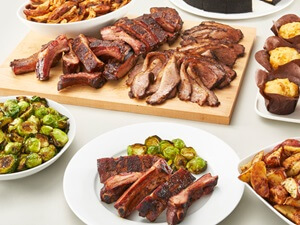
Menu prices often exclude some event expenses. Depending on the venue, hosts may pay for an exclusive room, service labor, mandatory charges, sales tax, delivery, rentals, decoration, parking, and cleanup.
Zola’s 2026 guidance identifies service charges around 18% to 22% and sales tax around 6% to 10% as possible additions, with actual amounts dependent on the vendor and jurisdiction. A service charge is not necessarily equivalent to a gratuity.
A private-event contract can also have a guest-count guarantee. If the agreement requires the final number several days before the gathering, lowering attendance after the deadline may not reduce the invoice.
Decorations can be kept simple in a restaurant with furnished tables. However, a more elaborate arrangement may involve separate flowers, signage, or installations. The cost of a balloon arch illustrates how delivery, setup, and decoration design can affect the amount paid.
Invitations need not be expensive. Digital messages can work for a small gathering, while printed invitations and individual menus add an optional expense.
Rehearsal dinner clothing may create another personal cost that is separate from the hosted event. The Brides rehearsal dinner attire guidance discusses clothing choices for hosts and guests, depending on the event’s formality.
Couples should also check whether the dinner’s timing permits ordinary restaurant service or requires an after-hours event, because that distinction may change the venue’s staffing and minimum-spend requirements.
Who Pays for the Rehearsal Dinner?
Traditionally, the groom’s parents hosted and paid for the rehearsal dinner. Today, the couple, either family, or several contributors may share the expenses.
The Knot’s rehearsal dinner etiquette discussion explains that the gathering is not mandatory and that hosting responsibilities are flexible.
A family contribution should be discussed before the venue is booked. The parties paying for the event need to agree on the guest list, spending limit, deposits, beverages, and any extras requested after the original plan.
For a smaller or more casual event, there is no need to reproduce the full wedding reception. A dinner with the wedding party and close relatives may meet the purpose of thanking participants and spending time together.
The related cost of renewing wedding vows addresses a different kind of celebration, where ceremony and reception choices can also influence the size of the event budget.
Choosing the Right Dinner Format
The largest savings opportunities often involve the number of people invited, the meal format, and the venue’s minimum requirements. A family-style restaurant dinner can provide a shared meal without booking an elaborate private event, provided the restaurant can accommodate the group.
A hosted meal at home may lower the need for room rental. However, food delivery, rented tables, serving equipment, and cleanup should still be priced. The cheapest food offer is not necessarily the least expensive complete event.
Makes sense if
- The group wants a planned meal after the wedding ceremony rehearsal.
- The hosts can afford the full event without reducing necessary wedding spending.
- The private room’s minimum is realistic for the expected attendance.
- The restaurant offers suitable food, timing, and seating for the group.
Does not make sense if
- The venue minimum forces spending well beyond the intended dinner budget.
- The invited group becomes so large that the event resembles a second reception.
- A casual meal could meet the same purpose at a lower cost.
- Service, tax, room, and rental charges make the proposed venue poor value.
Before paying a deposit, request an estimate showing the final guest count, food and drink package, minimum spend, room charges, service fees, taxes, and cancellation conditions. This provides a meaningful comparison between venues that advertise different pricing structures.
Answers to Common Questions
What is the average cost of a rehearsal dinner?
The latest reported U.S. average is $2,800 for couples married in 2025. Individual events vary widely by guest count, restaurant, food, and service arrangements.
How much does a rehearsal dinner cost per person?
A useful restaurant-based planning range is approximately $55 to $150 per guest, although casual catering can cost less and upscale private dining can cost more.
How much should you budget for 30 guests?
At $55 to $150 per guest, the preliminary estimate is $1,650 to $4,500. The modeled complete restaurant dinner in this article costs $3,275.
Who traditionally pays for the rehearsal dinner?
The groom’s parents traditionally hosted and paid for it, but couples and families can choose any arrangement that fits their finances and preferences.
Is a rehearsal dinner required?
No. Couples may host a formal dinner, arrange a smaller informal meal, or skip the separate gathering entirely.
Disclosure: Educational content, not financial advice. Prices reflect public information as of the dates cited and can change. Confirm current rates, fees, taxes, and terms with official sources before purchasing. See our methodology and corrections policy.