
How Much Does a Swan Cost?
Updated on | Written by Alec Pow
This article was researched using 17 sources. See our methodology and corrections policy.
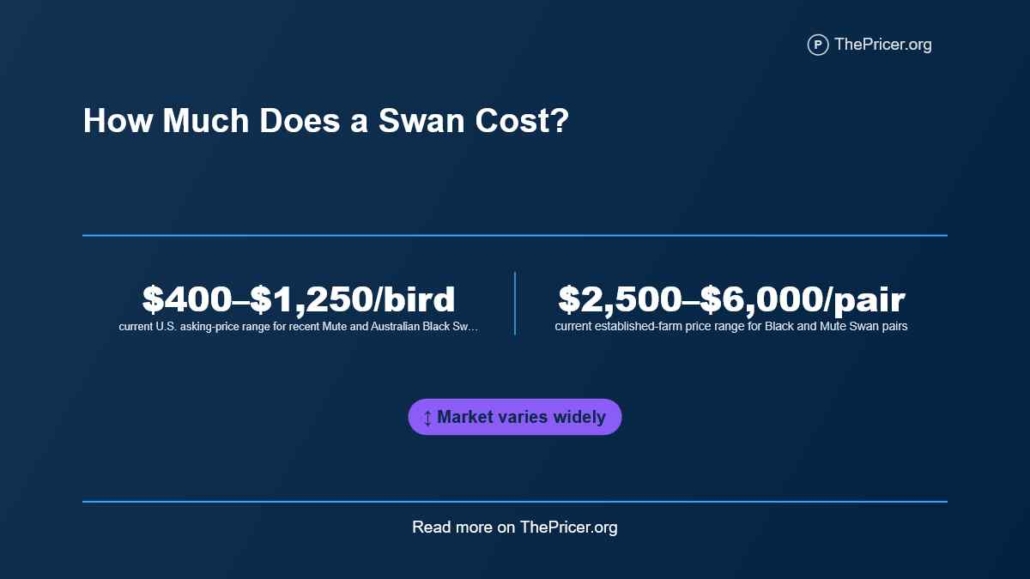
A swan currently costs about $400 to $1,250 per bird in recent U.S. classified listings for Mute and Australian Black Swans, while established farm pricing can reach $2,500 to $6,000 per pair.
A current 2026 marketplace also lists captive-reared Trumpeter Swans around $850 to $1,000 each, but protected native swans sit inside a regulated federal transfer system rather than the same unrestricted market as nonnative ornamental birds. Current classified examples are visible on recent U.S. swan listings, while a 2026 farm price sheet shows pair prices up to $6,000.
The bird can be cheaper than the property work. A suitable pond, secure shoreline, feed, specialized veterinary access, transport, winter management, and legal compliance can push the first-year commitment far beyond the purchase price. Species changes everything. The pond changes more.
Article Highlights
Jump to sections
- Recent Mute Swan classifieds run about $400 to $1,250 (at $30 per hour, earning that amount would take about 0.3 to 1 full-time workweeks, before taxes) per bird.
- Recent Australian Black Swan listings run about $600 to $1,000 per bird, with one pair listed at $1,300.
- An established 2026 farm lists Mute Swan pairs from $4,500 to $6,000.
- Protected native swan sales use federal waterfowl-transfer rules and may also face state requirements.
- A modeled first year for a $4,500 pair with an existing suitable pond is about $5,080 to $5,426 before delivery and habitat work.
- Adding a newly built pond can push that modeled entry cost to about $7,980 to $21,026.
How Much Does a Swan Cost?
The current U.S. market does not support one clean price for every swan. Recent Mute Swan listings include a $400 (about 1.7 full-time workdays at $30 per hour) cygnet, $550 cygnets, an $800 adult male, $875 2026-hatch birds, and a $1,250 adult listing. These are classified asking prices from individual sellers, not completed-sale data or a national market average.
Australian Black Swan listings show a similar channel effect. Current Black Swan listings include $600 birds and a $1,000 male, while another current listing offers one male and one female at $1,300 together. Established farm pricing sits higher because pair formation, age, breeding status, availability, and seller program can change the package.
| 2026 price example | Current asking price | Scope |
|---|---|---|
| Mute Swan cygnet classified | $400 to $875 each | Recent individual-seller listings |
| Adult Mute Swan classified | $800 to $1,250 each | Recent individual-seller listings |
| Australian Black Swan classified | $600 to $1,000 each | Recent individual-seller listings |
| Established farm Black Swan pair | $2,500 to $3,500 per pair | Young versus older pair |
| Established farm Mute Swan pair | $4,500 to $6,000 per pair | Young, older, or breeder pair |
| Trumpeter Swan classified | $850 to $1,000 each | Protected native species, regulated transfer |
The table is a snapshot of current offers, not a claim that every seller will quote the same amount. Age, sexing, pair status, breeder history, transport, and legal status can move the payable amount sharply.
Legal Market Comes First
Native and nonnative swans cannot be priced as though they use the same legal channel. The federal Migratory Bird Treaty Act rules regulate possession, sale, purchase, transport, and other activities involving protected migratory birds. Trumpeter and Tundra Swans are native species within that federal framework. Captive-reared protected waterfowl can enter lawful transfers, but those transactions come with marking and paperwork requirements.
A seller disposing of captive-reared protected swans needs the federal Waterfowl Sale and Disposal permit. The current application fee is $75 (about 2.5 hours of work at $30 per hour), and each transfer requires Form 3-186. That $75 is a permittee application charge, not a universal buyer fee. The federal waterfowl permit application lists several approved marking methods, so pinioning is not a universal federal rule for every transaction. State and tribal approvals can still apply.
Mute Swans are different at the federal level because they are nonnative, yet state law can be stricter. New York currently prohibits sale, importation, transport, or introduction of Mute Swans under its invasive-species rules. This is why the old idea of one generic $50 to $150 state permit is misleading. Some locations allow possession, some regulate it, and some block the transaction the buyer is trying to make.
Single Birds vs Pair Prices
Seller channel can create a larger price difference than species name alone. One current 2026 Mute listing asks $875 each and states that pairs are available. Two birds at that price total $1,750. The established-farm price cited in the opening is $4,500 for a 2026-hatch Mute pair. The difference between those two current asking-price examples is $2,750.
That farm pair is about 157% more expensive than buying two $875 classified birds. This does not prove that one channel is better. The offers may differ in bloodline management, unrelated pairing, breeder support, health history, transport options, availability, or other terms not visible in the headline price. The calculation shows why a buyer should compare matched pair status and included services instead of treating “Mute Swan price” as one commodity number.
Black Swans show the same problem. A current classified pair is advertised at $1,300, while the 2026 farm list shows young Black Swan pairs at $2,500 and older pairs at $3,500. A buyer choosing by sticker price alone is comparing different sales channels and possibly different ages. Ask whether the birds are DNA sexed, already bonded, full-wing or flight-restricted, pickup-only or deliverable, and whether the seller supplies health or transfer records.
Pond and Habitat Costs
The old claim that each swan needs only 60 to 100 square feet of pond surface is too small and too universal to use as a husbandry rule. Swan needs vary by species, flight status, pair behavior, breeding status, climate, water quality, and whether the birds forage naturally. Cornell notes that wild Trumpeter Swans use shallow freshwater habitat and can need at least 100 yards of open water for running takeoff. A pinioned ornamental Mute Swan is a different case, but that does not make a tiny decorative pool a sound substitute for substantial water access.
If a suitable pond already exists, the buyer avoids the largest construction variable. If one has to be built, current U.S. pond projects cost about $2,900 to $15,600 on average, with smaller-than-10-acre ponds quoted around $3,000 to $15,000 per acre. Those are general pond-construction figures, not swan-habitat quotes. A swan project may need different grading, shoreline design, predator control, drainage, shelter, water management, and local permits.

The financial lesson is simple. A cheap bird does not create a cheap swan property. Buyers starting without appropriate water should price the land and pond work before shopping for birds.
First-Year Swan Budget
A reproducible first-year model is easiest for a pair living on a property that already has suitable water. Start with the current $4,500 2026-hatch Mute pair from the farm price list. Grand Swan Farm says its captive Mute Swans eat about one-half to three-quarters pound of feed per bird daily. For two birds, that is about 365 to 547.5 pounds of feed per year.
A 50-pound bag of Mazuri Waterfowl Maintenance currently costs $47.99, or about $0.96 per pound. Applying the breeder’s feeding quantity gives about $350 to $526 in annual bagged feed for two swans. Fresh greens, natural forage, breeding diets, waste, and regional feed prices can change that figure.
A current 2026 avian-pricing review places bird wellness exams around $115 to $200 per bird. Using two routine exams adds $230 to $400. The resulting existing-pond scenario is $4,500 + $350 to $526 + $230 to $400 = about $5,080 to $5,426. Delivery, fencing, shelter changes, winter equipment, diagnostic testing, permits, and emergencies are excluded.
If the property also needs a pond, adding the current general pond-construction range produces an illustrative entry total of about $7,980 to $21,026. That second figure is a property scenario, not a national swan-ownership average.
Feed and Routine Care
Feed cost depends heavily on how much useful vegetation the pond and surrounding land provide. A managed captive bird may still receive commercial pellets or grain mixes even where natural forage is present. The current feed calculation above uses a breeder’s real-world Mute Swan quantity and a retail waterfowl-pellet price, which is more useful than assigning every swan a flat $500 to $1,000 annual food allowance.
Commercial feed is only one input. Water quality, pasture access, greens, seasonal feeding, breeding status, and waste all change consumption. Wild Mute Swans can consume several pounds of aquatic vegetation per day, but that plant mass should not be converted directly into an equivalent number of pounds of bagged pellets. The nutritional density and moisture content are different.
Routine habitat work can cost more than the ration. Shoreline repair, pump or aerator service, fencing, water testing, algae management, de-icing, shelter repairs, and predator control depend on the property. There is no defensible national $2,000 annual pond-maintenance fee that applies to every swan owner. A natural farm pond with good water movement has a different cost structure from a lined ornamental pond with pumps and filtration.
Readers comparing smaller domestic waterfowl can also check duck ownership costs, live chicken costs, and pigeon costs.
Veterinary and Long-Term Costs
Swan veterinary care is specialized enough that the nearest dog-and-cat clinic may not be useful. The avian exam figures used in the first-year model are reference prices for bird wellness visits, not swan-specific guarantees. A large waterfowl case may involve mobile service, transport, imaging, laboratory work, sedation, hospitalization, or referral care. Those services can make a sick-bird bill much larger than the routine exam fee.
The old article also treated immunizations, insurance, emergency treatment, and specialist training as if each had a standard annual swan price. That structure should be removed. There is no broad routine vaccine schedule or public national swan-insurance premium that supports those fixed lines. Mortality or liability coverage may be available through specialty farm, animal, or commercial insurers, but pricing depends on the property, use, number of birds, insured value, and policy exclusions.
Swans can also create a long ownership horizon. North American banding records show a Mute Swan reaching at least 26 years and 9 months. Planning around two decades is reasonable for property and succession decisions even though individual lifespans vary. Feed, pond upkeep, veterinary access, winter care, and replacement equipment can repeat long after the original purchase price is forgotten.
Choosing a Swan Setup
The buyer’s first decision is not white swan versus black swan. It is whether the intended species can be lawfully acquired and responsibly kept at the specific property. Check federal status, state wildlife rules, county or municipal restrictions, pond suitability, transport, and veterinary access before paying a deposit or arranging delivery. Native protected species need extra scrutiny because a seller’s asking price does not replace federal transfer compliance.
The second decision is whether the property already carries most of the habitat cost. A $550 cygnet can look inexpensive beside a $4,500 farm pair, yet the difference becomes less important if the site needs a five-figure pond project. Purchase price matters most after water, containment, legal status, and long-term care have been solved.
Makes sense if
- You already have suitable water or have priced the pond project before buying birds.
- You have confirmed state and local rules for the exact swan species.
- You can access an avian or waterfowl veterinarian.
- You can fund decades of feed, habitat work, and seasonal care.
Does not make sense if
- You are relying on a small decorative pond as the entire habitat.
- You are buying a protected native swan without transfer paperwork.
- You assume a seller’s delivery claim settles state legality.
- Your budget covers the bird but not the property work.
Answers to Common Questions
How much does a pet swan cost?
Recent U.S. Mute and Black Swan classified listings run about $400 to $1,250 per bird, while established breeder pairs can cost about $2,500 to $6,000.
How much does a pair of swans cost?
Current examples range from about $1,300 for one classified Black Swan pair to $6,000 for an established-farm Mute breeder pair. Pair age, species, seller, and breeding status change the price.
Can you legally buy a Trumpeter Swan?
Captive-reared protected waterfowl can be transferred through the federal Waterfowl Sale and Disposal system when the required seller permit, marking, and transfer paperwork are in place. State rules still apply.
How much does feeding two swans cost?
Using the current breeder feeding quantity and retail pellet price in the worked model, two Mute Swans consume about $350 to $526 of bagged feed per year before greens, waste, or special diets.
How much can the first year cost?
The modeled pair with an existing suitable pond costs about $5,080 to $5,426 before delivery and habitat work. Adding a new pond moves the illustrative total to about $7,980 to $21,026.
Disclosure: Educational content, not medical advice. Pricing varies by provider, location, and insurance. Confirm eligibility, coverage, and out-of-pocket costs with a licensed clinician and your insurer. See our methodology and corrections policy.