
How Much Does an American Bully Cost?
Updated on | Written by Alec Pow
This article was researched using 14 sources. See our methodology and corrections policy.
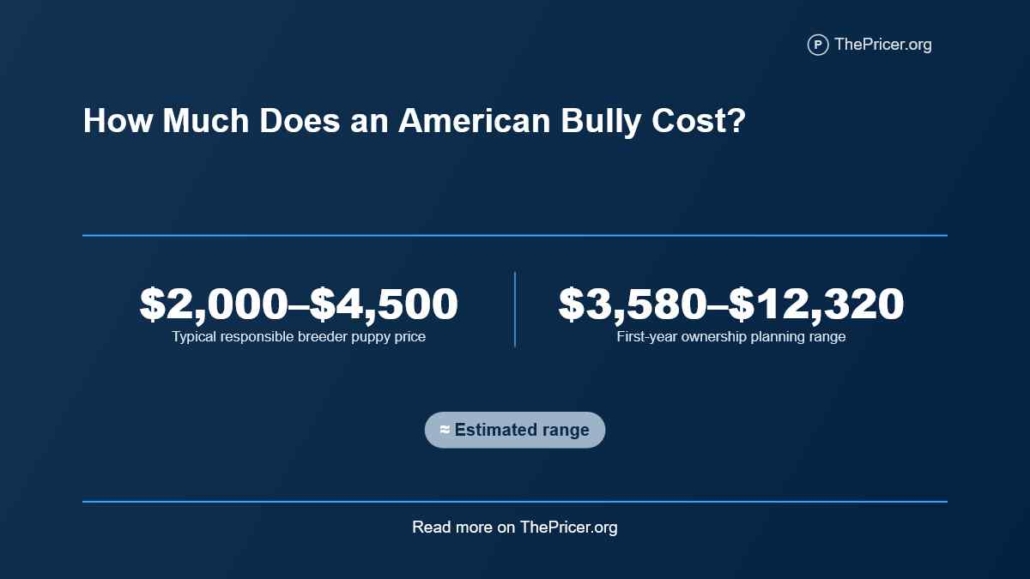
An American Bully puppy from a responsible U.S. breeder currently costs about $2,000 to $4,500. Good Dog’s current American Bully buyer guide places national breeder pricing in that range. Individual programs can run higher, especially for XL dogs, show prospects, or sought-after pedigrees.
The purchase price is only part of the commitment. The American Bully is a U.S.-developed companion breed sold in Pocket, Standard, Classic, and XL forms under major bully registries. Size class, pedigree, registration terms, parental health work, early veterinary care, training, insurance, and housing rules can all change what a buyer pays. A cheap classified puppy and a documented breeder placement are not equivalent purchases.
Article Highlights
Jump to sections
- Current national breeder guidance places many American Bully puppies at $2,000 to $4,500 (at $30 per hour, earning that amount would take about 1.7 to 3.8 full-time workweeks, before taxes).
- One current breeder publishes Standard puppies around $2,000 to $3,000 and XL puppies from $4,000+.
- A first-year planning scenario built from current puppy and care costs reaches about $3,580 to $12,320, depending heavily on puppy price and food choices.
- Current U.S. dog accident-and-illness insurance averages about $836 per year, though an American Bully quote can differ widely.
- Housing and liability-insurance restrictions can matter separately from pet health insurance.
- ABKC recognizes Pocket, Standard, Classic, and XL varieties rather than a five-variety list that includes Extreme.
How Much Does an American Bully Cost?
The best current planning range for a breeder puppy is $2,000 to $4,500 (about 1.7 to 3.8 full-time workweeks at $30 per hour), but the market extends beyond those endpoints. A current Arizona breeder lists puppies from $2,000 to $8,000 depending on pedigree. That program says Standards are commonly $2,000 to $3,000, while XL puppies are usually $4,000+.
Another current program in Maryland publishes a total price of $1,800 to $5,000 before taxes and fees. Its package lists a microchip, deworming, an eight-week vaccine, vet check, collar and leash, food, toys, a blanket, and 30 days of Trupanion coverage. Those inclusions help explain why two breeder prices cannot be compared by the sticker amount alone.
| Current price reference | Published amount | Scope |
|---|---|---|
| Good Dog national buyer guide | $2,000 to $4,500 | National breeder guidance |
| Forgiati American Bullies | $2,000 to $8,000 | Pedigree-dependent breeder pricing |
| Household 6 Bullies | $1,800 to $5,000 | Current breeder package before taxes and fees |
These are current published examples, not a representative national survey. They show a real spread from lower-priced companion placements to premium pedigree or XL puppies. A buyer should match registration, health records, contract terms, age, transport, and included care before deciding that one breeder is cheaper than another.
What Changes the Puppy Price?
Size class can create a large price difference inside the same breeding program. Using the Arizona prices already cited, a Standard at the top of its stated band is $3,000 (about 2.5 full-time workweeks at $30 per hour), while the same breeder says XL puppies start around $4,000. That puts the XL entry point at least $1,000 above the Standard ceiling in that program. At the other end, a $4,000 XL starts at twice the breeder’s $2,000 Standard floor.
Pedigree can matter just as much. Breeders may charge more for a puppy evaluated as a show or breeding prospect, for a placement with broader registration rights, or for offspring from highly titled dogs. Coat color can influence asking prices in the commercial market, but a rare-color label does not substitute for structure, temperament, health records, or a sound contract. Buyers paying a premium for appearance should still ask what objective documentation comes with that premium.
Deposits also change the cash flow even when they do not change the final total. Current breeder pages show nonrefundable deposits of several hundred dollars before the balance is due. Read the transfer and refund terms before sending money. A deposit that can move to a later litter is financially different from one that is lost if the buyer changes plans.
American Bully Classes
The American Bully does not have one official adult weight range. Its common registry classes are built mainly around height and frame. The ABKC breed standard recognizes Pocket, Standard, Classic, and XL. Pocket males are under 17 inches but at least 14 inches at the withers, while Pocket females are under 16 inches but at least 13 inches. Standard males are 17 to 20 inches and females are 16 to 19 inches.
Classic dogs use the Standard height band with a lighter frame and less body mass. XL males are over 20 inches through 23 inches, while females are over 19 inches through 22 inches. Terms such as Micro, Exotic, Extreme, and XXL appear in breeder marketing, but buyers should not treat every label as a fifth or sixth official ABKC class.
This distinction matters financially. A dramatic size label can raise an asking price without describing a recognized class. The useful question is what registry standard the breeder follows, how the adult dogs are measured, and whether the puppy’s structure remains functional. Height class describes the dog more reliably than a promotional weight target.
Health Testing Matters
Health records deserve close attention before a buyer pays several thousand dollars. Good Dog’s current American Bully testing guide lists hip and elbow evaluations among its higher-level screening recommendations, along with selected DNA tests. Hip and elbow screening is especially relevant for a muscular breed that can carry substantial body mass.
The Orthopedic Foundation for Animals also explains that a breed missing from its parent-club CHIC list should not be interpreted as a breed that needs no screening. OFA maintains searchable records for hips, elbows, eyes, cardiac disease, patellas, respiratory function, and DNA-based tests. A buyer can search a sire or dam by registered name and ask the breeder to explain every result that applies to the mating.
There is another issue beyond test names. Some American Bullies are marketed for extremely broad chests, very short muzzles, or unusually heavy mass. A buyer should favor dogs that can move and breathe normally over exaggerated features sold as premium traits. Price does not prove functional structure.
A health guarantee also needs to be read, not assumed. Ask which conditions are covered, how long coverage lasts, whether a veterinarian diagnosis is required, and what remedy the contract provides. Replacement-puppy language, reimbursement limits, and return requirements can produce very different outcomes even when two breeders both advertise a guarantee.
First-Year Cost
The first-year bill can exceed the puppy price by several thousand dollars. Rover’s 2026 U.S. data lists an initial vet exam at $80 to $180, vaccinations at $180 to $300, preventatives at $75 to $175, essential supplies at $260 to $1,125, puppy food at $575 to $4,775 per year, puppy training at $235 to $385, and puppy insurance at $175 to $880 per year. Those broad figures cover dogs of many sizes and diets, so an XL Bully may sit toward the higher side for crates, beds, walking gear, food, and weight-based preventatives.
A ThePricer first-year scenario combines the current $2,000 to $4,500 breeder range with those Rover care categories. Adding puppy + initial exam + vaccinations + preventatives + supplies + food + training + puppy insurance produces about $3,580 to $12,320. This excludes spay or neuter surgery, licensing, emergency veterinary treatment, transport, boarding, and housing-related costs.
The width of that range matters. The upper end is driven heavily by Rover’s broad food, supplies, and insurance bands rather than a claim that every American Bully costs five figures in year one. A household choosing mainstream dry food and modest equipment could land far below it, while premium fresh food, larger XL equipment, or higher insurance premiums can push spending upward.
The useful lesson is the gap between purchase price and funded ownership. A buyer stretching to afford a $4,500 puppy still needs room for routine care and an emergency reserve after pickup day.
Insurance and Housing
 Pet health insurance is much more expensive than the old $8 to $15 per month estimate. Current NAPHIA data summarized by NerdWallet puts the 2025 U.S. average dog accident-and-illness premium at 2025 U.S. dog average of $836 per year, or about $70 per month. Accident-only coverage averages $190 per year, but it does not cover illnesses. An American Bully quote can move above or below the industry average based on age, ZIP code, deductible, reimbursement level, limits, and insurer underwriting.
Health insurance is only one policy to check. The National Association of Insurance Commissioners notes that some homeowners and renters insurers still use breed lists in liability underwriting. Pit bull-type appearance can create classification problems even when the dog’s registry says American Bully. State rules differ, and some jurisdictions limit breed-based insurance decisions.
Before paying a breeder deposit, check the lease, homeowners association rules, municipal ordinances, and property-insurance policy that apply to the actual address. A dog that is legal to own can still create a lease or coverage conflict. That risk is separate from pet medical insurance.
Existing owners comparing medical coverage can also review current pet insurance costs. The policy should be compared by deductible, reimbursement rate, annual limit, exclusions, exam-fee treatment, and hereditary-condition language rather than monthly premium alone.
Training and Everyday Care
Training is not a monthly subscription by default. PetSmart currently lists its six-week Puppy and Beginner classes at $149, while a four-session private package is $259. Store availability can differ. A muscular adult dog can be difficult to manage if leash skills, handling, visitor manners, and recall are ignored during puppyhood.
The coat is short, so professional haircuts are not a baseline American Bully expense. Home brushing, bathing when needed, nail care, ear care, and skin checks can cover much of routine grooming. Owners who use a salon can compare current professional grooming prices, but a fixed six-to-eight-week full-groom schedule would overstate the normal requirement for this coat.
Food is the larger recurring variable. Rover’s 2026 adult-dog budget places annual food anywhere from $785 to $2,635 across dogs, with breed size and diet affecting the bill. A Pocket Bully and a tall XL should not be assigned the same food allowance from a generic breed article.
Related muscular breeds can provide useful cost context, but they are separate breeds. The purchase and ownership figures for a Pit Bull or a Rottweiler should not be substituted for an American Bully quote.
Breeder or Rescue?
A breeder puppy offers more visibility into parentage, registration, early socialization, and parental testing, but it carries the highest acquisition price. Rescue and shelter adoption can lower that entry cost sharply. Rover’s May 2026 puppy-cost research puts U.S. adoption fees around $50 to $500, with many organizations including some combination of initial veterinary care, vaccines, deworming, sterilization, and microchipping.
American Bully identification in shelters can be less precise because bully-type dogs may be labeled by appearance rather than documented pedigree. The recurring budget does not disappear after a low adoption fee. Food, training, supplies, insurance, preventatives, and medical care still follow the dog home.
Makes sense if
- You can pay the puppy or adoption fee without using the emergency-care reserve.
- You can verify breeder health records and contract terms before sending a deposit.
- Your housing and liability insurance permit the dog you intend to bring home.
- You are prepared to train and manage a strong companion dog through adulthood.
Does not make sense if
- The purchase price consumes nearly all of the first-year dog budget.
- The breeder sells extreme structure or a marketing label without health documentation.
- Your lease, insurer, or local rules create an unresolved ownership conflict.
- You are choosing only by color, size, or a social-media pedigree name.
Verification
- Checked the current UKC breed standard for origin, temperament, coat, height classes, and warnings against exaggerated structure.
- Confirmed that the AKC currently registers 205 breeds and does not list the American Bully among them.
- Cross-referenced the latest North American insurance report, released in June 2026, for the current pet-insurance market period.
Answers to Common Questions
How much does an American Bully puppy cost?
A current U.S. planning range is about $2,000 to $4,500 from responsible breeders. Individual breeder programs can run below or above that band based on class, pedigree, placement terms, and included care.
Are XL American Bullies more expensive?
They can be. One current breeder publishes Standards around $2,000 to $3,000 and XL puppies from $4,000+, showing a meaningful class premium within the same program.
Is the American Bully recognized by the AKC?
No. The breed is recognized by registries including UKC and ABKC, but it is not on the current AKC list of recognized breeds.
How much can the first year cost?
The modeled breeder-puppy scenario above reaches roughly $3,580 to $12,320 after adding broad current care inputs including a current puppy-insurance range. Food choice and puppy price create much of that spread.
Is adopting an American Bully cheaper?
Usually at the acquisition stage. Current U.S. puppy-adoption benchmarks run about $50 to $500, but recurring food, medical, training, insurance, and supply costs still apply.
Disclosure: Educational content, not medical advice. Pricing varies by provider, location, and insurance. Confirm eligibility, coverage, and out-of-pocket costs with a licensed clinician and your insurer. See our methodology and corrections policy.