
How Much Does an Asian Water Monitor Cost?
Updated on | Written by Alec Pow
This article was researched using 14 sources. See our methodology and corrections policy.
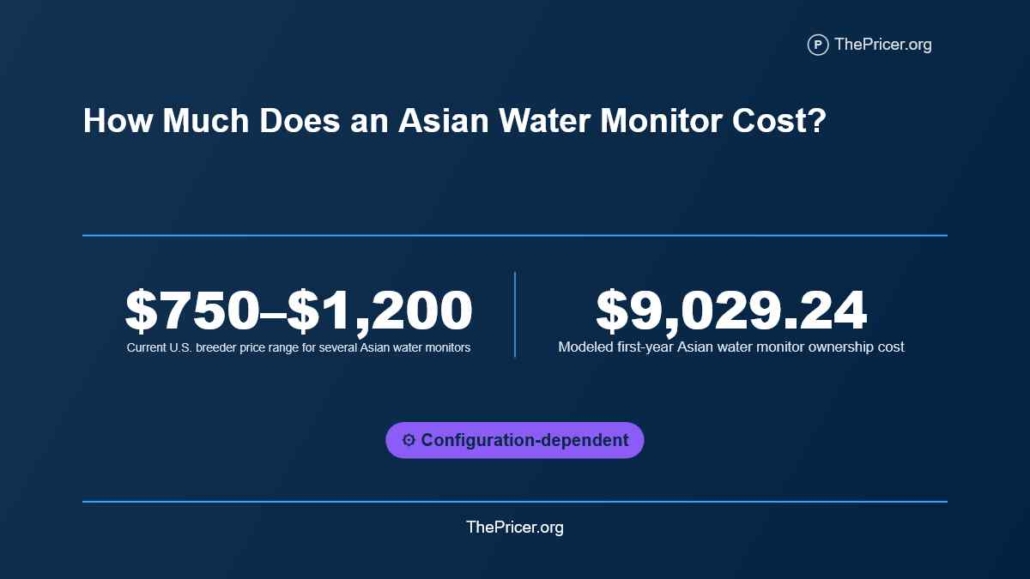
An Asian water monitor currently costs about $750 to $1,200 in several active 2026 U.S. breeder listings, while premium albino and specialty lines can reach $3,500 to $7,500. The animal is often cheaper than the habitat. One current 8-by-4-by-6-foot commercial reptile enclosure starts at $5,348 before the water system, heating, UVB lighting, substrate, furnishings, and the monitor itself.
That makes purchase price a poor measure of affordability. Asian water monitors are large, semi-aquatic varanids that can exceed 8 feet in total length. A modeled first-year setup using current prices reaches about $9,029 after adding a room-scale enclosure, water hardware, environmental control, food, and veterinary care, but before sales tax, animal shipping, feeder shipping, advanced plumbing, and emergency treatment.
Article Highlights
Jump to sections
- Current NERD listings reviewed run from $750 to $1,200 (at $30 per hour, earning that amount would take about 0.6 to 1 full-time workweeks, before taxes) for several Asian water monitors.
- A 2026 breeder price list shows Coral Albinos at $3,500 and T-negative albinos at $6,000 to $7,500.
- A current 8-by-4-by-6-foot commercial enclosure starts at $5,348.
- A 300-gallon stock tank currently sells for about $319.99 before filtration or plumbing.
- A 500-watt continuous-use electricity model costs about $803 per year at the June 2026 U.S. residential rate.
- The worked first-year scenario totals about $9,029 before several optional and location-dependent costs.
How Much Does an Asian Water Monitor Cost?
The 2026 breeder market is much broader than the old $200 to $2,500 (about 0.2 to 2.1 full-time workweeks at $30 per hour) range. Current New England Reptile listings include a male Asian water monitor at $750, a baby male het T-negative or T-positive from Coral at $850, a Hypo Celebensis male at $950, other babies at $1,000, and an adult Guru male at $1,200. These are advertised breeder prices, not a national average.
A second breeder shows how genetics can push the number much higher. A recent Jon’s Jungle price list puts possible-het Coral animals at $500, Black Dragons at $1,500, T-positive albinos at $1,500, Coral Albinos at $3,500, and T-negative albinos at $6,000 to $7,500. The cheapest animal on a list and a rare albino are different markets.
| 2026 example | Advertised price | Price driver |
|---|---|---|
| NERD male Asian water monitor | $750 | Young standard-type animal |
| NERD Hypo Celebensis male | $950 | Line and coloration |
| NERD adult Guru male | $1,200 | Adult animal and line |
| Jon’s Jungle Coral Albino | $3,500 | Premium albino line |
| Jon’s Jungle T-negative albino | $6,000 to $7,500 | High-value specialty genetics |
Why Morphs Cost Thousands
Genetics can change the acquisition bill by several thousand dollars even before housing begins. Standard, het, hypo, Black Dragon, Coral Albino, and T-negative animals are not interchangeable price points. Breeder line, visual traits, sex, age, captive-bred status, and documented genetics can all affect the asking price. The current market sample above shows the gap directly, from a $500 (about 2.1 full-time workdays at $30 per hour) possible-het animal to a $7,500 T-negative albino.
Temperament should not be priced as a guarantee. A higher breeder price does not turn an individual monitor into a predictable handling prospect. Asian water monitors can be fast, powerful, defensive, or more manageable depending on the individual, age, history, and keeper routine. That makes temperament a husbandry issue rather than a simple dollar premium.
Captive-bred provenance also deserves attention because the species is internationally traded and regulated. Keep receipts, breeder records, and any required transfer paperwork. A lower asking price with poor origin documentation can create a legal or practical problem that has nothing to do with the lizard’s color. Moving from the $950 example to a $6,000 specialty animal adds $5,050 without changing a single habitat requirement.
The Enclosure Costs More
The enclosure changes the math. Current eight-foot reptile enclosures include an 8-by-4-by-3-foot unit from $2,674 and an 8-by-4-by-6-foot unit from $5,348. Even that larger commercial enclosure should be treated as a price benchmark rather than proof that one stock cage meets every adult Asian water monitor’s needs.
Current Asian water monitor husbandry guidance describes adults as animals for room-sized or secure outdoor housing and gives 300 by 180 by 180 centimeters as only a starting point for young adults. The enclosure also needs an appropriate basking zone, shaded retreats, secure climbing structures, humidity control, drainage, and a water area large enough for soaking and swimming.
Space is the expensive part. The $5,348 empty enclosure costs about 5.6 times as much as the $950 monitor used in the worked scenario below. Custom construction can shift that relationship, but DIY does not make structural materials, waterproofing, locks, ventilation, heat-resistant surfaces, and drainage free. Door width, floor loading, access for cleaning, and the eventual removal of a large enclosure can also affect the practical build plan.
Readers comparing smaller reptile setups can see how sharply the scale changes in the cost of a Gargoyle gecko.
Water, Heat, and Electricity
The semi-aquatic requirement adds costs that ordinary large-lizard cage budgets often miss. A water monitor needs a basin that is practical to drain, scrub, refill, or filter. A current 300-gallon stock tank sells for about $319.99. That product is a useful hardware benchmark, not a universal enclosure prescription. Pumps, drains, filtration, waterproof flooring, heated water, and additional plumbing can raise the installed total.
Heat and light keep charging after setup. The June 2026 U.S. residential electricity rate averaged $0.1834 per kWh. A chosen 500-watt continuous equivalent load uses 4,380 kWh in a year and costs about $803.29. A 1,000-watt equivalent load would cost about $1,606.58.
Those are power-consumption models, not claims that every enclosure draws the same wattage. Thermostat cycling, room temperature, enclosure insulation, UVB schedule, water heating, and local electricity prices can move the result sharply. The calculation is useful because a few hundred dollars of heat and lighting hardware can create a four-figure operating expense over time. A warm dedicated reptile room may reduce enclosure heating demand, while a cold room or heated water system can push it higher.
Food and Veterinary Bills
Asian water monitors are carnivorous. Merck’s current lizard nutrition guidance says carnivorous lizards may be offered appropriately sized mice, rats, chickens, and eggs, while large carnivorous species may feed once or twice weekly. Whole prey matters because a diet built from muscle meat alone does not provide the same mineral balance.
Current frozen feeder-rat prices put large rats at $23.70 for five, or $4.74 each, and triple-extra-large rats at $9.99 each. If a price model uses two large rats per week, 104 rats cost $492.96 per year before shipping. That is only a food-cost illustration. Actual prey size, variety, frequency, and body-condition management should fit the individual animal. Bulk ordering can change the delivered cost through shipping and freezer-space needs, while a price model built around one prey size should not be treated as the diet for every age or body condition.
Reptile veterinary care is another variable. One current exotic-vet network lists wellness exams at $90 in Arizona and $115 in Colorado and Oregon, with urgent-care exams at $150 to $185. Diagnostics, sedation, imaging, medication, surgery, and hospitalization are separate. A six-foot monitor can make handling and diagnostic work more involved than a basic exam price suggests.
Laws, Shipping, and Provenance

There is no useful national permit price for an Asian water monitor. Laws differ by state and locality. New York provides a clear restrictive example. The New York Department of Environmental Conservation reported intercepting a $1,400 Asian water monitor sale and states that the dangerous-animal license for this species is issued for scientific, educational, exhibition, zoological, or propagation purposes, not private pet keeping.
Shipping also resists a fixed national number. Current NERD listings state that shipping is calculated at checkout, so the old automatic $50 to $100 assumption should not be carried forward as a guaranteed charge. Distance, carrier terms, weather, box size, and seller policy can affect the delivered cost.
Proof of legal origin matters even when local possession is allowed. An invoice, breeder identity, captive-bred records, and any required wildlife paperwork can protect the buyer if ownership rules or transfer questions arise later. The New York case also shows why a seller’s willingness to negotiate does not establish that a private sale is lawful. Check the law before paying for the animal or commissioning a room-sized habitat.
A First-Year Cost Scenario
A useful first-year model starts with one current breeder price and separates published prices from chosen allowances. Use the $950 NERD Hypo Celebensis monitor, the $5,348 commercial 8-by-4-by-6-foot enclosure, and the current $319.99 300-gallon stock-tank benchmark. Add a chosen $600 allowance for heat, UVB, thermostatic control, and fixtures, plus $400 for substrate, heavy furnishings, and basic plumbing parts.
- Asian water monitor at $950
- 8-by-4-by-6-foot commercial enclosure at $5,348
- 300-gallon stock-tank benchmark at $319.99
- Environmental-control hardware allowance at $600
- Substrate, furnishings, and basic plumbing allowance at $400
- Large-rat price model for one year at $492.96
- One wellness exam at $115
- 500-watt continuous-equivalent electricity model at $803.29
- Calculated first-year scenario at $9,029.24
The $9,029.24 result is an illustrative setup, not a national average. It excludes sales tax, monitor shipping, feeder shipping, filtration equipment, water charges, advanced plumbing, emergency veterinary care, and building modifications. It also does not claim that an 8-by-4-by-6-foot enclosure is sufficient for every adult.
The monitor itself is only about 10.5 percent of this modeled first-year subtotal. Replacing the $950 animal with a $6,000 T-negative albino raises the same scenario to $14,079.24. Genetics can dominate the purchase price, yet the habitat still remains a multi-thousand-dollar commitment.
Long-Term Ownership Fit
Asian water monitors can live 15 to 20 years or longer in stable captive care, so the first-year build is only the beginning. Using the food, wellness-exam, and 500-watt electricity inputs from the worked model produces $1,411.25 per year before substrate replacement, filtration, water, feeder shipping, UVB replacement, repairs, and medical problems. Holding only those three inputs flat for 15 years produces $21,168.78. It is a planning floor, not a lifetime-care forecast.
The size commitment matters just as much as the money. Adult size demands a housing plan before purchasing a small juvenile. A cheap baby does not remain a small-cage pet, and rebuilding the habitat after rapid growth can create another large capital expense.
Smaller reptiles create very different housing economics. The cost of an iguana still includes a large enclosure, while ball python costs come from a much smaller habitat and feeding scale.
Makes sense if
- You can dedicate room-scale space to one reptile.
- You can fund large-scale heat, water, filtration, and enclosure maintenance.
- You have access to a veterinarian willing and able to treat large monitors.
- Your state and local rules allow private possession.
Does not make sense if
- Your budget is centered on the animal’s purchase price.
- You expect a normal glass terrarium to remain suitable for adulthood.
- You cannot absorb four-figure habitat or emergency costs.
- You need a beginner reptile with simple handling and housing needs.
Answers to Common Questions
How much does an Asian water monitor cost in 2026?
Several current breeder listings reviewed fall around $750 to $1,200, while premium specialty morphs can cost $3,500 to $7,500.
How much does an Asian water monitor enclosure cost?
Current commercial eight-foot enclosures range into the thousands. One 8-by-4-by-6-foot unit starts at $5,348 before the pool, heat, lighting, substrate, furnishings, and plumbing.
How much can an Asian water monitor cost in the first year?
The worked scenario reaches $9,029.24 using a $950 monitor, a large commercial enclosure, a stock-tank benchmark, selected habitat allowances, one wellness exam, a feeder model, and a 500-watt electricity model.
How much does feeding an Asian water monitor cost?
Current frozen large rats cost about $4.74 each. The article’s two-per-week price model equals $492.96 per year before shipping and other prey types.
Are Asian water monitors legal everywhere in the United States?
No. State and local laws differ, and some jurisdictions prohibit private pet possession. Check the rules for the exact location before buying or arranging shipment.
Disclosure: Educational content, not medical advice. Pricing varies by provider, location, and insurance. Confirm eligibility, coverage, and out-of-pocket costs with a licensed clinician and your insurer. See our methodology and corrections policy.