
How Much Does it Cost to Rent a Chicken?
Updated on | Written by Alec Pow
This article was researched using 13 sources. See our methodology and corrections policy.
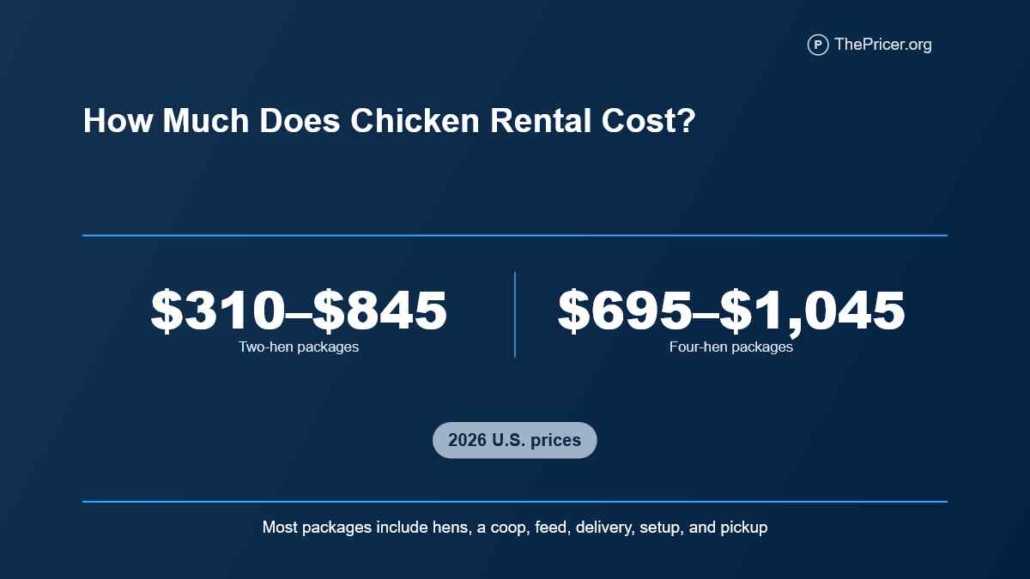
Renting chickens in the U.S. costs about $310 to $1,045 for the packages we found, with most programs bundling two to four laying hens, a portable coop, feed, feeders, waterers, delivery, setup, and end-of-season pickup. The price depends heavily on location and rental length. A three-month two-hen package in Illinois costs $310, while 2026 seasonal packages from Rent The Chicken range from about $495 in several markets to $845 for two hens in Phoenix.
Chicken rental is rarely the cheapest way to acquire eggs. You are paying for the temporary flock, housing, supplies, delivery, setup, support, and the ability to return everything when the season ends. That makes the service closer to a backyard-chicken trial package than a simple livestock rental.
Article Highlights
Jump to sections
- Current chicken rental packages we found run about $310 to $1,045 (at $30 per hour, earning that amount would take about 1.3 to 4.4 full-time workdays, before taxes).
- Two-hen seasonal packages commonly land around $495 to $845 among the providers reviewed.
- Four-hen packages can cost about $695 to $1,045.
- Feed, a portable coop, feeders, waterers, delivery, setup, and pickup are often bundled into the rental price.
- Delivery outside the normal service area, organic feed, extra months, rare breeds, and permits can raise the total.
- Renting can make financial sense as a trial before buying a coop and committing to hens for several years.
How Much Does It Cost to Rent a Chicken?
The old idea that most chicken rentals cost $200 to $400 (about 0.8 to 1.7 full-time workdays at $30 per hour) no longer matches the live packages we found. Willow City Farm in Springfield, Illinois still offers one of the lower published prices, charging $310 for three months with two hens. Larger national-network packages cost more. Rent The Chicken lists a 2026 two-hen standard package at $595 in Central New York and $845 in Phoenix.
Rent a Hen and House, serving parts of Wisconsin and Minnesota, listed its 2026 two-hen seasonal package at $599 regular price, with a displayed sale price of $549. These packages are not identical, so the price differences should not be read as a national low-to-high quote for one standardized product.
| Chicken rental package | Published price | Rental scope |
|---|---|---|
| Willow City Farm Two Buck Cluck | $310 | 2 hens, 3 months |
| Willow City Farm seasonal package | $375 | 2 hens, April through October |
| Rent a Hen and House | $549 sale / $599 regular | 2 hens, about mid-April through mid-November |
| Rent The Chicken, Central New York | $595 | 2 hens, seasonal 2026 package |
| Rent The Chicken, Phoenix | $845 | 2 hens, seasonal 2026 package |
| Rent The Chicken, Phoenix Deluxe | $1,045 | 4 hens, deluxe coop, 200 pounds of feed |
What the Package Includes
The flock is only one part of what you rent. Most programs supply adult hens that are already laying, a portable coop, a feeder, a waterer, feed for at least part of the rental, and instructions for caring for the birds. Delivery, setup, and pickup are frequently bundled too. That equipment and service explain why a rental can cost many times more than simply purchasing two live chickens.
Willow City Farm’s two-hen package includes the coop, hens, delivery and setup within 50 miles, three months of layer feed, dishes, pine shavings, a chicken-care class, support, removal, and replacement of hens lost to natural causes or predators when neglect was not responsible. Its larger coop package is priced at $500 for three months or $575 (about 2.4 full-time workdays at $30 per hour) for its seasonal term and can accommodate up to four hens.

Rent a Hen and House bundles even more feed. Its two-hen 2026 package includes 100 pounds, while its four-hen package costs $949 and includes 200 pounds of feed. Both include a movable coop, feed and water dispensers, bedding, treats, delivery, setup, instruction, and fall pickup. A renter comparing two companies should compare the contents before choosing the lower headline price.
Location Changes the Price
Chicken rentals are unusually local. A provider must transport live hens and a physical coop to the customer’s property and later collect them. That creates a much stronger geographic price effect than with an item that can simply be shipped. Rent The Chicken illustrates the difference clearly. Its standard two-hen package appears at $495 in several 2026 markets, while Central New York lists $595 and Phoenix lists $845.
The Phoenix standard package includes two hens, 100 pounds of feed, a movable coop, feeders, waterers, delivery, setup, and pickup. Its deluxe four-hen package costs $1,045 and includes 200 pounds of feed. Moving from the two-hen standard package to four hens raises the bill by only $200. The package price rises about 23.7%, while the number of hens doubles. The additional two hens therefore cost an effective $100 each within that package comparison, with the larger coop and another 100 pounds of feed also included.
That calculation does not mean a hen itself is worth $100. It measures the incremental package price. Buying birds outright can cost far less because the renter is also paying for temporary housing and logistics. Households considering permanent ownership can compare those package costs with the separate prices of hens and the longer ownership commitment.
Feed, Delivery, and Add-Ons
Feed is often included, but it is worth checking how much. Alabama Cooperative Extension reports that a laying hen consumes about 0.25 pound of feed per day. Two hens therefore consume around 0.5 pound daily, or about 105 pounds over a seven-month season. That puts the 100-pound feed allocation in some two-hen seasonal rentals remarkably close to the theoretical requirement for that period.
The calculation also reveals a hidden variable. Feed loss to wildlife, spills, wet feed, or a longer season can leave the renter buying another bag. Willow City Farm specifically states that the renter must replace feed if pets or wild animals eat the supplied amount. Organic or specialty feed can also cost extra. Rent The Chicken’s Phoenix page lists an optional organic-feed upgrade of $105 for the two-hen packages and $175 for its four-hen deluxe package.
Transportation is another possible charge. Phoenix-area delivery is included inside the defined service area, but customers farther away can face a separately quoted transportation fee. Rent a Hen and House includes delivery around its service area but says delivery beyond 35 miles from Hudson, Wisconsin can carry additional charges. These fees are difficult to convert into one national range because distance and local routes matter.
What the Eggs Really Cost
Buying a chicken rental solely to save money on eggs rarely produces an attractive comparison. Rent a Hen and House estimates about 12 to 14 eggs per week from its two-hen package. Its rental runs from roughly mid-April through mid-November, close to 30 weeks. At that production estimate, the hens could produce around 360 to 420 eggs, equal to about 30 to 35 dozen during the season.
Using the displayed $549 sale rental price, the package alone works out to roughly $15.69 to $18.30 per dozen eggs. The arithmetic is $549 ÷ 35 dozen = $15.69 at the higher production estimate and $549 ÷ 30 dozen = $18.30 at the lower estimate. That calculation excludes the value of the temporary coop, delivery, pickup, education, supplies, and the experience of keeping the hens. Egg production can also vary.
This makes the economics much clearer. A chicken rental should be judged as a temporary livestock experience with eggs as one of the benefits, not as an egg-discount program. Oklahoma State University’s backyard-hen budget research also treats housing, feed, bedding, water, and labor as distinct ownership costs. Rental programs bundle many of those startup items into one temporary price.
Renting Versus Buying
Renting solves the largest commitment problem with backyard hens. The renter does not need to buy permanent housing, raise chicks until laying age, find a home for the birds if the experiment fails, or maintain the flock through winter. A family can test the daily routine first, then return the coop and hens. Buying is cheaper over a long period when the household already knows it wants chickens and has suitable housing.
Willow City Farm provides an unusually useful rent-to-own comparison. Its two-hen package costs $310 for three months. After that minimum rental, the customer can purchase the hens, coop, and supplies for another $225. A renter who tries the flock for three months and then keeps everything would spend $535 under those published prices. That gives a concrete path from trial to ownership instead of losing the entire rental payment.
The same farm charges $375 for its April-to-October seasonal rental or $80 per month for extensions after the initial agreement. If a renter bought the $310 three-month term and then added four $80 extensions, the total would be $630. Booking the $375 seasonal option instead saves $255 under that seven-month comparison. Someone already confident about keeping hens for the full season has little reason to assemble the same period one month at a time.
Rules and Flock Health
Renting the birds does not bypass local chicken rules. The person keeping the hens may still have to comply with limits on flock size, coop location, sanitation, setbacks, or permits. Denver, as one concrete case, allows up to eight hens under a Food-Producing Animals permit and charges a one-time $25 property fee. Other cities use different rules, and some locations prohibit backyard poultry entirely.
Check municipal rules and HOA restrictions before paying a non-refundable reservation charge. A portable coop does not automatically satisfy setback or enclosure requirements. Roosters are also treated differently in many ordinances, which is one reason chicken-rental packages overwhelmingly use laying hens rather than males. Permanent flock owners considering both sexes can separately review rooster costs and local rooster restrictions.
Disease control matters when live birds move between locations. USDA states that avian influenza remains a threat to backyard poultry and explains that contaminated shoes, equipment, vehicles, wild birds, and other animals can move pathogens between flock areas. Renters should follow the provider’s care rules and avoid exposing rental hens to unrelated poultry without permission.
Who a Rental Fits
The main financial advantage of a rental is risk reduction rather than cheap eggs. A household can find out whether it enjoys daily feeding, watering, manure cleanup, predator protection, and egg collection before buying permanent housing. Parents can also give children a season of livestock care without committing the family to birds that may live for years.
The arrangement loses value when the household already owns a safe coop, knows how to keep poultry, and wants hens permanently. Buying laying hens directly avoids repeatedly paying for rental equipment, delivery, pickup, and provider support. Rental also becomes less attractive when the customer is far outside a service area and transportation charges are added.
Makes sense if
- You want to test backyard chicken keeping before buying permanent equipment.
- You want laying hens for one season and do not want to overwinter them.
- You need a coop, feeders, waterers, feed, and setup bundled together.
- You value delivery, support, and a provider willing to take the hens back.
Does not make sense if
- Your main goal is obtaining eggs as cheaply as possible.
- You already own a suitable coop and poultry equipment.
- You intend to keep hens permanently and are comfortable with year-round care.
- Your property cannot meet local poultry or HOA rules.
Answers to Common Questions
How much does it cost to rent two chickens?
Current two-hen packages we found range from about $310 for a three-month rental to $845 for a higher-priced seasonal package. A figure around $495 to $600 appears in several live 2026 offers, but location and rental duration matter.
Does a chicken rental include the coop?
Most of the programs reviewed include a portable coop along with hens, feeding equipment, and at least some feed. Delivery, setup, and pickup are also common inclusions.
Do I keep the chickens after the rental?
Usually not automatically. The hens and coop remain rental property unless the provider offers an adoption or purchase option. Some programs let renters purchase the entire setup after the trial period.
Is renting chickens cheaper than buying eggs?
Usually not. One 2026 two-hen package works out to roughly $15.69 to $18.30 per dozen based on the provider’s estimated seasonal egg production and the displayed $549 package price. The rental also pays for housing, delivery, supplies, support, and the experience.
Can I rent chickens anywhere in the U.S.?
No. Providers operate within defined service areas, and local zoning, animal ordinances, HOA rules, and delivery limits can determine whether a rental is available at your property.
Disclosure: Educational content, not financial advice. Prices reflect public information as of the dates cited and can change. Confirm current rates, fees, taxes, and terms with official sources before purchasing. See our methodology and corrections policy.