
How Much Does MiraDry Cost?
Updated on | Written by Alec Pow
This article was researched using 13 sources. See our methodology and corrections policy.
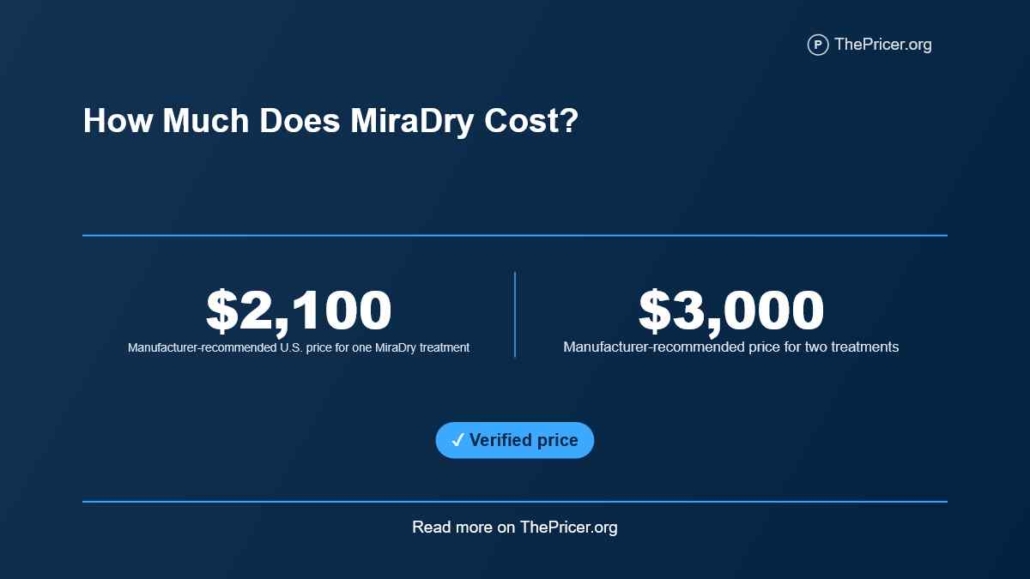
MiraDry costs about $2,100 for one treatment or $3,000 for two treatments under the manufacturer’s current U.S. recommended pricing. Clinics set their own rates, so real offers can be lower or higher. Current examples include a 2026 promotion at $1,500 for one treatment and $2,500 for two, while another dermatology practice lists $2,500 for the first treatment and $1,500 for a second.
The biggest money question is whether one session gives enough improvement or whether a second treatment is purchased. MiraDry is a non-surgical, FDA-cleared underarm treatment that uses microwave energy to reduce sweat and odor and permanently reduce unwanted underarm hair. It is designed for the axillae, not for sweaty hands or feet.
Article Highlights
Jump to sections
- MiraDry recommends $2,100 (at $30 per hour, earning that amount would take about 1.8 full-time workweeks, before taxes) for one treatment and $3,000 for two in the United States.
- A current 2026 promotion lists $1,500 for one treatment and $2,500 for two.
- One dermatology practice publishes $2,500 for the first session and $1,500 for the second.
- The manufacturer’s two-treatment recommendation makes the second session an incremental $900, not another full $2,100.
- Long-term research shows meaningful improvement can persist for three years, but some patients in the study received two treatments.
- Insurance often does not routinely cover MiraDry, while medical Botox may have a different coverage path.
How Much Does MiraDry Cost?
The strongest national price anchor is MiraDry’s own recommended treatment pricing. The company recommends $2,100 (about 1.8 full-time workweeks at $30 per hour) for one treatment and $3,000 for two treatments, while stating that individual providers can set their own prices. That makes the manufacturer figure a planning benchmark rather than a fixed retail tariff.
Current clinic pricing shows the real spread. Front Door MedSpa’s summer 2026 MiraDry offer lists $1,500 for one treatment and $2,500 for two. HK Dermatology publishes MiraDry treatment pricing of $2,500 for the first treatment and $1,500 for a second. Two sessions there total $4,000.
| Current price example | One treatment | Two-treatment total |
|---|---|---|
| MiraDry recommended U.S. pricing | $2,100 | $3,000 |
| Front Door MedSpa 2026 promotion | $1,500 | $2,500 |
| HK Dermatology published pricing | $2,500 | $4,000 |
These examples should not be blended into a fake national average. They show how much package policy and provider pricing can move the bill. The old state-by-state table with precise figures to the cent did not disclose a sample, method, date, or source, so it is not reliable enough to keep.
What MiraDry Treats
MiraDry is an FDA-cleared medical device for underarm treatment. The FDA’s 510(k) record classifies the system as an instrument for treatment of hyperhidrosis. MiraDry’s current U.S. labeling also states that the system is cleared for unwanted underarm sweat and odor and for permanent removal of unwanted underarm hair.
The treatment uses microwave energy focused near the junction of the dermis and subcutaneous tissue, where eccrine and apocrine glands sit. The device also uses cooling at the skin surface. Once targeted glands are thermally destroyed, they are not expected to regenerate. That is why the treatment is marketed differently from antiperspirants, prescription wipes, and botulinum toxin injections that require repeated use.
The scope is narrow. MiraDry is an underarm procedure. It should not be presented as a general solution for sweating of the palms, soles, scalp, or other body areas. Readers dealing with broader hyperhidrosis may first need a medical evaluation, which is why the cost of a dermatologist visit can be relevant before treatment pricing is compared.
The manufacturer reports an average 82% sweat reduction in cited clinical data. That number describes measured reduction, not an 82% guarantee of satisfaction and not an 82% chance that every patient will need only one session.
One Treatment Versus Two
The second session is the main hidden cost. Under the manufacturer recommendation, moving from one treatment at $2,100 (about 1.8 full-time workweeks at $30 per hour) to a two-treatment plan at $3,000 adds $900. ThePricer calculation: the second treatment costs about 43% of the first-session price, which is equivalent to roughly a 57% discount versus paying another full $2,100.
Front Door’s current promotion uses a different structure. One treatment costs $1,500, while two cost $2,500. The second session adds $1,000. Buying two separately at the advertised one-session rate would total $3,000, so the prepaid two-treatment offer saves $500, or about 16.7%.
HK Dermatology moves in the other direction. The first session is $2,500 and the second is $1,500, giving a two-treatment total of $4,000. That example shows why a reader should ask for both the first-session price and the repeat-session price before deciding whether a low initial quote is really the lower treatment-plan cost.
A useful worked scenario is the manufacturer plan. One MiraDry treatment at $2,100 is the starting commitment. If the patient later chooses the recommended two-treatment plan price, the total becomes $3,000. The incremental second-session spend is $900. Consultation, financing interest, travel, and any unrelated medical care are excluded because MiraDry’s pricing policy does not establish those charges.
How Long Results Last
A 2026 three-year MiraDry study followed patients with severe primary axillary hyperhidrosis who had received one or two microwave treatments. The study began with 103 treated patients. At the three-year survey stage, 87 were contacted and 45 responded, giving a 51.7% response rate. The responders showed a statistically meaningful improvement in sweating severity and quality-of-life scores compared with baseline.
The response rate matters because the long-term result should not be described as if all 103 original patients were assessed at three years. Among the 45 respondents, 39 had an HDSS score of 1 or 2. Eighteen of those 39 had received one treatment and 21 had received two. That makes the old claim that about 80% of patients need only one treatment too strong for current long-term evidence.
The manufacturer’s current patient information says eliminated sweat and odor glands do not regenerate and cites 82% average sweat reduction. The three-year study adds real long-term support, but it also shows that repeat treatment can be part of the path to a durable result.
That distinction changes the budget. A reader should view $2,100 as a one-treatment benchmark and $3,000 as the manufacturer’s two-treatment benchmark rather than assuming the lower amount is always the complete course cost.
Side Effects and Recovery
Common short-term reactions include swelling, soreness, bruising, numbness, tenderness, and temporary altered sensation. A recent review of hyperhidrosis treatments also describes redness, rash, dermatitis, nodules, patchy hair loss, and rare brachial plexus injury among reported effects of microwave thermolysis.
More serious problems are uncommon, but they should not be hidden inside a cosmetic-sales description. A 2026 microwave complication report summarizes published cases involving nerve injury, thermal burns, infection, and other unusual adverse events. Some severe reports involved off-label treatment outside the standard underarm area, so they should not be treated as the expected risk of routine axillary MiraDry.

The old article also said most side effects occur in inexperienced hands. That causal claim is not supported well enough to keep. Provider training and correct device use matter, but published adverse-event data do not justify assigning most complications to inexperience.
MiraDry says treatment is administered by a licensed healthcare practitioner and uses local anesthesia. A prospective patient should ask who performs the procedure, who administers anesthesia, how the office handles burns or nerve symptoms, and what follow-up is included in the quoted fee.
MiraDry Versus Botox
Botulinum toxin is a different cost model because its effect wears off and repeat injections are required. The International Hyperhidrosis Society gives about $1,000 for treatment of both underarms as a broad estimate. BOTOX’s official axillary hyperhidrosis data report a median response duration of 6.7 months, or 201 days, in the clinical program.
That lets us make a matched spending comparison. Three $1,000 Botox rounds total $3,000, the same as MiraDry’s recommended two-treatment plan. At a 6.7-month median response per Botox round, three rounds represent about 20 months of median-duration treatment. This is a price comparison, not a claim that the medical outcomes are identical.
The comparison changes if insurance covers Botox. BOTOX is indicated for severe primary axillary hyperhidrosis that is inadequately managed with topical agents, while MiraDry is often sold as self-pay. A covered Botox course can leave a patient with much less than the full $1,000 cash cost. Readers can compare the broader Botox cost structure separately from the hyperhidrosis indication.
Surgery belongs in another tier. The hyperhidrosis surgery cost article covers sympathectomy and other invasive approaches. Those procedures have different risks, body-area indications, facility costs, and insurance questions, so they should not be compared with MiraDry only by sticker price.
Insurance and HSA or FSA
MiraDry is commonly treated as a self-pay service. The International Hyperhidrosis Society explains that some hyperhidrosis treatments are not routinely covered and that insurers may require documentation of medical necessity before approving certain therapies. That distinction matters because hyperhidrosis is a medical disorder even when one specific treatment is excluded by a plan.
Insurance coverage for MiraDry itself is uncommon, but readers should confirm their own plan rather than rely on a clinic’s blanket statement. A diagnosis, treatment history, prior authorization rules, and benefit exclusions can all affect whether another hyperhidrosis therapy receives coverage.
HSA and FSA use also needs careful wording. IRS medical expense rules say qualifying care must primarily alleviate or prevent illness or disability. A MiraDry procedure used to treat diagnosed hyperhidrosis may fit that medical-purpose test, but reimbursement rules, documentation, and plan administration can differ. The payment account should not be assumed to approve every claim automatically.
Financing can lower the immediate cash requirement but does not lower the treatment price. Interest or fees can push a $3,000 two-treatment plan above its advertised amount. Compare the financed payoff total with the cash price before judging affordability.
Choosing a MiraDry Plan
The most useful quote is not just the first-session price. Ask for the price of one treatment, the price if a second treatment is needed, the timing policy for repeat treatment, what follow-up is included, and whether a discounted second session expires. A clinic charging $1,500 once can still end up near or above another clinic’s treatment-plan total if the second session is priced differently.
The manufacturer recommendation gives a clean benchmark of $2,100 for one treatment and $3,000 for two. Current market examples show both lower promotional pricing and higher clinic totals. That makes a realistic planning range less useful than knowing the exact one-session and two-session terms from the provider you are considering.
Makes sense if
- You are treating underarm sweating, odor, or unwanted axillary hair within MiraDry’s cleared scope.
- You understand the price of both the first and a possible second treatment.
- You prefer a non-surgical underarm procedure over a recurring injection schedule.
- You have reviewed the provider’s training, anesthesia process, aftercare, and complication plan.
Does not make sense if
- Your main sweating problem is on the hands, feet, scalp, or another untreated body area.
- You are assuming one treatment will always be enough.
- You have not compared insurance-covered medical alternatives with the self-pay MiraDry total.
- You are choosing a provider only because of a temporary low advertised price.
Answers to Common Questions
How much does one MiraDry treatment cost?
The manufacturer currently recommends $2,100 for one treatment in the United States, but providers set their own prices.
How much do two MiraDry treatments cost?
MiraDry’s recommended two-treatment price is $3,000. Current clinic examples reviewed here range from a promotional $2,500 two-treatment offer to $4,000 at another practice.
Is MiraDry permanent?
The treated sweat and odor glands are not expected to regenerate, and three-year research shows persistent improvement in many respondents. Individual symptom response can still vary, and some patients receive a second treatment.
Is MiraDry covered by insurance?
Routine coverage is uncommon. Hyperhidrosis itself is a medical condition, so patients should check their plan’s treatment exclusions, medical-necessity rules, and alternative covered therapies.
Is MiraDry cheaper than Botox over time?
Using a $1,000 Botox estimate, three rounds equal $3,000, the same as MiraDry’s recommended two-treatment price. Insurance coverage and individual treatment duration can change that comparison substantially.
Disclosure: Educational content, not medical advice. Pricing varies by provider, location, and insurance. Confirm eligibility, coverage, and out-of-pocket costs with a licensed clinician and your insurer. See our methodology and corrections policy.