
How Much Does Mobile Tire Repair Cost?
Updated on | Written by Alec Pow
This article was researched using 14 sources. See our methodology and corrections policy.
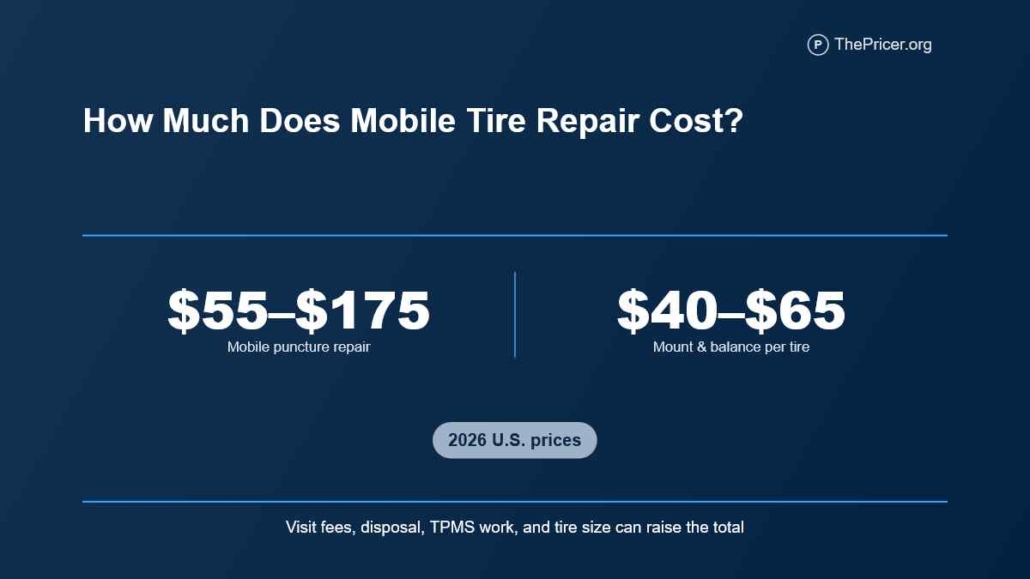
Mobile tire repair in the U.S. can cost about $55 to $175 for a repairable puncture, depending on the provider, location, and whether a call-out fee is built into the price. Mobile mounting and balancing commonly starts around $40 to $65 per tire, with some services adding a visit minimum, mobile-service fee, tire disposal, or TPMS hardware. Tire Rack currently advertises mobile installation from $40 per tire, while Zohr lists customer-supplied tire installation starting at $65 per tire.
The per-tire price is not always the amount you pay. A one-tire visit can be expensive because the technician still has to send a fully equipped van. Four-tire installations spread that travel and setup cost across more work.
Article Highlights
Jump to sections
- Mobile puncture repair can run about $55 to $175 (at $30 per hour, earning that amount would take about 1.8 to 5.8 hours of work, before taxes) for the first tire among published services we found.
- Mobile mounting and balancing commonly starts near $40 to $65 per tire.
- A visit minimum or mobile-service fee can add roughly $49 to $120 before disposal or TPMS charges.
- A four-tire mobile installation can cost around $240 to $300 before new-tire prices and tax in several published examples.
- A puncture is repairable only when its location, size, and tire condition meet accepted repair criteria.
- Scheduled home or workplace service is not the same product as emergency highway roadside assistance.
How Much Does Mobile Tire Repair Cost?
Mobile tire pricing now falls into two distinct categories. Scheduled service covers work at a home, office, parking lot, or another safe location. Emergency roadside providers price around the cost of dispatching someone immediately. That difference explains why an old $25 to $40 (about 0.8 to 1.3 hours of work at $30 per hour) mounting figure or $40 to $60 puncture estimate can understate the real bill today.
| Mobile tire service | Price | Common pricing unit |
|---|---|---|
| Repairable puncture | $55 to $175 | First tire or visit |
| Mount and balance | $40 to $65 | Per tire |
| Mobile visit fee or minimum | $49 to $120 | Per appointment |
| Four-tire installation labor | $240 to $300 | Typical published examples before tire price and tax |
| Tire disposal | $0 to $7.50+ | Per tire in examples reviewed |
Prices vary inside those bands. One roadside network currently advertises $49 plus a $5.99 booking fee for an eligible puncture, producing a $54.99 checkout total. HopTire publishes $169 for the first repaired tire and $50 for each additional repair during the same visit. That gap reflects different dispatch models and service scopes, not one universal national repair rate.
The price of a new tire is separate. Drivers replacing worn or unrepairable tires should add the tire itself to the mobile labor charge. The cost of new tires varies far more by size, brand, speed rating, and vehicle than the installation labor does.
What the Visit Covers
A mobile tire van can carry a tire changer, balancer, air supply, jacks, torque tools, TPMS equipment, weights, valve hardware, and common repair materials. That allows many providers to mount and balance replacement tires at the vehicle rather than removing the wheels and taking them to a separate shop. Tire Rack says its technicians can install each tire in about 15 minutes once the mobile appointment is underway.
Bundling differs by provider. Zohr states that its installation charge includes mounting, balancing, standard rubber valve stems, reinstalling the wheels, and required TPMS relearn procedures. Its published terms also say TPMS sensor replacement and tire recycling are outside that installation price. A quote that looks higher can still be the better deal if it includes services that another provider bills separately.
Mobile installation should also be separated from a tire rotation. Rotation moves mounted wheel-and-tire assemblies around the vehicle. Mounting removes a tire from its wheel, installs another tire, then balances the assembly. A seasonal wheel swap can be cheaper than a seasonal tire change when the winter and summer tires each have their own wheels.
A TPMS relearn may be included after installation, but a broken pressure sensor, corroded service kit, or new programmable sensor can add parts and labor.
Which Flats Can Be Repaired?
A mobile technician cannot safely patch every flat. The U.S. Tire Manufacturers Association says a repair candidate should have damage in the tread area only, with a puncture no larger than 1/4 inch or 6 mm. The tire must come off the wheel so the inner liner and internal structure can be inspected. The accepted repair uses both a stem or plug through the injury and a patch sealing the inner liner.
Sidewall and shoulder injuries are outside that repair zone. A tire that has been driven flat can also have internal damage that is not visible from the outside. Existing improper repairs, overlapping injuries, damaged cords, bulges, severe aging, or manufacturer restrictions can turn a repair call into a replacement call.
This is where a low advertised puncture price can become a much larger invoice. If the tire fails inspection, the technician may need to source and install a replacement tire instead. Run-flat tires add another layer because repair policies vary by tire maker and by whether the tire was driven after pressure loss. Drivers with that equipment can compare replacement exposure in the run-flat tire cost research.
A rope plug installed from outside the tire is not equivalent to the industry repair procedure above. A proper mobile repair needs enough equipment and working space to remove the tire and inspect it from inside.
Four Tires
The mobile model becomes easier to justify when several tires need work at once. Tire Rack’s Northern Virginia mobile operation lists $60 per tire with a $120 minimum charge. One tire therefore still costs at least $120 (about 4 hours of work at $30 per hour) for installation under that rate card. Four tires cost $240, assuming no other charge applies.
That creates a useful quantity effect. The effective installation price is $120 per tire for a one-tire appointment but $60 per tire for four tires. Doing four at once cuts the effective per-tire labor cost by 50% compared with a one-tire visit under this specific published schedule. The reason is not cheaper labor on the fourth tire. The minimum trip charge is being spread across more work.
A second live example shows a different structure. A Missouri Tire Rack listing for Zohr shows $49.75 per tire, a $49 mobile-service fee, and a $7.50 disposal fee per tire. Installing and disposing of four customer-supplied tires comes to $278 before tax. The arithmetic is four times $49.75 = $199, plus $49 for the visit and $30 for disposal.
The $278 total equals $69.50 per tire. The visit and disposal lines add $79 to the $199 mounting-and-balancing subtotal, increasing that subtotal by about 39.7%. That is why comparing only the advertised per-tire labor rate can miss a large part of the invoice.
Fees That Raise the Total
Travel or mobile-service charges are the first hidden line to check. Tire Rack listings show different business models even within its installer network. A Colorado Springs GoMobile Tires listing has a $50 mobile-service fee, $40 mounting and balancing per tire, $6 disposal per tire, $5 TPMS rebuild kits, and a 5% shop fee. It also lists a $10 run-flat charge and $10 large-tire upcharge where applicable.
Location can change the same brand’s rate. Another Zohr listing in Missouri shows $65 per tire plus a $69 mobile-service fee. That is higher than the Zohr example above, so a national brand name does not guarantee one national installation price.
TPMS can also add cost. A simple relearn may be bundled, but replacement sensors and rebuild components can be separate. Disposal is another line that ranges from free to a per-tire charge. Large wheels, low-profile tires, run-flats, and special balancing requirements can push labor up. Drivers chasing vibration rather than replacing tires may need a separate wheel balancing service or a shop with road-force equipment.

Ask for the full installed total before comparing providers. The useful quote includes the visit fee, mounting, balancing, valve hardware, TPMS work, disposal, taxes, and any tire-specific surcharge that applies to your vehicle.
Roadside Help
The old article treated mobile tire service and roadside tire rescue as if they were interchangeable. They are not. Many mobile installers focus on scheduled work at homes and workplaces. Zohr states that it does not perform roadside repairs and asks stranded drivers to move the vehicle to a safe location or arrange towing to a home, office, or parking lot before service.
Other businesses are built around roadside dispatch. Those services can charge more because the van is being sent immediately, sometimes after hours, and may need to source a replacement tire before arrival. A roadside provider can also be limited by where the car stopped. A shoulder on a high-speed road may not provide a safe working area for mounting equipment.
Scheduled mobile replacement is much closer to a tire shop appointment that happens at your address. Tire Rack’s mobile network lets customers buy tires or supply their own, then select an installer based on location and published charges.
That distinction should drive the price comparison. If the car is safely parked at home and needs four worn tires replaced next Tuesday, compare scheduled mobile installation with local-shop installation. If the car is disabled tonight, compare emergency mobile help with roadside assistance and towing.
Three Realistic Cost Scenarios
A repairable nail puncture at a safe location is the smallest job. One provider advertises a $54.99 total after its booking fee, while another mobile service publishes $169 for the first tire. A driver should ask whether removal, internal inspection, patch-plug repair, remounting, balancing, and travel are all included before treating either number as directly comparable.
A single customer-supplied replacement tire can be surprisingly expensive. Under the Northern Virginia Tire Rack schedule above, the $120 minimum controls the invoice even though the stated labor rate is $60 per tire. The new tire itself is extra. This is the case where a local shop can have a substantial price advantage if the car can be driven safely or the loose wheel can be transported separately.
A four-tire replacement makes better use of the visit. Using the Missouri Zohr rate card, the itemized service is $199 for four mount-and-balance charges, $49 for the mobile visit, and $30 for disposal. That produces the calculated $278 pre-tax service total. Add the purchase price of four tires to reach the full replacement bill.
Seasonal changeovers can sit between these cases. A swap involving tires already mounted on a second set of wheels requires less equipment and labor than dismounting four tires, mounting four replacements, and balancing each assembly. Ask whether the quote is for a wheel swap or a tire change because those are different jobs.
When Mobile Service Makes Sense
Mobile tire work is easiest to justify when the technician handles several tires in one visit. A four-tire installation spreads the trip cost across four assemblies, while a one-tire job can leave the same dispatch expense concentrated on a small repair. That is why a full set can be competitively priced even when a single flat is expensive.
Compare the cash invoice first, then decide what avoiding a shop trip or missed work is worth to you. Multiple vehicles at one location can make the visit fee easier to justify.
Makes sense if
- You are replacing two to four tires during one scheduled visit.
- Your vehicle is already parked at a safe home, office, or parking location.
- The mobile quote includes mounting, balancing, and the TPMS work you need.
- A shop visit would require a ride, lost work time, or a second vehicle.
Does not make sense if
- You need only one cheap service and the provider has a large visit minimum.
- The vehicle is stopped in a dangerous roadside position where the technician cannot work safely.
- The tire has sidewall, shoulder, structural, or run-flat damage that makes repair unlikely.
- A nearby shop includes installation, rotation, balancing, or disposal with tires you already plan to buy there.
Answers to Common Questions
How much does mobile flat tire repair cost?
Published services we found range from about $55 to $175 for the first repairable puncture. The price depends on dispatch model, location, and what the visit includes.
How much does mobile tire installation cost?
Current published prices start around $40 to $65 per tire, but mobile-service fees or minimum appointment charges can raise the invoice.
Does mobile tire installation include balancing?
Many providers bundle mounting and balancing. Valve stems, TPMS relearn, disposal, TPMS parts, and specialty-tire surcharges vary, so the quote should list each inclusion.
Can a mobile tire technician repair a sidewall puncture?
A normal puncture repair is limited to the tread repair area. Sidewall and shoulder damage falls outside the USTMA repair procedure and can require tire replacement.
Is mobile tire service cheaper than a tire shop?
It can be competitive for several tires in one visit. A single-tire appointment can cost more because the mobile provider may apply a call-out fee or minimum charge to a small job.
Disclosure: Educational content, not financial advice. Prices reflect public information as of the dates cited and can change. Confirm current rates, fees, taxes, and terms with official sources before purchasing. See our methodology and corrections policy.