
How Much Does Nature Stone Cost Per Square Foot?
Updated on | Written by Alec Pow
This article was researched using 10 sources. See our methodology and corrections policy.
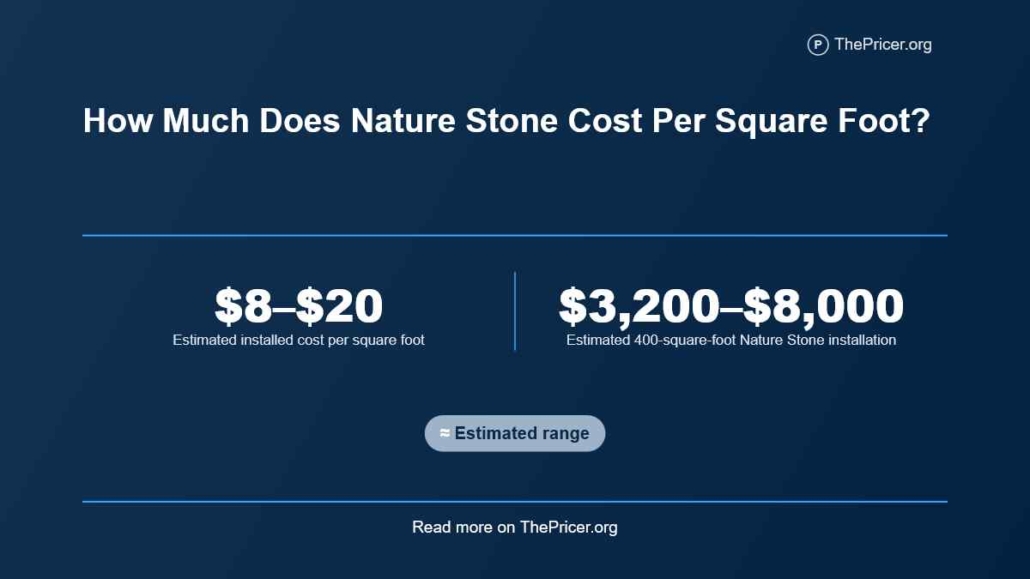
Nature Stone flooring costs an estimated $8 to $20 per square foot installed, or $3,200 to $8,000 for a 400-square-foot garage or basement. This is an independent U.S. pricing estimate, not an official Nature Stone price list. The company provides custom quotes following an inspection of the existing concrete.
Nature Stone is a branded pebble-and-epoxy flooring system used in garages, basements, patios, and other concrete areas. The final price depends on the floor’s condition, stone selection, access, preparation work, and available promotions.
One important distinction is that Nature Stone’s branded system can cost considerably more than generic pebble-epoxy flooring. Warranty coverage and optional maintenance also deserve attention before comparing estimates.
Article Highlights
Jump to sections
- Nature Stone’s estimated installed price is $8 to $20 (at $30 per hour, earning that amount would take about 16 to 40 minutes, before taxes) per square foot, based on independent published cost research.
- A 400-square-foot installation has a baseline budget of $3,200 to $8,000, before separately quoted extras.
- Generic pebble-epoxy flooring can cost approximately $3 to $7 per square foot installed.
- Traditional smooth epoxy flooring commonly costs $4 to $10 per square foot installed.
- Concrete repairs, difficult access, design upgrades, and maintenance can change the payable amount.
- Nature Stone’s published warranty descriptions differ, making the actual contract especially important.
How Much Does Nature Stone Cost Per Square Foot?
Nature Stone does not provide a public fixed price per square foot. Its official flooring pricing explanation states that an in-home assessment is needed to calculate an installation price.
For budgeting, HomeGuide’s Nature Stone installation cost research puts professionally installed flooring at $8 to $20 (about 16 to 40 minutes at $30 per hour) per square foot. The estimate includes material and labor, although extensive floor preparation and upgrades can change the final price.
| Floor area | Estimated installed cost | Common project |
|---|---|---|
| 100 sq. ft. | $800–$2,000 | Small utility area |
| 200 sq. ft. | $1,600–$4,000 | Patio or workshop |
| 300 sq. ft. | $2,400–$6,000 | Small garage |
| 400 sq. ft. | $3,200–$8,000 | Garage or basement |
| 500 sq. ft. | $4,000–$10,000 | Large garage |
| 600 sq. ft. | $4,800–$12,000 | Large basement |
These totals multiply floor area by the published planning range. They are not actual company proposals. Small installations may have different effective rates because mobilization and preparation work must still be covered.
Nature Stone’s stated service territory covers parts of Ohio, Pennsylvania, Kentucky, Michigan, Indiana, and West Virginia. Customers outside its operating area cannot assume the branded installation service is available locally.
What Is Nature Stone Flooring?

Nature Stone is a proprietary flooring product made from natural stone pebbles bound together with epoxy resin. Unlike a conventional smooth epoxy coating, the finished surface has a textured stone appearance.
The company offers different stone sizes, blends, and colors for garages, basements, and outdoor settings. Its flooring system description explains that the material contains passages designed to allow moisture beneath the surface to evaporate.
This feature does not make the flooring a waterproofing system. It also does not repair structural damage, eliminate an active water leak, or substitute for foundation drainage work.
Nature Stone should not be confused with quarried marble, slate, granite tile, or other natural stone flooring. These are different products with different installation methods and prices.
What Makes Installation More Expensive?
Floor area affects the total, but two identically sized basements may receive different quotes because their concrete and access conditions differ.
Concrete Preparation
The installer may need to remove adhesive, paint, dirt, or old coverings before installing the pebble-and-epoxy mixture. Existing cracks, deteriorated concrete, and uneven areas can increase the amount of preparation or material required.
A floor with serious movement, heaving, or structural deterioration may require concrete replacement rather than resurfacing. Those costs should be identified separately.
Homeowners comparing this project with other finishes should distinguish cosmetic resurfacing from structural flooring construction, where the scope and materials are entirely different.
Access and Layout
A garage accessible directly from the driveway is usually easier to work in than a basement reached through narrow stairways. Moving stone and equipment through finished rooms can increase labor time.
Complex room shapes, floor drains, columns, stairs, and extensive edges also affect installation effort. Color borders, logos, and decorative patterns add customization work.
Indoor Versus Outdoor Applications
Outdoor installations face sunlight, temperature changes, rain, and seasonal exposure. The correct product specification and maintenance requirements may differ from those of an indoor basement floor.
Nature Stone’s installation information for homeowners says many jobs can be installed in one day, although floor condition, preparation, weather, and curing can affect the schedule.
Installation time is not necessarily the same as the time before furniture, vehicles, or regular foot traffic can return. The installer should provide the applicable curing instructions.
Preparation and Upgrades
An advertised installation rate does not establish what happens when the concrete requires additional work. Ask which preparation operations are included in the standard quoted price and which are additional charges.
Nature Stone’s expired September 2026 promotion terms provide a useful illustration. Discounts applied to materials and standard installation, but excluded extras, upgrades, and finance purchases.
The distinction matters even when a new promotion replaces the expired offer. A discount advertised against the standard installation price may leave other project charges unchanged.
Worked 400-Square-Foot Example
Consider a hypothetical basement receiving a quoted base installation price of $12 (about 24 minutes at $30 per hour) per square foot, which falls within the independently published planning range.
- 400 square feet × $12 = $4,800 base installation
- Illustrative separately quoted preparation allowance = $600
- Combined project budget = $5,400
The preparation allowance is an assumption for calculation, not a published Nature Stone fee. The scenario excludes taxes, major slab repairs, and optional custom designs.
The first useful calculation is the difference between the advertised installation unit price and the effective price after preparation. Dividing $5,400 by 400 square feet gives $13.50 per square foot, which is 12.5% higher than the original unit quote.
A written proposal should identify the actual preparation items rather than burying them inside a general adjustment.
Nature Stone Discounts
Nature Stone has used substantial promotional discounts, but customers should compare the completed project total rather than the advertised percentage.
The company’s August 2026 offer advertised discounts of 10% to 70%, depending on square footage and a purchase incentive at the initial sales presentation. That published promotion expired on September 30, 2026. Its terms cannot establish that the discount remains available today.
A second hypothetical calculation illustrates the effect of excluded charges.
Assume standard materials and installation total $5,000, with another $800 in separately priced extras. If an otherwise applicable promotion reduced only the base by 30%, the total would become $4,300, calculated as $3,500 plus $800.
The nominal 30% base discount becomes an effective 25.9% discount against the original $5,800 completed project. The homeowner saves $1,500, not 30% of every charge.
These figures demonstrate the discount mechanics. They are not current Nature Stone promotional prices.
Ask for the undiscounted base, each added charge, the discountable amount, and the final payable total. Written terms are particularly useful when an incentive is available only during the initial appointment.
Nature Stone vs Other Epoxy Floors
Nature Stone’s branded system has a textured pebble surface. A smooth epoxy coating and a generic pebble-epoxy installation can cost less, but the finished appearance, cleaning requirements, product formulation, and warranty may differ.
Angi’s pebble stone epoxy flooring research estimates professionally installed generic systems at $3 to $7 per square foot, including materials and labor.
HomeGuide’s conventional epoxy flooring comparison places installed epoxy floors at approximately $4 to $10 per square foot.
For a 400-square-foot area, generic pebble epoxy at the published range works out to $1,200 to $2,800. The branded Nature Stone planning range produces $3,200 to $8,000 for the same area.
The ranges overlap only indirectly because they represent different products and potentially different installation scopes. A lower-priced generic offer may not include equivalent preparation, aggregate specifications, maintenance service, or warranty coverage.
Comparing identical written work scopes gives a more useful answer than choosing between two published price ranges.
How Long Does Nature Stone Last?
Nature Stone markets its flooring as a long-lasting surface, but longevity depends on substrate condition, installation quality, exposure, maintenance, and usage. A warranty duration is not a guaranteed service-life measurement.
The company’s published warranty description covers several conditions, including cracking, delamination, discoloration, and loss of gloss, with labor and materials provided for covered work.
There is an important discrepancy in the company’s public information. Its current homepage advertises a lifetime unconditional warranty, while its FAQ continues to describe 10 years of indoor protection and one year of labor and material coverage outdoors.
An older Nature Stone product manual distinguishes between ten-year materials coverage and shorter outdoor labor coverage. It also notes that warranty arrangements may differ for dealers and franchisees.
The most useful document is the warranty attached to the homeowner’s actual proposal. Confirm the covered period, covered defects, transfer rights, exclusions, and whether future topcoating is included.
Maintenance, Cleaning, and Moisture
A textured pebble surface needs regular cleaning to remove debris between the stones. Nature Stone recommends vacuuming and appropriate cleaning methods for ordinary dirt and spills.
Its care and maintenance instructions also describe repair materials and periodic topcoat application. The need for a new topcoat depends on wear, environmental exposure, and loss of shine.
Coverage for this service depends on the warranty applying to that particular floor. Owners outside the covered period, or with excluded damage, should ask about the cost of professional service or compatible products.
Moisture requires more careful interpretation. Nature Stone says its floor allows water vapor to escape and can help with damp concrete conditions. Its FAQ also states that the product does not redirect water and is not a waterproofing system.
The presence of seepage, standing water, or an active basement leak should trigger an investigation of the underlying problem before buying decorative flooring.
Homeowners planning other finishes may also compare subfloor repair costs when existing flooring support is damaged, although a conventional wood subfloor project is different from resurfacing concrete.
Is Nature Stone Worth the Extra Cost?
The strongest reason to choose Nature Stone is a preference for its branded stone finish, together with a suitable substrate and an acceptable written installation proposal.
Price alone is a weak way to compare it with generic epoxy. The buyer should establish whether the alternatives include comparable preparation, surface performance, repairs, aftercare, and warranty protection.
Makes sense if
- You prefer a textured natural-pebble appearance over smooth epoxy.
- Your existing concrete is suitable for the proposed system.
- The completed quoted price fits your renovation budget.
- The installer provides written warranty and maintenance terms.
Does not make sense if
- Your priority is the lowest possible installed flooring cost.
- The concrete requires major structural replacement.
- You need flooring to stop active basement water intrusion.
- You dislike maintaining a textured surface with spaces between the stones.
Before accepting an estimate, request an itemized scope covering preparation, aggregate choice, floor thickness, installation, curing, custom features, taxes, warranty coverage, and future topcoating. Compare competing proposals using the same room area and concrete conditions.
What We Verified
- Nature Stone does not publish a fixed standard installed price.
- The independent branded-system estimate is higher than published generic pebble-epoxy installation estimates.
- Company pricing depends on area, access, surface condition, and material selection.
- The promotional discount page reviewed expired on September 30, 2026.
- Current public warranty descriptions are inconsistent, so an installation-specific contract is necessary.
- The project totals and discount calculations are illustrative and do not represent contractor invoices.
Answers to Common Questions
How much does Nature Stone cost for a two-car garage?
A 400-to-576-square-foot two-car garage has an estimated baseline cost of approximately $3,200 to $11,520, using the published $8 to $20 per-square-foot range. Repairs and custom work can increase the total.
Does Nature Stone install over cracked concrete?
The product can cover some minor cracks and uneven surfaces, subject to preparation and inspection. Severely damaged, shifting, or structurally unsound concrete may require replacement first.
Is Nature Stone waterproof?
No. The company describes a moisture-permeable flooring system, not a waterproofing or drainage solution. Existing water intrusion still needs separate attention.
Can Nature Stone be installed in one day?
The company says many installations are completed in one day. Additional preparation, the floor’s condition, weather, and curing requirements may extend the period before normal use resumes.
Does Nature Stone need to be resealed?
Periodic topcoating may be recommended to restore gloss or protect the finish. Whether the work is covered depends on the warranty attached to the installation and the cause of the surface condition.
Disclosure: Educational content, not financial advice. Prices reflect public information as of the dates cited and can change. Confirm current rates, fees, taxes, and terms with official sources before purchasing. See our methodology and corrections policy.