ThePricer Media
  • Latest: How Much Do ICE Electric Shock Gloves Cost?
  • Cost Guides
  • News & Investigations
  • Daily Price Puzzle (60s)
  • Methodology
  • Press & Mentions
  • Contact
  • Click to open the search input field Click to open the search input field Search
  • Menu Menu
Building and Construction, Family & Lifestyle, Home and Garden

How Much Does a Mezzanine Floor Cost?

Updated on July 27, 2026 | Written by Alec Pow
This article was researched using 5 sources. See our methodology and corrections policy.

A commercial or warehouse mezzanine typically costs $50 to $150 per square foot installed. Basic, large storage platforms may cost $35 to $70 per square foot, while heavy-duty, office-finished, difficult-access, or highly customized systems can reach $150 to $250+ per square foot.

A residential mezzanine or habitable loft commonly costs $100 to $300+ per square foot once architectural plans, structural engineering, code-compliant stairs, guardrails, flooring, electrical work, fire protection, finishes, and permits are included. A small 250-square-foot residential mezzanine can therefore cost $25,000 to $75,000+, rather than the outdated $12,500 estimate previously given for a similar area.

The price depends on what the mezzanine must support and how people will use it. A warehouse platform holding cartons is a different structural and code project from an office level, machinery platform, retail space, bedroom, or residential library.

Article Highlights

Jump to sections
  • Does a Mezzanine Floor Cost?
  • Structure-Only vs Installed Cost
  • Warehouse Mezzanine Example
  • Residential Mezzanine Example
  • Load Capacity Changes the Steel
  • The Existing Slab Can Fail the Plan
  • Stairs and Access Costs
  • Installed warehouse mezzanines commonly cost $50 to $150 (at $30 per hour, earning that amount would take about 1.7 to 5 hours of work, before taxes) per square foot.
  • Basic large storage platforms may cost $35 to $70 per square foot.
  • Heavy-duty or finished commercial systems can cost $150 to $250+ per square foot.
  • Residential mezzanines commonly cost $100 to $300+ per square foot.
  • A 1,000-square-foot warehouse mezzanine often costs $70,000 to $150,000+ after code-related work.
  • Stairs, gates, fire sprinklers, foundations, and electrical work can add tens of thousands of dollars.
  • The existing slab must be checked before columns and concentrated loads are approved.
Mezzanine Floor Cost

How Much Does a Mezzanine Floor Cost?

Mezzanine type Installed price Typical scope
Basic large storage platform $35 to $70 (about 1.2 to 2.3 hours of work at $30 per hour) per sq. ft. Standard steel framing, basic decking, rails, and straightforward installation
Typical warehouse mezzanine $50 to $150 per sq. ft. Engineered structure, decking, stairs, rails, freight, and installation
Heavy-duty equipment platform $80 to $175+ per sq. ft. Higher loads, heavier steel, equipment supports, and specialized connections
Warehouse office mezzanine $125 to $250+ per sq. ft. Structure plus walls, ceilings, HVAC, electrical work, exits, and finishes
Retail or public-access mezzanine $150 to $300+ per sq. ft. More demanding stairs, accessibility, fire protection, finishes, and occupancy rules
Residential mezzanine or loft $100 to $300+ per sq. ft. Architectural design, residential structure, stairs, railing, utilities, and finishes
Engineering and permits $3,000 to $20,000+ Drawings, calculations, plan review, surveys, and inspections
New foundations or slab reinforcement $5,000 to $50,000+ Footings, thickened pads, piers, demolition, excavation, and concrete work

Allied Modular places the broad mezzanine market between approximately $40 and $250 per square foot, depending on size, load, materials, and customization. Speedrack West reports a common range of $50 to $150 per square foot, with an average near $70 per square foot for many projects.

A more standardized storage platform may fall below these figures when it covers a large open area, uses repeated column bays, carries ordinary loads, and can be installed without interrupting operations. A small, irregular mezzanine may cost more per square foot because stairs, engineering, mobilization, and freight are spread across less usable area.

Related guides

  • How Much Does Wood Piling Cost?
  • How Much Does Eldorado Stone Cost?
  • How Much Does Precast Concrete Cost?

Structure-Only vs Installed Cost

A low advertised mezzanine price may cover only steel columns, beams, joists, and basic decking. It may exclude stairs, guardrails, pallet gates, freight, unloading, installation, engineering stamps, foundations, lighting, sprinklers, permits, and sales tax.

Some suppliers estimate the structure and decking at approximately $15 to $40 (about 0.5 to 1.3 hours of work at $30 per hour) per square foot. Once stairs, rails, gates, freight, assembly, and ordinary project services are included, the completed price can move above $50 per square foot. An office or public-access level can cost far more because the platform becomes only the structural starting point.

Ask every bidder to identify whether the quote includes:

  • Structural steel and connections
  • Decking and finished floor surface
  • Stairs, landings, handrails, and guardrails
  • Material or pallet access gates
  • Engineering calculations and stamped drawings
  • Freight, unloading, lifts, and installation labor
  • Concrete footings or slab modifications
  • Permits, inspection support, and closeout documents

Warehouse Mezzanine Example

Consider a 1,000-square-foot storage mezzanine with standard steel framing, engineered decking, one straight staircase, perimeter rails, and one pallet gate. At $80 per square foot, the primary mezzanine package costs $80,000.

Add $5,000 for structural engineering and permits, $12,000 for new concrete footings, $8,000 for sprinkler and electrical changes, and $4,000 for equipment rental and operational disruption. The completed project reaches $109,000, or $109 per square foot.

If the platform creates 1,000 square feet of usable storage and remains in service for 15 years, the initial capital cost averages about $7,267 per year before maintenance or financing. That comparison can be useful when the alternative is leasing a larger warehouse or constructing another building.

Residential Mezzanine Example

A residential mezzanine involves more finish work and often more difficult structural integration. Assume a homeowner wants a 250-square-foot loft inside a room with a vaulted ceiling.

  • Architectural and structural design: $6,000
  • Steel or engineered-wood structure: $18,000
  • Code-compliant staircase and landing: $9,000
  • Guardrail or balustrade: $6,000
  • Flooring, ceiling, drywall, and paint: $10,000
  • Electrical work and lighting: $4,000
  • Permits and inspections: $2,000

The example totals $55,000, or $220 per square foot. A simple open sleeping platform may cost less, while a high-end glass-and-steel mezzanine with custom stairs can exceed $300 per square foot.

A homeowner should compare the finished price with building a conventional addition, converting an existing attic, or constructing a separate guest house. A mezzanine avoids exterior walls and roofing, but it may sacrifice ceiling volume, privacy, acoustics, and natural light.

Load Capacity Changes the Steel

Mezzanine loads are measured in pounds per square foot, but the engineer does not select one number from a generic price list. The design depends on occupancy, stored products, rack layouts, pallet weights, machinery, concentrated loads, moving equipment, seismic forces, and applicable building codes.

Steele Solutions describes 125 PSF as a common platform design load in its work, but that does not make 125 PSF suitable for every project. Office occupancy may use a different load from dense storage, manufacturing machinery, archive shelving, or palletized products.

A concentrated machine weighing 8,000 pounds does not behave like an evenly distributed 8,000 pounds of cartons. The engineer must evaluate the machine footprint, vibration, connections, supporting beams, columns, and foundation reactions.

Higher load capacity increases beam and column sizes, connection weight, erection difficulty, and footing requirements. It may also reduce column spacing and interfere with activity on the warehouse floor below.

The Existing Slab Can Fail the Plan

A warehouse slab may support forklifts and stored products while still being unable to carry mezzanine columns. A column transfers a large load through a small base plate, creating concentrated pressure and possible punching or settlement.

The structural engineer may review original drawings, slab thickness, reinforcement, concrete strength, soil reports, cracks, joints, underground utilities, and column positions. Testing may include scanning, coring, or localized investigation.

If the slab is inadequate, the contractor may cut openings and install new reinforced footings below each column. Other projects need thickened pads, grade beams, helical piles, micropiles, or new piers. These items can add $5,000 to $50,000+ depending on column count, soil, depth, access, and operating conditions.

The cost structure resembles other concentrated structural work involving steel columns and foundations. The current guide to steel I-beam costs shows why the beam price alone represents only one part of an engineered installation.

Stairs and Access Costs

A straight industrial staircase commonly costs several thousand dollars once it includes stringers, treads, landings, rails, fabrication, freight, and installation. Switchback stairs, wide public stairs, architectural residential stairs, and limited-access installations cost more.

OSHA stair rules require industrial stairs to have uniform riser heights and tread depths and at least 6 feet 8 inches of vertical clearance above stair treads. Building codes can impose additional stair width, landing, headroom, rise, run, and egress requirements.

Compact alternating-tread or spiral stairs may not be acceptable for normal access, public occupancy, emergency egress, or residential bedrooms. Choosing the smallest staircase from a catalog before code review can create redesign and removal costs.

Residential buyers can compare the broader cost of custom stairs, guardrails, and layout changes through ThePricer’s guide to staircase replacement costs.

Guardrails and Gates

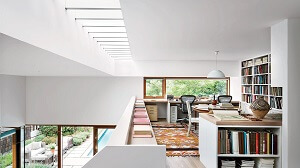
Residential mezzanine floor inside a high-ceiling room

Guardrails are life-safety systems rather than decorative options. OSHA fall-protection rules generally require top rails around 42 inches high, with limited permitted variation. Top rails must withstand a force of at least 200 pounds applied in an outward or downward direction.

Residential and public-access guardrails may follow different adopted building-code provisions, including limits on opening size intended to protect children. Glass panels, stainless-steel cable, custom woodwork, perforated metal, and architectural steel can cost much more than an industrial two-rail system.

Material access points need self-closing safety gates or another approved system. A removable chain is not always an acceptable substitute. Multiple pallet gates, conveyor openings, lifts, or loading zones increase both steel and engineering costs.

Fire Protection Is Not Optional

A new mezzanine can interfere with sprinkler spray patterns, smoke detection, emergency lighting, exit signs, and fire-alarm coverage. It can also create concealed areas above or below the platform that need additional protection.

The local fire marshal, building department, insurer, and fire-protection engineer may require new sprinkler heads below the deck, relocated piping, alarm devices, emergency lighting, extinguishers, smoke control, or fire-rated construction. The work may need to occur before the mezzanine receives final approval.

A small sprinkler alteration may cost several thousand dollars. A large warehouse redesign involving new mains, hydraulic calculations, lifts, and shutdown coordination can cost tens of thousands. The broader cost drivers are detailed in ThePricer’s guide to commercial fire sprinkler systems.

Office Buildout Costs More

Turning the mezzanine into an office adds walls, ceilings, insulation, HVAC, electrical outlets, data cabling, lighting, doors, windows, flooring, sound control, and finished surfaces. The occupancy change may also trigger stricter egress, accessibility, plumbing, and fire-protection requirements.

A 1,000-square-foot storage platform might cost $80,000 to $120,000 as a completed industrial structure. Building a conditioned office on it could add another $50,000 to $150,000+, depending on finishes, mechanical capacity, accessibility, and local labor.

The existing building’s HVAC and electrical systems may not have spare capacity. Extending ducts or refrigerant lines to an elevated level can be difficult, while an office filled with people and equipment creates cooling and ventilation loads that storage does not.

Ceiling Height Requirements

There is no universal rule that every mezzanine needs a room at least 12 feet high. The required height depends on beam depth, floor construction, intended use above and below, stair headroom, ducts, sprinklers, lighting, and the adopted code.

A nominal 12-foot room might leave only 5 feet 6 inches below and 5 feet 6 inches above after accounting for a 12-inch structural depth. That can work for limited storage but not for two comfortable occupied levels.

Warehouses with 20- to 30-foot clear heights are usually easier candidates. Residential rooms may need 14 to 18 feet or more to create useful headroom above and below, depending on layout. Sloped roofs and vaulted ceilings require measurements at the actual walking areas, not only at the highest ridge.

Seismic and Lateral Bracing

Mezzanines must resist more than vertical weight. The structure may need bracing or moment connections for earthquake loads, wind effects, equipment movement, and accidental impacts. Seismic requirements can increase steel weight, anchorage, connection complexity, and engineering fees.

Braces can also interfere with forklifts, production lines, doors, storage racks, or vehicle routes beneath the platform. A more open layout may require stronger moment frames and foundations instead of inexpensive diagonal bracing.

Do not accept a supplier’s generic drawing unless it has been reviewed for the actual building location, occupancy, loads, slab, and code. A structure engineered for one state or warehouse may not satisfy another jurisdiction.

Hidden Project Costs

The steel platform is often the most visible expense, but several less obvious items can move the final total:

  • Relocating lights, ducts, sprinklers, alarms, or cameras
  • Removing storage racks and production equipment
  • Night, weekend, or phased installation
  • Forklift and aisle shutdowns
  • Crane, telehandler, or scissor-lift rental
  • Freight, unloading, and indoor material handling
  • Floor scanning and concrete testing
  • Fireproofing or protective coatings
  • Accessibility lifts or elevators
  • Temporary fall protection during construction

A project installed over an active production line can cost substantially more than the same structure erected in an empty warehouse. The contractor may need smaller lifts, more handling, protective barriers, dust control, and several mobilizations.

Mezzanine vs More Building Space

A mezzanine can be economical when a company already pays for unused vertical space. It avoids buying land, constructing exterior walls and a roof, and extending parking, drainage, and utilities to a new footprint.

It is not automatically cheaper than expansion. A congested building with a weak slab, low roof, inadequate sprinklers, and no suitable exits may turn the mezzanine into an expensive compromise. The company should compare it with relocation, leased overflow storage, rack reconfiguration, and a new steel building.

Assume a 5,000-square-foot mezzanine costs $100 per square foot, for a total of $500,000. A simple installed steel-building shell at $35 per square foot would cost $175,000, but land, site work, utilities, paving, permits, interior systems, and operational duplication could make the new-building option much more expensive overall.

Three Project Scenarios

Basic storage platform: A 2,000-square-foot mezzanine costs $60 per square foot, or $120,000. Engineering, permits, and minor electrical changes add $12,000. The total reaches $132,000, or $66 per square foot.

Heavy-duty manufacturing platform: A 1,500-square-foot platform supporting machinery costs $145 per square foot, or $217,500. New foundations and equipment isolation add $35,000. The project reaches $252,500, or about $168 per square foot.

Residential library mezzanine: A 300-square-foot custom mezzanine costs $175 per square foot for structure and finishes, or $52,500. Architectural stairs, glass guardrails, and electrical work add $22,000. The completed project totals $74,500, or about $248 per square foot.

When a Mezzanine Fits

Makes sense if:

  • The building has useful clear height above existing operations.
  • The slab and foundations can carry the proposed column loads.
  • The added space delays a costly move or building expansion.
  • Stairs, exits, fire protection, and access can be added without disrupting operations.
  • The intended loads and occupancy are clearly defined before quoting.

Does not make sense if:

  • The room lacks usable headroom above or below the platform.
  • The slab requires extensive foundation reconstruction.
  • The mezzanine blocks sprinklers, ducts, forklifts, loading doors, or production lines.
  • The property cannot obtain approval for the intended occupancy.
  • A separate building or relocation provides better space at a lower lifetime cost.

What We Verified

  • Checked current installed price ranges against multiple U.S. mezzanine suppliers.
  • Confirmed OSHA stair headroom and uniformity requirements.
  • Verified OSHA guardrail height and strength requirements.
  • Separated structure-only prices from installed and office-finished project costs.
  • Included slab, foundation, fire protection, seismic, accessibility, and operational costs commonly omitted from simple square-foot estimates.

Answers to Common Questions

How much does a warehouse mezzanine cost per square foot?

A warehouse mezzanine commonly costs $50 to $150 per square foot installed. Basic large storage platforms may cost less, while heavy-duty or customized projects can exceed $150 per square foot.

How much does a 1,000-square-foot mezzanine cost?

A typical 1,000-square-foot warehouse mezzanine may cost $70,000 to $150,000+ after stairs, rails, engineering, installation, and ordinary code work. Foundation or sprinkler changes can raise the total.

How much does a residential mezzanine cost?

A residential mezzanine commonly costs $100 to $300+ per square foot. A finished 250-square-foot project may total $25,000 to $75,000+.

Does a mezzanine require a permit?

Most permanent commercial and residential mezzanines require structural plans, a building permit, and inspections. Fire, electrical, mechanical, and accessibility reviews may also apply.

Can a warehouse slab support a mezzanine?

Not automatically. A structural engineer must evaluate the slab, soil, reinforcement, joints, and concentrated column reactions. New footings may be required.

How tall must a room be for a mezzanine?

There is no universal minimum. The room must provide required headroom above and below after accounting for beam depth, flooring, stairs, sprinklers, lights, and the intended occupancy.

Disclosure: Educational content, not financial advice. Prices reflect public information as of the dates cited and can change. Confirm current rates, fees, taxes, and terms with official sources before purchasing. See our methodology and corrections policy.

by Alec Pow
ThePricer cost research Independent price research used by media, universities and public institutions.

We research provider pricing, market examples, buyer reports, hidden fees and public records.

Methodology · Citations · Newsroom
© 2014 - 2026 - ThePricer Media, LLC, 4 Grove Street, New York, NY, 10014, Phone: (212) 431-2441
We don’t use affiliate links or paid placements. All sources are cited only for verification.
  • Link to X
  • Link to LinkedIn
  • Link to Facebook
  • Link to Instagram
  • Link to Pinterest
  • Link to Youtube
  • Contact Us
  • About Us
  • Press & Mentions
  • Careers
  • Meet the Founder
  • Privacy Policy
  • Editorial Ethics
  • Methodology
  • Corrections
  • Disclosure
  • Terms and Conditions
Scroll to top Scroll to top Scroll to top