
How Much Does Stem Cell Therapy Cost?
Updated on | Written by Alec Pow
This article was researched using 14 sources. See our methodology and corrections policy.
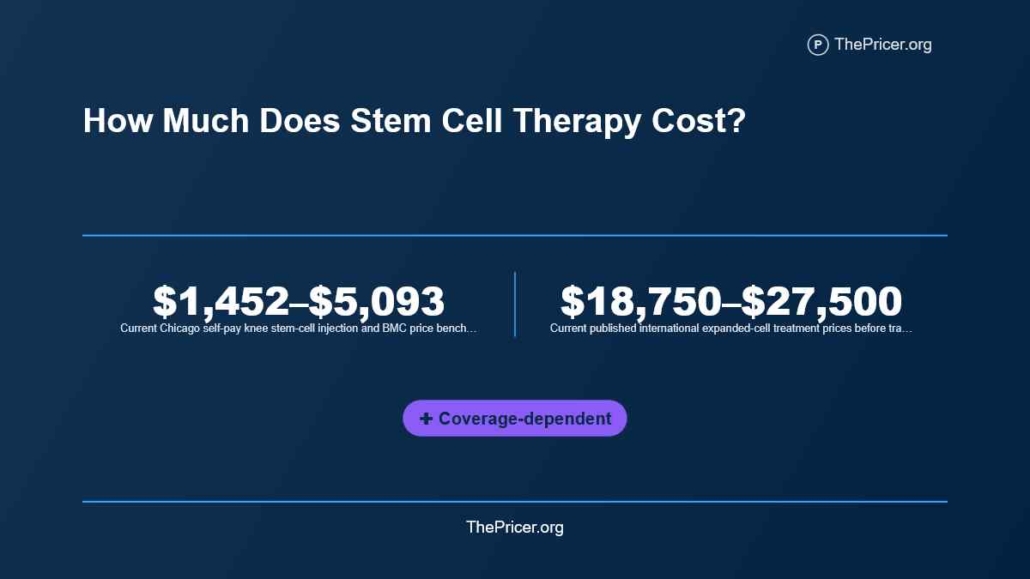
For U.S. self-pay knee injections marketed as stem cell therapy, a 2025 Chicago market study found mean prices of about $1,452 per injection at orthopedic sports-medicine practices and $4,594 at alternative regenerative clinics. Bone marrow aspirate concentrate, or BMC, averaged about $3,500 and $5,093 in those two settings. Commercial expanded-cell programs can cost far more, with one current international provider publishing figures from $18,750 to $27,500 before travel.
There is no useful single U.S. average for “stem cell therapy.” An orthopedic injection, BMC procedure, commercial IV mesenchymal stromal cell program, and medically indicated hematopoietic stem-cell transplant are different treatments with different evidence, regulation, insurance rules, and bills.
Article Highlights
Jump to sections
- A 2025 Chicago study found mean advertised knee stem-cell injection prices of about $1,452 (at $30 per hour, earning that amount would take about 1.2 full-time workweeks, before taxes) at orthopedic practices and $4,594 at alternative clinics.
- In the same market study, BMC averaged about $3,500 at orthopedic practices and $5,093 at alternative clinics.
- FDA says regenerative medicine therapies are not approved for osteoarthritis, back pain, knee pain, shoulder pain, or other orthopedic conditions.
- FDA-approved stem-cell and cell-based treatments do exist for defined medical indications, but they should not be confused with cash-pay orthopedic injections.
- Most commercial orthopedic cellular procedures are self-pay, while qualifying hematopoietic stem-cell transplantation can be covered by Medicare and other insurers.
- International patient-funded programs can add travel, lodging, payment fees, and follow-up costs to the advertised treatment price.
How Much Does Stem Cell Therapy Cost?
The best price answer depends on the product and indication. The Chicago study cited above contacted 25 orthopedic sports-medicine practices and 40 alternative clinics offering orthobiologic knee injections. Among practices willing to disclose prices, a single product advertised as a stem-cell injection averaged $1,451.75 (about 1.2 full-time workweeks at $30 per hour) at orthopedic practices and $4,593.50 at alternative clinics. BMC averaged $3,500 and $5,093, respectively. These are Chicago-area study means, not national averages.
Commercial systemic programs sit in another price category. A current Grand Cayman pricing page advertises expanded umbilical-cord MSC treatment starting at $18,750, with travel and accommodation excluded. The provider’s homepage separately states a $27,500 treatment price, which shows why a written quote and exact protocol matter before comparing international programs.
| Current price evidence | Published amount | What the figure covers |
|---|---|---|
| Chicago orthopedic practice, advertised stem-cell knee injection | $1,451.75 mean | One injection among price-disclosing practices in the study |
| Chicago alternative clinic, advertised stem-cell knee injection | $4,593.50 mean | One injection among price-disclosing clinics in the study |
| Chicago orthopedic practice, BMC | $3,500 mean | One BMC injection among price-disclosing practices |
| Chicago alternative clinic, BMC | $5,093 mean | One BMC injection among price-disclosing clinics |
| Commercial expanded-cell program abroad | $18,750+ | Published starting treatment price, excluding travel and accommodation |
A quote should identify the exact cell or tissue product, source, processing method, dose, number of injections or infusions, imaging, harvesting, facility charges, and follow-up. Without those details, two prices labeled “stem cell therapy” may describe entirely different purchases.
Not All Stem Cell Therapy Is the Same
The term covers several distinct medical categories. Hematopoietic stem-cell transplantation uses blood-forming cells from bone marrow, peripheral blood, or cord blood to rebuild the blood and immune system in defined diseases. Orthopedic clinics may offer BMC taken from the patient’s marrow, while other businesses market adipose, amniotic, umbilical-cord, or culture-expanded cell products. Some products advertised with “stem cell” language may contain mixed cell populations rather than one standardized stem-cell drug.
That distinction changes the price and the evidence. FDA has licensed cell and gene therapies for defined indications. In December 2024, FDA approved Ryoncil for pediatric graft-versus-host disease, making it the first U.S.-approved mesenchymal stromal cell therapy. That approval does not cover arthritis or sports injuries.
The older idea that a patient can compare “bone marrow stem cells,” embryonic cells, adipose cells, and induced pluripotent cells by a single price hierarchy should be dropped. Many of those categories are research platforms rather than interchangeable retail treatments. Ask what product is actually being administered and what regulatory status applies to that exact use.
That question is especially important for orthopedic care. Readers comparing cellular injections with other bone-healing approaches can also review the cost of an EXOGEN bone stimulator, which is a prescription device with a different indication and reimbursement structure.
FDA Status Changes the Meaning
FDA states in its regenerative medicine guidance that these therapies have not been approved for orthopedic conditions such as osteoarthritis, tendonitis, disc disease, back pain, hip pain, knee pain, neck pain, or shoulder pain. The same guidance warns about serious harms reported with illegally marketed regenerative products, including bacterial infections, neurological events, tumor formation, and blindness.
This does not mean every cell therapy is unapproved. Ryoncil has a narrow pediatric graft-versus-host disease indication, and licensed cord-blood hematopoietic products are used in transplant medicine. Approval is tied to a product and indication. It does not transfer to a clinic’s knee, spine, shoulder, COPD, neurologic, or chronic-pain offering. A clinic cannot borrow the regulatory status of a different cell product.
A clinic’s registration, laboratory language, testimonial page, or IRB review should not be read as FDA approval for treatment. The patient needs the regulatory status of the exact product and use being sold. A licensed product can be lawful for one indication and unapproved for another. Ask for the product name, manufacturer, and applicable FDA status rather than relying on broad claims about stem-cell science.
Knee Injection Prices
The Chicago data gives one of the clearest current comparisons because the researchers used a standardized telephone script and separated orthopedic practices from alternative clinics. Alternative clinics charged a mean $4,593.50 (about 3.8 full-time workweeks at $30 per hour) for a single advertised stem-cell injection compared with $1,451.75 at orthopedic practices. The difference is $3,141.75. Dividing the two means shows that the alternative-clinic price was about 3.16 times the orthopedic-practice price in that study.
Higher price did not establish stronger evidence. Alternative clinics were also much more likely to offer these injections, and their prices were more variable. For BMC, the same study found mean prices of $5,093 at alternative clinics and $3,500 at orthopedic practices, a difference of $1,593, or about 46%. That BMC price difference did not reach statistical significance, so it should be treated as an observed study difference rather than proof of a broad market rule.
 A patient with knee osteoarthritis should compare the cellular quote with the diagnosis-specific evidence and with alternatives. Current QC Kinetix costs show how commercial regenerative plans can reach several thousand dollars and still require careful separation of PRP, BMC, and cellular procedures.
A lower fee does not prove better value either. Product identity, clinician qualifications, imaging guidance, follow-up, and evidence for the exact diagnosis still matter.
International Programs
The old recommendation to travel to “DVC Stem in Tijuana” for $2,900 is obsolete. DVC Stem currently operates in Grand Cayman. Its current patient FAQ says treatment starts at $18,750, requires a 50% deposit, excludes travel and accommodation, adds a 4% convenience fee to credit or debit card payments, and charges $75 for wire transfers.
A simple payment scenario shows how the advertised starting price can change before airfare or a hotel is booked. If the entire $18,750 starting amount were paid by card, a 4% convenience fee would add $750, producing $19,500. Travel, lodging, companion costs, local transport, and any care needed after returning home remain outside that figure.
The same provider’s current homepage states a treatment cost of $27,500. That is $8,750 above the published starting figure. The difference reinforces the need for a dated written quote that identifies cell dose and protocol rather than relying on a search snippet or an older article.
Medical travel adds logistics as well as money. Ask who manages complications after you return home, whether records will be sent to your U.S. clinicians, and what follow-up is included in the quoted fee. International care should not be framed as a simple percentage discount.
Insurance Depends on the Treatment
Commercial orthopedic injections marketed as stem-cell or BMC treatment are commonly self-pay. The 2025 Chicago study reported that no major insurance carrier covered the in-clinic stem-cell or BMC products examined in that market. A clinic’s financing plan changes when payment is due, but it does not make the treatment an insured benefit.
Hematopoietic stem-cell transplantation belongs to a different coverage category. Current Medicare transplant coverage includes defined allogeneic HSCT indications such as leukemia, aplastic anemia, severe combined immunodeficiency, Wiskott-Aldrich syndrome, and qualifying myelodysplastic syndromes. The transplant process can include harvesting, preparative chemotherapy or radiotherapy, infusion, inpatient care, and follow-up.
That distinction matters when someone asks whether “insurance covers stem cell therapy.” A Medicare-covered transplant for a blood disorder is not evidence that an insurer will pay for a cash-pay knee injection. The reverse is also true. An insurer denial for an orthopedic regenerative procedure says nothing about coverage for a medically indicated transplant.
For severe knee disease, compare patient responsibility rather than sticker prices alone. An insured knee replacement can have a much higher gross medical bill while leaving a smaller out-of-pocket amount than a fully self-pay cellular procedure.
What the Evidence Says
The evidence for knee osteoarthritis is more nuanced than the old claim of a 75% or higher success rate. A 2025 systematic review and meta-analysis found pain reductions after adipose- and bone-marrow-derived stromal cell injections, but those improvements did not translate into substantial gains in knee function. The authors also identified publication bias, which weakens confidence in a simple success-rate claim.
A separate 2026 randomized-trial meta-analysis found some favorable pain and functional outcomes but emphasized inconsistent results across cell sources, preparations, doses, and techniques. That heterogeneity is one reason a clinic cannot responsibly apply a single published percentage to every product it sells.
The evidence also does not justify saying these injections reliably prevent or delay surgery. Research may support symptom improvement in selected study settings, but a commercial product can differ from the cells, processing, dose, and protocol used in a trial. A testimonial or case report cannot establish what another patient should expect.
The American Academy of Orthopaedic Surgeons continues to call for stronger evidence and long-term outcome data around orthobiologics. That position fits the price question directly. Spending several thousand dollars should start with the diagnosis, exact product, evidence for that product, and realistic outcome measure, not the label “regenerative.”
How to Evaluate a High-Cost Quote
High price is not proof of a better or more legitimate stem-cell treatment. In January 2025, the FTC announced court orders requiring more than $5.1 million in penalties and refunds in a case involving deceptive marketing of unproven stem-cell therapy. Regulatory history is a reason to ask for evidence, not a reason to equate a premium price with quality.
The ISSCR patient guide recommends checking whether a treatment has been evaluated for safety and effectiveness in regulated trials. NIH also warns that a study being listed on ClinicalTrials.gov does not mean FDA has reviewed or authorized the therapy. Registration and approval are different things.
Makes sense if
- The clinic identifies the exact cell product, source, processing method, dose, and regulatory status.
- The price quote states what imaging, harvesting, facility work, follow-up, and repeat treatment are included.
- The evidence being cited matches your diagnosis and the product being offered.
- You have compared the self-pay amount with insured and evidence-supported alternatives.
Does not make sense if
- The clinic promises a universal success rate or claims one cell product treats many unrelated diseases.
- A ClinicalTrials.gov listing or IRB review is presented as proof of FDA approval.
- The sales discussion focuses on promotions, group discounts, or urgency rather than product identity and evidence.
- The quoted price excludes major items that the provider will not identify in writing.
Get the exact product name first. Then evaluate the price.
Answers to Common Questions
How much does a stem cell injection for a knee cost?
In a 2025 Chicago market study, a single injection advertised as stem-cell treatment averaged about $1,452 at orthopedic practices and $4,594 at alternative clinics. Those are regional study means, not national prices.
Does insurance cover stem cell therapy?
Commercial orthopedic cellular procedures are commonly self-pay. Medically indicated hematopoietic stem-cell transplantation can be covered when the diagnosis and plan rules qualify.
Are stem cell injections FDA-approved for arthritis?
No. FDA says regenerative medicine therapies have not been approved for orthopedic conditions such as osteoarthritis, knee pain, back pain, shoulder pain, or disc disease.
Is treatment abroad always cheaper?
No. International programs can charge five-figure treatment fees before airfare, hotels, payment charges, local transport, and follow-up care. Compare complete written totals rather than the advertised base price.
Do stem cell injections have a 75% success rate?
No universal 75% success rate is supported across knee, shoulder, spine, neurologic, and other conditions. Results vary by diagnosis, cell product, preparation, outcome measured, and study design.
Disclosure: Educational content, not medical advice. Pricing varies by provider, location, and insurance. Confirm eligibility, coverage, and out-of-pocket costs with a licensed clinician and your insurer. See our methodology and corrections policy.