
How Much Does Threading Cost?
Updated on | Written by Alec Pow
This article was researched using 17 sources. See our methodology and corrections policy.
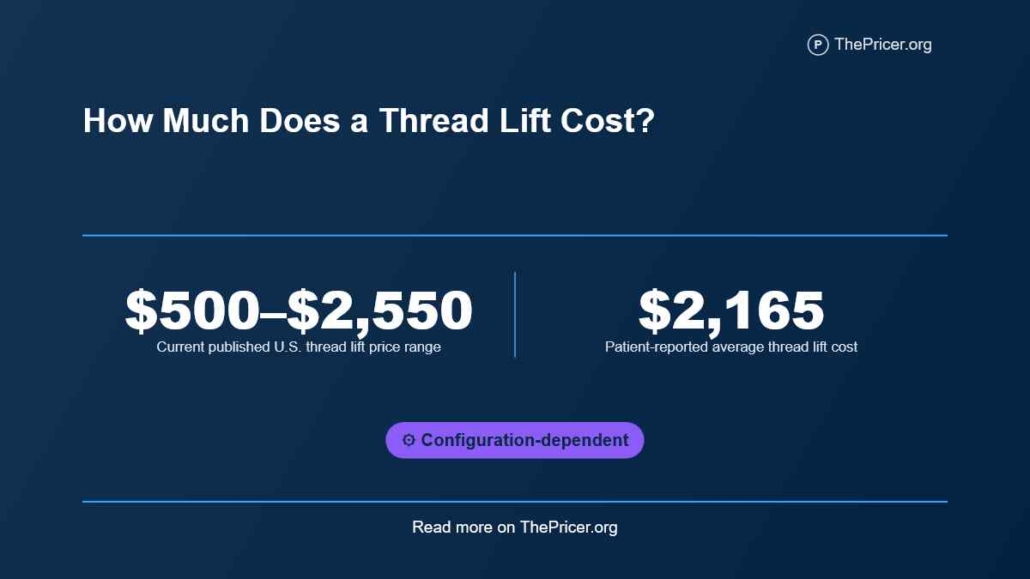
A thread lift in the United States can cost from several hundred dollars for a limited treatment to several thousand dollars for a broader face or neck plan. Current published 2026 clinic menus reviewed by ThePricer show examples from $500 for 10 under-eye PDO threads to $2,550 for a full-face session. Separate patient-reported data place the average at $2,165, with reported prices up to $4,800.
The bill depends on the treatment area, thread type, thread count, provider, and what is included in the quote. A small skin-quality treatment with smooth threads is not financially comparable with a barbed suspension lift for the cheeks, jawline, or full face. Results are temporary, so repeat treatment can also become part of the long-term cost.
Article Highlights
Jump to sections
- Current 2026 clinic examples reviewed run from $500 (at $30 per hour, earning that amount would take about 2.1 full-time workdays, before taxes) for a limited under-eye treatment to $2,550 for a full-face session.
- Patient-reported pricing averages $2,165, with reports reaching $4,800.
- One current menu lists a six-thread mini lift at $1,850 and an eight-thread package at $2,250.
- A cheek plus jawline starting-price combination can cost about the same as a full-face starting price at one current provider.
- Thread lift results are temporary and may last about one to three years.
- Cosmetic thread lifts are commonly self-pay, and complications can create extra care costs.
How Much Does a Thread Lift Cost?
RealSelf’s patient-reported thread lift pricing lists an average of $2,165 (about 1.8 full-time workweeks at $30 per hour) from 218 reviews, with reported costs as high as $4,800. That dataset is useful as consumer spending evidence, but it mixes different treatment areas, thread counts, providers, and cities. It should not be treated as one fixed national quote for a face or neck procedure.
Current clinic menus add better scope. MD Ventures lists a 2026 PDO thread menu with under-eye skin rejuvenation at $500 for 10 threads, $900 for 20 threads, a six-thread mini facelift at $1,850, an eight-thread lift at $2,250, and PLLA neck rejuvenation at $1,400. BYou’s April 2026 treatment menu lists cheeks from $860, jawline from $1,720, chin from $860, and full face from $2,550.
| Published 2026 example | Price | Quoted scope |
|---|---|---|
| Under-eye PDO treatment | $500 | 10 threads |
| Under-eye PDO treatment | $900 | 20 threads |
| Mini facelift | $1,850 | 6 lifting threads |
| Expanded facelift | $2,250 | 8 lifting threads |
| Jawline | $1,720 | Starting session price |
| Full face | $2,550 | Starting session price |
These are published offers, not a representative national sample. A quote near $500 can be legitimate for a limited thread treatment while a broader lifting plan can cost several times more. The treatment scope explains much of the apparent contradiction.
What the Quote Includes
A thread lift quote can bundle the threads, local anesthetic, provider time, sterile supplies, insertion work, and routine follow-up, or it can price some pieces separately. Cleveland Clinic’s clinical thread lift overview says the procedure is performed with local anesthesia and commonly takes about an hour. That makes the service very different from a surgical facelift with an operating room and deeper anesthesia.
The consultation deserves attention because published menu prices do not always state whether an evaluation is included. A provider may also quote one amount for smooth threads intended mainly for skin quality and another for barbed or coned threads used to reposition tissue. Follow-up policy matters too. A clinic that includes an early post-treatment check is selling a different package from one that charges for later evaluation or correction.
BlueCross BlueShield of Tennessee’s facial thread lift policy classifies a thread lift performed to restore a younger facial appearance as cosmetic. Other plans have their own terms, so a cosmetic-only treatment should be budgeted as self-pay unless the insurer confirms an exception.
Ask for a written quote that names the treatment area, product, number of lifting threads, number of smooth threads if used, consultation fee, follow-up policy, and correction policy. That makes two quotes much easier to compare.
Area and Thread Count
Thread count matters, but it does not act like a simple retail unit price. On the MD Ventures menu already cited, moving from six lifting threads at $1,850 (about 1.5 full-time workweeks at $30 per hour) to eight at $2,250 adds $400. The thread count rises by 33.3%, while the package price rises by 21.6%. The implied package price per lifting thread falls from about $308 to $281, though those figures include provider work and should not be mistaken for the wholesale cost of a thread.
The same problem appears when comparing areas. On BYou’s current menu, cheeks start at $860 and jawline at $1,720. If those two starting rates were charged separately, the combined starting total would be $2,580. The provider’s full-face starting price is $2,550, or $30 less, while covering a broader facial contour. This is a menu comparison, not a promise that every cheek-plus-jawline plan will receive that full-face price.
The difference is not small. Buyers who compare only thread count can miss package pricing, area bundles, and the type of thread being placed. A 20-thread skin-quality treatment can still cost less than a six-thread suspension lift because the material and placement goals differ.
Ask the provider to separate lifting threads from smooth collagen-stimulating threads when both appear in the plan. That one detail can explain why two treatments with similar thread counts have very different prices.
Thread Lift or Facelift?
A thread lift and a surgical facelift should not be compared as though they buy the same result. The American Society of Plastic Surgeons describes absorbable barbed suture lifting as a minimally invasive treatment for the face and neck. A surgical facelift can reposition deeper tissues and remove excess skin, which gives it a different treatment scope, recovery profile, and price structure.

The lower upfront price can make threads attractive to someone seeking a smaller change without a surgical operation. That does not make the two procedures financially interchangeable. A thread lift may need to be repeated as its effect fades, while a facelift usually has a much longer treatment horizon. Readers comparing a surgical option can use the facelift cost article for the separate surgeon, anesthesia, and facility model.
Other cosmetic treatments solve different problems again. Dermal filler pricing is built around product volume and syringes, while Botox pricing is often based on units injected. Face liposuction costs involve fat removal rather than suture suspension.
The better comparison is goal against goal. The consultation should establish whether the desired change is subtle enough for a thread lift or whether the person is really comparing the procedure with surgical correction. That distinction changes both the expected result and the price being compared.
How Long Results Last
Thread lift results are temporary. Cleveland Clinic states that results can last from one to three years as the threads dissolve and are absorbed. The University of Florida gives a narrower average of about one to one and a half years for clinical results from temporary thread lifting. Those ranges differ because products, treated areas, technique, skin characteristics, and follow-up periods differ.
Cost over time can change the value calculation. Using the $2,165 patient-reported average already cited, one treatment lasting three years spreads that spending across about $722 per year. The same $2,165 session repeated yearly would require $2,165 each year before any price changes or correction costs. This is a budget sensitivity calculation, not a prediction of how long one person’s result will last.
Results also should not be sold as a permanent collagen-driven lift. A review of absorbable thread lifts found immediate improvement across published studies but said long-term efficacy data remain limited. The visual lift can also change as swelling settles and the face continues to age.
That makes repeat cost a real part of the purchase. Ask what duration the provider expects for the specific product and area being treated, then budget for the possibility of another procedure rather than treating the first payment as permanent facial rejuvenation.
Risks and Recovery
Thread lifting is minimally invasive, but “no side effects,” “no bruising,” and “zero pain” are not defensible claims. The ASPS list of listed thread lift risks includes swelling, bruising, pain, infection, thread extrusion, anesthesia risks, temporary difficulty opening the mouth, light sensitivity, and an unfavorable result. Those possibilities can also create extra spending if another visit, medication, or corrective treatment is needed.
A fresh 2026 complication meta-analysis pooled 26 studies with 2,827 patients. It reported swelling in 34% of cases, bruising or ecchymosis in 26%, visible or palpable threads in 10%, and skin dimpling in 7%. The authors found substantial variation between studies, so these pooled figures should not be treated as a personal risk calculator.
Recovery is also not literally instant. ASPS thread lift recovery guidance says many patients are presentable within three to five days, while swelling or bruising can occur and full healing may take a few weeks. That is still a shorter recovery profile than many surgical facial procedures, but it is not zero downtime for every patient.
Ask how the practice handles visible threads, asymmetry, infection, dimpling, or an unsatisfactory cosmetic result. Correction policy can matter financially as much as the initial quoted price.
FDA Status and Provider Choice
The phrase “FDA-approved threads” is too broad. FDA status depends on the exact device and intended use. Silhouette InstaLift has an FDA 510(k) record as a Class II absorbable suture system, with an intended use for temporary mid-face suspension. A 510(k) substantial-equivalence decision is usually described as FDA clearance, not blanket approval of every thread product or every cosmetic use.
That distinction became especially concrete in a 2025 FDA warning letter. FDA said a different barbed PDO suture had been cleared for soft-tissue approximation, while marketing claims for cheek, jawline, neck, and brow lifting went beyond the cleared intended use. A clinic saying only “our threads are FDA cleared” has not yet answered whether the product is cleared for the cosmetic use being advertised.
Provider credentials are a separate question from device status. ASPS surgeon credential guidance advises patients to verify board certification, training, and facility credentials. The person placing the thread needs a detailed knowledge of facial anatomy as well as experience with the chosen product.
Ask for the product name and the clinician’s credentials before paying a deposit. A branded device, a regulated suture, and an experienced provider are three separate facts.
How to Compare Quotes
Start with equal scope. A $900 quote for 20 smooth threads around one small area should not be compared with a $2,250 eight-thread suspension package as though the expensive clinic is charging more for fewer threads. The treatment goal, thread design, and placement work differ. Written estimates should state whether the quote is per thread, per area, or per completed session.
Ask whether consultation, anesthetic, photographs, aftercare, follow-up, and correction visits are included. If the clinic sells combined treatments with filler, PRP, toxin injections, or device-based skin tightening, request the thread-lift price on its own before comparing bundles. Financing also changes monthly cash flow but does not reduce the underlying treatment price.
Makes sense if
- You want a subtle temporary lift and accept that another treatment may be needed later.
- You are comparing written quotes with the same areas and thread types.
- You know the product name, provider credentials, and follow-up policy.
- You have budgeted for possible repeat treatment rather than treating the first session as permanent.
Does not make sense if
- You expect the same degree or duration of correction as a surgical facelift.
- You choose only by the lowest advertised thread count price.
- You assume every PDO suture has the same FDA-cleared cosmetic indication.
- You ignore possible correction costs because the procedure is marketed as minimally invasive.
Get the scope in writing. That is the fastest way to turn an attractive advertisement into a usable cost comparison.
Answers to Common Questions
How much does a thread lift cost?
Current published 2026 clinic examples reviewed range from $500 for a limited under-eye thread treatment to $2,550 for a full-face starting price. Patient-reported totals can be higher.
How much does a full-face thread lift cost?
One current U.S. provider lists full-face treatment from $2,550. The final quote can change with thread count, product, anatomy, and whether another area is added.
How long does a thread lift last?
Clinical references place temporary results around one to three years, with variation by product, area, technique, and patient.
Does insurance cover a cosmetic thread lift?
Cosmetic thread lifting is commonly treated as self-pay. Coverage rules differ by plan, so an insurer should confirm any claimed exception before treatment.
Are all thread lift products FDA approved?
No. FDA status is product- and indication-specific. Some devices have FDA clearance for defined uses, while another suture may be cleared for wound or tissue approximation rather than cosmetic facial lifting.
Disclosure: Educational content, not medical advice. Pricing varies by provider, location, and insurance. Confirm eligibility, coverage, and out-of-pocket costs with a licensed clinician and your insurer. See our methodology and corrections policy.