
How Much Does Verizon Frontline Cost?
Updated on | Written by Alec Pow
This article was researched using 12 sources. See our methodology and corrections policy.
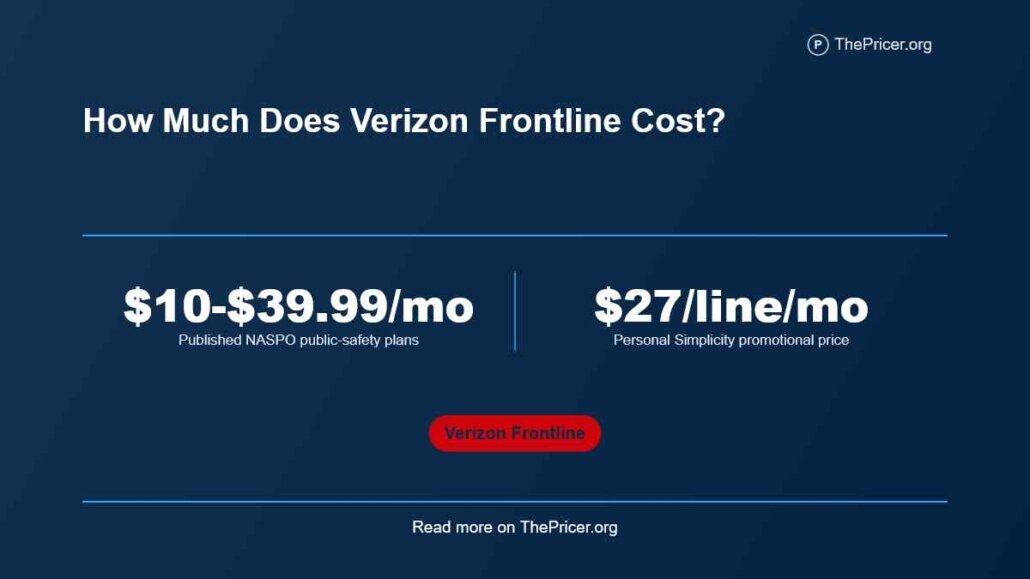
Verizon Frontline does not have one universal retail price. For eligible government and public-safety buyers using Verizon’s current NASPO ValuePoint contract, published public-safety wireless plans run from $10 per month for a second-number backup line to $39.99 per month for an unlimited mobile broadband plan with priority and preemption. Verizon Frontline Network Slice plans cost $20 per month for a tablet or connected laptop, $30 per month for a connected vehicle, and $36.99 per month for a smartphone. Separately, eligible first responders buying personal Verizon service can currently get Simplicity for as little as $27 per line per month when the published promotion requirements are met.
Article Highlights
Jump to sections
- Public-safety contract pricing spans $10 to $39.99 per month across several current NASPO plans.
- Frontline Network Slice smartphone costs $36.99 per month under the cited government contract.
- Network Slice tablet or laptop costs $20 per month.
- Connected vehicle access costs $30 per month.
- Personal first responder service can start at $27 per line per month under the current Simplicity promotion.
- Priority features can be included at no added monthly charge on qualifying public-safety service.
How Much Does Verizon Frontline Cost?
The strongest published price sheet for agency buyers is Verizon’s current NASPO pricing catalog. Contract MA152 uses government-liable service and may depend on a participating state addendum, customer qualification, device type, and plan eligibility. It is not a universal retail menu for every first responder. The catalog version dated August 12, 2026 gives the following monthly access charges.
| Public-safety service | Monthly access price | Main scope |
|---|---|---|
| 5G second-number smartphone backup | $10.00 | 250 MB data and unlimited voice |
| Frontline Network Slice tablet | $20.00 | Unlimited data with priority and preemption |
| Frontline Network Slice connected laptop | $20.00 | Unlimited data with priority and preemption |
| Frontline Network Slice connected vehicle | $30.00 | Unlimited data for compatible vehicle equipment |
| Public Safety UWB mobile broadband | $30.00 | Unlimited mobile broadband with priority and preemption |
| Frontline Network Slice smartphone | $36.99 | Unlimited smartphone service with priority and preemption |
| Unlimited smartphone with MBP and preemption | $36.99 | Government-liable public-safety smartphone service |
| Unlimited mobile broadband with MBP and preemption | $39.99 | Eligible data devices and routers |
Several costs that can appear on ordinary wireless accounts are handled differently under this contract. Government voice and data activation fees are waived, and qualifying government accessories receive a 25% discount. Some equipment subsidies can create an offer-recovery charge if the agency disconnects service or moves the device to a lower-price plan before the required term ends. The monthly access figure is only one part of an agency budget. Hardware, taxes, international use, local contract terms, and any nonincluded services still need to be checked against the purchasing entity’s agreement.
Personal First Responder Pricing
Personal first responder discounts are a different program from agency-billed Frontline service. Verizon’s first responder discount rules currently give eligible Simplicity lines a 10% discount. Select Unlimited plans can receive account-level savings, while many older standard plans can receive 15% off an eligible monthly account access fee. The older Start Unlimited, Play More, Do More, and Get More plans in the previous article are marked as no longer available to add, so their old multi-line price table should not be used for a new 2026 purchase.
For a new personal account, Verizon’s first responder offer currently advertises Simplicity from $27 per line per month after Auto Pay, Switch & Save, and the first responder discount, plus taxes and fees. If four new lines each meet those conditions, the service portion is $108 per month, or $1,296 over 12 months, before taxes and devices. That is an illustrative four-line total, not a separate Verizon package quote.
Eligible first responders also receive 25% off select accessories purchased online through My Verizon and 10% in a Verizon store. The account owner or account manager must complete verification, and the discount must be renewed when Verizon requests revalidation. A reader comparing this personal offer with ordinary consumer service can use the Verizon mobile plan cost page for adjacent plan context.
Network Slice Cost
Verizon Frontline Network Slice is sold for public-safety use on compatible 5G devices. Verizon’s network slice description says the service assigns dedicated 5G network resources to eligible public-safety traffic and supports smartphones, tablets, laptops, and connected vehicles. Agencies must pass prequalification, and the relevant device must support the service. The NASPO catalog prices a slice smartphone at $36.99 per month, a tablet or connected laptop at $20 per month, and a connected vehicle at $30 per month.
One price comparison is easy to miss. The same NASPO catalog lists a non-slice custom 4G/5G unlimited smartphone plan with Mobile Broadband Priority and preemption at $36.99 per month. The Frontline Network Slice smartphone plan is also $36.99 per month.
Under this contract, the monthly access difference between those two smartphone options is $0. A 100-line agency would pay $3,699 per month in access charges under either smartphone rate before taxes, devices, and other contract costs. That does not make the plans interchangeable. The slice plan has its own eligibility, compatible-device, coverage, and service rules, but the published access price itself is equal.
Priority Services
Priority and preemption describe several related services, and the names should not be treated as synonyms. Mobile Broadband Priority assigns eligible data users a higher access priority than lower-priority traffic. Preemption can activate during full network utilization so approved public-safety users keep network access. Those features are built into several agency plans and into the Frontline Network Slice offers. They are part of the service design, not a separate consumer discount.
Wireless Priority Service is different. The federal WPS program is managed by CISA and provides priority cellular voice calling for authorized users across participating carriers, including Verizon. CISA says enrollment and use carry $0 in WPS charges. A WPS-enabled user invokes a priority call by dialing *272 before the destination number. WPS does not disconnect calls already in progress, and it should not be used to call 911.
The distinction matters for budgeting. An agency buying a $36.99 per month smartphone plan may already have data priority and preemption in the plan, while WPS addresses prioritized voice calling through a separate federal service. The old article’s blanket statement that every device must choose between WPS and MBP is too broad for the current product set. Compatibility and provisioning rules depend on the selected plan and device, so an agency should confirm both features on its line configuration before deployment.
Frontline and FirstNet
Verizon Frontline and FirstNet are separate public-safety offerings. The FirstNet Authority partnership remains a public-private arrangement with AT&T. The FirstNet Authority is the federal entity overseeing that network. Verizon Frontline is Verizon’s own portfolio of public-safety wireless, priority, network-slice, device, and crisis-response services. The existence of Verizon Frontline did not replace the FirstNet partnership with AT&T.
That distinction also prevents an eligibility mistake. Verizon’s personal first responder discount is aimed at eligible state and local firefighters, EMT and EMS personnel, law enforcement, and qualifying next of kin. Verizon says federal-level law-enforcement personnel such as FBI, DEA, FEMA, CIA, NSA, and Border Patrol personnel do not qualify for that personal discount. Government and public-safety service is broader. The current NASPO public-safety catalog includes plan eligibility categories such as national security and assigned federal law enforcement for some offerings.
Those are separate buying channels. A federal agency looking for public-safety connectivity should not conclude that Verizon service is unavailable because an individual employee cannot claim the consumer first responder discount. A state or local responder shopping for a personal phone plan should not assume an agency contract price applies to a private account. Matching the payer and account type is the first pricing step.
Current Device Offers
Verizon also publishes device offers for government and public-sector customers. Its public-sector device page currently advertises the Google Pixel 10 Pro at $0, the Samsung Galaxy XCover7 Pro as an on-us offer, the iPhone 17e as an on-us offer, and the Inseego MiFi Pro M4 5G at $49.99. Other phones on the page carry different promotional prices. These are contract and eligibility offers, not unrestricted retail prices.
The device page says government offers are available to qualifying government-liable accounts and remain subject to the applicable contracting vehicle. Some subsidized hardware can also carry an offer-recovery obligation if the line is disconnected or moved to an ineligible plan before the required period ends. A separate public-sector port-in incentive offers a $200 bill credit on qualifying smartphone ports through September 30, 2026, with a qualifying plan of at least $29.99 per month. Taxes and fees remain outside the advertised device price.
Hardware selection can affect service selection as well. Network Slice requires compatible 5G equipment, and the connected-vehicle plan requires compatible router and antenna hardware in the vehicle. An agency should price the service line and the approved hardware together. That is closer to planning a communications system than shopping for an ordinary discounted handset. The Cisco phone system cost article covers another form of organization-wide communications spending.
Crisis Response Support
 Verizon Frontline also includes an emergency-support operation that does not fit neatly into a per-line price. Verizon’s 2026 hurricane response briefing says its Frontline Crisis Response Team supports public-safety agencies during emergencies at $0 cost to the agencies it assists.
The team can deploy portable cell sites, Wi-Fi hotspots, charging stations, and other connectivity equipment when normal infrastructure is damaged or overloaded.
That service should not be confused with a promise that every piece of hardware or every routine wireless line is free. The no-cost statement applies to Crisis Response Team support during qualifying emergency operations.
Routine agency subscriptions, network-slice lines, purchased devices, and contract hardware still carry their own rates. In 2025, Verizon reported nearly 1,500 response requests, almost 700 agencies served, and nearly 9,000 devices and connectivity solutions provided through the team.
For an agency building resilience outside a disaster deployment, recurring connectivity still matters. Backup broadband, fixed wireless, and wired circuits can create a separate operating budget from the mobile public-safety lines described here. The business internet cost guide provides a useful comparison for permanent site connectivity.
Worked Agency Budget
A mixed fleet shows why the device type matters more than a single headline Frontline price. Consider an illustrative agency that qualifies for the current NASPO pricing and needs 20 Frontline Network Slice smartphones, 10 slice-enabled tablets, and five connected vehicles. Using the published monthly access rates, the 20 smartphone lines cost 20 × $36.99 = $739.80. The 10 tablet lines cost 10 × $20 = $200. Five connected-vehicle lines cost 5 × $30 = $150.
The combined access bill is $1,089.80 per month. Across 12 months, that becomes $13,077.60. This ThePricer scenario covers 35 wireless access lines and uses the contract rates already cited above. It excludes smartphones, tablets, vehicle routers and antennas, taxes, international usage, device protection, local contract modifications, and any equipment recovery charges. Those exclusions matter because a heavily subsidized hardware purchase can change the first-year cash requirement even when the monthly service math stays the same.
The scenario also gives an effective average service cost of about $31.14 per line per month, calculated as $1,089.80 divided by 35 lines. That average is useful only for this stated mix. An agency with more $20 tablet lines would come in lower, while a fleet weighted toward $36.99 smartphones would come in higher. Procurement teams can substitute their own line counts into the same three-rate calculation before requesting the final contract quote.
Which Option Fits
The old article treated Verizon Frontline as though one consumer unlimited-plan table answered the entire cost question. The current product structure needs two budgets. A public-safety agency should start with its government purchasing vehicle, device mix, priority requirements, coverage needs, and compatible hardware. An individual first responder shopping for a personal phone line should start with the consumer discount rules and the current plan promotion. Those paths can produce very different bills even though both use the Verizon first responder name.
Contract restrictions matter. A low device price can be tied to service eligibility and an offer-recovery period. Network Slice requires compatible equipment and prequalification. Personal discounts require verification and periodic renewal. WPS has its own federal eligibility process. A quote that ignores those conditions can be numerically correct yet unusable.
Makes sense if
- Your agency qualifies for public-safety contract service and needs priority or preemption.
- Your fleet uses compatible 5G devices that can benefit from Network Slice.
- You are an eligible first responder buying personal service and can meet the current discount conditions.
- Your emergency plan benefits from Verizon’s separate crisis-response support.
Does not make sense if
- You are applying a personal $27 promotional rate to an agency procurement budget.
- You are applying a NASPO government rate to a private consumer account.
- Your devices cannot support the public-safety feature or slice you intend to buy.
- A subsidized device commitment creates recovery costs that your deployment plan cannot support.
Answers to Common Questions
How much does Verizon Frontline cost per month?
There is no single Frontline price. The current NASPO catalog lists eligible public-safety plans from $10 to $39.99 per month, while Frontline Network Slice plans run from $20 to $36.99 per month depending on the device type.
How much is Verizon Frontline Network Slice for a smartphone?
The current NASPO government pricing catalog lists the Frontline Network Slice smartphone plan at $36.99 per month for qualifying government accounts.
Do first responders get a Verizon personal discount?
Eligible state and local first responders can receive plan discounts. The current new-customer Simplicity promotion can reach $27 per line per month after the stated Auto Pay and switching conditions, plus taxes and fees.
Is Verizon Frontline the same as FirstNet?
No. Verizon Frontline is Verizon’s public-safety portfolio. FirstNet is a separate nationwide public-safety network overseen by the FirstNet Authority through its partnership with AT&T.
Does WPS cost extra?
CISA currently says authorized WPS enrollment and use carry $0 in WPS charges. The underlying wireless service still has its normal plan cost.
Disclosure: Educational content, not financial advice. Prices reflect public information as of the dates cited and can change. Confirm current rates, fees, taxes, and terms with official sources before purchasing. See our methodology and corrections policy.