
How Much Does a Nebelung Cat Cost?
Updated on | Written by Alec Pow
This article was researched using 14 sources. See our methodology and corrections policy.
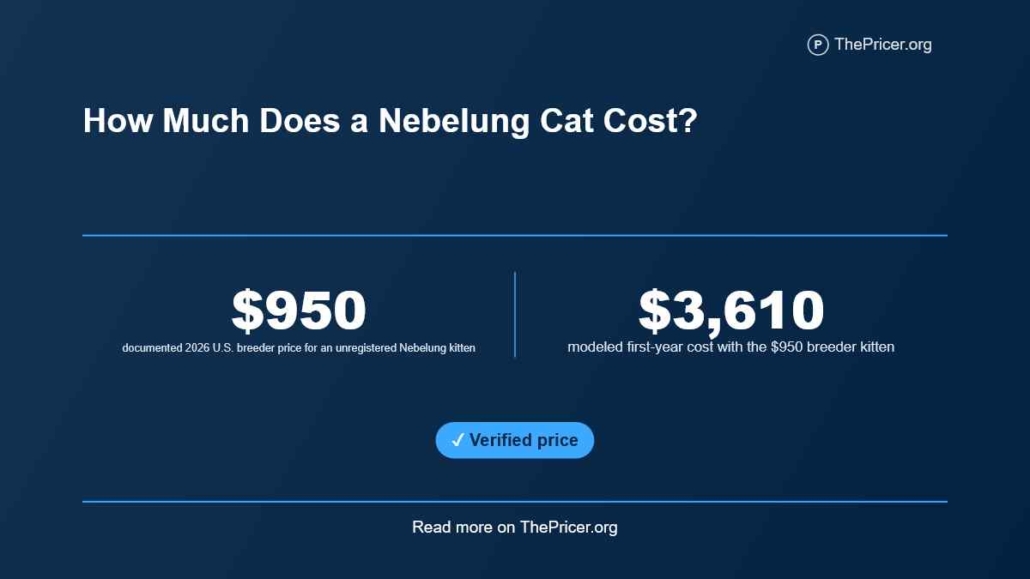
A Nebelung cat can cost about $50 to $150 to adopt when a shelter or rescue labels a cat as Nebelung, while a documented 2026 U.S. breeder listing priced kittens at $950 without pedigree or registration. Verifiable pedigreed supply is much thinner. A current Dutch cattery listing asks €1,550 for a Nebelung kitten with pedigree, EU passport, vaccinations, microchip, and deworming.
That split matters more than an old national average. The Nebelung is a rare pedigreed breed, but many blue longhaired cats are advertised or listed as Nebelungs without papers. Buyers should price the cat they are actually getting, then add normal cat ownership costs for food, litter, veterinary care, insurance, dental care, and supplies.
Article Highlights
Jump to sections
- A documented 2026 U.S. breeder listing priced Nebelung kittens at $950 (at $30 per hour, earning that amount would take about 4 full-time workdays, before taxes) without pedigree or registration.
- A current pedigreed Dutch listing asks €1,550 and includes a pedigree, EU passport, vaccines, microchip, and deworming.
- Adopt a Pet currently gives a breed-search adoption range of $50 to $150, but a shelter label does not prove pedigree.
- A modeled first year with the $950 U.S. breeder kitten comes to about $3,610 before emergencies, boarding, dental treatment, or transport.
- The 2025 U.S. accident-and-illness premium average reported from NAPHIA’s 2026 data is $435 per year.
- Nebelungs need regular combing, but repeated professional salon grooming is not a standard breed requirement.
How Much Does a Nebelung Cat Cost?
The Nebelung market does not support one clean U.S. pedigreed average. A 2026 Texas breeder listing on GoKitty priced its Nebelung kittens at $950, but the same listing explicitly says pedigree and registration are absent. That makes $950 (about 4 full-time workdays at $30 per hour) a documented 2026 breeder-sold U.S. price, not proof of what a registered Nebelung kitten costs nationally.
Current European pedigreed evidence provides a different price point. One Dutch cattery listing prices a pedigreed Nebelung at €1,550. The kitten comes with pedigree documentation, an EU passport, vaccination, microchip, and deworming. That offer should stay in euros rather than being converted into a false U.S. market quote.
| Acquisition route | Current published price | What the price represents |
|---|---|---|
| Shelter or rescue breed search | $50 to $150 | Adoption fee for cats labeled Nebelung |
| 2026 U.S. breeder listing | $950 | Breeder-sold kittens without pedigree or registration |
| Current pedigreed Dutch listing | €1,550 | Pedigree, passport, vaccines, microchip, and deworming included |
The price gap is partly an identity gap. A blue longhair can resemble a Nebelung without documented ancestry. On a rare breed, papers and registry records carry more weight than color alone. Supply is thin.
Pedigree Changes the Price
The International Cat Association describes the Nebelung as a relatively rare breed with a silky medium-length blue coat, silver tipping, and a long plumed tail. TICA traces the breed to Siegfried and Brunhilde, born in 1984 and 1985.
Their foundation was not a simple Russian Blue and domestic-longhair cross. Siegfried’s mother was a black domestic shorthair, while his father was a longhair resembling a black Angora. Russian Blue was later approved as an outcross as breeders developed the gene pool. TICA recognized the Nebelung for championship competition in 1997 through its official Nebelung breed history.
This history matters to price because appearance alone cannot establish pedigree. A gray-blue longhaired shelter cat may fit much of the visual description and still have no documented relationship to registered Nebelung lines. The reverse is also true. A pedigreed kitten can have registry documentation even when its coat is still developing and does not yet look like the mature photos buyers expect.
TICA maintains a breeder directory by breed, which is a better starting point for registry verification than an informal marketplace label. Buyers should ask for the registered names of the parents, the issuing registry, the kitten’s pedigree terms, and whether registration papers are included in the quoted price.
Breeder vs Adoption Costs
Adoption can cost far less. Adopt a Pet currently says adopting a cat listed as Nebelung commonly costs $50 to $150. Its breed search also shows only a small number of available cats at a time, which fits the breed’s scarcity. A shelter identification should still be read as the shelter’s label unless pedigree documentation is available.
Compared with the documented $950 (about 4 full-time workdays at $30 per hour) 2026 U.S. breeder listing, the sticker-price difference is $800 to $900. The calculation is simple. $950 – $150 = $800 and $950 – $50 = $900. The real acquisition gap can be larger because adoption fees often include services such as spay or neuter, vaccines, microchipping, and an initial exam, while the reviewed $950 breeder listing states only that first vaccination records are included.
That does not make a shelter cat interchangeable with a pedigreed kitten. Adoption is a strong route for a person who wants a blue longhaired companion and does not need proof of lineage. A buyer seeking a registered Nebelung for showing, breeding, or documented ancestry needs different evidence and may face a much longer search. Availability is very limited.
First-Year Nebelung Budget
Current 2026 cat-cost research gives a useful base for building a first-year scenario. Rover lists initial examination and vaccinations at $180 to $410, spay or neuter at $165 to $195, annual food and treats at $320 to $1,870, and annual litter at $125 to $580. Its gear, enrichment, and grooming categories also show how basic supplies can range from inexpensive to premium.
For a reproducible middle-case model, start with the documented 2026 $950 U.S. breeder kitten. Use $295 for initial examination and vaccinations, the midpoint of the published range, and $180 for spay or neuter. Use $1,095 for a year of food and treats and $352.50 for litter, again using the published midpoints. Add $300 as an explicit moderate setup assumption for a carrier, litter box, scratching surface, bowls, grooming tools, and toys.
A current summary of NAPHIA’s 2026 State of the Industry data puts the 2025 U.S. accident-and-illness average for cats at $435 per year. Add that benchmark to the model. The total is $950 + $295 + $180 + $1,095 + $352.50 + $300 + $435 = $3,607.50, rounded to about $3,610. The purchase itself is about 26% of this modeled first year. The result excludes dental treatment, emergencies, pet rent, boarding, professional grooming, and any cross-border transport.
Food, Litter, and Vet Costs
After the first year, acquisition and most setup spending disappear. Rover’s 2026 research puts adult cat ownership at roughly $850 to $4,400 per year, depending on food, veterinary needs, insurance, litter, equipment, and optional services. Food and treats alone span $320 to $1,870 per year, while litter runs about $125 to $580. Those ranges are more useful than automatically adding a full dry-food budget, a full wet-food budget, treats, liners, deodorizer, and waste bags as though every owner buys all of them.
Nebelungs do not require a special “grain-free” or boutique diet simply because of the breed name. PetMD notes that long-term breed-specific health data are limited because the Nebelung remains uncommon, and it recommends ordinary veterinary guidance based on the individual cat rather than a unique breed diet. Its Nebelung care profile also gives a broad life expectancy of 11 to 18 years, which makes recurring annual costs far more important than saving a few hundred dollars on the kitten.
Veterinary spending also varies by year. A healthy adult may need a routine examination and only the vaccines that are due, while another year may include diagnostics, medication, or dental work. Owners should budget for the care actually scheduled rather than assume the same vaccine and laboratory bundle repeats every year.
Grooming and Dental Costs
The Nebelung coat is medium-long and dense, so regular combing matters. TICA describes routine combing as necessary to prevent tangles and mats. PetMD recommends regular brushing and notes that the coat is silky rather than a coat that needs repeated clipping. This makes brushes, combs, nail tools, and occasional bathing products reasonable ownership expenses, while a fixed professional grooming appointment every month is not a normal baseline.

That gives the Nebelung a different care profile from a more labor-intensive longhaired breed such as the Persian cat. The Birman cat is another useful pedigreed longhair comparison, but coat texture and grooming needs should still be assessed by breed rather than by hair length alone.
Dental care deserves a larger reserve than salon grooming. Rover’s 2026 cat figures put annual medical and dental spending at $145 to $900 during kitten and adult years.
If tooth disease progresses to extraction, the cat tooth extraction cost can move into the hundreds or thousands depending on the number and complexity of teeth removed. Daily home dental care is inexpensive, but it does not make future professional treatment impossible.
Insurance, Emergencies
NAPHIA’s 2026 industry report covers 2025 market data. A current analysis of the report puts the U.S. accident-only average for cats at $112 per year. Compared with the already established $435 accident-and-illness benchmark, the category gap is $323 per year. An individual Nebelung quote can move above or below either benchmark based on age, ZIP code, deductible, reimbursement percentage, annual limit, and coverage design. The related pet insurance cost page covers those pricing levers in more detail.
Insurance is primarily protection against covered accidents and illnesses. Routine exams, vaccines, and preventive dental cleaning often require a separate wellness benefit rather than standard accident-and-illness coverage. That distinction matters when comparing a monthly premium with predictable annual care.
Importing is the less obvious Nebelung expense. Current pedigreed supply is visible in Europe, so a U.S. buyer may eventually consider a foreign breeder. The CDC says cats must appear healthy on arrival and does not require federal proof of rabies vaccination for cat entry, though state, territorial, airline, and destination rules can add requirements.
There is no single federal “Nebelung import fee.” Air transport, carrier requirements, breeder delivery terms, and local rules need separate quotes before a deposit is paid.
Choosing a Real Nebelung
A low price is not proof that a cat is a bargain, and a high price is not proof of pedigree. The current U.S. example at $950 is useful precisely because the listing discloses that the kittens are not registered and do not have pedigree papers. A buyer who wants a pedigreed Nebelung should ask for documents before treating any blue longhair as the same product as the current €1,550 pedigreed European example.
Breed rarity also changes the decision. Waiting for a verifiable kitten may be more practical than paying a premium to the first seller using the Nebelung name. A shelter cat can be an excellent companion without pedigree evidence, but the acquisition should be described honestly as adoption of a cat labeled Nebelung or Nebelung-type rather than proof of registered ancestry.
Makes sense if
- You care about the Nebelung’s temperament and coat, not only the blue-gray color.
- You can verify pedigree when paying a pedigree-level price.
- You have room for about $3,610 in the modeled first year plus an emergency reserve.
- You are prepared for a long search or possible transport if registered supply is scarce.
Does not make sense if
- You are paying a large premium for appearance without registration or ancestry evidence.
- You expect every shelter cat labeled Nebelung to be pedigreed.
- Your budget covers purchase but not routine veterinary, litter, food, and dental costs.
- You assume a long coat requires constant professional salon grooming.
Answers to Common Questions
How much does a Nebelung kitten cost?
One documented 2026 U.S. breeder listing priced unregistered kittens at $950. A current pedigreed Dutch listing asks €1,550. The market is too thin to treat either figure as a universal national average.
How much does it cost to adopt a Nebelung?
Current breed-search guidance puts shelter or rescue adoption around $50 to $150. Pedigree is usually not established by the breed label alone.
How much should I budget for the first year?
The modeled U.S. breeder scenario totals about $3,610 for acquisition, initial veterinary care, spay or neuter, food, litter, moderate setup, and insurance. Emergency care, boarding, dental treatment, and transport are excluded.
Are Nebelung cats expensive to groom?
Usually not compared with breeds that need repeated clipping or professional coat styling. Regular home combing is the main coat-care requirement, with professional grooming optional for many owners.
How can I tell whether a cat is a pedigreed Nebelung?
Ask for registration and pedigree records and verify the breeder or cattery through the relevant registry. Blue-gray color, green eyes, and long fur can resemble the breed but do not prove ancestry.
Disclosure: Educational content, not medical advice. Pricing varies by provider, location, and insurance. Confirm eligibility, coverage, and out-of-pocket costs with a licensed clinician and your insurer. See our methodology and corrections policy.