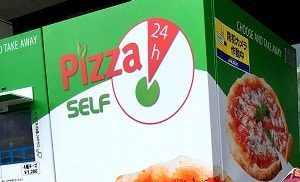
How Much Does a Pizza Vending Machine Cost?
Updated on | Written by Alec Pow
This article was researched using 13 sources. See our methodology and corrections policy.
A pizza vending machine can cost about $8,500 to $11,000 for a basic factory-direct heating kiosk, around €19,000 to €26,800 for some European commercial or fresh-dough systems, and $75,078 to $109,617 for a current PizzaForno turnkey package in the United States. The wide spread exists because “pizza vending machine” can mean anything from a heated frozen-pizza dispenser to a refrigerated robotic kiosk with an oven, payment system, software, branding, training, supply-chain support, and warranty.
For a buyer looking for a supported U.S. commercial system, the clearest current price benchmark is PizzaForno. Its 2026 U.S. price table lists a new single ATM unit at $85,078, an indoor kiosk at $96,216, and an outdoor kiosk at $109,617. Buying three or more lowers those prices to $75,078, $86,216, and $99,617 per unit.
The sticker price is only part of the startup budget. Site preparation, permits, electrical work, location charges, cold storage, food-safe preparation space, initial pizza inventory, boxes, payment processing, cleaning, restocking labor, and repairs outside warranty can all affect the real cost of putting a machine into service.
Article Highlights
Jump to sections
- Basic factory-direct heated-food kiosks marketed for pizza currently start around $8,500 to $11,000 (at $30 per hour, earning that amount would take about 7.1 to 9.2 full-time workweeks, before taxes).
- PizzaForno’s current U.S. single-unit prices run from $85,078 to $109,617.
- Buying three or more PizzaForno units cuts the listed price by $10,000 per machine.
- Let’s Pizza does not publish a direct 2026 price on its manufacturer site, while its current GEN 3 specifications list 7 kW rated power and about 715 kWh per month at 30 pizzas per day.
- Pizza ATM’s current site is quote-based. The widely repeated $55,000 figure dates to the first U.S. installation in 2016.
- A machine can run 24/7, but the business still needs restocking, food handling, cleaning, monitoring, maintenance, and a viable location.

How Much Does a Pizza Vending Machine Cost?
| Machine or system | Current price evidence | What the price represents |
|---|---|---|
| Basic factory-direct heated pizza kiosk | $8,500-$9,300 (about 7.1 to 7.8 full-time workweeks at $30 per hour) | Current Chinese marketplace listing for an indoor heating vending machine, before freight, duties, setup, local certification, or support |
| European smart commercial pizza vending machine | €19,000 ex. VAT | Commercial stock-and-bake system with freezer, touchscreen, payments, and remote management |
| European fresh-dough system | €26,800 ex. VAT | Machine marketed to mix flour and water, apply toppings, bake, and dispense a pizza |
| PizzaForno ATM, one unit | $85,078 | U.S. turnkey package |
| PizzaForno indoor, one unit | $96,216 | U.S. turnkey package |
| PizzaForno outdoor, one unit | $109,617 | U.S. turnkey package |
| Pizza ATM | Current quote required | Prepared-pizza refrigeration, baking/heating, dispensing, installation support, and operator training options |
| Let’s Pizza GEN 3 | Current quote required | Automated preparation platform with refrigerated dough, multiple toppings, touchscreen ordering, and integrated oven |
The low end needs context. One current factory-direct heating-machine listing is $9,000 for one or two units, $8,700 for three or four, and $8,500 for five or more. That is equipment pricing from an overseas supplier, not a U.S. turnkey automated-pizzeria package.
A European reseller provides a middle tier. Its 2026 smart-machine price is €19,000 ex. VAT, while a separate fresh-dough machine is listed at €26,800 ex. VAT. Shipping, VAT, options, destination requirements, and installation can change those totals.
What You’re Actually Buying
Pizza vending machines fall into several operating formats. A low-cost heating kiosk stores prepared or frozen food and heats it after payment. A stock-and-bake machine keeps prepared pizzas chilled or frozen and transfers the selected pizza to an oven. A more mechanically complex system can handle refrigerated dough or ingredients and complete more of the preparation process inside the machine.
PizzaForno is a stock-and-bake system. Its current operating information says each kiosk stores up to 70 pizzas in a refrigerated compartment. A robotic arm retrieves the boxed pizza and transfers it to a pulsed-air convection oven, with the order ready in about three to four minutes. PizzaForno also says the operator receives frozen pizzas through its supply chain and is responsible for storage, boxing, restocking, cleaning, and routine maintenance.
Pizza ATM follows another prepared-pizza model. Its current equipment specifications say the machine can hold up to 136 12-inch pizzas and cook up to eight simultaneously in about four minutes. The operator prepares the pizzas before loading them, rather than having the machine mix flour into fresh dough.
PizzaForno Prices
PizzaForno is useful as a benchmark because it publicly posts exact U.S. prices. The package includes the machine, branding, supply-chain access, integrated software, payment equipment, training, technical support, and a two-year parts-and-labor warranty. The company says it charges $0 in licensing or royalty fees, although site and operating expenses remain with the licensee.
The multi-unit discount is exactly $10,000 (about 8.3 full-time workweeks at $30 per hour) per machine across all three formats. Three ATM units bought at the single-unit price would total $255,234. At the published multi-unit price, three cost $225,234. The difference is $30,000.
The same discount applies to the outdoor model. Three at $109,617 each would total $328,851, while three at $99,617 total $298,851. Again, the published volume discount removes $30,000 from the three-machine equipment/package total.
Fresh-Dough vs Stock-and-Bake Machines
Let’s Pizza is the brand most closely associated with the original from-scratch pizza-vending concept, but buyers should verify the current model rather than relying on descriptions from older generations. The manufacturer’s current GEN 3 specification page lists refrigerated dough with two or three dough types, multiple toppings, a standard pizza cutter, 5G connectivity, and ingredients for up to 100 pizzas. It also lists a three-minute preparation time.
The same page gives a rated electrical load of 7 kW and an example consumption of about 715 kWh per month at 30 pizzas per day. That means every $0.01 per kWh in the operator’s local electricity rate changes that monthly electricity calculation by about $7.15. A buyer paying $0.15/kWh would calculate the machine-side example at about $107.25 per month, while a buyer paying $0.25/kWh would calculate about $178.75. Those are arithmetic examples using the manufacturer’s energy figure, not quoted utility bills.
The manufacturer does not publish a current GEN 3 selling price on that page. An older $33,000 Let’s Pizza figure should not be presented as a current 2026 retail price.
The Site and Prep Area

The machine may be unmanned during a sale, but the business is not labor-free. PizzaForno says operators need a cold-storage freezer for incoming frozen inventory and a food-safe preparation area where pizzas can be unwrapped, boxed, and prepared for transport to the kiosk. Local requirements can also include business licensing, health approval, electrical work, zoning, fire review, signage rules, and site preparation.
Electrical needs can change the installation budget. PizzaForno’s ATM and indoor units call for 208V 20A single-phase power plus a 120V receptacle, while its outdoor kiosk calls for 208-240V 50A single-phase power with a neutral. Let’s Pizza lists 230V single-phase or 380/415V three-phase options for its current machine. A site without the required circuit can need electrical work before installation.
PizzaForno also states that hands-on installation support is now optional and charged separately at a flat fee covering travel costs. Other costs that can sit outside the machine price include location rent or revenue share, initial product, boxes, card-processing fees, insurance, cleaning supplies, spoilage, restocking trips, and repairs after the warranty period.
A buyer comparing these expenses with a conventional vending operation can use our vending machine cost guide to see why refrigerated hot-food equipment sits at a much higher investment level than a normal snack or beverage machine.
How Many Pizzas?
PizzaForno currently models its business at a $12 pizza price and about 30% net operating margins on its current licensing page. Those are manufacturer assumptions, not guaranteed results. They do allow a transparent sensitivity calculation.
Start with the cheapest current single PizzaForno unit, the $85,078 ATM. At $12 per pizza, the machine price alone equals the gross revenue from about 7,090 pizzas: $85,078 ÷ $12 = 7,089.8. Gross sales equal to the machine price are not the same thing as payback because most of each sale covers product and operating expenses.
Using the manufacturer’s 30% net operating margin assumption produces a more useful model:
20 pizzas per day: 20 × $12 × 365 = $87,600 in annual sales. At 30%, modeled operating profit is $26,280. Dividing $85,078 ÷ $26,280 gives about 3.24 years to recover the machine price.
30 pizzas per day: annual sales reach $131,400. At 30%, modeled operating profit is $39,420, producing a machine-price payback of about 2.16 years.
40 pizzas per day: annual sales reach $175,200. At 30%, modeled operating profit is $52,560, producing a machine-price payback of about 1.62 years, or roughly 19 months.
This model does not add site preparation, permits, freezer and prep-space costs, financing interest, location fees, or other startup expenses. It also assumes the manufacturer’s stated margin can be achieved at the selected location. A weak location can stretch payback far beyond these figures.
The old Pizza ATM price provides useful historical context, but it should not be mistaken for today’s quote. Xavier University’s student newspaper reported that its first U.S. Pizza ATM installation cost under $60,000 including installation and its enclosure in 2016. Its current ROI material promotes a quick return and uses $10 per pizza in its revenue example, but it does not publish a current machine price.
When This Business Makes Sense
Makes sense if:
- You have a location with enough late-night, campus, hospital, transit, industrial, entertainment, or residential traffic to support frequent purchases.
- You can handle cold storage, restocking, food-safety procedures, cleaning, and inventory rotation even though customers serve themselves.
- You price the electrical work, permits, location agreement, payment costs, inventory, and service support before buying the machine.
- You can tolerate a payback period that may be several years rather than relying on a one-year marketing claim.
Does not make sense if:
- You are comparing a $9,000 factory-direct heating kiosk with a $100,000+ supported turnkey system as though they provide the same hardware and service.
- You do not control or have reliable access to a food-safe prep and storage operation.
- The location cannot provide the electrical service or permits required by the selected machine.
- Your business case works only if the machine sells 40 or more pizzas every day from opening day.
Operators comparing automated businesses can also look at the cost of an ATM machine. Both depend heavily on location traffic, but hot-food vending adds refrigeration, cooking, inventory life, food handling, and cleaning costs that a cash machine does not have.
What We Verified
- Checked: PizzaForno’s current operating documentation supports a 70-pizza capacity and the manufacturer’s 30%+ margin claim at a $12 selling price.
- Confirmed: the current Let’s Pizza process description still markets made-to-order pizza in under three minutes, while the GEN 3 specification table separately describes refrigerated dough.
- Cross-referenced: Pizza ATM’s current preparation workflow requires operators to prepare pizzas before placing them into cold storage inside the machine.
- Verified: a current commercial model comparison separates fresh-dough, refrigerated, frozen, capacity, payment, delivery, and configuration factors rather than treating every pizza vending machine as the same product.
Related Vending Costs
Pizza equipment is at the expensive end of unattended retail. A standard arcade machine can cost far less because it does not need refrigeration, food inventory, cooking equipment, health permits, or daily product rotation.
Answers to Common Questions
How much does a pizza vending machine cost in 2026?
Current prices range from about $8,500 to $11,000 for basic factory-direct heating machines to $75,078 to $109,617 for PizzaForno’s current U.S. turnkey packages. Other automated pizza systems are quote-based.
How much is a PizzaForno machine?
A new single PizzaForno costs $85,078 for the ATM model, $96,216 for the indoor model, or $109,617 for the outdoor model. Buying three or more cuts $10,000 from each listed unit price.
How much is a Let’s Pizza machine?
Let’s Pizza does not publish a direct current GEN 3 sales price on its manufacturer specifications page. The older $33,000 figure found in past articles should not be treated as a verified 2026 price.
How much is a Pizza ATM?
The current Pizza ATM site requires prospective buyers to request pricing. Xavier University’s first U.S. installation was reported at under $60,000 including installation and its enclosure in 2016, so that historical number is not a current quote.
Can a pizza vending machine pay for itself in one year?
It can only do so if sales volume and margins are high enough. Using PizzaForno’s $85,078 ATM price, its $12 selling-price example, and its 30% net operating margin assumption, 40 sales per day produce modeled operating profit of $52,560 per year. That implies about 1.62 years to recover the machine price before extra startup costs.
How much electricity does a pizza vending machine use?
It depends on the machine. Let’s Pizza currently lists about 715 kWh per month at an example volume of 30 pizzas per day. PizzaForno publishes circuit requirements rather than one monthly kWh figure, with its ATM and indoor units requiring 208V 20A service plus a 120V receptacle and its outdoor unit requiring 208-240V 50A service.
Price note: Pizza vending equipment is sold internationally and final cost can change with configuration, quantity, freight, taxes, duties, electrical work, installation, permits, cold storage, site requirements, and support. Prices above were checked in August 2026. Obtain a written model-specific quote before using any published price in a business plan.
Disclosure: Educational content, not financial advice. Prices reflect public information as of the dates cited and can change. Confirm current rates, fees, taxes, and terms with official sources before purchasing. See our methodology and corrections policy.