
How Much Does Skydiving Cost?
Updated on | Written by Alec Pow
This article was researched using 14 sources. See our methodology and corrections policy.
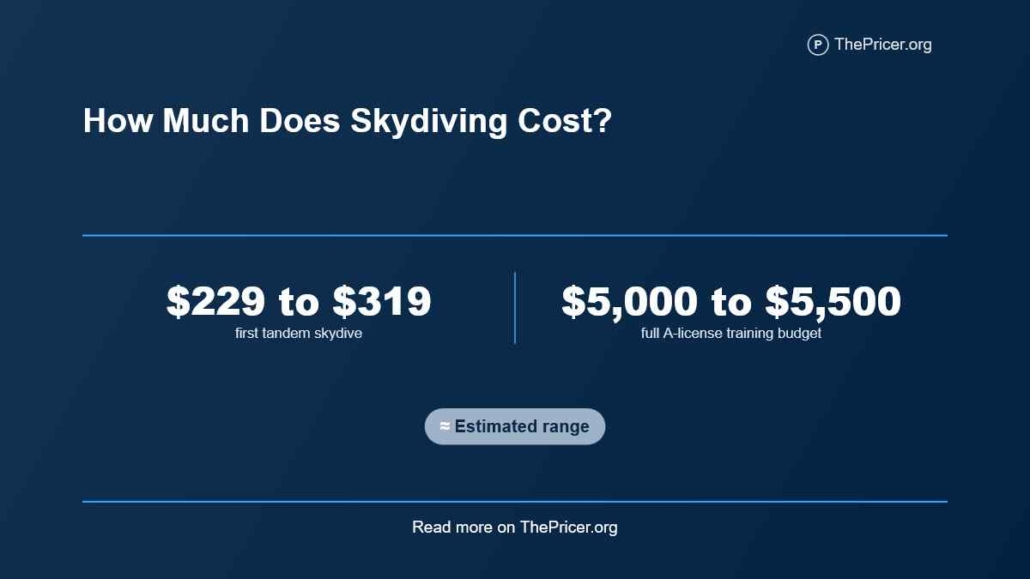
A first tandem skydive currently costs about $229 to $319 at the large U.S. drop zones checked here before optional photos or video. The low end comes from current Dallas tandem pricing at $229 prepaid on weekdays, while Skydive Chicago’s walk-in rate reaches $319.
Learning to skydive is a separate multi-thousand-dollar purchase. The 2026 Perris student syllabus tells students to plan on $5,000 to $5,500 to obtain a USPA A license, while other schools publish lower package prices that leave out prerequisite jumps or possible repeats.
Skydiving cost changes with jump type, booking method, media, student progress, gear ownership, and drop-zone pricing. A tandem customer is paying for an instructor-led first jump. A student is buying repeated training toward a license. A licensed skydiver with personal equipment is mainly buying an aircraft ride to altitude, so these prices should not be treated as versions of the same product.
Article Highlights
Jump to sections
- First-tandem pricing and media should be budgeted separately.
- Completing the early AFF stages does not by itself earn a USPA A license.
- A complete student budget can include prerequisite tandems, repeated levels, gear rental, membership, and the license application.
- Licensed-jumper lift tickets become much cheaper per jump, but equipment ownership moves large costs outside the ticket price.
- Bulk jump packages can reduce the effective lift-ticket cost for frequent skydivers.
- Reserve service, inspections, travel, and event charges remain part of the hobby after licensing.
How Much Does Skydiving Cost?
| Skydiving purchase | Current published price | What the number leaves out |
|---|---|---|
| Promotional first tandem | Skydive Chicago’s 2026 weekday deal is $269 (at $30 per hour, earning that amount would take about 1.1 full-time workdays, before taxes) with the listed promo code. | Optional media and other personal spending. |
| A-license training package | Spaceland Dallas lists its package at $3,226. | Two prerequisite tandem jumps and any rejumps. |
| New complete sport rig | Current complete-rig listings run from about $8,433 to $10,210 among the listed sport packages. | Personal accessories, later inspections, repacks, repairs, and replacement parts. |
The lowest tandem advertisement is not always the cheapest booking for the trip you actually want. Compare the same jump altitude, reservation timing, media choice, and refund or rescheduling terms. A prepaid slot can cost less than a walk-in because the drop zone knows the aircraft load in advance. Group and service-member offers can change the rate again. For a first jump, the clean comparison is the total charged for one person on the same day type with the same media choice. For students, compare the milestone reached after the package, because a cheap early training phase can leave many paid jumps before the A-license requirements are complete.
What You’re Actually Buying
A tandem skydive is an instructor-led first-jump experience. The passenger is securely attached to a tandem instructor using the tandem system. The aircraft ride, parachute equipment, briefing, freefall, canopy flight, and landing are part of that purchase. A student program is different. It teaches body flight, altitude awareness, deployment, canopy control, landing patterns, emergency procedures, packing, and the skills needed to progress toward a license.
After licensing, the pricing model changes again. The jumper may own or rent a rig and buys a seat on the aircraft. Equipment servicing, reserve packing, association membership, coaching, event registration, travel, and replacement gear sit outside that lift ticket. Some student programs also use indoor tunnel sessions. These categories should stay separate because each price covers a different share of the actual activity.
$289 Can Become $508
Photos and video can be one of the largest first-jump add-ons. The Skydive Chicago 2026 store lists a tandem at $289 (about 1.2 full-time workdays at $30 per hour) and a Tandem + Ultimate media product at $508. The media portion is $219 because $508 – $289 = $219.
That add-on raises the purchase by about 75.8% relative to the base tandem price: $219 ÷ $289 = 75.8%. The extra money documents the experience rather than extending freefall time. When comparing drop zones, separate the jump, instructor-shot footage, outside-camera footage, still photos, and combined packages instead of assuming the cheapest displayed tandem includes media.

Seven AFF Jumps Are Not a License
Accelerated Freefall is a training method, not the final licensing milestone. The USPA A-license requirements require 25 jumps, completion of the A-License Progression Card, a practical check dive, a written exam, and an oral exam.
This is where older cost comparisons go wrong. A price for the first seven AFF levels can be a valid price for that phase of instruction, yet the student can still have many jumps and skills left before licensing.
Training designs also differ by school. A program may combine tandems, instructor jumps, coached freefall, hop-and-pop jumps, solos, packing work, canopy drills, or tunnel sessions. The useful comparison is the cost to reach the same licensing milestone, not the price of similarly named early lessons.
The 25-Jump A-License Budget
A current Spaceland Dallas example shows the advertised-price trap well. Its student-program pricing explanation puts the A-license package at $3,226 (about 2.7 full-time workweeks at $30 per hour) and says the program requires two tandem skydives before the solo-training sequence.
For a new student who needs both prerequisites, the current prepaid weekday tandem rate starts at $229. Using that rate twice produces an itemized ThePricer scenario:
- A-license package: $3,226
- Prerequisite tandem 1: $229
- Prerequisite tandem 2: $229
- Combined training purchase: $3,684
The arithmetic is $3,226 + $229 + $229 = $3,684. That total still excludes rejumps if a level must be repeated, along with transportation, meals, and other personal spending. It also shows why a $3,226 package and a $5,000 to $5,500 full-program planning figure can both be real without describing identical training designs or inclusions.
What a $38 Lift Ticket Leaves Out
Once a jumper is licensed and using suitable personal equipment, the cost per skydive falls sharply because the instructor and student-equipment package are no longer bundled into every jump. Volume can lower the ticket price further. Skydive Chicago’s 2026 pricing lists normal lift tickets at $38, a 50-jump package at $1,800, and a 100-jump package at $3,500.
Buying 100 individual $38 tickets would cost $3,800. The $3,500 package saves $300, which works out to about 7.9%. The bulk package reduces the aircraft-seat cost. It does not remove gear servicing, coaching, travel, lodging, event registration, packing, or replacement equipment.
A casual estimate of only $100 per month for an active licensed jumper is too low to use as a broad rule. Someone who makes ten $38 jumps has already spent $380 on lift tickets before any of those other costs appear.
Owning a Rig Changes the Math
The new-rig prices in the table show why gear ownership deserves its own budget. A complete sport rig combines the container system, main canopy, reserve canopy, and automatic activation device. A helmet, visual or audible altimeter, jumpsuit, gloves, gear bag, and other personal items can sit outside the complete-rig package depending on what is purchased.
Used equipment can lower the upfront purchase, but a cheap rig is not directly comparable with a properly fitted and inspected system. Container fit, canopy size, component age, reserve condition, service history, and automatic activation device status can change both suitability and later spending. Repairs, relines, reserve work, and replacement components also arrive on different schedules.
The same logic applies to the related cost of buying a parachute. A canopy price alone is not the cost of a complete ready-to-jump personal system.
Who This Cost Makes Sense For
One-time tandem: The meaningful number is the booked tandem plus the media package you actually want. A lower jump price can stop being the cheaper booking after a large photo-and-video add-on. Someone comparing another one-time height-and-freefall experience can also look at bungee jumping costs, where the equipment and training model are different.
A-license student: Budget to the licensing milestone rather than stopping at the first AFF quote. The student who has enough money for only the early levels can face a much larger remaining training bill.
Frequent licensed jumper: Bulk tickets can reduce the aircraft cost, but owning a rig turns equipment purchase and servicing into separate line items. The economics improve only when the jumper actually uses the package or equipment enough to justify the upfront spending.
Makes sense if:
- You want one tandem and have decided whether media is worth the extra charge.
- You can fund the full student progression rather than only the opening lessons.
- You expect to jump often enough for bulk tickets or personal gear to reduce repeated costs.
Does not make sense if:
- You are comparing a tandem price with a licensed lift ticket as though both include the same service.
- Your student budget has no room for repeat levels, travel, weather delays, or rental needs.
- You are choosing used parachute equipment based only on the asking price.
What We Verified
- Checked: The current USPA license fee page lists each license as a one-time $43 purchase and says licenses do not require annual renewal, although an active USPA membership is required for the license to remain valid.
- Confirmed: A current rigging service sheet lists a sport reserve inspection and repack at $75 and a full used-rig inspection including the AAD at $75.
- Verified: The current federal parachute rule states that reserves made from the usual rot-resistant materials must have been packed by the appropriately rated rigger within the preceding 180 days. At the cited shop price above, two routine repacks work out to about $150 over roughly a year before repairs or parts.
Related Airborne Costs
Skydiving training is much shorter than professional flight training, so the cost of becoming a pilot belongs in a different budget. Pilot training buys repeated flight instruction, aircraft time, tests, and certification rather than parachute-jump progression.

Answers to Common Questions
How much does a first skydive cost?
Current first-tandem examples checked here run about $229 to $319 before optional photos or video.
Are photos and video included in a tandem skydive?
Often no. Media is commonly sold as a separate package, and a premium option can add more than $200 to the booking.
How much does it cost to get a skydiving license?
Current examples put the full path in the several-thousand-dollar range. One sourced scenario reaches $3,684 before rejumps, while another school advises students to plan on $5,000 to $5,500.
How much does skydiving cost after you are licensed?
A normal lift ticket at one large 2026 drop zone is $38, with lower effective rates available through some bulk packages.
How much does a new skydiving rig cost?
Current complete sport-rig examples run from about $8,400 to $10,200+ before personal accessories and later servicing.
Disclosure: Educational content, not financial advice. Prices reflect public information as of the dates cited and can change. Confirm current rates, fees, taxes, and terms with official sources before purchasing. See our methodology and corrections policy.