ThePricer Media
  • Latest: How Much Will Gas Prices Rise After the Iran Strikes?
  • Daily Price Puzzle (60s)
  • Talk to Alec
  • Blog
  • Podcast
  • eBook
  • Click to open the search input field Click to open the search input field Search
  • Menu Menu
Home and Garden, Building and Construction, Family & Lifestyle

How Much do Concrete Steps Cost?

Last updated on April 26, 2026 | Written by Alec Pow
This article was researched using 7 sources. See our methodology and corrections policy.

TL;DR: Most homeowners pay between $1,800 and $4,500 (that's 3.8 workweeks of your life at a $30/hr wage, or $1,800 in 1990 money) for a concrete step installation, with precast jobs landing near the low end and custom poured-in-place work pushing into the mid-thousands once demolition, railings, and finishing are included.

  • Entry (precast, 3–5 steps, no removal): $600 to $2,000 (about $800 in 1990 money) installed, per HomeAdvisor’s 2025 concrete steps guide
  • Mid (poured-in-place, 5–8 steps, standard finish): $1,800 to $4,500 (about $1,800 in 1990 money), per HomeGuide’s December 2025 cost breakdown
  • All-in (poured, removal, railings, sealing, 8–10 steps): $4,000 to $6,000class="tpp" data-u="6000">$6,000+, per Angi’s March 2026 pricing data
  • Repair only (cracks, spalling, surface damage): $250 to $750 for most jobs, per HomeAdvisor’s repair cost guide
  • Per step, 4-foot width: $200 to $600 (Angi, 2026)

Concrete step pricing splits cleanly into two job types: dropping in a precast unit versus building poured-in-place stairs from scratch. The method you choose, combined with width, step count, and whether demolition is needed, does more to set the final number than material cost alone. A five-step precast swap can stay under $1,500; a ten-step poured stoop with railings and a sealed finish can clear $5,500 before permit fees are added.

Concrete Steps: Installed Cost by Method (2025–2026)
Method Installed Range Per Step (Typical Width) Best For
Precast (drop-in) $600 – $2,000 $100 – $350 Standard-width replacements, fast installs
Poured-in-place $1,800 – $6,000 $200 – $500 Custom shapes, landings, wider stoops
Repair (surface/structural) $250 – $800 N/A Cracks, spalling, limited damage

What you’re actually buying

Jump to sections
  • What drives the price gap
  • Hidden costs
  • Worked example
  • Repair versus replace
  • Who this cost makes sense for
  • Takeaways
  • Answers to Common Questions

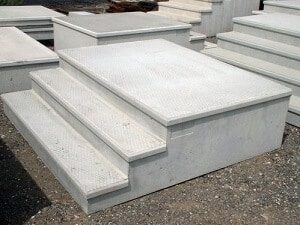
A concrete step installation is not a single product purchase. It combines site preparation, material delivery, forming or placement labor, finishing work, and in many cases demolition of whatever is already there. Precast concrete steps arrive as factory-cast units in standard configurations. A contractor sets them on a prepared base, levels them, and anchors the assembly. The job is faster and the cost is more predictable, but available widths, tread depths, and riser counts are fixed by the manufacturer.

You might also like our articles about the cost to remove concrete, to have concrete delivered, or to build a concrete driveway.

Poured-in-place concrete steps are built on site. A contractor excavates, sets forms to the exact dimensions required by the design and local code, places reinforcing steel, pours ready-mix concrete, and then finishes and cures the surface. The result can match any width, landing configuration, or decorative finish the homeowner specifies. The tradeoff is more labor hours, forming materials, and a longer project timeline while the concrete cures. Neither type substitutes for the other in every situation. Precast works where standard dimensions fit and speed matters. Poured-in-place is the only option when a custom landing, non-standard width, or integrated handrail footing is part of the design.

Brick or natural stone steps occupy a similar niche but tend to cost more per step in most residential markets, according to HomeAdvisor’s stone steps pricing data.

Concrete Steps Cost

What drives the price gap

Width is the single biggest per-step price driver. HomeAdvisor’s data shows the cost per step climbing from $150 to $450 for a 3-foot-wide step to $300 to $900 for a 6-foot-wide step. That is a doubling of the per-step range across a 3-foot difference in width, driven by forming materials, concrete volume, and finishing time. Step count compounds the effect: a 5-step precast project at standard width totals $500 to $3,500 installed, while a 10-step poured project at 6-foot width can reach $3,000 to $9,000 before add-ons.

Finish choice also moves the number. A broom-finished surface costs less than stamped or stained concrete, which requires a contractor with decorative concrete experience and adds both material and labor time. A plain broom finish on a five-step stoop might add nothing to the base quote. A stamped finish with a color release can add $500 to $1,500 or more depending on the pattern and square footage involved, per HomeGuide’s December 2025 breakdown.

Related guides

  • How Much Does Kohler LuxStone Cost?
  • How Much Does Arborvitae Cost?
  • How Much Does It Cost to Build an Indoor Basketball Court?

Hidden costs

Handrails are the most common surprise. Under OSHA’s construction stairway rules, stairways with four or more risers or rising more than 30 inches require at least one handrail, per OSHA standard 1926.1052. Most residential front entries with more than three steps will trigger this. Wood or metal railings add $300 to $600 to the project, and that cost is separate from any footing or anchor work required to secure the rail post to the concrete.

Surface coatings and sealing are sold as optional on many bids but carry real durability consequences in climates with road salt or freeze-thaw cycles. Epoxy coating or sealing runs $200 to $400 per HomeAdvisor. Stamped or colored finishes cost more and require a contractor experienced with decorative concrete. Homeowners who skip sealing on a poured stoop in a cold climate often face surface spalling within five to ten years, which brings the repair cost back into play.

Permit fees are not included in any of the consumer-facing price ranges above. Local permit costs for exterior concrete work at a residential property can range from under $100 to several hundred dollars depending on the jurisdiction. Some municipalities require an inspection before the pour and another after completion, which can affect the project timeline.

Worked example

To show how line items stack, here is an itemized estimate for a typical mid-range residential project: seven poured-in-place steps at 5 feet wide, replacing an existing stoop, with a single metal railing and a sealed finish.

  • Demolition of existing concrete steps: $300 (midpoint of HomeAdvisor’s $200 to $400 range)
  • Poured concrete steps, 7 steps at 5-foot width: $2,450 (using HomeGuide’s midpoint of $350 per step for poured work, 7 steps)
  • Single metal railing: $450 (midpoint of HomeAdvisor’s $300 to $600)
  • Concrete sealing: $300 (midpoint of HomeAdvisor’s $200 to $400)
  • Permit fee (estimated, varies by city): $150

Total: approximately $3,650

That figure sits just above HomeAdvisor’s average project cost of $3,500 for concrete steps, which confirms the estimate is realistic for a mid-range poured job with standard add-ons. If the width were increased to 6 feet, the per-step cost would climb toward HomeAdvisor’s 6-foot range of $300 to $900 per step, pushing the seven-step concrete line alone to $2,100 to $6,300 and the total project well above $4,000.

Repair versus replace

Precast Concrete StepsConcrete step repair averages about $500, with most residential jobs falling between $250 and $750, according to HomeAdvisor’s November 2025 repair cost data. Small crack or patch repairs start around $100. Structural repairs, where a riser or tread has fractured or the base has settled and cracked the slab, can reach $800 before replacement becomes the cheaper option.

The tipping point is roughly when repair quotes exceed $700 to $800 for a set of steps that still has structural movement or settling as an underlying cause. Patching a symptom without correcting the base condition means the repair will fail again, often within a few years. At that point, a full replacement at the $1,800 to $3,500 midpoint range is a better value over a five-to-ten-year horizon. For surface spalling or hairline cracking without structural compromise, repair at $250 to $500 remains the rational choice.

Who this cost makes sense for

Concrete steps are a high-durability, low-maintenance option for front entry stoops, basement egress stairs, garage approaches, and exterior side entrances. They hold up well in freeze-thaw climates where wood rots and composite materials can crack, and they carry load without the long-term maintenance cycles that timber stairs require. The cost is front-loaded, but a properly poured and sealed set of concrete stairs can last decades.

Makes sense if:

  • You need exterior front-entry stairs that will see heavy foot traffic and weather exposure year-round.
  • Your existing wood or precast steps are structurally compromised and repair estimates are approaching $800 or more.
  • You want a finish that can be stamped, stained, or coated to match existing hardscape.
  • You are replacing a crumbling precast unit and want a custom width or landing configuration that precast sizes cannot match.
  • Local code or an HOA requires a permanent, permitted structure at the entry.

Doesn’t make sense if:

  • You need a temporary or seasonal solution (precast modular units or treated lumber are cheaper and removable).
  • The existing concrete shows only surface spalling or hairline cracks, where a $250 to $500 repair job is the rational call.
  • Budget is under $800 and the job requires demolition of existing stairs.
  • Site access is severely restricted and a concrete truck cannot get within reasonable distance of the pour location.

Takeaways

  • Precast concrete steps cost $600 to $2,000 installed; poured-in-place runs $1,800 to $6,000, with most mid-range residential jobs landing around $3,500.
  • Width is the strongest per-step price driver. A 6-foot-wide step costs roughly twice as much per step as a 3-foot-wide step.
  • Demolition of existing stairs adds $200 to $400 and is often unavoidable on replacement projects.
  • Railings are required by code once a stairway has four or more risers or rises more than 30 inches. Budget $300 to $600 for a standard railing.
  • Repair makes sense when damage is surface-level and the quote is under $700. Once structural settling is involved, replacement is the better long-run spend.
  • Permit fees are not included in consumer-facing price ranges. Add a local permit cost estimate before finalizing any project budget.

Answers to Common Questions

How much does it cost to replace 5 concrete steps?

A five-step precast replacement runs roughly $500 to $1,750 installed. A five-step poured-in-place job starts around $1,000 and can reach $3,000 or more depending on width, demolition needs, and finish level. HomeGuide’s December 2025 data puts a 5-to-10-step precast project at $500 to $3,500 and a poured project at $1,000 to $5,000 for the same step count range.

Is precast or poured concrete better for exterior steps?

Precast is faster and cheaper for standard-dimension replacements. Poured-in-place is the better option when the required width, landing configuration, or riser count does not match available precast sizes. Poured steps also allow decorative finishes and custom footing details for railing posts. The durability of both methods is comparable when properly installed and sealed.

Do concrete steps require a permit?

Most municipalities require a permit for new or replacement exterior concrete steps, particularly when the work involves demolition or a structural connection to the home’s foundation. Permit requirements and fees vary by city and county. Contact your local building department before starting work. The OSHA handrail and dimensional standards cited above apply to construction sites; residential code is set by local adoption of model codes such as the IRC, which may differ.

When does repairing concrete steps stop making financial sense?

Repair averages about $500 and is cost-effective for surface cracks, spalling, or minor edge damage. When structural settling or base failure is the cause, repairs tend to fail again within a few years. At that point, a repair quote approaching $800 is a signal to price out full replacement, which averages around $3,500 for a typical residential job but delivers a much longer service life.

What is the cheapest way to get new concrete steps installed?

Precast concrete steps at a standard width are the lowest-cost installed option, with projects starting around $600 when no demolition is needed. Keeping the step count low, avoiding decorative finishes, and choosing a width that matches a stock precast unit all reduce the quote. Getting at least three contractor bids is the most reliable way to find a competitive price for your specific site conditions.

Verification

  • Confirmed the installed range of $400 to $6,000 with an average of $3,500 for residential concrete steps via HomeAdvisor’s June 2025 concrete steps cost page.
  • Cross-referenced precast per-step pricing ($100 to $350) and poured per-step pricing ($200 to $500) against HomeGuide’s December 2025 precast vs. poured breakdown.
  • Checked Angi’s March 2026 data showing a 4-foot-wide step at $200 to $600 and linear foot pricing at $30 to $65 for materials via Angi’s 2026 concrete steps article.
  • Verified the handrail trigger of four or more risers or a rise exceeding 30 inches against OSHA standard 1926.1052 on stairways.
  • Confirmed repair cost range of $250 to $750 and structural repair ceiling of $800 via HomeAdvisor’s November 2025 repair cost guide.
  • Cross-referenced tread and riser dimensional standards (minimum 9.5-inch tread depth, maximum 9.5-inch riser) against OSHA’s general industry stairway standard 1910.25.
  • HomeAdvisor: Concrete Steps Cost (June 2025)
  • HomeGuide: Concrete Steps Cost (December 2025)
  • Angi: How Much Does It Cost to Install Concrete Steps (March 2026)
  • HomeAdvisor: Concrete Step Repair Cost (November 2025)
  • HomeAdvisor: Stone Steps Pricing
  • OSHA 1926.1052: Stairways (Construction)
  • OSHA 1910.25: Stairways (General Industry)

Disclosure: Educational content, not financial advice. Prices reflect public information as of the dates cited and can change. Confirm current rates, fees, taxes, and terms with official sources before purchasing. See our methodology and corrections policy.

Published: July 13, 2021/Updated: April 26, 2026/by Alec Pow
ThePricer Daily Price Puzzle
© 2014 - 2026 - ThePricer Media, LLC, 4 Grove Street, New York, NY, 10014, Phone: (212) 431-2441
We don’t use affiliate links or paid placements. All sources are cited only for verification.
  • Link to X
  • Link to LinkedIn
  • Link to Facebook
  • Link to Instagram
  • Link to Pinterest
  • Link to Youtube
  • Contact Us
  • About Us
  • Press & Mentions
  • Careers
  • Meet the Founder
  • Privacy Policy
  • Editorial Ethics
  • Methodology
  • Corrections
  • Disclosure
  • Terms and Conditions
Scroll to top Scroll to top Scroll to top