How Much Does Kobe Beef Cost?
Updated on | Written by Alec Pow
This article was researched using publicly available sources. See our methodology and corrections policy.
Authentic Kobe beef usually costs about $200 to $400+ per pound at retail when it is available in the United States, depending on the cut, certification, seller, portion size, and frozen shipping. Japanese A5 Wagyu that is not Kobe often costs about $100 to $250+ per pound, while American Wagyu commonly costs about $40 to $150+ per pound.
Restaurant pricing is usually higher because the steak is served in small luxury portions. A certified Kobe or Japanese A5 Wagyu tasting portion may cost $25 to $80+ per ounce, and a steakhouse plate can reach $150 to $500+. Very rare specialty cuts, tasting menus, and high-end Tokyo or U.S. steakhouse experiences can cost more.
The most important price detail is authenticity. Kobe beef is not a loose word for any expensive marbled steak. Real Kobe beef is a specific type of Japanese Wagyu from Tajima-strain Japanese Black cattle raised in Hyogo Prefecture under Kobe Beef Marketing & Distribution Promotion Association rules. Many U.S. menus and stores use words like Wagyu, American Wagyu, domestic Wagyu, Kobe-style, or Wagyu-Angus, which are not the same as certified Kobe beef.
Article Highlights
Jump to sections
- Real Kobe beef: Certified Kobe beef often costs about $200 to $400+ (equivalent to 1.7 workdays at $30 per hour, or about $160 in 1990 dollars) per pound at retail when available.
- Japanese A5 Wagyu: High-grade Japanese Wagyu from regions other than Kobe often costs about $100 to $250+ per pound.
- American Wagyu: Domestic Wagyu or Wagyu-Angus beef often costs about $40 to $150+ per pound, depending on bloodline, cut, and marbling.
- Restaurant pricing: Kobe or A5 Wagyu is often sold by the ounce, with tasting portions around $25 to $80+ per ounce.
- Authenticity check: Ask for the certificate, designated seller or restaurant status, Japanese origin, grade, cut, and traceability number before paying Kobe prices.

Kobe Beef Cost By Type
The phrase Kobe beef is often used too loosely. A steak labeled Kobe-style, American Kobe, or Wagyu burger may be tasty, but it is not certified Kobe beef unless it meets the Japanese Kobe rules and comes through a certified supply chain. That is why the price range is wide.
Kobe beef is a form of Wagyu, but not all Wagyu is Kobe. Wagyu means Japanese cattle in a broad sense and covers Japanese Black, Japanese Brown, Japanese Polled, and Japanese Shorthorn cattle. Kobe comes from Tajima-strain Japanese Black cattle raised in Hyogo Prefecture and certified under regional rules.
| Beef type | Typical price | What the label usually means |
|---|---|---|
| Certified Kobe beef, retail | $200 to $400+ (about $160 in 1990 dollars) per pound | Real Kobe beef from Hyogo Prefecture, sold through a certified source |
| Certified Kobe beef, restaurant | $25 to $80+ per ounce | Small tasting portions, steakhouse markup, tax, tip, and service |
| Japanese A5 Wagyu, not Kobe | $100 to $250+ per pound | High-grade Japanese Wagyu from regions such as Miyazaki, Kagoshima, Omi, Hida, or Matsusaka |
| American full-blood Wagyu | $80 to $150+ per pound | U.S.-raised cattle with 100% Japanese Wagyu lineage, when documented |
| American Wagyu or Wagyu-Angus | $40 to $120+ per pound | Usually crossbred domestic beef with more marbling than standard USDA Prime |
| Regular USDA Prime steak | $20 to $60+ per pound | High-quality U.S. beef, but not Kobe or Japanese Wagyu |
| Kobe-style burger or slider | $15 to $40+ at restaurants | Usually a marketing phrase, not certified Kobe beef |
A simple price check helps. If a restaurant sells a “Kobe burger” for $18, it is almost certainly not certified Kobe beef. If an online butcher sells a small certified Kobe steak for $180, ask how many ounces it weighs. A 12-ounce steak at $180 works out to $240 per pound.
What Real Kobe Beef Is
Real Kobe beef is a protected regional beef from Japan. It comes from Tajima cattle, a strain of Japanese Black cattle, raised in Hyogo Prefecture. The beef must meet strict carcass, marbling, yield, weight, and processing rules before it can be sold as Kobe beef.
The key official entities are Tajima cattle, Japanese Black, Hyogo Prefecture, Kobe Beef Marketing & Distribution Promotion Association, BMS marbling score, meat quality grade, yield grade, carcass weight, designated slaughterhouses, certificate, and traceability number. If those words never appear in the seller’s explanation, the buyer should be careful.
Japan also has a cattle traceability system. Certified Kobe and Japanese Wagyu sellers should be able to provide origin and traceability details. For a retail buyer, this matters more than a glossy label or a menu phrase. A true Kobe purchase should come with a clear paper trail.
Kobe Beef vs Wagyu vs American Wagyu
Kobe beef is Wagyu, but Wagyu is a much larger category. Japanese Wagyu can come from many prefectures and brands, including Miyazaki, Kagoshima, Omi, Hida, Matsusaka, Yonezawa, and others. Some of those beef brands can cost almost as much as Kobe and may be easier to find in the U.S.
Japanese A5 Wagyu is graded by yield and meat quality. A5 is the highest combination, with A as the highest yield grade and 5 as the highest meat quality grade. The meat quality score reflects marbling, color, firmness, texture, fat color, fat luster, and fat quality. BMS, or Beef Marbling Standard, is one of the key reasons highly marbled beef becomes expensive.
American Wagyu is different. Some U.S. producers raise full-blood Wagyu cattle with documented Japanese lineage. Others sell crossbred Wagyu-Angus beef. Food & Wine reported that USDA’s Certified Authentic Wagyu program launched in January 2025 to certify full-blood Wagyu, meaning cattle with 100% Japanese DNA lineage. That can help shoppers separate full-blood American Wagyu from looser “Wagyu-style” marketing.
Why Kobe Beef Is So Expensive
Kobe beef is expensive because the supply is limited, the rules are strict, and the certification path is narrow. Only cattle meeting the Kobe requirements can carry the name. The beef must come from the right cattle, region, processing path, marbling level, and quality grade.
The eating style also affects price. Kobe and A5 Wagyu are very rich because of intramuscular fat. Most people eat smaller portions than they would with a USDA Prime ribeye. A restaurant may serve 2 to 4 ounces as part of a tasting menu rather than a normal 16-ounce steak.
Shipping raises retail cost. Many online orders are frozen and shipped with dry ice, insulated packaging, and express delivery. A buyer may face a minimum order, frozen shipping charge, or higher price per ounce for small portions. That is why a retail Kobe order can look much more expensive than a standard steak order.
How To Tell If Kobe Beef Is Real
Ask direct questions before paying Kobe prices. Real Kobe beef should have a certificate or documentation from the supply chain. A restaurant should be able to say whether it is a designated Kobe beef restaurant or seller, what cut is being served, where the beef came from, and whether the certificate is available for review.
At retail, ask for the certificate of authenticity, Japanese origin, prefecture, grade, cut, traceability number, and whether the seller is allowed to sell certified Kobe beef. If the seller only says “premium Kobe-style Wagyu,” “domestic Kobe,” or “American Kobe,” treat it as a different product.
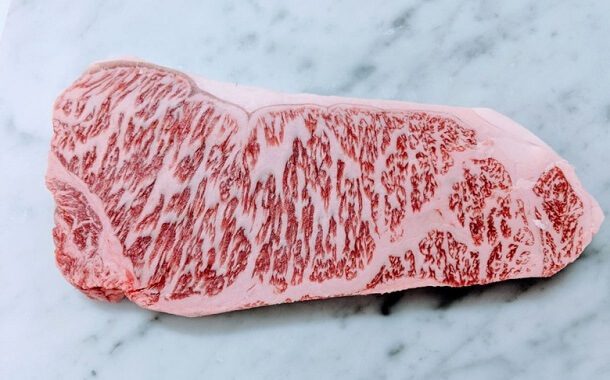
Visual clues help, but they are not proof. Japanese A5 Wagyu and Kobe beef often look pale pink because fat is distributed heavily through the muscle. The fat appears as fine white marbling throughout the meat. Still, only paperwork and a trusted seller can confirm the origin.
Restaurant Kobe Beef Prices
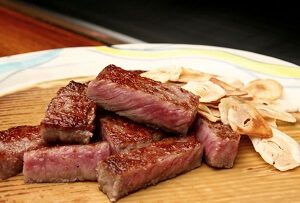
Restaurant Kobe beef is usually priced by the ounce, by tasting portion, or as part of a tasting menu. A small serving may look expensive because the meat is rare, rich, imported, and often handled through a certified supply chain. A steakhouse may charge $25 to $80+ (about $32 in 1990 dollars) per ounce for certified Kobe or Japanese A5 Wagyu, and a full dinner can move above $300 once sides, drinks, tax, service, and gratuity are included.
Restaurants can also use confusing language. A menu may list Wagyu, Japanese Wagyu, domestic Wagyu, American Wagyu, Wagyu-Angus, Miyazaki A5, Kagoshima A5, Omi beef, Kobe-style, or certified Kobe. Those are not interchangeable terms. The most expensive line on the menu should have the clearest sourcing.
Ask whether the restaurant can show the certificate. Also ask how many ounces are served. A $160 menu item may be a 4-ounce tasting portion, which works out to $40 per ounce. A larger steak with the same per-ounce cost can easily become a $400 plate.
Retail Cuts And What You Pay For
Cut choice changes the price. Ribeye, striploin, tenderloin, filet mignon, sirloin, and chateaubriand do not cost the same. Tenderloin and ribeye are usually among the more expensive cuts. Smaller tasting steaks, cubes, or thin slices may cost less per package but more per pound.
Japanese Wagyu is often sold boneless in U.S. retail because import and handling rules favor boneless cuts. If a seller claims a cheap bone-in Kobe tomahawk, that should raise questions. A true Kobe or Japanese A5 retail listing should make the cut, weight, grade, region, and frozen shipping terms clear.
Compare Kobe with familiar cuts before buying. A standard high-end beef tenderloin, Porterhouse steak, or prime rib roast can cost far less per pound while still feeling premium. Kobe is a special occasion purchase, not a normal substitute for everyday steak.
Online Shipping And Extra Costs
Online Kobe or Japanese Wagyu orders often involve frozen shipping, insulated liners, gel packs or dry ice, signature delivery, and a minimum cart size. A $160 steak can become a $200+ order after shipping and taxes if the seller does not offer free shipping above a threshold.
Buying more at once can lower shipping cost per pound, but only if the buyer will use or freeze the meat correctly. Wagyu fat can absorb freezer odors if packaging is damaged. Keep the beef sealed, frozen, and protected until thawing. Thaw slowly in the refrigerator and cook in small portions.
Restaurant costs have their own add-ons. A menu price does not include sales tax, tip, wine, sides, tasting menu supplements, or service charges. A $250 Kobe dinner can become $325+ after tax and gratuity.
Common Kobe Beef Myths
The first myth is that Kobe beef does not exist. It does exist, but it is a specific certified product. The more accurate warning is that many products called Kobe in the U.S. are not certified Kobe beef.
The second myth is that all Wagyu is Kobe. Kobe is one type of Wagyu from Hyogo Prefecture. Japanese A5 Wagyu from other prefectures can be excellent and expensive, but it should not be labeled Kobe unless it qualifies under Kobe rules.
The third myth is that Kobe cattle are always fed beer or massaged daily. Those stories are often repeated in food writing, but they are not the best way to explain the price. Certification, genetics, feeding standards, marbling, grading, scarcity, and controlled distribution matter more for the buyer.
How To Spend Less
Buy Japanese A5 Wagyu from another region if the goal is rich marbling and a special meal, not the Kobe name itself. Miyazaki, Kagoshima, Omi, Hida, Matsusaka, and other Japanese beef brands can deliver the same luxury category at a lower or more available price.
Buy a smaller portion. Because Kobe and A5 Wagyu are rich, 3 to 4 ounces per person can be enough. A 12-ounce steak can serve several people as a tasting course if sliced thinly.
Choose American Wagyu for a lower-cost middle ground. Full-blood American Wagyu costs more than crossbred Wagyu-Angus, but both can be cheaper than imported Japanese A5 or certified Kobe. Just make sure the seller explains the bloodline and does not market it as real Kobe.

Answers to Common Questions
How much does Kobe beef cost per pound?
Certified Kobe beef often costs about $200 to $400+ per pound at retail when it is available. The exact price depends on the cut, seller, certificate, portion size, and shipping.
How much does Kobe beef cost at a restaurant?
Restaurants often sell certified Kobe or Japanese A5 Wagyu by the ounce. A tasting portion may cost $25 to $80+ per ounce, and a full plate can reach $150 to $500+.
Is Kobe beef the same as Wagyu?
No. Kobe beef is a specific kind of Wagyu from Tajima-strain Japanese Black cattle raised in Hyogo Prefecture under strict rules. All Kobe is Wagyu, but not all Wagyu is Kobe.
Why is American Wagyu cheaper than Kobe beef?
American Wagyu is usually raised in the United States and may be full-blood or crossbred with Angus. It does not follow the same Japanese Kobe certification path, so it usually costs less.
How can I tell if Kobe beef is real?
Ask for the certificate, Japanese origin, Hyogo Prefecture connection, grade, cut, seller status, and traceability number. Be careful with labels such as Kobe-style, American Kobe, or domestic Kobe.
Is a Kobe burger real Kobe beef?
Usually not. A low-priced Kobe burger is often made from domestic Wagyu, Wagyu-Angus, or regular beef. Certified Kobe is too expensive and tightly controlled to appear in most casual burgers.
Is Japanese A5 Wagyu worth buying instead of Kobe?
Yes, for many buyers. Japanese A5 Wagyu from other regions can be extremely high quality and may cost less than certified Kobe while still offering heavy marbling and a luxury steak experience.
How much Kobe beef should I buy per person?
Plan on about 3 to 4 ounces per person for a tasting portion. Kobe and A5 Wagyu are very rich, so most people eat less than they would with a normal steak.
Disclosure: Educational content, not financial advice. Prices reflect public information as of the dates cited and can change. Confirm current rates, fees, taxes, and terms with official sources before purchasing. See our methodology and corrections policy.