
How Much do New Tires Cost?
Updated on | Written by Alec Pow
This article was researched using 12 sources. See our methodology and corrections policy.
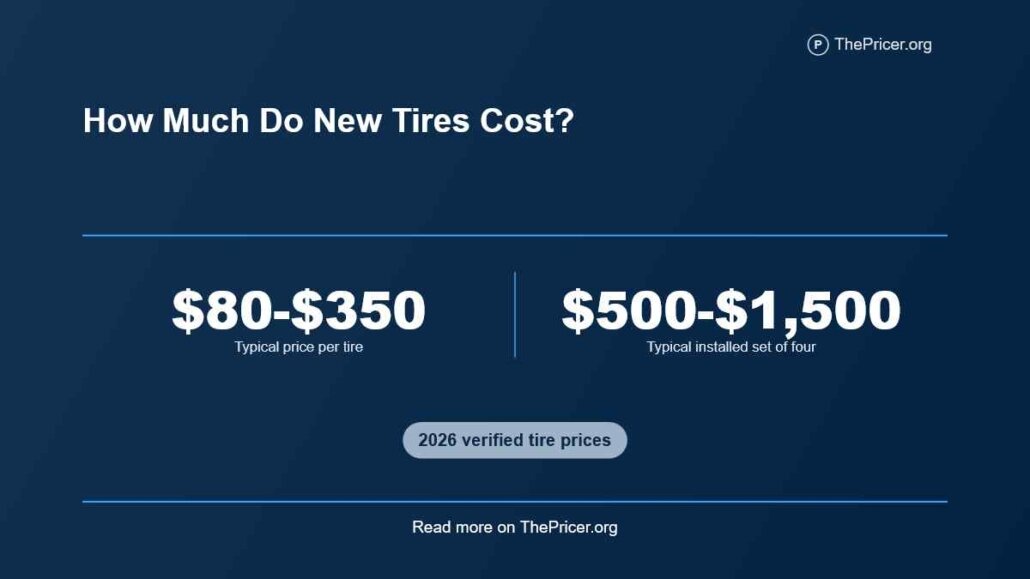
New tires typically cost about $80 to $350 each for most passenger cars, crossovers, and light trucks, while premium performance, large-diameter, run-flat, and specialty tires can cost $400 to $1,000+ per tire. For a complete set of four, a realistic current budget is about $500 to $1,500 installed for many everyday vehicles and $1,500 to $4,000+ for luxury, truck, EV, or high-performance applications.
The sticker price of the tire is only part of the bill. Mounting, balancing, disposal, TPMS service, taxes, road-hazard coverage, and possibly an alignment can add another $80 to $300+ to a four-tire purchase. Wheel diameter, tire width, speed rating, load rating, season, brand, and vehicle type all materially affect the final price.
Article Highlights
Jump to sections
- Most new passenger-car tires cost about $80 to $350 each.
- A typical installed set of four costs roughly $500 to $1,500.
- Large performance, truck, and specialty tires can cost $400 to $1,000+ each.
- Current 18-inch mainstream all-season tires commonly cost around $180 to $275 each.
- Mounting and balancing can add about $20 per tire at retailers that charge separately.
- You do not always need four tires, although AWD vehicles may require closely matched tread depths.
- Tires should be replaced at or before 2/32 inch of tread, and age can also make replacement necessary.
How Much Do New Tires Cost?
Current retail pricing is broader than older $100-to-$350 estimates suggest.
Discount Tire’s current tire-price guide lists small 12- to 15-inch all-season tires around $80 to $150 each. Medium 16- to 20-inch all-seasons are typically around $100 to $250, while performance tires in that same general size range can stretch to $750.
For larger 18- to 26-inch truck, utility, and performance applications, Discount Tire shows all-terrain tires around $200 to $500 and performance tires from roughly $200 to $1,000 each.
| Tire Category | Typical Current Price Per Tire |
|---|---|
| Small economy all-season | $80-$150 |
| Mainstream 16-20 inch all-season | $100-$250 |
| Winter / snow | $100-$400+ |
| All-terrain | $150-$500 |
| Performance | $150-$750+ |
| Large / exotic performance | $400-$1,000+ |
Current retailer examples back up those ranges. Goodyear currently lists an 18-inch Assurance ComfortDrive at about $180, an Assurance MaxLife at $205, and several sport-oriented 18-inch tires between roughly $231 and $272 each.
Current Examples
Real-world pricing varies even among tires that fit roughly the same class of vehicle.
For a current 18-inch application, Goodyear currently lists:
- Assurance ComfortDrive: $180 each;
- Discoverer EnduraMax: $200 each;
- Assurance MaxLife: $205 each.
A different 18-inch fitment currently shows the Assurance ComfortDrive at $231, Eagle F1 All Season at $240, Eagle Sport All-Season at $253, and Vector 4Seasons Gen-3 at $272.
That demonstrates why giving one brand-wide price such as “$100 to $400 for Goodyear” is not very useful without the actual size and vehicle.
Michelin pricing can also reach the upper end of the mainstream market. Costco recently listed one Michelin CrossClimate2 at $299.99 per tire, or $1,199.96 for four before an $80 promotion.
Full Set Cost
For most buyers, the useful number is the installed cost of four tires rather than the advertised price of one.
| Vehicle / Tire Type | Typical Set of Four |
|---|---|
| Small economy car | $400-$700 |
| Mainstream sedan | $600-$1,000 |
| Crossover / SUV | $700-$1,300 |
| Pickup / all-terrain | $900-$2,000 |
| Luxury / performance car | $1,000-$2,500+ |
| Exotic / large high-performance fitment | $2,000-$4,000+ |
A current Goodyear example for a 20-inch Jeep Grand Cherokee fitment runs about $900 to $1,156 for four tires before any separate installation charges, depending on the model chosen.
That is why a $500 total still exists at the low end, but it is no longer a realistic universal budget for larger modern vehicles.
Installation Costs
Installation pricing depends heavily on the retailer.
Sam’s Club currently charges $20 per tire for its Premium Tire Installation Package on most vehicles. That $80 four-tire package includes mounting, a valve stem where applicable, lifetime balance, lifetime rotation, flat repair, and other benefits.
Sam’s Club separately lists tire recycling at $2.50 per tire and TPMS reset services from $5 per wheel or $19 per vehicle, depending on the service.
Costco takes a different approach. Its current tire program advertises installation at no additional charge on tires purchased through Costco, along with rotation, balancing, flat repair, and a five-year road-hazard warranty.
On one current Michelin listing, Costco charged only a $2.25-per-tire disposal fee, with installation shown as $0.
The Hidden Price
The tire rack total is not always the checkout total.
Mounting and balancing: Around $20 per tire at some retailers, while others include it.
Disposal: Commonly a few dollars per tire.
TPMS: Service, valve kits, or complete sensors can add cost, especially on older vehicles where sensors are failing.
State tire fees: California currently charges a $1.75 tire fee per new tire. Other jurisdictions have their own environmental or recycling fees.
Alignment: An alignment is not automatically required every time tires are replaced, but uneven wear, pulling, steering-angle problems, or suspension repairs may justify one.
Road-hazard coverage: Sometimes included, sometimes optional.
Shipping: Online retailers may ship free to an installer, while others charge freight.
Large or low-profile wheels: Some shops charge extra for difficult mounting or specialty equipment.
Worked Example
Consider a crossover using four 18-inch all-season tires priced at $220 each.
| Item | Example Cost |
|---|---|
| Four tires at $220 | $880 |
| Mounting and balancing | $80 |
| Disposal | $10 |
| TPMS service | $25 |
| State / local tire fees | $10 |
| Installed total | $1,005 |
The tires themselves account for 87.6% of the $1,005 total. Installation and fees add another $125, or roughly 14% above the raw tire price.
If the same owner chooses $300 premium tires instead, the four tires alone cost $1,200 and the installed total rises to roughly $1,325 using the same fees.
At earnings of $30 per hour, a $700 set represents about 23 hours of gross earnings. A $1,200 set equals 40 hours, while a $2,000 truck or performance-tire purchase represents roughly 67 hours.
Do You Need Four?
No. The old statement that every vehicle requires replacement of all four tires at once is incorrect.
On a conventional two-wheel-drive car, replacing one tire can sometimes be acceptable if the replacement closely matches the other tire on the same axle in size, type, construction, and tread depth.
When only two tires are replaced, tire retailers commonly install the newer pair on the rear axle to reduce the risk of oversteer in wet conditions. Costco specifically states that when fewer than four tires are installed, the new tires go on the rear except in certain special applications.
AWD and 4WD vehicles require more care.
Tire Rack notes that manufacturers specify different maximum tread-depth or circumference differences. Some call for all four tires to remain within 2/32, 3/32, or 4/32 inch of one another, while others specify circumference limits.
A single replacement may therefore be acceptable when the other three tires are nearly new.
AWD Replacement
The cost issue becomes more important when one tire on an AWD vehicle is damaged halfway through the life of the set.
A brand-new tire has a larger rolling diameter than a substantially worn tire. On some AWD systems, that difference forces differentials or couplings to compensate continuously.
Tire Rack says mismatched tires can create unnecessary heat and wear in driveline components.
But replacing all four is not always the only answer.
Its current tire-shaving guidance says a new tire can sometimes be shaved to match the tread depth of the remaining tires. Tire Rack currently lists shaving at approximately $25 to $35 per tire.
Spending $35 to match one replacement tire can be considerably cheaper than replacing three otherwise serviceable tires worth $600 or more.
When to Replace
Price matters only after determining whether the tires actually need replacement.
NHTSA states that tires should be replaced when tread reaches 2/32 inch. Built-in treadwear indicators become level with the tread at that depth.
Replacement may be necessary earlier if the tire has:
- sidewall bulges;
- deep cuts or cracking;
- exposed cords;
- irregular wear;
- repeated pressure loss;
- unrepairable punctures;
- impact damage.
NHTSA also notes that tire age matters independently of tread depth. Some manufacturers recommend replacing tires after six to ten years, even when tread remains.
Continental similarly recommends removing tires from service by ten years of age, including spare tires.
All-Season Tires
All-season touring tires remain the most common and generally the least expensive mainstream category.
Current Discount Tire pricing puts medium 16- to 20-inch all-season tires around $100 to $250 each.
A typical sedan therefore lands around $600 to $1,000 for four installed tires, while a crossover with larger wheels often falls around $800 to $1,200.
Higher-end all-weather tires carrying the Three-Peak Mountain Snowflake rating can cost more. Michelin CrossClimate2 and Goodyear Vector or WeatherReady-type products often sit in the upper part of the all-season price range.
Winter Tires
Winter tires generally cost about $100 to $400+ each depending on diameter and performance level.
The real expense can be higher because drivers who use dedicated winter tires often purchase a second set of wheels as well.
That raises the initial cost, but seasonal wheel swaps can be cheaper and easier than dismounting and remounting the same tires twice a year.
Winter tires use compounds and tread designs optimized for colder conditions. Running them through hot summer weather generally accelerates wear and reduces the value of that investment.
Truck Tires
Truck tires can move beyond passenger-car pricing quickly.
Current 16-inch Goodyear truck examples include the Wrangler Territory AT around $231 each and Wrangler Fortitude HT around $249.
Larger all-terrain and LT-rated tires can reach $300 to $500 each, putting a set of four around $1,200 to $2,000 before optional services.
Load range, reinforced construction, aggressive tread blocks, and larger physical size all increase material and manufacturing costs.
Performance Tires
High-performance tires have one of the widest price ranges.
A common 17- or 18-inch performance tire may cost only $180 to $300, but large ultra-high-performance tires for sports and exotic cars can climb to $500, $700, or even $1,000 each.
They may also wear faster than ordinary touring tires because their compounds prioritize grip rather than maximum tread life.
This is why tire cost should be evaluated per mile as well as per tire.
Premium vs Budget
More expensive does not automatically mean better for every driver, but a tire is not just a black rubber commodity.
Different models are engineered around tradeoffs between wet braking, dry grip, snow traction, rolling resistance, noise, tread life, steering response, and price.
A premium tire may be worthwhile for a driver who frequently travels at highway speeds, drives in heavy rain, owns a performance vehicle, or values lower noise.
A reputable midrange tire may provide better financial value for a low-mileage commuter.
The important comparison is the tire’s actual test performance, warranty, expected mileage, and suitability for the vehicle, not just the brand name.
Saving Money
Manufacturer rebates remain one of the easiest ways to cut the cost of a complete set.
Current promotions frequently offer $60 to $120 back on four tires. Costco recently offered $80 off a four-tire Michelin purchase, while current Goodyear listings show rebates on selected models.
Compare the installed price, not simply tire MSRP. One retailer may advertise a lower tire price but then add $100 for installation, while another includes installation and road-hazard coverage.
Also compare:
- mounting and balancing;
- lifetime rotation;
- flat repairs;
- road-hazard coverage;
- disposal fees;
- TPMS charges;
- manufacturer rebates.
For smaller emergency replacements, see our guide to the cost of a donut tire. Drivers with factory run-flats can compare our run-flat tire cost guide, while routine maintenance is covered in our article on tire rotation costs.
What We Verified
We checked current 2026 retail tire pricing, installation programs from Costco and Sam’s Club, current Goodyear and Michelin examples, Discount Tire’s category pricing, Tire Rack AWD replacement guidance, federal tire-safety information from NHTSA, manufacturer age guidance, and current state tire fees.
The old $100 to $350 per-tire range remains useful for many mainstream tires but no longer covers the complete market. Current products span roughly $80 at the economy end to $1,000+ for certain large performance applications.
We also corrected the statement that all vehicles require four new tires every time. The proper number depends on drivetrain, tread-depth difference, manufacturer requirements, and tire condition. AWD vehicles require closer matching, but even there a single matched or shaved replacement can sometimes be appropriate.
Answers to Common Questions
How much do four new tires cost?
Most drivers should budget about $500 to $1,500 installed for four new tires. Economy cars can cost less, while trucks, luxury cars, and performance vehicles can exceed $2,000.
How much does one new tire cost?
A mainstream passenger tire usually costs about $80 to $350. Large performance and specialty tires can reach $400 to $1,000 or more.
How much does tire installation cost?
Some retailers include installation. Where it is charged separately, about $20 per tire is a useful current benchmark. Sam’s Club currently charges $20 per wheel for its premium installation package.
Do I have to replace all four tires at once?
No. It depends on the vehicle and tread condition. Two-wheel-drive vehicles may be able to replace one or two tires, while AWD systems often require much closer tread-depth matching. Check the owner’s manual before mixing tread depths.
When should tires be replaced?
NHTSA says tires should be replaced when tread reaches 2/32 inch. Damage, bulging, cracking, repeated air loss, age, or irregular wear can require replacement sooner.
Are premium tires worth the extra cost?
They can be when the extra money buys better wet grip, lower noise, stronger performance, longer tread life, or other characteristics that matter for your vehicle and driving conditions. Compare actual tire specifications and test performance rather than relying only on brand reputation.
Disclosure: Educational content, not financial advice. Prices reflect public information as of the dates cited and can change. Confirm current rates, fees, taxes, and terms with official sources before purchasing. See our methodology and corrections policy.