ThePricer Media
  • Latest: The Cost to Cool an AI Data Center
  • Cost Guides
  • News & Investigations
  • Daily Price Puzzle (60s)
  • Methodology
  • Press & Mentions
  • Contact
  • Click to open the search input field Click to open the search input field Search
  • Menu Menu
Building and Construction, Family & Lifestyle, Home and Garden

How Much Does a Whole House Dehumidifier Cost?

Updated on July 30, 2026 | Written by Alec Pow
This article was researched using 8 sources. See our methodology and corrections policy.

A whole-house dehumidifier usually costs $1,300 to $2,800 installed. Straightforward installations with nearby drainage and limited ductwork can stay near $1,300 to $2,000, while larger equipment, custom ducting, condensate pumps, electrical work, ventilation controls, or difficult attic and crawl-space access can raise the total to $3,000 to $5,000+.

The equipment alone commonly costs about $900 to $2,000. The remaining price pays for sizing, delivery, mounting, duct connections, wiring, controls, drainage, startup, and testing. A quote for a freestanding basement unit should cost less than a fully ducted system integrated with the home’s HVAC equipment.

A whole-house dehumidifier is a permanently drained appliance that removes water from indoor air. It may serve the living space through dedicated ducts, connect to an existing HVAC system, or control moisture in a sealed basement or crawl space. It cannot repair a roof leak, plumbing leak, groundwater problem, or unsealed crawl space.

Article Highlights

Jump to sections
  • Does a Whole-House Dehumidifier Cost?
  • What the Installation Quote Covers
  • Capacity vs Square Footage
  • Moisture Diagnosis
  • Annual Electricity Calculation
  • the Efficiency Rating
  • Drainage Can Add Hundreds
  • Most whole-house dehumidifier installations cost $1,300 to $2,800 (at $30 per hour, earning that amount would take about 1.1 to 2.3 full-time workweeks, before taxes).
  • Equipment commonly accounts for $900 to $2,000 of the project.
  • Ductwork, a condensate pump, electrical work, and controls can add $300 to $1,500+.
  • Square footage alone does not determine the correct capacity.
  • ENERGY STAR models in current listings use about 628 to 926 kWh per year.
  • At 18.44 cents per kWh, annual electricity can cost about $115.80 to $170.75.
  • Water leaks and ground moisture should be corrected before buying larger equipment.
Whole House Dehumidifier Cost

How Much Does a Whole-House Dehumidifier Cost?

Angi’s July 2026 cost data places professional whole-house installation between $1,300 and $2,800 (about 1.1 to 2.3 full-time workweeks at $30 per hour). It also identifies condensate pumps, electrical work, permits, and old-unit removal as possible additions.

Carrier gives a similar range, stating that a whole-home dehumidifier installation commonly costs $1,000 to $2,800 or more, including the equipment and professional labor.

Project type Working installed cost Typical scope
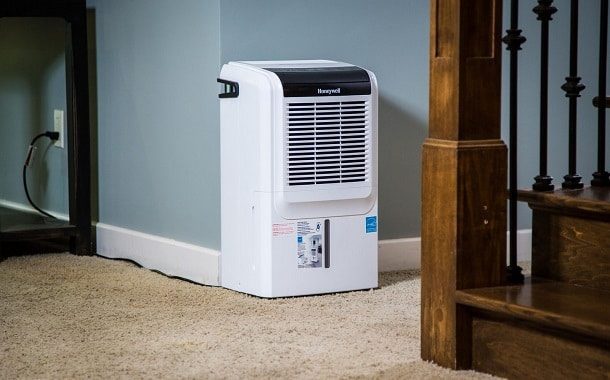
Freestanding basement installation $1,300 to $2,400 Unit, drain, outlet, basic controls
Simple HVAC duct connection $1,800 to $3,000 Unit, short duct runs, drain, wiring
Dedicated whole-home ducting $2,500 to $4,000+ New return and supply ducts, controls
Large or ventilating system $3,000 to $5,000+ High capacity, outdoor-air kit, dampers
Crawl-space system with moisture work $2,000 to $14,000+ Unit plus sealing, drainage, or encapsulation

The last row includes work beyond the appliance. A crawl-space quote can become expensive when it includes a vapor barrier, vent sealing, drainage correction, sump work, insulation removal, or structural repairs.

Related guides

  • How Much Does It Cost to Build a Mosque?
  • How Much Does Fieldstone Cost?
  • How Much Do Bright Covers Cost?

What the Installation Quote Covers

The unit is only one line on the invoice. A professional installation may include:

  • Humidity and moisture-source assessment
  • Equipment sizing
  • Platform, hanging kit, or floor mounting
  • Return and supply duct connections
  • Insulated flexible or sheet-metal ducting
  • Backdraft dampers or zone controls
  • Electrical outlet or hardwired circuit
  • Gravity drain or condensate pump
  • Wall-mounted humidistat or HVAC controls
  • Airflow, drainage, and control testing

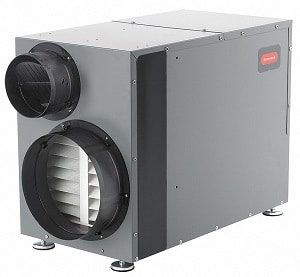
AprilAire’s installation instructions show several possible arrangements, including dedicated ducting and connections between the main return and supply. The E080 and E100 installation manual also specifies duct dimensions, spacing, static-pressure limits, and drain requirements.

A contractor who connects the appliance incorrectly can reduce airflow or send dry air back through the wrong path. A written proposal should identify the return-air source, discharge location, duct sizes, control method, and whether the main HVAC blower must run.

Whole-house dehumidifier unit

Capacity vs Square Footage

A 2,000-square-foot house does not always need the same equipment as another house of equal size. Moisture load changes with climate, air leakage, occupancy, basement conditions, ventilation, temperature, and the selected humidity target.

Resideo’s whole-home sizing guide illustrates the difference. Under its extreme-humidity assumptions, a 2,080-square-foot home needs about 55 to 58 pints per day to maintain 50% relative humidity, but 71 to 78 pints to hold 40%.

For 3,120 square feet, the same guide gives about 79 to 86 pints per day at 50% humidity and 95 to 110 pints at 40%. Lowering the target can require a much larger machine even though the floor area has not changed.

Manufacturer coverage claims also use different assumptions. Santa Fe rates its 100-pint Ultra98 for spaces up to 2,300 square feet. Another manufacturer may advertise greater square-foot coverage for a lower-capacity unit. Pint capacity, test conditions, airflow, and application matter more than the largest square-foot number on a sales page.

Moisture Diagnosis

A dehumidifier removes water vapor after it enters the air. It does not stop liquid water from entering the building.

Check for:

  • Roof, window, plumbing, or appliance leaks
  • Poor grading and overflowing gutters
  • Foundation seepage
  • An open or poorly sealed crawl space
  • Missing ground vapor barriers
  • Bathroom or kitchen exhaust vented indoors
  • Excessive outdoor-air leakage
  • An oversized air conditioner with short run cycles

Installing a $2,500 (about 2.1 full-time workweeks at $30 per hour) machine while water continues entering through a wall can create a high electricity bill without solving the damage. EPA guidance says indoor mold control requires cleaning existing mold and removing the moisture source, not merely reducing humidity.

A home with damaged or poorly sized air distribution may also need HVAC duct replacement before a central dehumidifier can distribute dry air properly.

Annual Electricity Calculation

ENERGY STAR lists annual energy consumption for certified whole-home models. Current examples include an AprilAire E080 at 632 kWh per year and an E130 at 926 kWh per year in the certified dehumidifier database.

The U.S. residential electricity price averaged 18.44 cents per kWh in May 2026, according to the Energy Information Administration.

ThePricer calculated the annual operating cost:

632 kWh × $0.1844 = $116.54 per year.

926 kWh × $0.1844 = $170.75 per year.

The larger model costs about $54.21 more per year under the ENERGY STAR usage assumptions. Over ten years, the difference reaches approximately $542.10 before electricity-rate changes.

This does not prove that the smaller unit is the cheaper choice. An undersized dehumidifier may run longer, fail to reach the set point, and wear out sooner. Capacity should match the moisture load first, then efficiency can be compared between suitable models.

Understanding the Efficiency Rating

ENERGY STAR measures dehumidifier efficiency with Integrated Energy Factor, or IEF. The rating shows how many liters of water the appliance removes per kilowatt-hour while accounting for dehumidification, standby, and off modes.

The ENERGY STAR efficiency criteria define IEF in liters per kilowatt-hour. A higher number means more water is removed for the same electricity use.

Do not compare annual kWh figures without considering capacity. A 105-pint model may consume more electricity than a 65-pint model because it removes substantially more water. Compare models that can handle the same calculated moisture load.

Drainage Can Add Hundreds

A whole-house unit produces liquid condensate that must drain continuously. Gravity drainage is the least expensive arrangement when a suitable floor drain, sump, or condensate line is lower than the appliance.

A condensate pump may add about $150 to $500 when water must be lifted to another drain location. The quote may also include tubing, a trap, cleanout access, overflow protection, and a safety switch.

Drainage should not discharge where water can damage the foundation or re-enter the crawl space. Existing plumbing problems may need separate repair. The cost of replacing deteriorated galvanized pipes is not part of a normal dehumidifier installation, even when a plumbing leak first revealed the humidity problem.

Ductwork and Electrical Add-Ons

Short insulated duct connections may be included in the base quote. Long runs, large round ducts, new return grilles, sheet-metal transitions, dampers, and difficult attic work can add $300 to $1,500+.

Electrical work may be minimal when the model uses a nearby compliant receptacle. Hardwired equipment, a missing outlet, overloaded circuit, or remote control wiring can increase labor and material costs.

A current homeowner reported a $2,398 quote for a freestanding AprilAire E080 serving a basement and connected crawl space. The July 2026 user-reported quote included a nearby sump for drainage but no HVAC duct connection. It is an anecdotal local price, not a national benchmark, yet it shows that equipment and basic professional setup can approach the upper end of the normal installed range.

Maintenance and Replacement

Whole-home units need filter cleaning, coil inspection, drain maintenance, and periodic checks of the humidistat and duct connections. AprilAire recommends cleaning its washable filter at least every six months on supported models.

Maintenance costs can include:

  • DIY filter cleaning: $0
  • Replacement filter when required: $25 to $80+
  • HVAC service visit: $100 to $250+
  • Condensate-pump replacement: $150 to $500
  • Drain clearing or repair: $100 to $350+

Access matters. A unit suspended in a cramped attic may cost more to maintain than one installed at chest height in a basement mechanical room.

Humidity Targets and Mold Claims

The EPA recommends keeping indoor relative humidity below 60%, ideally between 30% and 50%, to help control moisture and mold. A setting near 45% to 50% is common in humid weather, but the right target can change with climate, building materials, and comfort.

A dehumidifier can reduce conditions that support mold growth. It cannot remove existing mold colonies, repair wet drywall, or prove that the air is safe after water damage.

Setting the control unnecessarily low increases runtime and electricity use. A house that remains comfortable and dry at 50% does not gain a clear financial benefit from forcing the system to maintain 40%.

Three Installation Scenarios

Simple basement setup: An $1,250 unit drains by gravity to a nearby sump. A contractor charges $550 for placement, control setup, drainage, and testing. The installed total is $1,800.

Ducted HVAC installation: The unit costs $1,500. Duct transitions, wiring, drain work, controls, and labor add $1,100. The complete price is $2,600.

Complex attic project: A high-capacity ventilating model costs $2,100. New insulated ducts, dampers, an electrical circuit, condensate pump, platform, and difficult-access labor add $2,000. The installed total reaches $4,100.

When a Whole-House Unit Makes Sense

It can make sense if:

  • Humidity remains above the desired range across several rooms.
  • The home needs continuous drainage rather than bucket emptying.
  • Portable units cannot serve the full moisture load.
  • The building envelope and water leaks have already been addressed.
  • The HVAC system leaves the house humid during mild weather.

A portable unit or repair may be better if:

  • Humidity is limited to one small basement room.
  • A plumbing or foundation leak is the main moisture source.
  • The crawl space is still open and lacks a ground vapor barrier.
  • The house is dry except during a short seasonal period.
  • The installation cost is higher than correcting the moisture entry point.

What We Verified

  • Checked the $1,300 to $2,800 installed range against current Angi and Carrier cost data.
  • Confirmed that capacity changes with floor area and humidity target through Resideo’s sizing table.
  • Cross-referenced certified annual energy use with the ENERGY STAR product database.
  • Verified the May 2026 residential electricity price through the EIA.
  • Confirmed manufacturer ducting, drainage, and maintenance requirements through AprilAire documentation.

Answers to Common Questions

How much does a whole-house dehumidifier cost installed?

Most installations cost $1,300 to $2,800. Complex ductwork, electrical upgrades, drainage pumps, ventilation, or crawl-space work can push the price above $3,000 to $5,000.

How much electricity does a whole-house dehumidifier use?

Current certified models show about 628 to 926 kWh per year in ENERGY STAR data. At 18.44 cents per kWh, that equals roughly $116 to $171 per year.

What humidity should a house be kept at?

The EPA recommends keeping relative humidity below 60%, ideally between 30% and 50%. Many homes target about 45% to 50% during humid weather.

Can a whole-house dehumidifier remove mold?

No. It can reduce moisture that supports future growth, but existing mold and the water source must be cleaned up or repaired separately.

Can one dehumidifier control the entire house?

Yes, when the unit is sized for the moisture load and installed with suitable airflow or ducting. A unit placed in one closed room may not control humidity evenly elsewhere.

Disclosure: Educational content, not financial advice. Prices reflect public information as of the dates cited and can change. Confirm current rates, fees, taxes, and terms with official sources before purchasing. See our methodology and corrections policy.

by Alec Pow
ThePricer cost research Independent price research used by media, universities and public institutions.

We research provider pricing, market examples, buyer reports, hidden fees and public records.

Methodology · Citations · Newsroom
© 2014 - 2026 - ThePricer Media, LLC, 4 Grove Street, New York, NY, 10014, Phone: (212) 431-2441
We don’t use affiliate links or paid placements. All sources are cited only for verification.
  • Link to X
  • Link to LinkedIn
  • Link to Facebook
  • Link to Instagram
  • Link to Pinterest
  • Link to Youtube
  • Contact Us
  • About Us
  • Press & Mentions
  • Careers
  • Meet the Founder
  • Privacy Policy
  • Editorial Ethics
  • Methodology
  • Corrections
  • Disclosure
  • Terms and Conditions
Scroll to top Scroll to top Scroll to top