How Much Does Achilles Tendon Surgery Cost?
Updated on | Written by Alec Pow
This article was researched using 7 sources. See our methodology and corrections policy.
Achilles tendon surgery commonly costs $5,000 to $18,000 through self-pay surgery programs, while hospital-based repair can produce charges above $20,000 to $30,000. MDsave currently lists bundled Achilles tendon repair prices from $4,124 to $17,508, with a displayed national average of $12,353.
Patients with health insurance may owe anything from a copayment to several thousand dollars. The amount depends on the remaining deductible, coinsurance, provider network, facility, anesthesia coverage, physical therapy benefits, and the plan’s annual out-of-pocket limit.
The surgical quote may not include the emergency visit, orthopedic consultation, imaging, walking boot, crutches, follow-up appointments, rehabilitation, or time away from work. Once those costs are added, a $12,000 procedure can create a total financial impact above $20,000.
Article Highlights
Jump to sections
- Bundled self-pay Achilles repair prices currently range from about $4,124 to $17,508 (at $30 per hour, earning that amount would take about 0.8 to 3.4 months of full-time work, before taxes).
- Hospital charges and complex chronic reconstructions can exceed $20,000 to $30,000.
- Insured patients pay their deductible, copayments, and coinsurance until reaching the applicable out-of-pocket limit.
- Physical therapy can add $2,400 to $4,400 in a 20-session self-pay scenario.
- A chronic rupture requiring tendon transfer or graft work usually costs more than a straightforward acute repair.
- Both surgical and nonsurgical treatment normally require a boot, progressive rehabilitation, and months of recovery.

How Much Does Achilles Tendon Surgery Cost?
| Cost category | Planning range | What the amount may cover |
|---|---|---|
| Bundled self-pay repair | $4,124 to $17,508 (about 0.8 to 3.4 months of full-time work at $30 per hour) | Procedure and the services listed by the participating provider |
| Hospital-based acute repair | $10,000 to $30,000+ | Facility, surgeon, anesthesia, and related hospital charges |
| Complex chronic reconstruction | $15,000 to $35,000+ | Longer surgery, tendon transfer, graft, implants, and facility care |
| Initial specialist and imaging costs | $300 to $2,000+ | Consultation, X-ray, ultrasound, or MRI when ordered |
| Boot, crutches, or knee scooter | $100 to $700+ | Durable medical equipment and rental or purchase costs |
| Postoperative physical therapy | $2,400 to $4,400 | Worked self-pay example using 20 visits at $120 to $220 each |
| Insured patient responsibility | $500 to the plan maximum | Deductible, copayments, coinsurance, and noncovered services |
MDsave currently shows Achilles tendon repair prices from $4,124 to $17,508 and a marketplace average of $12,353 on its Achilles repair pricing page. These are prepaid prices at participating providers, not a guaranteed national hospital rate.
A bundled price must be read carefully. Ask whether it includes the surgeon, surgery center, anesthesia, implants, postoperative visits, imaging, pathology, medications, and treatment of an unexpected complication.
What the Operation Repairs
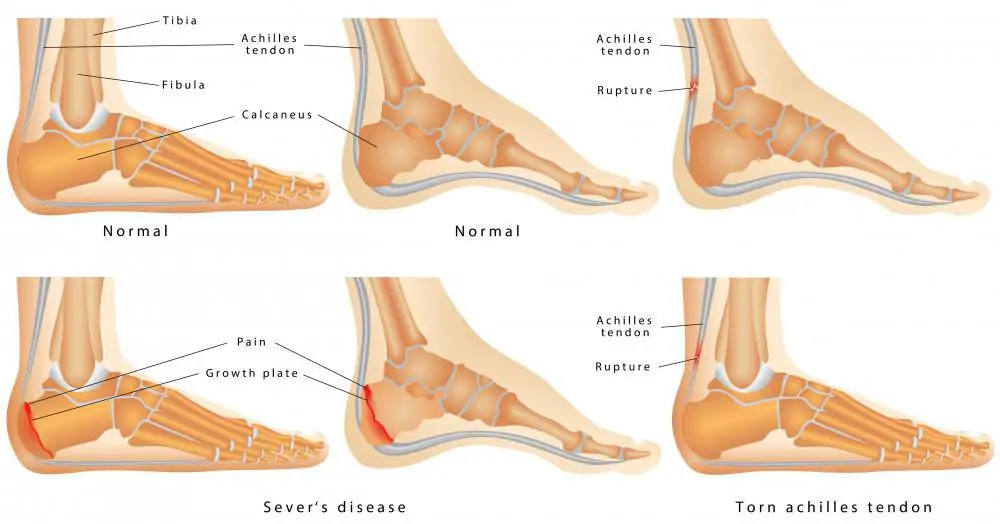
The Achilles tendon connects the calf muscles to the heel bone and helps the foot push against the ground. A rupture can make walking, climbing stairs, running, and rising onto the toes difficult.
An acute repair usually involves bringing the recently torn tendon ends together with sutures. The surgeon may use an open incision or a smaller-incision technique. A chronic rupture can be more complex because the tendon ends may have shortened, scarred, or separated by a larger gap.
Chronic reconstruction may involve tendon advancement, tendon lengthening, graft augmentation, or transfer of another tendon. These procedures should not be compared with a simple acute repair using one broad price.
The existing image shows several Achilles conditions, but tendinopathy, partial tears, acute rupture, and chronic rupture may call for different treatment plans.

How the Tear Is Diagnosed
A clinician can often identify an Achilles rupture from the injury history and physical examination. The examination may include checking the tendon gap, ankle movement, push-off strength, and the response when the calf is squeezed.
An X-ray can help identify a fracture, bone injury, or another cause of heel pain, but it does not show the tendon well enough to classify most ruptures. Ultrasound or MRI may be ordered when the diagnosis, location, tendon gap, or extent of damage is uncertain.
The American Academy of Orthopaedic Surgeons explains that MRI can show how much of the tendon is torn and where the tear is located in its Achilles rupture guidance. Imaging use varies by patient and surgeon, so not every rupture needs an MRI.
When an MRI is ordered, the separate MRI cost may apply before treatment begins.
Surgery Is Not the Only Treatment
Both surgical repair and structured nonsurgical care are used for acute Achilles ruptures. Nonsurgical treatment commonly uses a cast or functional boot that positions the foot so the tendon ends can heal, followed by progressive weight bearing and rehabilitation.
A randomized trial published in the New England Journal of Medicine compared nonoperative treatment, open surgery, and minimally invasive surgery. Patient-reported function and physical performance were similar among the three groups at 12 months. Rerupture occurred in 6.2% of nonoperative patients and 0.6% in each surgical group, while nerve injuries were more frequent after surgery, particularly minimally invasive repair. The results are available in the randomized treatment trial.
That does not make one option right for every patient. Treatment can differ based on age, activity goals, tear pattern, injury timing, skin condition, smoking, diabetes, anesthesia risk, access to rehabilitation, and the surgeon’s assessment.
This article explains financial patterns and does not choose a treatment for an individual rupture.
Surgery and Rehab Costs
Nonsurgical care avoids an operating-room bill, but it is not free. Both treatment paths can involve specialist visits, a boot, heel wedges, crutches, physical therapy, repeat examinations, and time away from work.
A surgical patient might face:
- Orthopedic evaluation and imaging
- Surgeon and facility charges
- Anesthesia
- Sutures, anchors, graft, or other materials
- Boot or cast
- Medication
- Follow-up appointments
- Physical therapy
A nonsurgical patient may avoid the surgeon, facility, and anesthesia bills but still pay for repeated clinical monitoring and rehabilitation. A rerupture or failed healing can later create a surgical cost.
The financial comparison should use the complete treatment episode, not surgery versus a zero-cost alternative.
The $3,000 Therapy Bill
Physical therapy is one of the largest costs commonly left outside the surgical quote. Rehabilitation usually begins after surgery or as part of nonsurgical treatment, not as a routine 8-to-16-week period before acute repair.
Assume an uninsured patient pays $150 (about 5 hours of work at $30 per hour) per session for 20 visits. The therapy bill is $3,000. At $120 per session, the same schedule costs $2,400. At $220, it reaches $4,400.
The number of appointments varies. Some patients need fewer supervised visits and perform much of the program at home. Others need longer care due to weakness, stiffness, gait problems, delayed healing, job demands, or a goal of returning to sport.
Insurance may apply a specialist copayment to each appointment, limit covered visits, require authorization, or place therapy under the deductible. Twenty visits with a $40 copayment still create an $800 patient bill.
Why Recovery Can Cost $25,000
The economic cost can be much higher than the medical invoice. Consider this self-pay scenario for an acute rupture:
- Bundled surgery: $12,000
- Orthopedic visits and MRI: $1,200
- Boot, crutches, and home supplies: $450
- Twenty therapy visits at $150: $3,000
- Medication and follow-up expenses: $600
- Six weeks of lost take-home income at $1,250 per week: $7,500
The medical and income impact reaches $24,750. The wage figure is a worked example rather than a national average, but it shows why the operation price alone can understate the financial burden.
Other indirect costs may include transportation, parking, child care, home assistance, temporary work restrictions, a knee scooter, and changes needed to manage stairs.
What Insurance Leaves You Owing
Medical necessity does not mean the procedure is free. An insured patient’s cost begins with the plan’s negotiated rate rather than the hospital’s list charge.
The deductible is the amount paid for covered services before the plan begins paying its share. After that, the patient may owe coinsurance, such as 20%, until reaching the plan’s applicable out-of-pocket maximum. Healthcare.gov explains this structure in its deductible definition.
Consider an in-network allowed amount of $15,000. A patient with $2,000 remaining on the deductible pays that first. If the plan then uses 20% coinsurance, the patient pays another $2,600 on the remaining $13,000. The estimated responsibility is $4,600, unless the out-of-pocket limit reduces it.
Ask the insurer to confirm:
- Whether prior authorization is required
- Whether the surgeon and facility are in network
- Whether anesthesia is in network
- The remaining deductible
- The coinsurance percentage
- The remaining out-of-pocket maximum
- Physical therapy limits and copayments
- Coverage for the boot, crutches, and other equipment
Facility Choice Changes the Bill
Many uncomplicated Achilles repairs are outpatient procedures. They may be performed in an ambulatory surgery center or hospital outpatient department, with discharge on the same day.
A hospital can cost more due to its facility structure and ability to handle patients with greater medical needs. A surgery center may offer a lower bundled price for an appropriate patient, but not every case belongs in that setting.
CMS requires hospitals to publish standard charges, negotiated rates, and discounted cash prices through consumer-facing price tools or displays. Patients can use the hospital’s estimator and request a written quote under the hospital price transparency rules.
Ask for the relevant procedure code and whether the estimate covers all related services. A facility estimate may exclude a separate surgeon or anesthesiologist bill.
Acute Repair vs Chronic Reconstruction
An acute rupture repaired soon after injury may allow the surgeon to join the tendon ends directly. A chronic rupture can leave a gap that cannot be closed without added work.
Complex reconstruction can involve longer operating time, another incision, tendon transfer, graft material, fixation devices, and a slower rehabilitation path. Those additions may move the price from a lower outpatient repair range toward $15,000 to $35,000 or more.
A quote should name the planned procedure rather than say only “Achilles surgery.” Ask whether the estimate assumes primary repair, tendon transfer, graft augmentation, debridement, or tendon lengthening.
Tendon lengthening alone is a different operation. MDsave currently lists tendon-lengthening prices from $4,469 to $8,298 on its prepaid procedure page.
Recovery Takes Longer Than 12 Weeks
Twelve weeks may mark the end of an early rehabilitation phase, not complete recovery. Patients often move through protected weight bearing, boot adjustments, range-of-motion work, strength training, gait retraining, running progression, and sport-specific work.
Return to desk work may occur earlier than return to a physical job. Running and jumping place larger demands on the healing tendon than walking on level ground.
Mayo Clinic states that most people return to their former activity level within 18 to 24 months after injury in its diagnosis and treatment overview. Individual timelines vary, and some people have lasting weakness, reduced calf size, stiffness, or lower push-off power.
Three Patient Cost Scenarios
Insured outpatient repair: The in-network allowed medical cost is $14,000. The patient has $1,500 left on the deductible and then owes 20% coinsurance. Before applying the out-of-pocket limit, the estimated surgery responsibility is $4,000. Ten therapy copayments at $40 add $400, bringing the example to $4,400.
Bundled self-pay repair: Surgery costs $9,500. Imaging, equipment, medications, and therapy add $4,000. The medical total is $13,500, excluding lost income.
Chronic reconstruction: A hospital quotes $24,000 for reconstruction involving a tendon transfer. Therapy and equipment add $4,500, while work restrictions create $8,000 in lost income. The economic impact reaches $36,500.
When the Expense May Make Sense
Surgical evaluation may carry more weight when:
- The tear is complete, displaced, chronic, or difficult to manage in a boot.
- The patient places high demands on push-off strength for work or sport.
- The surgeon believes the tear pattern has a higher risk of poor nonsurgical healing.
- The patient accepts surgical risks in exchange for the lower rerupture rate seen in some studies.
A nonoperative path may receive more attention when:
- The tear can be managed within an early functional rehabilitation program.
- Medical conditions raise the risk of anesthesia, infection, or wound trouble.
- The patient accepts the different rerupture profile and can follow the boot protocol closely.
- The treating clinician believes functional results can meet the patient’s goals without surgery.
The decision belongs to the patient and qualified treating team after reviewing the injury, evidence, health risks, and goals.
What We Checked
- Checked: Current prepaid repair prices range from $4,124 to $17,508 through participating MDsave providers.
- Confirmed: Physical examination often identifies an Achilles rupture, while MRI or ultrasound can clarify uncertain injuries through the AAOS diagnostic overview.
- Cross-referenced: Modern trial evidence supports both surgical and nonsurgical treatment paths, with different rerupture and complication patterns.
- Verified: Recovery extends beyond early tendon healing and can continue for many months.
- Checked: Hospitals must make discounted cash prices and negotiated rates available under current federal transparency requirements.
Related Orthopedic Costs
Achilles repair belongs to a wider group of sports and tendon procedures. Comparable recovery planning may be useful when reviewing the cost of Tommy John surgery or surgery for a torn MCL. A sudden injury evaluated through a hospital may also generate a separate emergency room bill before the orthopedic treatment begins.
Answers to Common Questions
Is Achilles tendon repair usually outpatient surgery?
Many uncomplicated repairs are completed as outpatient procedures. Hospital admission may be needed for complex reconstruction, medical concerns, complications, or local clinical practice.
Does insurance cover Achilles tendon surgery?
Insurance often covers medically necessary in-network repair, subject to authorization, deductible, copayments, coinsurance, equipment rules, and therapy benefits.
Do you always need an MRI before surgery?
No. Many ruptures are diagnosed through the history and physical examination. MRI or ultrasound may be used when the diagnosis, tear location, or surgical plan needs clarification.
How much does physical therapy cost after surgery?
In a worked self-pay example, 20 sessions at $120 to $220 each cost $2,400 to $4,400. The prescribed number of visits and insurance benefits vary.
How long are you out of work?
It depends on the job and treatment. Desk work may resume sooner, while jobs involving climbing, lifting, prolonged standing, or driving can require a much longer restriction.
Disclosure: Educational content, not medical advice. Pricing varies by provider, location, and insurance. Confirm eligibility, coverage, and out-of-pocket costs with a licensed clinician and your insurer. See our methodology and corrections policy.