
How Much Does a Backhoe Cost?
Updated on | Researched and reviewed by Alec Pow, Founder & Pricing Investigator
Prices, claims, and calculations checked against 8 cited sources. See our research methodology and corrections policy.
A new full-size backhoe loader typically costs about $115,000 to $160,000+ in current 2026 pricing, although the exact price changes with brand, cab, drivetrain, extendable dipperstick, buckets, couplers, hydraulics, and other options. Current examples include a new CASE 580SV purchased by a North Carolina municipality for $119,032, a Cat 420 configuration starting around $129,592 MSRP, and a configured Cat 420 municipal purchase costing $160,936.94.
Used backhoes can cut the upfront investment dramatically. Current 2020 John Deere 310SL listings range from about $49,500 for a machine with 4,965 hours to $96,000 for one with only 955 hours. Rental is another option: current 2026 marketplace data averages about $582 per day, $1,434 per week, or $3,103 per month, with smaller machines costing less and larger backhoes reaching $700 to $1,000+ per day.
The cheapest option depends less on an arbitrary “rent for six months, then buy” rule and more on how many days you will actually use the machine, the rental term you can negotiate, financing, transport, maintenance, attachments, downtime, and how much resale value the backhoe retains.
Article Highlights
Jump to sections
- Current new full-size backhoe examples run roughly $115,000 to $160,000+.
- A current Cat 420 configuration starts around $129,592 MSRP before freight, taxes, additional attachments, and dealer-specific charges.
- A real 2026 CASE 580SV municipal purchase cost $119,032.
- A configured Cat 420 purchased by a municipality cost $160,936.94, showing how far the final machine can move above a basic starting price.
- Modern used machines can range from roughly $50,000 to $100,000+, with hours and configuration driving much of the spread.
- Current 2026 rental data averages around $582/day, $1,434/week, and $3,103/month.
- At a modeled $582/day, the $129,592 Cat starting price equals about 223 daily rentals before considering maintenance, financing, resale value, delivery, or rental discounts.

How Much Does a Backhoe Cost?
| Backhoe cost | Current price | Example or context |
|---|---|---|
| New CASE 580SV | $119,032 | 2026 municipal purchase |
| Cat 420 starting configuration | $129,592 | Current Cat Build & Price MSRP example |
| Configured Cat 420 | $160,936.94 | Real municipal purchase |
| 2020 Deere 310SL, 4,965 hours | $49,500 | Current used listing |
| 2020 Deere 310SL, 3,475 hours | $62,500 | Current used listing |
| 2020 Deere 310SL, 710 hours | $82,500 | Current used listing |
| 2020 Deere 310SL, 955 hours | $96,000 | Current used listing |
| Average rental | $582/day | 2026 national marketplace data |
| Average weekly rental | $1,434/week | 2026 national marketplace data |
| Average monthly rental | $3,103/month | 2026 national marketplace data |
The current Cat 420 Build & Price tool shows just how quickly configuration changes the number. One 420 canopy configuration starts at $129,592, while another is $138,870 and a cab configuration reaches $142,768 before additional attachments.
Individual attachments are not trivial either. On the same current Cat configurator, a 24-inch heavy-duty backhoe bucket is about $2,076, a coupler about $2,514, and a multipurpose front bucket about $7,806.
A public Cottage Grove equipment purchase shows how this plays out in the real world. The municipality paid $160,936.94 for its Cat 420.
Compared with the current $129,592 starting configuration, that is:
$160,936.94 – $129,592 = $31,344.94.
The finished municipal machine cost about 24.2% more than that current base-price example. This is why a bare MSRP should not be treated as the final budget for a working backhoe.
A second public benchmark comes from Emerald Isle, North Carolina, which approved a new CASE 580SV purchase for $119,032 in March 2026.
Used Prices Depend on Hours
Age alone is a poor way to price a used backhoe. Two machines built in the same year can differ by tens of thousands of dollars because one has hundreds of hours and another has several thousand.
Current 2020 Deere 310SL listings demonstrate the spread:
- $49,500 at 4,965 hours
- $62,500 at 3,475 hours
- $69,500 at 1,348 hours
- $82,500 at 710 hours
- $96,000 at 955 hours with a strong equipment package
Hours are only one variable. Cab and air conditioning, 4WD, extendable dipperstick, ride control, hydraulic thumb, auxiliary hydraulics, loader coupler, bucket inventory, tire condition, leaks, service history, and transmission condition all affect what a used machine is worth.
This is more useful than applying a blanket rule that every five-year-old backhoe is “20% to 50% cheaper.” A heavily worked five-year-old fleet machine and a low-hour owner-operated machine should not receive the same depreciation assumption.
Backhoe Rental Rates
Rental prices vary widely by horsepower, region, attachments, and duration. Fresh DOZR 2026 rental data, based on hundreds of quotes across the U.S. and Canada, gives an average of approximately $582 per day, $1,434 per week, and $3,103 per month.
The same data breaks current daily pricing into broad size classes:
- Small 70-90 HP backhoe: about $350-$500/day
- Standard 90-100 HP backhoe: about $500-$700/day
- Large 100+ HP backhoe: about $700-$1,000+/day
That makes the old $300-$500 per day figure too narrow for today’s market. It still describes some small machines and lower-cost markets, but a full-size current rental can easily sit above it.
The large discount for longer rental terms is also worth seeing in actual dollars. Twenty workdays at the current $582 daily average would theoretically cost:
20 × $582 = $11,640.
The current average monthly rental is only $3,103.
Those are different rental structures with different hour allowances and contract terms, so you cannot assume every rental house will let you substitute one for the other. It does show why anyone needing a machine for weeks should request a weekly or four-week quote instead of repeatedly extending a daily rental.
Delivery and pickup, fuel, taxes, attachments, protection plans, overtime hours, cleaning, and damage can sit outside the advertised machine rate.
The Buy vs Rent Math
The old idea that renting is automatically best for anything under six months is too crude.
Using the current $129,592 Cat 420 starting price and the current $582 average daily rental:
$129,592 ÷ $582 = about 223 rental days.
Using the current monthly rental average instead:
$129,592 ÷ $3,103 = about 41.8 months.
Neither number is a true break-even point.
The owner also pays financing costs, insurance, maintenance, transport, tires, repairs, storage, and eventually selling costs. The renter pays transport, fuel, optional protection, and possible overtime charges but avoids tying up more than $100,000 in equipment.
The owner also has something the renter does not: residual value. A maintained backhoe can still be worth tens of thousands of dollars years later.
The better question is how many productive hours the machine will generate each year. A contractor using a backhoe most weeks may justify ownership quickly. A property owner needing one for two drainage projects and a foundation excavation probably will not.
What Changes the Machine Price
Cab and climate control: An enclosed cab with heat and air conditioning costs more than an open canopy but can make a major productivity difference for a machine used year-round.
4WD: Most construction buyers want four-wheel drive for traction and resale value.
Extendable dipperstick: Extra reach increases digging capability and is one of the most important configuration differences in used listings.
Hydraulic thumb: Useful for rocks, logs, demolition debris, and irregular materials. It adds cost but also turns the rear boom into a much more versatile handling tool.
Quick couplers: Contractors changing buckets or tools regularly may recover the extra hardware cost through faster attachment changes.
Front bucket: A general-purpose bucket and a multi-purpose 4-in-1 bucket are not equivalent equipment packages.
Auxiliary hydraulics: Required for some powered attachments and valuable for buyers who want the machine to perform more than conventional loading and digging.
Backhoes overlap with several other equipment categories. For lighter work, compare the cost of a Bobcat tractor or Bobcat skid steer. For tight excavation work, a mini excavator may be more maneuverable. Long narrow utility trenches can also make a Ditch Witch trencher cheaper and faster than using a full backhoe.
Depth, Weight, and Transport
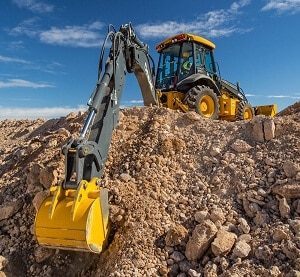
A typical full-size backhoe digs around 14 feet with a standard stick, while an extendable dipperstick can push useful depth toward 18 feet.
John Deere’s current 310 P-Tier specifications list a maximum standard digging depth of 14 ft 1 in. With the optional extendable dipperstick fully extended, maximum digging depth increases to 17 ft 10 in.
Transport is another hidden price. Caterpillar’s current 420 specifications show an estimated operating weight around 17,271 lb, with maximum configured operating weight reaching 24,251 lb.
That is not equipment most owners casually move with a light pickup and utility trailer. A buyer who works across multiple sites needs to account for appropriate truck and trailer capacity, commercial hauling, permits where required, loading time, and transport logistics.
Ownership and Operator Costs
Annual ownership costs should not be reduced to a fake universal figure such as $5,000 per year for insurance or $2,500-$5,000 for maintenance.
Service cost depends on operating hours and the manufacturer’s maintenance schedule. Tires, hydraulic hoses, pins, bushings, fluids, filters, batteries, brakes, cutting edges, buckets, and other wear items age according to how the machine is used.
A used machine with deferred maintenance can turn a cheap purchase into an expensive one quickly. Before buying, inspect:
- Engine cold-start behavior and smoke
- Transmission engagement and shifting
- Hydraulic leaks and cylinder drift
- Boom, stick, pins, and bushings for excessive play
- 4WD operation
- Stabilizers
- Tires
- Loader arms and bucket linkage
- Service records and hour-meter credibility
Insurance also varies by the machine’s value, business activity, deductible, liability limits, location, claims history, and whether the backhoe is part of a larger contractor equipment policy. Get an actual insurance quote rather than budgeting a universal annual premium.
The same applies to financing. As a simple planning model, financing the full current $129,592 Cat starting price for five years at a hypothetical 7% APR would produce a payment of about $2,566 per month. With a 20% down payment, the financed balance would be $103,673.60 and the modeled payment would fall to about $2,053 per month.
Those are calculations, not current lender offers. Actual dealer incentives, credit quality, term length, taxes, down payment, and equipment age change the payment.
One old statement also needs correction: OSHA does not issue a blanket “backhoe operator certification.” OSHA’s heavy-equipment operator interpretation says it does not provide a general Heavy Equipment Operator certification. Employers must train workers to recognize and avoid applicable hazards, while specific certification requirements can apply when equipment is used in activities covered by other OSHA standards, such as certain crane operations.
Three Real Cost Scenarios
Case 1, contractor buying new: Start with a current Cat 420 at approximately $129,592. A cab configuration or additional buckets, couplers, hydraulics, and attachments can move that price substantially higher. A real municipal configuration reached $160,936.94, a difference of $31,344.94 from today’s lower Cat configuration example.
Case 2, buyer choosing used: A 2020 Deere 310SL with 4,965 hours is currently listed at $49,500, while a 955-hour example is listed at $96,000. Paying another $46,500 buys a much lower-hour machine with a different configuration. The correct choice depends on condition, inspection results, expected annual use, and how costly downtime would be.
Case 3, one-month project: At the current national average, a four-week rental costs about $3,103 before transport, fuel, and add-ons. Even if the complete rental reaches several thousand dollars more, that is still a small fraction of a $119,000-$160,000+ new-machine purchase for a project that ends after one month.
Buy, Rent, or Used?
Makes sense if:
- You will use the machine frequently enough to spread a six-figure purchase over many productive hours.
- You need the loader and excavator functions regularly rather than occasionally.
- You can maintain the machine and manage repair downtime.
- A well-inspected used backhoe provides the capability you need without new-machine depreciation.
- You have transport, storage, insurance, and operator arrangements already in place.
Does not make sense if:
- You need a backhoe for only a few days or weeks each year.
- You are comparing purchase price with rental price but ignoring resale value and ownership expenses.
- You are buying used without inspecting hydraulics, pins, transmission, drivetrain, and maintenance history.
- You are choosing a machine based only on horsepower instead of digging depth, attachments, loader capability, and job requirements.
- You assume a $129,000 machine can be moved between jobs without significant transport planning.
What We Checked
- Checked current Cat Build & Price data and confirmed a current 420 configuration around $129,592 MSRP.
- Cross-referenced real public purchases of $119,032 for a CASE 580SV and $160,936.94 for a Cat 420.
- Verified current used Deere 310SL listings from $49,500 to $96,000 with machine hours attached to each price.
- Confirmed fresh 2026 rental averages of approximately $582/day, $1,434/week, and $3,103/month.
- Verified the Deere 310 P-Tier’s 14 ft 1 in standard and 17 ft 10 in extended maximum digging depths.
- Checked OSHA’s current position before removing the inaccurate claim that every backhoe operator needs an OSHA-issued heavy-equipment certification.
Answers to Common Questions
How much does a new backhoe cost?
Current full-size machines commonly land around $115,000 to $160,000+. Real current examples include a $119,032 CASE 580SV municipal purchase and Cat 420 configurations from roughly $129,592 to more than $160,000 once equipped.
How much does a used backhoe cost?
Modern used full-size machines commonly cost around $50,000 to $100,000+, although older or heavily used equipment can be cheaper. Current 2020 Deere 310SL listings range from $49,500 to $96,000 depending heavily on hours and equipment.
How much does it cost to rent a backhoe?
Current 2026 rental-market data averages approximately $582 per day, $1,434 per week, and $3,103 per month. Small backhoes can be closer to $350-$500/day, while large machines can reach $700-$1,000+ per day.
Is it cheaper to rent or buy a backhoe?
Renting is generally better for occasional or short projects. Buying becomes more attractive when utilization is high and the owner can recover part of the investment through resale. Using current averages, a $129,592 purchase price equals roughly 223 rentals at $582/day before accounting for ownership expenses or residual value.
How deep can a backhoe dig?
A full-size backhoe commonly digs around 14 feet with a standard stick. A current Deere 310 P-Tier reaches 14 ft 1 in standard and up to 17 ft 10 in with its extendable dipperstick.
Do I need an OSHA certification to operate a backhoe?
OSHA does not issue a universal Heavy Equipment Operator certification for ordinary backhoe operation. Employers are responsible for appropriate training and hazard instruction. Additional certification requirements can apply when equipment is used for work governed by a more specific OSHA standard.
What should I check before buying a used backhoe?
Check the hour meter, maintenance records, cold start, transmission, hydraulics, cylinder leakage, pins and bushings, stabilizers, 4WD, tires, loader linkage, attachments, and signs of structural repair. A qualified heavy-equipment inspection can be inexpensive compared with a major hydraulic or drivetrain repair after purchase.
Disclosure: Educational content, not financial advice. Prices reflect public information as of the dates cited and can change. Confirm current rates, fees, taxes, and terms with official sources before purchasing. See our methodology and corrections policy.