
How Much Does Baseboard Installation Cost?
Updated on | Researched and reviewed by Alec Pow, Founder & Pricing Investigator
Prices, claims, and calculations checked against 7 cited sources. See our research methodology and corrections policy.
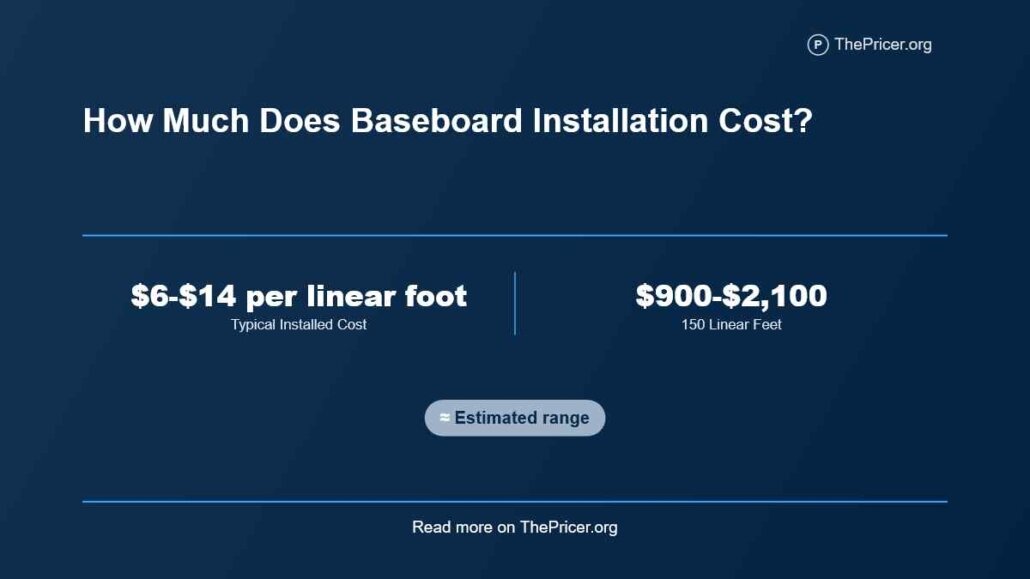
Baseboard installation typically costs about $6 to $14 per linear foot for materials and professional installation, putting a straightforward 150-linear-foot project around $900 to $2,100. Basic MDF or pine installed in an uncomplicated room can fall near the lower end, while tall hardwood trim, difficult corners, old-baseboard removal, wall repairs, caulking, and painting can push the project above $15 per linear foot.
The molding itself is often surprisingly inexpensive. Basic primed MDF can cost around $1.40 per linear foot, while premium hardwood or ornate profiles can cost $5 to $10+ per foot. Labor and finishing frequently make up more of the final bill than the baseboard material.
Article Highlights
Jump to sections
- Professional baseboard installation generally costs about $6-$14 per linear foot for a normal project.
- A 150-linear-foot installation works out to roughly $900-$2,100.
- Basic MDF currently starts around $1-$2 per linear foot for the molding itself.
- Removing existing baseboards may add $50-$100 per labor hour in current contractor-market estimates.
- Professional painting can add roughly $1-$5 per linear foot, depending on preparation and trim condition.
- Premium hardwood, tall trim, complicated rooms, damaged drywall, and many corners can push costs above the typical range.
How Much Does Baseboard Installation Cost?
There is no single national baseboard-installation price because contractors do not all quote the same scope. One price may include only cutting and nailing the molding, while another includes materials, caulk, filling nail holes, cleanup, and painting.
Several current cost sources illustrate the difference. HomeGuide’s current baseboard data puts typical installed baseboard molding at around $6 to $9 per linear foot. Angi reports approximately $5.70 to $9 per foot, while Homewyse’s September 2026 estimator starts higher at roughly $9.26 to $14.17 per foot for its modeled professional installation.
| Project | Planning range |
|---|---|
| Basic installation | $6-$9 per linear foot |
| Typical professionally finished project | $8-$14 per linear foot |
| Premium / complex installation | $15-$25+ per linear foot |
| 100 linear feet | $600-$1,400 |
| 150 linear feet | $900-$2,100 |
| 300 linear feet | $1,800-$4,200 |
| 500 linear feet | $3,000-$7,000 |
The higher end is more realistic when the quote includes taller molding, removal of existing trim, significant corner work, wall preparation, caulking, and final painting.
Material Prices
Baseboard material can range from inexpensive MDF to premium stain-grade hardwood.
Current retail pricing gives a useful reality check. Lowe’s currently lists an 8-foot length of 3¼-inch primed MDF baseboard at $11.52. That works out to approximately $1.44 per linear foot.
| Baseboard material | Typical material cost |
|---|---|
| PVC / basic synthetic | $0.90-$1.50/ft |
| MDF | $1-$3.50/ft |
| Pine | $1.40-$3/ft |
| Poplar | $2-$4/ft |
| Oak or maple | $2.50-$5+/ft |
| Cherry, mahogany, premium hardwood | $4.50-$10+/ft |
| Ornate/custom profiles | $5-$15+ possible |
The price gap matters most on larger projects. Upgrading 500 linear feet from $1.50 MDF to $5 hardwood adds approximately $1,750 in raw molding cost alone before waste, staining, or additional installation labor.
Labor Costs
Finish carpentry is usually the largest part of an ordinary baseboard quote.
Angi’s 2026 cost data places baseboard-installation labor around $5 to $7.75 per linear foot. Contractors may instead quote by the hour, room, or entire project.
The underlying trade is skilled work. The U.S. Bureau of Labor Statistics reports a median carpenter wage of $29.12 per hour as of May 2025. A homeowner’s contractor rate will be higher than the employee wage because it also has to cover payroll costs, insurance, vehicles, tools, travel, overhead, nonbillable time, and profit.
This helps explain why $1.50-per-foot molding does not lead to a $2-per-foot finished installation.
Removal Costs
Replacement projects cost more because the old molding has to come off before the new trim can go on.
Current Angi estimates put old-baseboard removal at around $50 to $100 per labor hour. The actual cost depends heavily on how easily the existing trim releases from the wall.
Removing a lightly nailed board is straightforward. Removing trim buried beneath layers of paint and caulk can tear drywall paper, pull loose plaster, or expose damaged wall sections that need repair.
A homeowner can sometimes save several hundred dollars by carefully removing the old baseboards before the installer arrives, provided doing so does not damage the walls.
Painting Costs
One of the biggest sources of misleading baseboard quotes is whether painting is included.
Homewyse’s September 2026 painting model starts around $2.36 to $4.97 per linear foot. Its scope includes preparation, minor defect repair, caulking, spot priming, and two coats.
Other current market estimates commonly put baseboard painting around $1 to $4 per foot.
For 300 linear feet, even an additional $2.50 per foot means $750 in finishing cost.
This is why homeowners should ask whether a quote means:
- install only;
- install plus filling and caulking;
- install plus primer;
- or completely painted and finished trim.
Two contractors quoting $7 and $11 per foot may actually be offering nearly identical value if the second includes finishing.
Tall Baseboards
Baseboard height changes both material price and installation time.
A simple 3¼-inch painted MDF profile is usually less expensive than a 5¼-inch or 7¼-inch decorative base. Taller profiles contain more material, cost more to ship and handle, and can make irregular walls more noticeable.
Angi’s current estimates place 3¼-inch material at roughly $1 to $2.50 per foot, while 5½-inch profiles run approximately $3.25 to $7 per foot depending on material and style.
A 500-linear-foot project moving from a $2 profile to a $5 profile adds about $1,500 before labor changes are considered.
Room Complexity
Linear footage is only part of the labor calculation.
A 50-foot rectangular room with four corners can be easier to trim than a 40-foot hallway containing eight door openings, alcoves, short returns, and numerous inside and outside corners.
Every corner requires measuring and cutting. Inside corners may be coped or mitered depending on the material and installer. Outside corners are especially visible when cuts do not meet cleanly.
This Old House’s installation guidance emphasizes careful layout, accurate joints, and coping/mitering techniques because small cutting errors become very visible after installation.
Complexity explains why contractors often will not quote an entire project accurately from linear footage alone.
Worked Example
Consider a homeowner replacing approximately 250 linear feet of baseboard with basic painted MDF.
Using a current retail price close to $1.44 per foot, 250 measured feet would theoretically require $360 of molding. Buying exactly 250 feet would be risky, however, because angled cuts and unusable offcuts create waste.
Add a 10% material allowance:
- Measured requirement: 250 ft
- 10% cutting/waste allowance: 25 ft
- Purchased material: 275 ft
- MDF at $1.44/ft: about $396
If professional installation costs approximately $6 per measured foot, labor contributes another $1,500.
Add $2.50 per foot for professional painting and finishing:
- Molding: $396
- Installation: $1,500
- Painting: $625
- Estimated total: $2,521
That is approximately $10.08 per measured linear foot once the trim, installation, waste, and finishing are considered.
Three Project Budgets
Budget bedroom: A basic room needing 50 linear feet of MDF could cost roughly $350 to $700 professionally installed and finished. A small project may have a higher effective per-foot price because contractors still have travel, setup, and cleanup time.
Several rooms: About 200 linear feet of straightforward painted MDF or pine could land around $1,200 to $2,800, depending largely on finishing and removal.
Whole-house replacement: A project using 500 linear feet could cost roughly $3,000 to $7,000 with conventional materials. Hardwood, taller trim, numerous corners, wall repair, and full paint work can move the budget substantially above that range.
House Size
 Square footage by itself does not tell you how much baseboard a house needs.
A 1,500-square-foot open-plan home may require much less trim than another 1,500-square-foot home divided into many bedrooms, closets, hallways, and small rooms.
Ceiling height also does not determine linear footage, so estimating that a 1,500-square-foot house requires 300 linear feet because it has 10-foot ceilings is not a reliable method.
The correct method is to measure the wall perimeter of every space receiving baseboard, subtract large openings where appropriate, and then add approximately 5% to 10% for cuts and waste. Complicated layouts may justify somewhat more.
DIY Costs
DIY installation can eliminate most of the labor expense, but it is cheapest when you already own the tools.
Typical requirements include a miter saw, tape measure, coping saw or other corner-cutting tools, finish nailer, compressor or cordless nailer, level, caulk gun, filler, sandpaper, and painting supplies.
A first-time DIYer buying several power tools can easily spend hundreds of dollars before purchasing any molding.
For a 150-foot project using $1.44-per-foot MDF plus 10% waste, the raw molding would cost approximately $238. Add perhaps $50 to $150 for nails, caulk, filler, primer, paint, and consumables, and the basic DIY material budget may stay around $300 to $400 if the necessary tools are already available.
That compares with approximately $900 to $2,100 for a typical professionally installed 150-foot project.
The Hidden Cost
The baseboard itself is often not the hidden expense. The walls behind it are.
Removing old trim can uncover torn drywall paper, broken plaster, water damage, mold, flooring gaps, uneven floors, or wall sections that were never properly finished because the old molding concealed them.
New flooring can create another issue. If thinner flooring replaces carpet or another thick surface, the old baseboard position may leave visible paint lines or wall damage. Conversely, a thicker floor may require the baseboard to be raised.
Shoe molding or quarter-round is another potential line item. Current trim-installation pricing demonstrates that finish-carpentry quotes can change materially depending on whether the contractor is supplying, installing, and painting the molding or simply fitting it.
Door casings can also interfere with taller replacement baseboards, creating extra return cuts or requiring modifications.
These details are why replacing apparently inexpensive trim can become a several-thousand-dollar project across an entire house.
MDF vs. Wood
MDF is usually the value choice for painted interiors. It is smooth, uniform, already available primed, and relatively inexpensive. It also lacks natural grain and is more vulnerable to swelling if exposed to significant moisture.
Pine and finger-jointed pine are another common paint-grade choice. Solid hardwood makes more sense when the trim will be stained rather than painted or when the homeowner specifically wants natural wood grain.
PVC and other moisture-resistant products can make sense in damp locations, although product suitability varies.
There is little financial logic in paying for premium oak only to cover the grain with ordinary white paint unless durability or another project-specific reason justifies it.
How to Save
- Keep existing trim when possible. Filling, caulking, and repainting sound baseboards is far cheaper than replacing them.
- Use MDF for painted trim. The current retail difference versus premium hardwood compounds quickly across hundreds of feet.
- Remove old molding yourself carefully. This can eliminate several labor hours.
- Prepaint before installation. A final touch-up coat can be easier than doing every coat along finished flooring.
- Combine rooms. A contractor’s setup and travel costs are spread over more linear footage on larger jobs.
- Avoid unnecessarily complex profiles. Simple profiles cost less and are usually faster to cut and join.
- Compare identical scopes. Make sure competing bids either both include painting, caulk, removal, and materials or both exclude them.
If your baseboard project is part of a larger renovation, our guides to ceramic tile removal costs, Acoustiblok pricing, and stretch ceiling installation costs can help build out the rest of the budget.
What We Verified
We compared current September 2026 Homewyse estimates with 2026 Angi and HomeGuide pricing, current retailer pricing for actual MDF molding, Thumbtack contractor-market data, current baseboard painting estimates, U.S. Bureau of Labor Statistics carpenter wages, and professional installation guidance.
The research led us to narrow the old article’s very broad $4 to $28+ headline into a more useful $6 to $14 per linear foot planning range for ordinary professional installations, while keeping premium projects open-ended above that level.
We also corrected the old whole-house estimating advice. Baseboard quantity should be calculated from actual wall perimeter rather than home square footage or ceiling height.
We separated installation from painting, removal, material waste, wall repair, and other costs that are often bundled differently from contractor to contractor.
Answers to Common Questions
How much does it cost to install baseboards per linear foot?
Most homeowners should plan on roughly $6 to $14 per linear foot for a normal professional project. Straightforward MDF installations can be lower, while premium materials, complicated cuts, removal, repair, and painting can push the cost above $15 per foot.
How much would 100 feet of baseboard cost?
A typical professionally installed project is roughly $600 to $1,400 for 100 linear feet. Material choice and whether finishing is included can move the price outside that range.
How much does a whole house cost?
A house needing 500 linear feet of baseboard might cost approximately $3,000 to $7,000 with ordinary materials and professional installation. Premium hardwood and extensive prep or painting can cost substantially more.
How much is MDF baseboard?
Basic primed MDF can cost around $1 to $3.50 per linear foot. One current 3¼-inch Lowe’s example costs $11.52 for an 8-foot board, or about $1.44 per foot.
How much does it cost to paint baseboards?
Professional baseboard painting generally adds around $1 to $5 per linear foot. Homewyse’s current model starts at approximately $2.36 to $4.97 per foot for preparation and two coats.
Should I replace or repaint my baseboards?
If the trim is structurally sound and the main problems are scuffs, nail holes, or faded paint, repainting is usually considerably cheaper. Replacement makes more sense for water damage, severe dents, broken sections, unwanted profiles, or a major style change.
How much extra baseboard should I buy?
For a straightforward project, adding approximately 5% to 10% to measured linear footage is a useful starting allowance for cuts and waste. Complicated layouts, stain-grade trim, or many short sections may justify more.
Does a 1,500-square-foot house need 300 feet of baseboard?
Not necessarily. Square footage does not reliably determine baseboard length. Measure the perimeter of each room, hallway, closet, and other area receiving trim, subtract relevant openings, and then add a waste allowance.
Disclosure: Educational content, not financial advice. Prices reflect public information as of the dates cited and can change. Confirm current rates, fees, taxes, and terms with official sources before purchasing. See our methodology and corrections policy.