
How Much Does Billboard Advertising Cost?
Updated on | Written by Alec Pow
This article was researched using 8 sources. See our methodology and corrections policy.
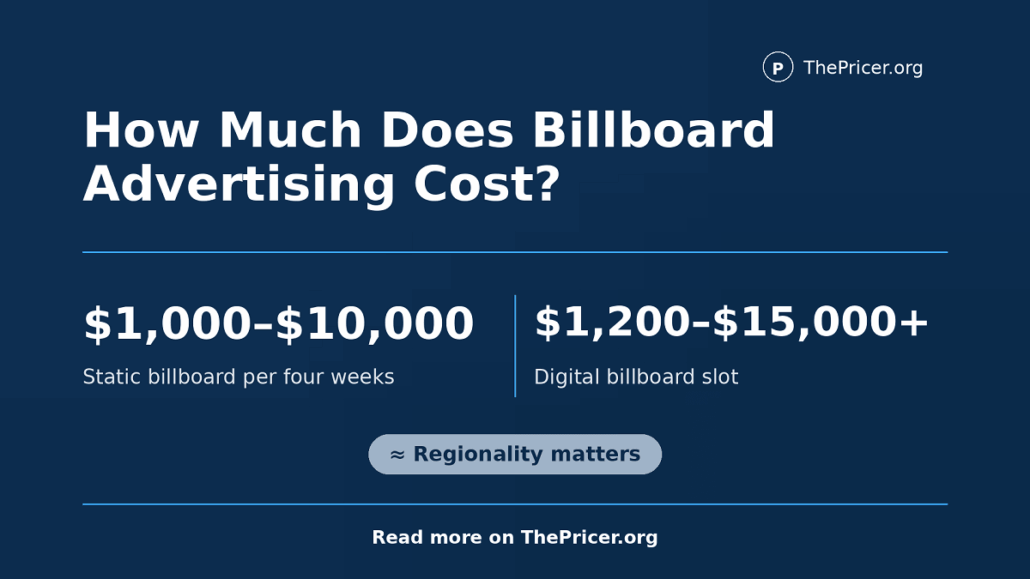
Billboard advertising commonly costs $1,000 to $10,000 per location for a four-week campaign. A small-market poster or rural billboard may cost less than $1,000, while a large bulletin in a major metropolitan area can cost $10,000 to $30,000+.
Digital billboard campaigns generally cost $1,200 to $15,000+ per four-week period when buying a recurring share of a digital display. Self-service digital platforms allow smaller test campaigns starting at roughly $10 to $20 per day, but the advertiser buys individual plays rather than exclusive use of the billboard.
Premium wallscapes, airport approaches, Times Square inventory, the Sunset Strip, and dominant urban placements can cost $25,000 to $150,000+ per four weeks. Design, vinyl production, installation, removal, data targeting, agency fees, and sales tax may be separate.
Article Highlights
Jump to sections
- A standard static billboard commonly costs $1,000 to $10,000 (at $30 per hour, earning that amount would take about 0.8 to 8.3 full-time workweeks, before taxes) per four weeks.
- Large metropolitan bulletins may cost $10,000 to $30,000+.
- A recurring digital billboard slot commonly costs $1,200 to $15,000+.
- Self-service digital tests may start around $10 to $20 per day.
- Premium wallscapes and landmark locations can exceed $100,000.
- Traditional OOH contracts often use 28-day cycles rather than calendar months.
- Static campaigns may require another $800 to $3,000+ for creative, printing, installation, and removal.
- Billboard impressions measure opportunities to see, not guaranteed attention or purchases.
How Much Does Billboard Advertising Cost?
| Billboard format | Typical four-week cost | How the space is sold |
|---|---|---|
| Junior poster | $300 to $1,000 (about 1.3 to 4.2 full-time workdays at $30 per hour) | Exclusive static face in a small local area |
| Poster billboard | $750 to $3,500 | Exclusive static display, often on surface streets |
| Large static bulletin | $1,500 to $30,000+ | Exclusive vinyl face for one advertiser |
| Digital poster | $1,200 to $5,000+ | Rotating slot shared with other advertisers |
| Large digital bulletin | $3,500 to $25,000+ | Recurring digital slot in a timed loop |
| Wallscape | $10,000 to $150,000+ | Large building-mounted or painted display |
| Self-service digital campaign | $300 to $2,000+ | Individual plays purchased through a bidding platform |
Blue Line Media currently publishes broad planning ranges of $1,500 to $30,000 for large static bulletins, $750 to $2,000 for posters, $300 to $750 for junior posters, and $3,500 to $25,000 for large digital displays per four-week period.
These are vendor estimates rather than universal prices. Actual inventory is priced by the board’s location, audience, visibility, demand, format, contract length, and available dates.
Why Rates Use Four Weeks
Traditional billboard schedules are commonly sold in four-week, or 28-day, periods. A full year therefore contains thirteen advertising cycles rather than twelve calendar months.
A board priced at $4,000 (about 3.3 full-time workweeks at $30 per hour) per four weeks costs $52,000 across thirteen cycles. Multiplying the rate by twelve would understate a full-year schedule by $4,000.
Some operators quote calendar months, weekly periods, or flexible programmatic dates. The contract should identify the exact start and end dates rather than using “monthly” as an assumed billing term.
Static Billboard Costs

A static billboard gives one advertiser continuous display during the contracted period. The creative is normally printed on flexible vinyl and attached to the billboard face.
Small posters in lower-demand markets may cost $750 to $2,500 per four weeks. Large highway bulletins commonly range from $2,000 to $10,000 in secondary markets and $5,000 to $30,000+ in larger metropolitan areas.
A current Blue Line Media Los Angeles guide lists large static bulletins around $5,500 to $14,000 per four weeks, while wallscapes range from $25,000 to $150,000. Individual landmark units can fall outside those ranges.
Static space often requires a longer lead time because the advertiser must finalize artwork, produce the vinyl, transport it, and schedule installation.
Digital Billboard Costs
A digital billboard normally rotates several advertisers in a timed loop. One advertiser might receive an eight-second display once every minute, but loop structure and display time vary by operator and local regulation.
The quoted price buys a recurring share rather than constant exposure. Buyers should ask:
- How long is each display?
- How many advertisers share the loop?
- How many plays are guaranteed?
- Which days and hours are included?
- Can the creative be changed without a fee?
Digital inventory can cost more than a comparable static board because it offers flexible scheduling and fast creative changes. It can also provide a lower entry point because advertisers share the screen rather than purchasing the entire face.
A current New Orleans market guide places large digital bulletins around $3,500 to $5,000 per four weeks, compared with $2,500 to $4,500 for large static bulletins in the same broad market estimate.
Self-Service Digital Campaigns
Self-service platforms allow advertisers to set a daily budget and bid for individual digital billboard plays. This is different from reserving a fixed share of one billboard for four weeks.
Blip describes each ad appearance as a “blip,” usually lasting about 7.5 to 10 seconds. The cost changes according to location, time, demand, and competition.
Its current help center says daily spending can begin around $20 in some locations, although lower-budget options may appear in selected markets. There is no universal flat price for one play.
A $20 daily campaign running for 30 days costs $600. The number of displays depends on the average bid needed to win plays on the selected boards.
ThePricer Digital Test Example
Consider a local restaurant spending $25 per day for 28 days on several digital billboards:
- Media budget: $700
- Creative design: $250
- Two additional creative versions: $150
- Campaign setup and reporting: $100
The completed test costs $1,200. The media itself represents 58.3% of the total budget.
If the campaign receives 140,000 estimated impressions, its CPM is:
$1,200 ÷ 140,000 × 1,000 = $8.57 CPM
Using media cost alone would produce a $5 CPM. Including creative and management gives a more honest campaign cost.
Location Determines the Price
A billboard is not priced by city population alone. Two units within the same market can have dramatically different rates because one offers a longer sightline, better approach angle, heavier traffic, less obstruction, or access to a more valuable audience.
Location factors include:
- Traffic volume
- Road direction and approach angle
- Vehicle speed and congestion
- Distance from the roadway
- Lighting and nighttime visibility
- Nearby buildings, trees, and signs
- Audience income and demographics
- Proximity to the advertiser’s location
- Scarcity of legal billboard inventory
A board near an airport, entertainment district, stadium, tourist corridor, or upscale retail center can command a premium even when another board nearby receives similar raw traffic.
Audience Measurement
Billboard operators may provide impressions, reach, frequency, audience composition, and geographic data. These measures are more useful than population or raw vehicle counts alone.
Geopath defines campaign delivery through metrics including impressions, gross rating points, reach, and frequency. Its OOH measurement glossary emphasizes matching delivery to the advertiser’s demographic target and market definition.
An impression represents an estimated opportunity for someone to see the advertisement. It does not prove that a person looked at the board, read the message, visited a store, or made a purchase.
Ask whether the supplied numbers are Geopath measurements, operator estimates, traffic counts, programmatic forecasts, or another methodology.
How Billboard CPM Works
CPM expresses the cost per thousand estimated impressions:
Campaign cost ÷ estimated impressions × 1,000
A billboard costing $5,000 and delivering 700,000 estimated impressions has a CPM of approximately $7.14.
A cheaper board is not necessarily a better purchase. A $2,000 board delivering 150,000 impressions has a higher CPM of $13.33.
CPM also does not measure audience relevance. A more expensive board close to the advertiser’s stores may generate better business results than a distant board with more traffic.
Creative Design Costs
A basic billboard adaptation using existing brand materials may cost $200 to $750. Original strategy, copywriting, photography, illustration, multiple concepts, or several board sizes can cost $1,000 to $5,000+.
Billboard creative must communicate quickly. OAAA planning guidance says effective outdoor design uses simple layouts and few words for stronger visual impact. Its OOH planning guide stresses clarity rather than dense advertising copy.
Creative costs may include:
- Campaign concept
- Copywriting
- Graphic design
- Photography or stock images
- Legal review
- Resizing for multiple formats
- Digital animation adaptation where permitted
- Proofing and final production files
Printing and Installation
Static billboards require a printed vinyl face or another approved production material. The total production charge may include printing, finishing, reinforced edges, shipping, installation, removal, and disposal.
A standard large bulletin face may add approximately $700 to $2,500+. Specialty extensions, dimensional objects, lighting changes, or difficult installation can cost much more.
Ask whether production is included in the media quote. Some operators include standard posting for longer contracts but charge separately for each creative change.
Digital billboards avoid vinyl printing and installation. They may still carry creative resizing, file preparation, trafficking, or campaign-management fees.
Roadside Digital Restrictions
Digital billboard does not automatically mean full-motion video. Roadside displays are commonly governed by federal guidance, state law, local sign codes, and media-owner rules.
OAAA’s industry overview notes that roadside digital billboards generally must not flash, scroll, or display full-motion content under applicable highway guidance. It also discusses brightness controls and minimum display times in its OOH reference guide.
Animation may be available on pedestrian displays, indoor networks, transit screens, and selected urban signs. The advertiser should obtain creative specifications for the exact unit before designing motion content.
Contract Length and Discounts
A one-cycle test generally has less negotiating power than a six-month or annual commitment. Multi-board packages may also lower the effective rate per location.
Possible discounts include:
- Multiple consecutive cycles
- Several units purchased together
- Remnant or last-minute inventory
- Lower-demand seasonal periods
- Nonprofit or public-service pricing
- Flexible locations selected by the media owner
Discounts should be compared with the cancellation terms. A lower annual rate may create a large obligation if the campaign performs poorly or the business changes locations.
Hidden Campaign Costs
- Agency commission
- Creative strategy and design
- Vinyl production
- Shipping and installation
- Creative removal or replacement
- Premium daypart or timing
- Audience data and targeting
- Programmatic technology fees
- Proof-of-performance reporting
- Sales tax
- Permit or approval costs for custom installations
- Contract cancellation charges
A media quote of $5,000 can become a $7,000 to $9,000 campaign after production, creative, management, and measurement are included.
Static Campaign Example
Consider a home-services company renting one local static bulletin:
- Four-week media rental: $4,500
- Creative design and copy: $650
- Vinyl printing and finishing: $1,100
- Installation and later removal: $500
- Campaign reporting: $250
The total is $7,000. Non-media charges add $2,500, increasing the advertised rental rate by 55.6%.
Running the same creative for three cycles would spread the one-time production costs over a larger media purchase. Replacing the vinyl every cycle would eliminate much of that efficiency.
Tracking Billboard Results
Billboards do not provide automatic clicks like search advertising. Advertisers need a measurement plan before the campaign begins.
Tracking methods include:
- A memorable campaign URL
- A unique phone number
- A location-specific offer code
- Website traffic changes by geography
- Branded-search volume
- Store visits or sales during the campaign
- Customer surveys asking how they heard about the business
A QR code is often difficult and unsafe for drivers to scan. It may work better on pedestrian posters, transit shelters, or place-based displays where viewers can stop.
When Billboards Make Sense
Billboards work best when the advertiser has a simple message, a geographically concentrated audience, and enough exposure to build recognition over time.
Good candidates include restaurants, hospitals, attorneys, real estate developments, attractions, retail stores, automotive dealers, events, universities, and home-service companies.
They are less suitable when the offer needs a long explanation, the audience is extremely narrow, or the business cannot track calls, visits, searches, or sales.
Local businesses comparing formats can review the cost of mall advertising, which provides slower pedestrian exposure rather than brief roadside viewing.
Choosing a Location
Visit the location during the hours your target audience travels. Check the board from the actual approach direction rather than judging only from a map or sales photograph.
Look for:
- A clear and long sightline
- Minimal tree or building obstruction
- Readable angle and height
- Traffic moving toward the business
- Proximity to an exit or turn
- A natural audience match
- Limited competition from nearby signs
Ask for recent photographs, unit identification, estimated impressions, illumination hours, digital loop details, and proof that the exact location remains available.
Reducing Billboard Costs
Start with one target corridor rather than buying several disconnected locations. Test a four-week cycle, measure response, and expand only when the data justify it.
Use digital inventory when the message must change frequently. Use static when one strong message can remain in place for several cycles.
Negotiate production, installation, and creative changes before signing. Ask whether unused or remnant inventory is available at a reduced rate.
Keep the design simple. A crowded layout costs more to develop and usually communicates less effectively.
Current OOH Market
Out-of-home advertising remains a large and growing media category. OAAA reported that U.S. OOH revenue reached a record $9.46 billion in 2025, an increase of 3.6% from the prior year.
Industry growth does not guarantee that one billboard will produce a profit. Results depend on the location, message, audience, repetition, offer, and measurement plan.
What We Verified
- Checked current broad static, digital, poster, bulletin, and wallscape price ranges.
- Confirmed that traditional billboard schedules commonly use four-week periods.
- Separated full-cycle digital purchases from pay-per-play campaigns.
- Reviewed current Blip display length and budget guidance.
- Verified Geopath definitions for impressions, reach, and frequency.
- Checked OAAA roadside digital and creative guidance.
- Confirmed current 2025 U.S. OOH industry revenue.
- Compared current Los Angeles and New Orleans market estimates.
Answers to Common Questions
How much does a billboard cost for one month?
A typical static billboard costs about $1,000 to $10,000 per four weeks. Major-market and premium placements can cost $10,000 to $100,000+.
How much does a digital billboard cost?
A recurring digital slot commonly costs $1,200 to $15,000+ per four-week period. Self-service campaigns may start around $10 to $20 per day.
Do you pay for the billboard design separately?
Often, yes. Basic creative may cost $200 to $750, while original strategy and multiple designs can cost $1,000 to $5,000+.
Is printing included?
Not always. A static vinyl face, finishing, shipping, installation, and removal may add $700 to $2,500+.
How long is a billboard contract?
Many campaigns are sold in 28-day periods. Advertisers can buy one cycle, several consecutive cycles, or an annual schedule of thirteen cycles.
How is billboard performance measured?
Common metrics include estimated impressions, reach, frequency, CPM, geographic delivery, website traffic, calls, branded searches, and store visits.
Are billboard impressions guaranteed views?
No. They represent estimated opportunities to see the display, not proof that every passing person noticed or acted on the advertisement.
Disclosure: Educational content, not financial advice. Prices reflect public information as of the dates cited and can change. Confirm current rates, fees, taxes, and terms with official sources before purchasing. See our methodology and corrections policy.