
How Much Does a Bombay Cat Cost?
Updated on | Written by Alec Pow
This article was researched using 14 sources. See our methodology and corrections policy.
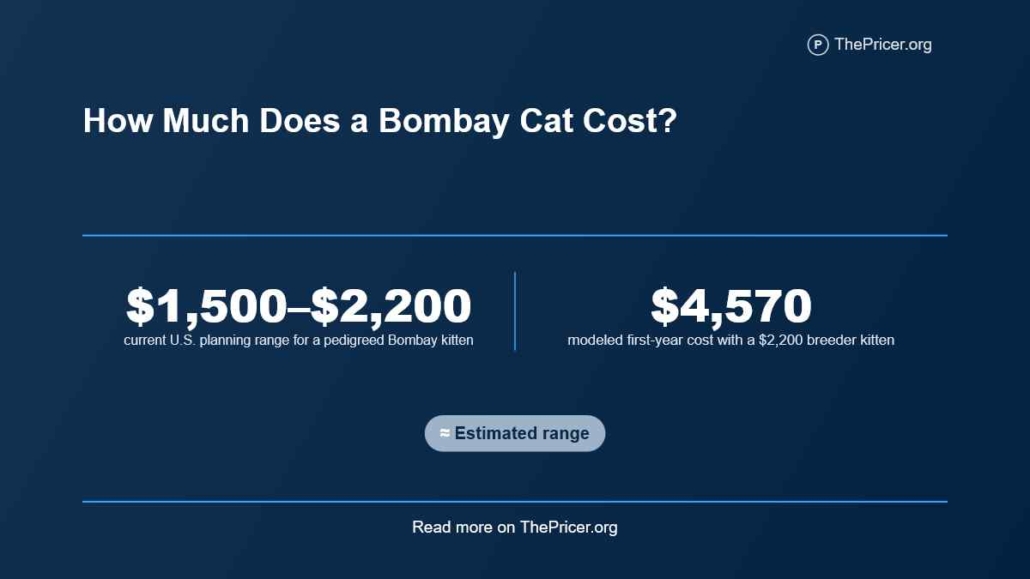
A pedigreed Bombay kitten currently costs about $1,500 to $2,200 in the United States. PetMD places Bombay kittens near $1,500 to $2,000, while one active U.S. Bombay breeder currently lists pet kittens at $2,200. Adoption is much cheaper, with cats labeled Bombay commonly listed around $100 to $300. The large gap exists partly because a shelter’s breed label does not prove pedigree.
Bombays are a rare registered breed created from Burmese and black American Shorthair lines. A real breeder purchase can include pedigree documentation, early veterinary work, a written contract, and health protections. The purchase price still covers only part of the first year. Food, litter, sterilization, microchipping, insurance, routine veterinary care, and basic equipment can push a breeder-kitten first year above $4,500.
Article Highlights
Jump to sections
- Use roughly $1,500 to $2,200 (at $30 per hour, earning that amount would take about 1.3 to 1.8 full-time workweeks, before taxes) as a current U.S. planning range for a pedigreed Bombay kitten.
- One active breeder currently lists pet Bombay kittens at $2,200 and a retired adult Bombay at $600.
- Adopt a Pet places Bombay-labeled shelter and rescue adoption around $100 to $300.
- A modeled first year with a $2,200 breeder kitten comes to about $4,570 before dental work, boarding, travel, or emergencies.
- TICA identifies hypertrophic cardiomyopathy as a condition that warrants cardiac screening in Bombay breeding cats.
- Bombay grooming is light, so repeated professional grooming should not be built into a normal monthly budget.
How Much Does a Bombay Cat Cost?
Current market evidence points to a much tighter breeder budget than the old $500 to $2,500 (about 0.4 to 2.1 full-time workweeks at $30 per hour) headline. PetMD says Bombay kittens cost $1,500 to $2,000. The same veterinary profile says only a handful of Bombay breeders operate in the United States and that buyers may face waits of 6 to 12 months. Supply is limited.
A current California breeder lists pet Bombay kittens at $2,200. The same page lists a retired adult Bombay at $600. Adopt a Pet places Bombay adoption around $100 to $300 and gives a lower secondary breeder estimate of $800 to $1,500. The direct breeder offer and current veterinary breed guidance support the higher planning band used here.
| Acquisition route | Current price | Scope |
|---|---|---|
| Shelter or rescue label | $100 to $300 | Cat listed as Bombay, pedigree often unverified |
| Retired breeder adult | $600 | One current breeder example |
| Veterinary breed-price guidance | $1,500 to $2,000 | Current U.S. breeder-kitten guidance |
| Active breeder kitten | $2,200 | Current pet-kitten asking price |
The useful buyer question is not whether a black cat can be found for less. It can. The useful question is whether the quoted price buys a documented pedigreed Bombay, a retired pedigreed adult, or a black domestic cat carrying a Bombay label.
What Makes a Bombay a Bombay?
The Bombay was created to resemble a miniature black panther while remaining a fully domestic cat. The Cat Fanciers’ Association dates the birth of the Bombay breed to 1966, when Kentucky breeder Nikki Horner combined Burmese and black American Shorthair cats. CFA later accepted the breed for championship competition. The Bombay name refers to the black-leopard look rather than an origin in India.
A registered Bombay is more narrowly defined than a black household cat. The breed has a short glossy black coat, a muscular compact body, and copper to gold eyes under U.S. registry standards. Pedigree records trace the cat through recognized breeding lines. Appearance cannot provide that paper trail. A black domestic shorthair may have a glossy coat and copper eyes without being a pedigreed Bombay.
This distinction changes how price should be read. A low shelter fee buys a companion cat that a shelter or listing service identifies as Bombay or Bombay mix. A breeder price can buy documented ancestry, contract terms, planned breeding, early socialization, and veterinary work. Those are different acquisition products even when two cats look similar in a photograph.
Breeder vs Adoption Prices
Using the already cited $2,200 (about 1.8 full-time workweeks at $30 per hour) breeder example and $100 to $300 adoption band, the acquisition gap is $1,900 to $2,100. The arithmetic is $2,200 – $300 = $1,900 at the high adoption fee and $2,200 – $100 = $2,100 at the low fee. That difference is acquisition cost only. It does not mean one route will cost $1,900 to $2,100 less over the cat’s full life.
Shelter pricing can carry substantial value because many organizations sterilize, vaccinate, and microchip cats before adoption. The exact inclusions differ by organization. Breed identification is the tradeoff that needs careful wording. A rescue group may identify a sleek black cat as Bombay from appearance and behavior without registry papers or a known pedigree. An adult cat may also arrive with established household habits that make its day-to-day fit easier to judge.
A buyer focused on pedigree, showing, or a known breeding line needs documentation that an adoption listing usually cannot supply. Someone seeking an affectionate black companion may not need that documentation at all. Readers comparing other rare or pedigreed cats can also see current Nebelung cat costs, where pedigree verification creates a similar pricing problem.
What to Verify With a Breeder
A breeder price should be read alongside the paperwork and care attached to the kitten. Ask whether the cat will be registered, which registry issued the pedigree, whether the sale is pet-only, what vaccinations have been completed, whether sterilization is included or required later, and what the written health guarantee covers. A large price tag without those details does not establish responsible breeding.
The International Cat Association provides a member breeder listing system that lets buyers look for breeders connected with the registry. Registry membership is still only one check. Buyers should match the seller’s identity, registered cattery name, parent information, contract, and health records before sending a deposit. Limited U.S. supply also means a buyer may need to join a waiting list rather than purchase the first black kitten advertised as Bombay.
Price comparisons should use the same scope. A kitten sold with pedigree papers and early veterinary work is not directly comparable with an unregistered kitten, a retired adult, or a shelter cat. The same rule applies to breeding rights. If a seller charges extra for rights or show prospects, that premium needs to be separated from the normal companion-kitten price rather than blended into one broad range.
First-Year Bombay Budget
A current first-year scenario can be built without inventing a special Bombay diet or salon schedule. CareCredit’s 2026 cat ownership cost data puts an initial veterinary visit at $50 to $250, spay or neuter at $40 to $300, microchipping at $30 to $80, food and treats at $30 to $90 per month, and litter at $15 to $75 per month. Its current equipment list also supports a basic setup with bowls, litter box, scoop, bed, scratcher, toys, brush, and nail clippers.
Use the already cited $2,200 breeder kitten and choose midpoints of $150 for a follow-up veterinary visit, $170 for sterilization, $55 for microchipping, $60 per month for food, and $45 per month for litter. Add an explicit $300 moderate setup assumption. Current NAPHIA 2026 data, reported in a 2026 pet insurance comparison, puts U.S. cat accident-and-illness coverage at an average $435 per year.
The itemized total is $2,200 + $150 + $170 + $55 + $720 + $540 + $300 + $435 = $4,570. The breeder purchase is about 48% of that modeled first-year bill, leaving $2,370 for the selected care and setup lines. In this scenario, those non-purchase costs exceed the kitten price by $170. Dental work, boarding, travel, and emergencies are excluded.
Annual Bombay Ownership Costs
After the first year, the purchase price and most setup expenses disappear. Rover’s 2026 adult cat cost research places yearly ownership around $850 to $4,400. Food spans about $225 to $1,920 per year, litter about $125 to $580, routine examinations about $80 to $200, and toys about $20 to $350. Insurance, dental work, boarding, and medical problems can move a household toward the upper end.
Bombays do not need food formulated for the breed. A nutritionally complete cat food suited to age, body condition, and medical needs is the useful starting point. Wet food, dry food, or a mixture can all create different monthly bills. The old article’s instruction to buy a special high-protein Bombay diet and automatically combine wet and dry food turned a normal cat-care decision into a breed surcharge without evidence.
Grooming also stays inexpensive for many owners. A healthy shorthaired Bombay does not create a separate breed surcharge for litter, bowls, or routine grooming tools. That separates the Bombay from longer-coated cats such as the Persian cat and Birman cat. Boarding and pet sitting remain optional lifestyle costs rather than fixed monthly expenses.
Health, Grooming, and Insurance
Bombay coat care is light, but cardiac screening deserves attention. TICA health and grooming guidance recommends weekly brushing for the short fine coat and identifies hypertrophic cardiomyopathy as a condition that breeders should screen for with echocardiography. The breed does not need scheduled haircuts or repeated salon grooming. Money that would have been assigned to monthly grooming is better left available for veterinary and dental expenses.

Dental work can become a much larger bill. Current CareCredit research places cat and dog dental cleaning around $300 to more than $700, before added treatment changes the total. Home tooth brushing can reduce plaque buildup, but ordinary dry kibble should not be presented as a replacement for dental care.
Insurance needs the same separation between routine and unexpected care. Standard accident-and-illness plans usually do not pay for routine vaccinations or wellness visits unless preventive coverage is added. Progressive’s routine-care coverage explanation makes that distinction explicit. A Bombay owner comparing policies should check hereditary-condition language, dental illness terms, annual limits, reimbursement percentage, deductible, and waiting periods rather than compare monthly premiums alone. A lower premium can still leave a larger share of a major claim with the owner.
Choosing the Right Bombay Route
The strongest value depends on what the buyer actually wants. A registered breeder kitten makes sense when pedigree, predictable ancestry, breeder support, and documented early care matter. A shelter cat can be the better fit when companionship matters more than papers and the buyer is comfortable with uncertain ancestry. Neither route makes a black coat proof of breed.
The first-year math also changes the decision. The modeled breeder route reaches about $4,570. Replacing the $2,200 purchase with a $200 adoption fee while holding every other modeled cost constant would lower the same illustrative total by $2,000, to about $2,570. Real adoption inclusions may lower it further if sterilization or microchipping is already covered.
Makes sense if
- You want documented Bombay ancestry rather than a black-cat look alone.
- You can afford the breeder price without using the money reserved for routine care.
- You can review the contract, health records, and relevant parent screening.
- You want a highly social cat and can provide regular interaction.
Does not make sense if
- You are paying a pedigree-level price without pedigree documentation.
- You are choosing the breed because you expect unusually cheap lifetime care.
- Your budget stops at the kitten purchase.
- You need a cat that is content with long periods of little human interaction.
Answers to Common Questions
How much does a Bombay kitten cost?
Current U.S. evidence supports about $1,500 to $2,200 for a pedigreed breeder kitten. One active breeder currently lists pet kittens at $2,200.
How much does it cost to adopt a Bombay?
Published adoption guidance is about $100 to $300. A shelter or rescue breed label does not automatically prove pedigree.
How much should I budget for the first year?
The worked breeder-kitten scenario above totals about $4,570 for purchase, routine first-year care, food, litter, setup, and insurance. Dental work, emergencies, boarding, and travel are excluded.
Are Bombay cats expensive to groom?
No recurring salon schedule is required for most Bombays. Their short coat can usually be maintained with simple home brushing and normal nail, ear, and dental care.
How can I tell whether a black cat is a real Bombay?
For a pedigreed Bombay, ask for registry and pedigree records that identify the cat and its parents. Black coat color, body shape, and copper eyes can support a visual identification but cannot establish ancestry by themselves.
Disclosure: Educational content, not medical advice. Pricing varies by provider, location, and insurance. Confirm eligibility, coverage, and out-of-pocket costs with a licensed clinician and your insurer. See our methodology and corrections policy.