
How Much Does Book Binding Cost?
Updated on | Written by Alec Pow
This article was researched using 11 sources. See our methodology and corrections policy.
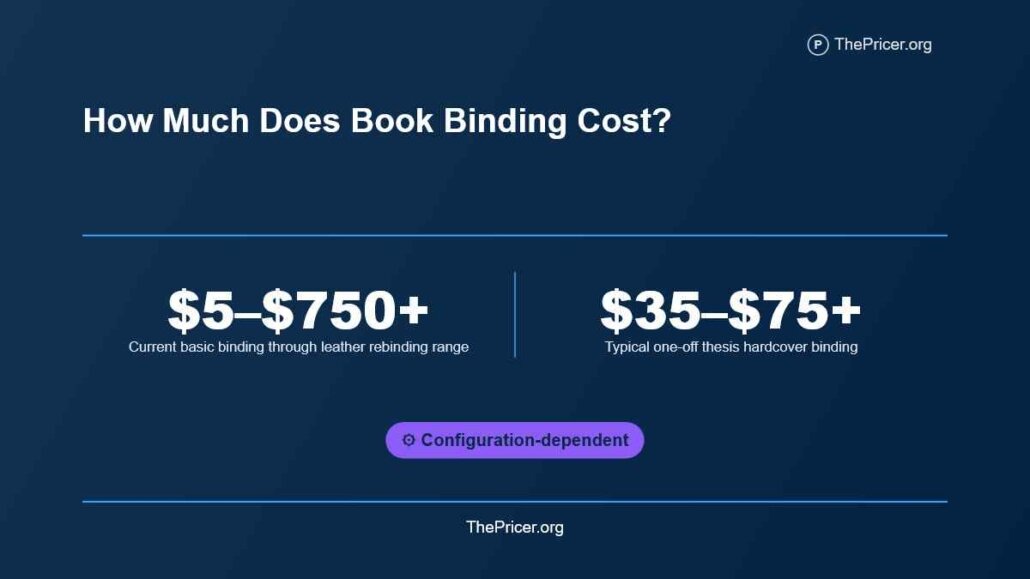
Book binding can cost from about $5 for basic spiral-bound documents to $35 to $75+ for a one-off thesis hardcover, $150 to $350+ for a custom hand-bound cloth book, and roughly $150 to $750+ to repair or rebind an existing book. Fine leather work, extensive restoration, decorative tooling, or oversized books can push the price beyond $1,000.
The number can be confusing because “book binding” describes several different purchases. A copy shop may charge only a few dollars to punch and coil-bind printed pages. A self-publishing printer may quote a per-copy price that includes printing and binding. A traditional bindery may spend hours sewing, repairing, casing, covering, and titling one heirloom book by hand.
For a simple report or manual, budget roughly $5 to $20. For a professionally bound thesis, a practical starting point is about $37 to $75+ before printing and shipping. For a damaged Bible, cookbook, novel, or family book that needs to be rebuilt, current professional examples commonly land around $150 to $450+, with leather work reaching $450 to $750+.
Article Highlights
Jump to sections
- Basic spiral-bound document services can start around $4.86.
- A current thesis bindery charges $37 to $47.50 for one to four fabric hardcovers depending on page count, with cowhide leather adding $25 per book.
- Current commercial softcover production can cost about $3.37 to $4.33 per book for a 50-page black-and-white title when ordering 100 to 500 copies.
- The same 50-page book in printed hardcover currently costs about $20.48 to $25.85 per copy in those quantities.
- Custom hand-bound cloth books can start around $150, with leather starting around $250 at one current bindery.
- Current book repairs range from about $75 for limited work to $400+ for significant restoration, while leather rebinding can reach $450 to $750+.
How Much Does Book Binding Cost?
| Type of binding job | Current price signal | What the price represents |
|---|---|---|
| Basic document or spiral binding | $5 to $20+ | Reports, manuals, school projects, presentations |
| Printed softcover books | $3.37 to $10+ per copy | Commercial print runs, quantity dependent |
| Printed hardcover books | $20 to $45+ per copy | Commercial runs of professionally printed books |
| Thesis hardcover, binding only | $37 to $72.50+ | One-off academic hardcover depending on pages and material |
| Custom cloth-bound book | $150 to $350+ | Hand-bound manuscript, presentation book, keepsake |
| Custom leather book | $250 to $850+ | Hand binding with genuine leather and optional decoration |
| Book repair | $75 to $425+ | Hinges, spine, pages, case, structural repair |
| Full leather rebinding | $360 to $750+ | Existing book rebuilt with a new leather cover |
The cheapest end of the market is commercial document finishing. Staples currently lists Custom Manuals starting at $4.86, with spiral binding among the available finishing choices. The complete price changes with page count, paper, color printing, quantity, and upgrades.
That is a very different service from asking a craft binder to dismantle and rebuild a damaged family Bible. The word “binding” is the same, but the labor and materials are not.
What You’re Actually Paying For

Binding-only means the pages already exist and a bindery is assembling them into a finished volume. Printing-and-binding means the company is producing the interior pages and cover before binding the book. Rebinding starts with an existing book and replaces some or all of its failed binding structure. Restoration can go further by repairing torn pages, sewing, hinges, boards, leather, or other original components.
Those categories should never share one per-book price. Automated commercial production spreads setup and machine costs across dozens or hundreds of copies. A one-off custom binder may handle almost every operation manually.
Materials matter too. Plastic coil, paper covers, binder’s board, book cloth, imitation leather, genuine leather, decorative papers, foil, and custom stamping dies have very different material and labor costs.
Printed Books Get Cheaper in Volume
Commercial printing is where quantity has the clearest effect on price per copy. Current Gorham Printing price charts list a 5.5-by-8.5-inch, 50-page black-and-white softcover at $4.33 per copy for 100 books, $3.73 at 250 books, and $3.37 at 500 books.
Mini case 1, volume discount: Moving from 100 to 500 copies reduces the unit price by $0.96, or about 22.2%. The 100-book order costs about $433, while 500 copies cost about $1,685. Volume lowers the unit price, but spending more in total only makes sense when the extra books will actually be used or sold.
The same supplier currently prices a 50-page printed hardcover at $25.85 per copy for 100 books and $20.48 at 500.
Mini case 2, hardcover premium: At 100 copies, the $25.85 hardcover costs $21.52 more per book than the $4.33 softcover. Across the entire 100-copy order, choosing hardcover adds about $2,152.
That comparison includes printing and binding. It should not be compared directly with a quote for binding pages that have already been printed.
Thesis and Dissertation Binding
Academic binding sits between copy-shop finishing and fully custom hand binding. Current PhD Bookbinding prices for one to four single-sided fabric or printed hardcovers start at $37 for 1 to 250 pages, $41 for 251 to 350 pages, $45 for 351 to 450 pages, and $47.50 for 451 to 550 pages.
Cowhide leather adds $25 per book. That puts a 200-page leather-bound thesis at about $62 for binding and a 500-page leather version at about $72.50, before any separate printing, shipping, or other options.
Quantity also lowers the binding price. For 21 or more copies, the same supplier lists a 1-to-250-page binding at $23.02 per copy rather than $37.
Mini case 3, thesis quantity: Twenty-one copies at $23.02 each would cost about $483.42 for binding. Pricing the same 21 books at the one-to-four-copy rate of $37 would equal $777. The published bulk tier therefore reduces the theoretical total by $293.58.
Custom Binding Costs More
A one-off handmade book is priced around skilled labor rather than a production line. Advantage Book Binding currently starts custom cloth-covered books at $150 and leather-bound books at $250, with printing charged separately.
Another current custom binder, JesterCat Binding Co., lists ordinary custom rebinding around $150 to $250 and leather-and-foil projects around $450 to $750. Its custom print-and-bind work often falls around $250 to $350.
The current custom binding price guide also shows why decorative choices matter. Genuine leather, hot foil, embossing, custom endpapers, raised bands, edge treatments, typesetting, and pre-binding repairs all add labor or material cost.
Custom binding can therefore cost more than printing dozens of ordinary paperbacks. The buyer is paying for an individually made object rather than simply fastening pages together.
Repair and Rebinding Prices
Many people searching for book-binding prices actually have an existing book falling apart. That is a repair question, not a printing question.
Current Haunton House 2026 pricing uses a labor rate of $65 per hour with a three-hour minimum. Its examples include minor repair around $200, moderate repair around $223 to $400, major repair at $423+, new binding at $300+, and leather rebinding from $360+.
Materials can add another $5 to $10 for simple consumables or around $20 to $120 when decorative paper, book cloth, or leather is required.
The existing book’s condition matters more than its original retail price. A $20 paperback with sentimental value can easily justify a $150 to $250 rebind, while repairing a common book with no personal or collectible significance may cost more than simply replacing it.
Rare or historically valuable books require another decision. Aggressive rebinding can alter collectible value. A qualified conservator or specialist bookbinder should examine valuable material before original covers, sewing, endpapers, inscriptions, or other historic components are replaced.
The Binding Add-On Trap
One of the easiest pricing mistakes is reading a printer’s binding surcharge as the complete cost of a book. Current 48 Hour Books pricing lists perfect binding at $0 additional per book, spiral coil at $0.60 extra per book, and case binding at $10 extra per book.
Those are binding choices added to the underlying printing quote. A $0.60 coil option does not mean a complete printed spiral book costs sixty cents.
Worked example: On a hypothetical order of 100 otherwise identical books, choosing spiral rather than perfect binding adds $60. Choosing case binding instead adds $1,000. The interior printing, cover printing, paper, page count, size, shipping, and other options still have to be priced separately.
The current binding selector is a useful example of why every quote should be checked for what is included rather than compared on one isolated number.
Decoration Can Rival the Binding
Cover decoration can become a meaningful part of a one-off project. Over Yonder Press currently quotes custom new books from about $195 to $850 depending on size and material. Its current custom binding price list charges $40 setup plus $1 per character for titling and $110 to $135 for a custom logo or artwork stamping die.
A title containing 25 stamped characters would therefore cost about $65 using that published formula. Adding a $125 custom die brings those two decorative operations to about $190 before the book itself is bound.
This is why a custom leather presentation book, wedding album, family history, or memorial book can reach several hundred dollars even when it contains relatively few pages.
What We Verified
- Checked: Advantage Book Binding currently lists custom cloth books from $150, leather books from $250, existing-cover repairs from $75, and new-cover repairs from $125 to $150+ in its 2026 price guidelines.
- Confirmed: 48 Hour Books says its perfect-bound paperbacks can range from 16 to 1,052 pages, so a universal 500-page maximum for glued paperback binding is incorrect.
- Cross-referenced: its spiral binding specifications recommend up to about 350 pages, with as many as 500 possible in some cases using special coils.
- Verified: Advantage says accurate custom quotes require binding style, trim size, page count, printing specifications, cover material, and foil requirements in its binding FAQ.
Related Printing Costs
For a straightforward school, office, or presentation project, our guide to the cost to get a book spiral bound at Staples is a closer comparison than a handmade bindery quote.
If the pages still need to be produced, compare current Staples printing costs before adding binding and finishing.
Another copy-shop option is covered in our guide to Office Depot printing prices, which can be useful for reports, manuals, presentations, and other short-run documents.
Answers to Common Questions
How much does it cost to bind one book?
A simple spiral-bound document can start around $5 to $20. A one-off thesis hardcover may cost around $37 to $75+, while a custom hand-bound book commonly starts around $150.
How much does it cost to rebind an old book?
Basic repairs can start around $75 to $200, while more substantial work commonly reaches $200 to $425+. A full custom leather rebind can cost around $360 to $750+.
Is hardcover binding more expensive than paperback?
Yes. In one current commercial printing example, a 50-page softcover costs $4.33 per copy at 100 copies, while the corresponding printed hardcover costs $25.85.
How much does thesis binding cost?
A current specialist charges about $37 to $47.50 for one to four fabric hardcovers depending on page count. Cowhide leather adds $25 per copy, and printing can be separate.
Can a 500-page book be perfect bound?
Yes, depending on the printer, trim size, paper, and equipment. One current commercial printer accepts perfect-bound books up to 1,052 pages, although thicker books can require additional curing or production time.
Is DIY book binding cheaper?
It can be after the necessary tools are already owned, especially for hobby projects. A first project may require paper, board, adhesive, thread, needles, cutting tools, cloth, and pressing equipment, so there is no reliable universal percentage by which DIY is cheaper than professional work.
Disclosure: Educational content, not financial advice. Prices reflect public information as of the dates cited and can change. Confirm current rates, fees, taxes, and terms with official sources before purchasing. See our methodology and corrections policy.