
How Much Does It Cost To Drill A Bowling Ball?
Updated on | Written by Alec Pow
This article was researched using 11 sources. See our methodology and corrections policy.
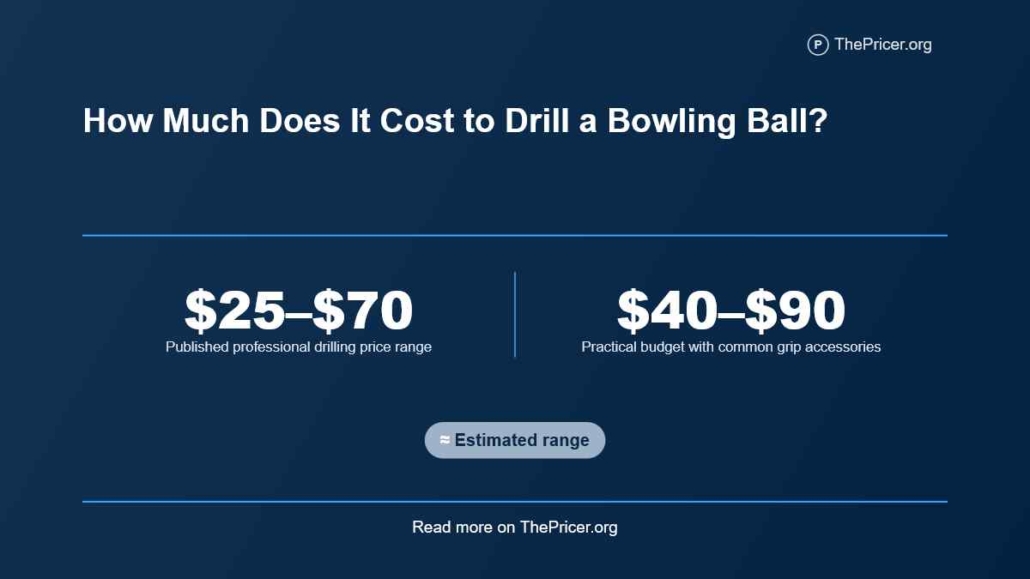
Drilling a bowling ball professionally typically costs $25 to $70 for the drilling and fitting service at U.S. pro shops, with a more practical budget of $40 to $90 when finger inserts, thumb slugs, or additional fitting work are needed. Some shops include basic drilling when you purchase the ball directly from them, while others charge separately for every drilling job.
Published pro-shop prices show why a single national average can be misleading. Conventional drilling may cost just $25 to $35, while fingertip drilling for a ball purchased elsewhere can approach $70 before accessories. The grip style, whether the ball was purchased in-store, and the components included in the quote often matter more than the bowling ball’s coverstock.
These figures cover drilling, not the purchase of the bowling ball itself. Plugging and redrilling an existing ball is a separate service, and the cheapest drilling quote may not include the fitting or grip components a bowler needs.
Article Highlights
Jump to sections
- Professional bowling ball drilling commonly costs $25 to $70 (at $30 per hour, earning that amount would take about 0.8 to 2.3 hours of work, before taxes) based on published U.S. pro-shop menus.
- A reasonable budget for drilling with common grip accessories is $40 to $90, depending on the shop and configuration.
- Some pro shops include drilling with a ball purchased in-store, but still charge for optional inserts.
- Finger inserts can cost about $5 to $15 per pair, while standard thumb slugs often cost $8 to $15 each at the shops reviewed.
- Plugging and redrilling commonly adds an entirely different service charge, with published examples from $40 to $65 for complete jobs.
- Extra balance holes are prohibited in USBC-certified competition, so older drilling advice recommending them is outdated.
How Much Does It Cost to Drill a Bowling Ball?
Independent pro shops publish substantially different drilling fees, but their menus also reveal meaningful differences in what is included. The strongest comparison is between the price to drill a ball purchased elsewhere and the price to drill one purchased from the shop, because these may have different labor charges.
Sports Plus/Carmen Don Bowling Pro Shop in Alexandria, Virginia, publishes conventional fitting and drilling at $35 (about 1.2 hours of work at $30 per hour) and fingertip fitting and drilling at $60. The same menu lists finger inserts at $8 and a thumb insert or slug at $15. Those are posted shop prices rather than estimates derived from unrelated equipment categories.
Storm V.I.P. Pro Shop at Schwoegler’s in Wisconsin offers a particularly useful comparison. Its published drilling price list charges $25 when the ball is purchased there and $45 for a ball purchased elsewhere. Finger grips and thumb slugs are extra.
| Pro shop | Published drilling price | Important distinction |
|---|---|---|
| Sports Plus, Virginia | $35 conventional or $60 fingertip | Fitting and drilling included |
| Schwoegler’s, Wisconsin | $25 in-store purchase or $45 outside ball | Grip accessories extra |
| Sahoma Lanes, Oklahoma | $35 plastic/urethane or $50 reactive | Outside balls, drilling included with shop purchase |
| Solid 9 Pro Shop | $50 per ball | Published June 2026 rate includes fitting consultation |
| Bowling Dynamix, Texas | $49.95 conventional or $69.95 fingertip | Outside balls, grip accessories extra |
| BnD Pro Shop, California | $40 | New or used ball drilling |
These are selected public offers, not a statistically representative survey of U.S. bowling shops. Bowling.com’s professional drilling price guidance independently describes approximately $40 to $70 as a practical general reference.
The quotes should be compared with the same grip style, accessories, and ball-purchase status. A $35 conventional job is not necessarily a cheaper substitute for a $60 fingertip job because the bowler is purchasing a different grip configuration.
What Drilling Includes
Professional ball drilling begins with determining how the ball should fit the bowler’s hand. The technician assesses finger and thumb dimensions where applicable, span, pitches, grip style, and other measurements. Holes are then positioned and drilled according to the fitting and the selected layout.
Conventional and fingertip grips are not identical. A conventional grip generally allows more of the fingers into the holes and is common on introductory equipment. A fingertip grip normally involves shallower finger insertion and can use removable finger inserts. Many experienced bowlers prefer fingertip configurations, but the appropriate fit depends on the individual rather than an automatic progression toward the most expensive option.
Bowling manufacturer Storm’s drilling specification resources explain why layout measurements and the bowler’s positive axis point, or PAP, can matter when positioning the ball’s core relative to the grip. A performance layout is not simply a matter of drilling holes at attractive-looking locations.
For an entry-level polyester spare ball, accurate hand fitting may be more important than extensive performance-layout analysis. A performance ball can warrant additional attention to drilling angles, the core, the bowler’s release, and the desired ball reaction. The technician should explain which measurements are part of the quoted service.
One important distinction is that a low price does not automatically mean the holes are generic or unsuitable. A shop offering conventional drilling may still measure the customer’s hand carefully. Conversely, a premium drilling fee does not guarantee better scores. Comfort, release consistency, lane conditions, and the ball itself all affect performance.
Grip Accessories and Fees
One of the most common sources of unexpected expense is a drilling quote that excludes the installed grip components. Finger inserts, thumb slugs, and interchangeable thumb systems are separate products and may also require extra fitting or installation work.
Countryside Proshop in North Carolina publishes installed finger insert prices of $6 each and thumb slugs at $12 (about 24 minutes at $30 per hour). It also states that balls purchased there include drilling, with inserts charged separately where needed.
Other shops have different arrangements. The Sahoma Lanes service menu lists installed finger inserts at $7 each when drilling and installation are involved, standard thumb inserts or slugs at $15, and interchangeable-thumb components or combinations at separately posted prices. Its listed drilling charges depend partly on ball type.
Premier Bowlers in Michigan publishes custom fingertip drilling at $40, with finger grips at $2.50 each under its drilling add-ons and a thumb insert at $10. It also lists layout and fitting services separately, making it worth asking which work is already included.
For someone who prefers a removable thumb component, an interchangeable system can carry costs for the outer receiver and the fitted inner component. Those costs differ from a conventional fixed thumb slug. A bowler with several balls may value the ability to use a consistent thumb fit across equipment, but compatibility and installation charges should be confirmed before purchasing.
The hidden-cost question is not simply whether a shop sells inserts. It is whether the advertised drilling charge includes measuring, boring the holes, supplying the grips, installing them, and adjusting the fit. Asking for one complete fitted-ball price prevents a cheap labor quote from being confused with the total service bill.
Three Drilling Budgets
Different bowlers may pay different amounts even at the same shop. The relevant differences include grip style, ball origin, and whether the ball needs modifications. The following scenarios use actual posted service prices, with the combined totals calculated from the listed components.
Conventional beginner ball
A recreational bowler could choose Sports Plus’s conventional fitting and drilling service for $35. If no separate grip hardware is required, that is the relevant posted service cost before applicable taxes. The price of the bowling ball itself remains separate.
A beginner comparing a complete equipment purchase should also consider the ball price and whether another shop includes drilling when the ball is purchased there. A lower-priced ball from an online retailer can lose some of its advantage after local drilling is added.
Fingertip ball with inserts
At Sports Plus, the published fingertip drilling charge is $60. Adding two finger inserts at $8 each and one $15 thumb slug produces a modeled total of $91, before taxes and any other requested accessories.
This scenario shows why a customer may spend more than the frequently quoted $40 to $70 drilling range without being overcharged for the labor itself. The additional amount buys installed grip components, and another shop may bundle those same products differently.
Ball purchased elsewhere
Schwoegler’s charges $45 to drill a ball bought elsewhere, compared with $25 for one purchased through its shop. Its menu lists grips at $5 each and a solid thumb slug at $8. Assuming two grips and one thumb slug, the outside-ball service totals $63.
The comparable in-store drilling and accessory total is $43. The difference is $20 per ball, assuming identical grip components. This is a genuine comparison of the same shop’s drilling charges, not a claimed national average or a comparison of different grip types.
Buying Online or Locally
Buying a bowling ball online can be economical, but the relevant comparison is the fully fitted ball rather than the advertised blank-ball price. An online retailer and a local pro shop may have different ball prices, included services, fitting arrangements, and adjustment policies.
Bowling.com states in its customer drilling guidance that it offers basic drilling on select plastic or polyester spare balls and custom drilling on certain higher-end balls. It advises customers who are not confident supplying their own fitting measurements to use a local pro shop.
Consider two hypothetical offers for the exact same bowling ball. An online retailer sells the undrilled ball for $115, while a local pro shop sells it for $135. Using Schwoegler’s published drilling fees, the online purchase with $45 outside-ball drilling totals $160, compared with $160 for the local ball plus $25 in-store drilling.
The apparent $20 online equipment saving disappears. The comparison assumes identical accessories and excludes shipping and tax. If the online purchase also incurs a shipping charge, the local purchase becomes less expensive under these assumptions.
This provides a useful buying threshold. At a shop charging $20 more to drill outside balls, an online ball needs to be more than $20 cheaper than the equivalent in-store ball before any shipping or other differences to produce a genuine saving.
The same approach applies to complete beginner equipment budgets. A bowling budget should distinguish the initial personal-equipment purchase from ongoing lane fees and shoe rental. A fitted ball is usually a one-time purchase, while lane access remains a recurring expense.
Redrilling and Repairs
 A bowling ball does not always need to be replaced when its holes no longer fit. A pro shop can fill existing holes with plugging material, allow the repair to cure, and drill a revised grip or layout. Whether this is appropriate depends on the ball’s condition, the desired modification, and the shop’s assessment.
Solid 9 Pro Shop’s June 2026 service schedule lists drilling at $50 per ball and plug-and-redrill work at $65, with new finger inserts included in the latter price. Its standalone grip charges also provide a useful benchmark for understanding the combined service.
BnD Pro Shop in California lists new or used ball drilling at $40 and plug-and-redrill work at $40, with grip accessories charged separately. These differences show why an identical service label may not always include identical materials.
Redrilling can be worthwhile for a secondhand ball when the coverstock is in good condition and the total modification cost remains comfortably below the price of a suitable replacement. The calculation becomes less attractive if the ball also requires extensive resurfacing or has cracks that affect its usefulness.
Used-ball purchases deserve additional caution because the previous owner’s grip may not match the new buyer’s hand or release. The seller’s price is only one part of the transaction. Plugging, drilling, inserts, and surface restoration may be necessary before the equipment is useful.
Many shops also provide maintenance services, including cleaning, polishing, resurfacing, and oil extraction. These are not automatically required every time a ball is drilled. Their cost and value depend on the condition of the existing equipment and how extensively it has been used.
Rules and DIY Drilling
Bowling ball drilling must also account for equipment rules if the ball will be used in sanctioned competition. The United States Bowling Congress prohibits balance holes, a major change from older drilling practices that used additional holes to alter ball reaction or static weight.
The USBC playing rules resources provide the current competition framework. The prohibition on extra balance holes took effect in August 2020, so a current drilling service should not recommend adding one for USBC-certified play.
For bowlers who deliver the ball without using the thumb, the equipment configuration requires attention. An unused thumb hole can be treated as an impermissible balance hole under the applicable rules, and a ball without a thumb hole requires the appropriate grip-orientation marking. A qualified technician should account for the bowler’s actual delivery and the competition rules.
Do-it-yourself drilling is possible in principle, but a household drill and ordinary hand tools are not equivalent to a properly equipped pro shop. Accurate measurement, secure positioning, suitable tooling, and knowledge of the ball’s construction are necessary to avoid mistakes.
The financial question is whether DIY ownership can recover its equipment cost through repeated work. Assume a suitably equipped setup costs $800, solely as an illustrative budget rather than a verified current retail offer, and that consumables cost $5 per ball. Compared with professional drilling at $45 per ball, the apparent saving is $40 per ball.
Under those assumptions, the equipment would require 20 successful drilling jobs to offset its initial cost. That calculation excludes mistakes, repairs, replacement tooling, time, training, and the risk of damaging a ball. It therefore represents a simplified equipment-cost threshold, not proof that home drilling becomes profitable at 20 balls.
For an individual who only buys a few balls, professional drilling is generally easier to justify financially. A person fitting equipment regularly may evaluate the tools differently, but should still obtain suitable training and follow current equipment specifications.
Choosing Your Pro Shop
The best-value drilling service is one that provides a comfortable, repeatable fit at a price that includes the components you actually need. A shop should be able to explain its fitting approach, identify the grip configuration, and distinguish standard drilling from optional layout or interchangeable-thumb work.
Ask whether drilling is included with a ball purchased in-store, whether outside balls carry another fee, and what happens if an initial fit needs a minor adjustment. A technician familiar with fingertip, conventional, and two-handed configurations can explain which details are relevant to your delivery rather than selling unnecessary options.
Makes sense if
- You choose conventional drilling for an introductory ball and do not need specialized grip hardware.
- The quoted service includes the measurement and fit adjustments you require.
- A local equipment package is cheaper once outside-ball drilling is included in the comparison.
- You choose a plug-and-redrill service for a sound used ball when the full repair total remains reasonable.
Does not make sense if
- You pay for an advanced layout on a ball without understanding what it changes or why you need it.
- An inexpensive online ball becomes more expensive after separate drilling and accessory charges.
- You attempt DIY drilling solely to avoid a relatively modest one-time professional fee.
- A technician proposes an extra balance hole for equipment intended for USBC-certified competition.
Regular bowlers can also compare the initial equipment expense with the money they spend participating in the sport. The cost of bowling at Dave & Buster’s or another entertainment venue relates to lane access and activities, while personal ball drilling concerns equipment ownership. Keeping these expenses separate makes the budget easier to understand.
What We Verified
- Compared published drilling menus from multiple U.S. pro shops rather than repeating the original article’s unsupported national pricing tiers.
- Confirmed examples where in-store ball purchases receive lower drilling charges or included drilling.
- Checked separately priced finger inserts, thumb slugs, and interchangeable-thumb components.
- Compared plugging and redrilling with ordinary drilling and identified differences in included accessories.
- Checked current USBC rules resources and the ban on balance holes.
- Separated actual published shop prices from illustrative combined totals and hypothetical buying scenarios.
Answers to Common Questions
How much does it cost to drill three holes in a bowling ball?
Published conventional drilling prices include about $25 to $50, with some shops charging more for balls purchased elsewhere. Fingertip drilling and optional grip components can increase the total.
Will a bowling shop drill a ball bought online?
Many pro shops accept outside balls. Some charge more than they do for balls purchased from their own inventory. Confirm the shop’s policy and complete price before buying online.
How much does it cost to plug and redrill a bowling ball?
Published complete-service examples range from approximately $40 to $65, although the number of holes, required inserts, and additional resurfacing work can change the quote.
Is bowling ball drilling free when you buy the ball?
Some shops include drilling with an in-store ball purchase. Other shops charge a reduced drilling fee. Finger inserts, thumb slugs, or interchangeable systems may still cost extra.
Can you drill a bowling ball without a thumb hole?
Yes. No-thumb layouts are used by bowlers whose delivery does not involve the thumb. The ball must satisfy applicable USBC equipment rules for sanctioned play, including grip-hole and orientation-marking requirements.
Disclosure: Educational content, not financial advice. Prices reflect public information as of the dates cited and can change. Confirm current rates, fees, taxes, and terms with official sources before purchasing. See our methodology and corrections policy.