
How Much Does a Congressional Country Club Membership Cost?
Updated on | Written by Alec Pow
This article was researched using 6 sources. See our methodology and corrections policy.
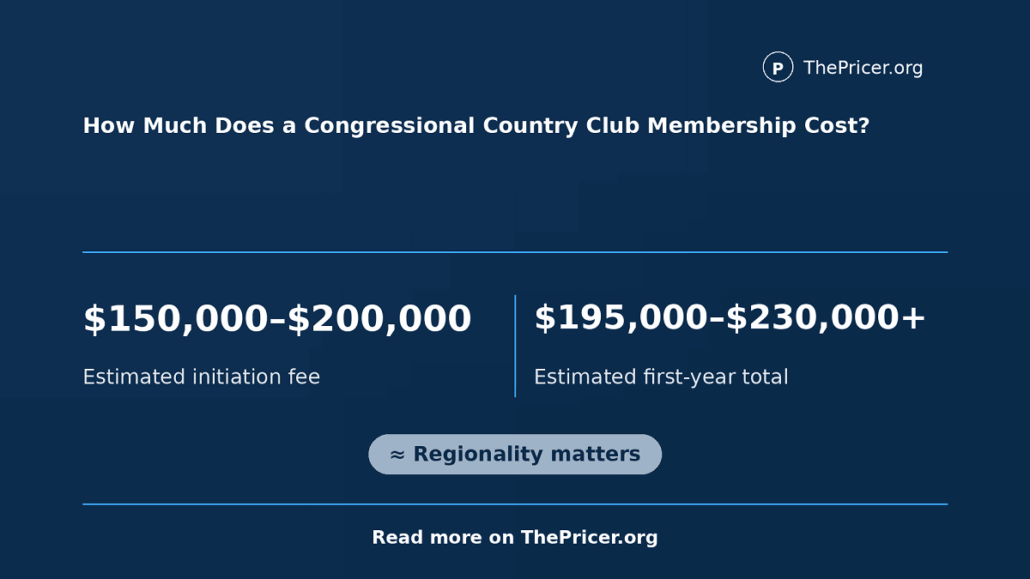
Congressional Country Club does not publish its initiation fee, annual dues, membership categories, or current waiting-list details. Based on recent third-party reports, a reasonable planning estimate is approximately $150,000 to $200,000 for initiation, followed by around $15,000 to $20,000+ in annual dues. Once dining, caddies, guest golf, lessons, tournaments, activities, lockers, and possible capital charges are included, a frequently active household could spend $25,000 to $40,000+ per year after joining.
One widely repeated current estimate places the initiation fee at approximately $180,000 and annual dues at $15,000. However, that number does not come from Congressional Country Club itself, and applicants should not treat it as a guaranteed quote. The actual cost may differ by membership category, age, family status, access privileges, and the fee schedule in effect when an invitation becomes available.
Article Highlights
Jump to sections
- Estimated initiation fee: $150,000 to $200,000 (at $30 per hour, earning that amount would take about 2.4 to 3.2 years of full-time work, before taxes)
- Estimated annual dues: $15,000 to $20,000+
- Possible total first-year spending: $195,000 to $230,000+
- Possible recurring annual spending: $25,000 to $40,000+
- Official prices and waiting periods are not publicly disclosed.
- The club has two 18-hole courses, the Blue Course and Gold Course.
- Congressional will host the 2027 KPMG Women’s PGA Championship, 2030 PGA Championship, and 2037 Ryder Cup.
How Much Does a Congressional Country Club Membership Cost?
| Cost category | Estimated amount | Confidence |
|---|---|---|
| Initiation fee | $150,000 to $200,000 (about 2.4 to 3.2 years of full-time work at $30 per hour) | Third-party estimate |
| Annual dues | $15,000 to $20,000+ | Third-party estimate |
| Dining and club spending | $4,000 to $10,000+ annually | Depends on household use |
| Caddies, guests, lessons, and golf events | $4,000 to $12,000+ annually | Highly usage-dependent |
| Capital assessments | Not publicly disclosed | May apply in some years |
| Estimated first-year total | $195,000 to $230,000+ | Illustrative planning range |
A recent private-club cost roundup estimates Congressional membership at a $180,000 initiation fee and $15,000 in annual dues. Another published event-industry source repeats the same figures. These sources are useful indicators of the current private-club market, but neither is an official club rate sheet. Older estimates of $100,000 to $152,000 may have reflected previous fee schedules and should not be presented as current prices without qualification.
Why the Exact Fee Is Private
Congressional Country Club is an invitation-based private organization rather than a public golf facility selling memberships from a posted price list. The public website provides extensive information about the club’s history, facilities, guest rules, championships, careers, and events, but membership pricing and application materials are not publicly displayed. This is common among highly selective clubs, where the admission process and financial terms are discussed privately with eligible candidates.
The cost may also vary according to the type of membership offered. A quoted figure might describe a full family golf membership, an individual category, a younger-member category, a legacy arrangement, or a fee from a previous year. Without a dated club document identifying the category, initiation fee, dues, food requirements, and capital obligations, one reported number cannot be assumed to apply to every applicant.
Invitation and Waiting Period
The older article claimed that applicants face a ten-year membership wait followed by another two-year wait to play golf. That may reflect an old anecdote, but Congressional does not currently publish a standard waiting period. Demand, membership turnover, available categories, sponsorship, and internal capacity can all influence how long an applicant waits. A highly desirable club may maintain a substantial candidate pipeline without guaranteeing that every applicant will be admitted after a fixed number of years.
Prospective members should ask whether they need sponsors, whether the club is accepting applications in their category, and whether admission provides immediate access to both courses. The club should also clarify whether there is a separate golf-access queue, whether privileges differ by category, and when initiation becomes payable. Those answers are more useful than relying on a waiting-list claim that may be more than a decade old.
ThePricer First-Year Example
Consider a household admitted at the frequently reported $180,000 (about 2.9 years of full-time work at $30 per hour) initiation fee. If annual dues are $15,000, the family spends another $6,000 on club dining and private events, $5,000 on caddies and guest golf, $2,500 on lessons and tournaments, and $1,500 on lockers, youth activities, and miscellaneous charges, its first-year cost reaches $210,000.
In this example, the recurring expenses total $30,000 per year after the initiation payment. The dues represent only half of that annual operating budget. Members who golf frequently, entertain guests, enroll children in programs, use overnight accommodations, or attend numerous social events can spend considerably more. A member who uses the club primarily for occasional golf and dining may remain closer to the annual dues figure.
Using the same assumptions, five years of membership would cost approximately $330,000. That calculation includes the $180,000 initiation fee and five years of recurring spending at $30,000 per year. It does not account for inflation, dues increases, extraordinary assessments, major family events, equipment purchases, or increased golf activity.
This longer view matters because the initiation fee receives most of the attention, while the ongoing lifestyle cost determines whether membership remains affordable. A household considering a six-figure club should evaluate the commitment against income, savings, retirement contributions, tuition obligations, travel, and other discretionary spending rather than focusing only on whether it can fund the entry payment.
What Annual Dues May Not Include
Annual dues generally support club operations and access, but they should not be assumed to cover every activity. Private-club members may pay separately for caddies, guest rounds, lessons, clinics, tournament entries, equipment storage, lockers, massages, private events, overnight rooms, childcare, camps, bowling, dining, and other programs. The exact structure at Congressional is not available on the public website, so applicants should request a complete schedule of charges.
Dining can become one of the largest secondary expenses because members use the club for ordinary meals, entertaining, business discussions, holidays, celebrations, and banquets. A food minimum, if one applies, is only the amount that must be spent. Actual dining bills can exceed it substantially, especially for families that treat the clubhouse as a regular social destination.
Golf, Guests, and Caddie Costs
The previous article listed public-style green fees of $130 to $170 per round. That presentation is misleading because Congressional is not a daily-fee golf course where anyone can reserve a tee time and pay a posted rate. Members may incur guest charges, caddie costs, cart or transportation fees where permitted, tournament charges, and other golf expenses, but the current amounts are not publicly disclosed.
A member who plays twice each week can generate a meaningful annual caddie and gratuity budget even when no separate member green fee applies. Hosting several guests can add more because the member generally assumes responsibility for guest charges, meals, and compliance with club policies. Applicants should ask for an example invoice showing the true cost of a member round, a guest round, a caddie, and participation in a club tournament.
Capital Assessments and Renovations
Major private clubs periodically invest in course renovations, clubhouse improvements, drainage, practice facilities, pools, racquet buildings, and other infrastructure. Those projects may be funded through existing reserves, borrowing, dues increases, or member assessments. Congressional does not publicly disclose whether a current capital assessment applies, but prospective members should not assume that initiation and dues are the only large payments they could face.
Before joining, ask whether any assessment has already been approved, whether new members pay it immediately, and whether additional projects are planned. It is also important to know whether resignation returns any portion of the initiation fee or creates a waiting period before financial obligations end.
About Congressional Country Club

Congressional Country Club is located at 8500 River Road in Bethesda, Maryland. Its origins date to 1921, when a prospectus was circulated among members of Congress and leaders in the Washington business community. Herbert Hoover helped organize the project and served as honorary founding president, while several presidents and other national figures became early lifetime members. The club formally opened on May 23, 1924.
The official Congressional Country Club history identifies Presidents Calvin Coolidge, William Howard Taft, Herbert Hoover, Woodrow Wilson, and Warren G. Harding as lifetime members. Dwight Eisenhower and members of his Cabinet later used the club regularly. That does not mean the club was founded collectively by presidents, nor does it mean every prominent political visitor was a formal member.
The Blue Course
The Blue Course is Congressional’s championship layout and the source of most of the club’s international reputation. Devereux Emmet designed the original courses, after which Robert Trent Jones Sr. and other architects reshaped the property over several decades. Andrew Green led the most recent comprehensive Blue Course renovation, restoring a more open, strategic character and reopening the layout in 2022.
The renovated Blue is a par-72 course rather than the par-70 layout described in the old article. Golf Digest lists it among the country’s leading courses and notes that the current routing stretches beyond 7,800 yards from its longest tees. The current Golf Digest course profile provides updated architectural and scoring information.
The Gold Course
The Gold Course gives members a second full 18-hole option and is a major reason Congressional is more than a single tournament venue. It has its own architectural history, character, and membership role rather than merely serving as an overflow course. The property’s development involved Devereux Emmet, Robert Trent Jones Sr., and George and Tom Fazio, so describing both modern courses as straightforward Robert Trent Jones designs is inaccurate.
Having two courses helps spread member play, accommodate events, and provide different golf experiences. It also contributes to the cost of maintaining the club because Congressional supports two full course operations, extensive practice facilities, instruction, grounds crews, equipment, and tournament preparation.
Major Championship History
Congressional has hosted three U.S. Opens, in 1964, 1997, and 2011. Ken Venturi won the first in extreme heat, Ernie Els won in 1997, and Rory McIlroy produced a record-setting performance in 2011. The Blue Course also hosted the 1976 PGA Championship, won by Dave Stockton, and the 1995 U.S. Senior Open, won by Tom Weiskopf.
More recently, Congressional hosted the 2022 KPMG Women’s PGA Championship and the 2025 Senior PGA Championship. It is therefore incorrect to call the club an annual PGA Tour stop. Congressional hosted PGA Tour events during selected periods, including the Kemper Open, AT&T National, and Quicken Loans National, but it is now better understood as a major-championship venue with scheduled events under a long-term PGA of America partnership.
Upcoming Championships
| Year | Championship |
|---|---|
| 2027 | KPMG Women’s PGA Championship |
| 2029 | PGA Professional Championship |
| 2030 | PGA Championship |
| 2033 | Senior PGA Championship |
| 2037 | Ryder Cup |
The current PGA of America schedule places the PGA Championship at Congressional in 2030 and the Ryder Cup there in 2037. Older announcements listed the events for 2031 and 2036, but the schedule shifted when the Ryder Cup calendar changed. The current PGA Championship venue list and Ryder Cup schedule should take priority over old articles.
Amenities Beyond Golf
Congressional’s value proposition extends far beyond the Blue and Gold Courses. Public club materials describe extensive fitness, swimming, racquet, bowling, dining, lodging, youth, banquet, and wellness operations. The careers page identifies 21 tennis courts, including 15 outdoor courts and six permanent indoor courts, along with paddle facilities and a large recreational program.
The clubhouse supports formal and casual dining, private meetings, banquets, weddings, overnight accommodations, and social events. Fitness and wellness services include exercise facilities, instruction, massage, swimming, and seasonal programs. These amenities explain why annual spending can rise well beyond golf dues, particularly for households using the club as a year-round family and social center rather than only as a place to play the Blue Course.
Guest Access
Congressional is not open for ordinary public play. Nonmembers generally enter as the guest of a member or as an attendee at an authorized banquet, wedding, championship, business event, or other club function. A company cannot simply issue its own invitation and create course access unless the event has been arranged and approved through the club.
Public spectators may purchase tickets for certain major championships, but a championship ticket does not provide access to the rest of the club’s private amenities. Guest privileges are subject to the sponsoring member’s responsibility, registration procedures, dress rules, phone policies, and restrictions that may vary across golf, dining, fitness, pool, and racquet areas.
Dress and Phone Rules
The club’s current guest rules are more nuanced than the original article suggests. Denim is not universally banned from every part of the property. Appropriate jeans may be permitted in certain casual lower-level dining areas, while formal dining spaces and golf areas follow stricter standards. Golf clothing must be consistent with club policy, and tennis players face a predominantly white clothing requirement.
Voice calls are limited to designated areas, including certain locker rooms, parking areas, and approved locations on the golf property. Silent phone use is permitted more broadly when it does not disturb other members. Guests should review the current Congressional Country Club visitor rules before arriving rather than relying on an old claim that every cell phone is prohibited everywhere.
Questions to Ask Before Joining
A prospective member should request a written schedule covering the initiation fee, annual dues, payment timing, food minimums, capital charges, guest golf, caddies, lockers, lessons, tournaments, youth programs, overnight rooms, and resignation terms. The candidate should also clarify whether admission includes immediate access to both courses and whether any privileges are restricted during the first years of membership.
Other important questions concern sponsorship, the current application timeline, family privileges, dues increases, assessments, club closures during major championships, and the transfer or refund treatment of initiation payments. These details can change the economic value of membership far more than a single headline initiation number.
Is the Membership Financially Practical?
A household spending $30,000 per year after initiation would need to use the club frequently for the membership to represent good personal value. At 60 rounds of golf per year, that recurring expenditure equals $500 per round before allocating any value to dining, fitness, tennis, swimming, events, or family programming. At 100 rounds, it falls to $300 per round.
That calculation is not intended to reduce a private club to a public green fee. Congressional membership also provides social relationships, family amenities, tournament access, dining, convenience, and the prestige of belonging to a historically important institution. It does show that the membership is most rational for a household that will use several parts of the club consistently rather than joining mainly for occasional golf.
Readers comparing other invitation-only golf clubs can review the estimated cost of Oak Hill Country Club, Scioto Country Club, and Canoe Brook Country Club.
What We Verified
- Confirmed that the club does not publish current membership prices publicly.
- Updated the estimated initiation and annual dues with clear confidence labels.
- Removed the unsupported ten-year and two-year waiting periods.
- Corrected the Blue Course to its current par-72 configuration.
- Corrected the course architecture and renovation history.
- Removed the inaccurate claim that Congressional is an annual PGA Tour stop.
- Updated the 2030 PGA Championship and 2037 Ryder Cup dates.
- Replaced unsupported public green fees with realistic private-club cost categories.
Answers to Common Questions
How much does it cost to join Congressional Country Club?
Congressional does not disclose its fees publicly. Recent third-party estimates place initiation at approximately $150,000 to $200,000, with one frequently repeated estimate of $180,000.
How much are the annual dues?
A reasonable unofficial planning range is approximately $15,000 to $20,000+ per year. Dining, guests, caddies, lessons, activities, lockers, and possible assessments may be additional.
How much could the first year cost?
A household paying $180,000 to join and spending another $30,000 during the year would have a first-year cost of approximately $210,000.
Is there a ten-year waiting list?
The club does not publicly disclose a current standard waiting period. Older reports mention long waits, but the actual timeline depends on category availability, sponsorship, demand, and internal approval.
Can the public play Congressional?
No ordinary public tee times are available. Nonmembers generally play only as guests of members or through an authorized event. Spectators may attend certain ticketed championships.
How many golf courses does Congressional have?
The club has two 18-hole courses, the championship Blue Course and the Gold Course.
When will Congressional host the Ryder Cup?
The Blue Course is scheduled to host the Ryder Cup in 2037. It will host the PGA Championship in 2030.
Disclosure: Educational content, not financial advice. Prices reflect public information as of the dates cited and can change. Confirm current rates, fees, taxes, and terms with official sources before purchasing. See our methodology and corrections policy.
My spouse and I have just retired and are interested in
joining the Club. A number of our dear friends are presently members.
Thank You