
How Much Do Crepes Cost?
Updated on | Researched and reviewed by Alec Pow, Founder & Pricing Investigator
Prices, claims, and calculations checked against 12 cited sources. See our research methodology and corrections policy.
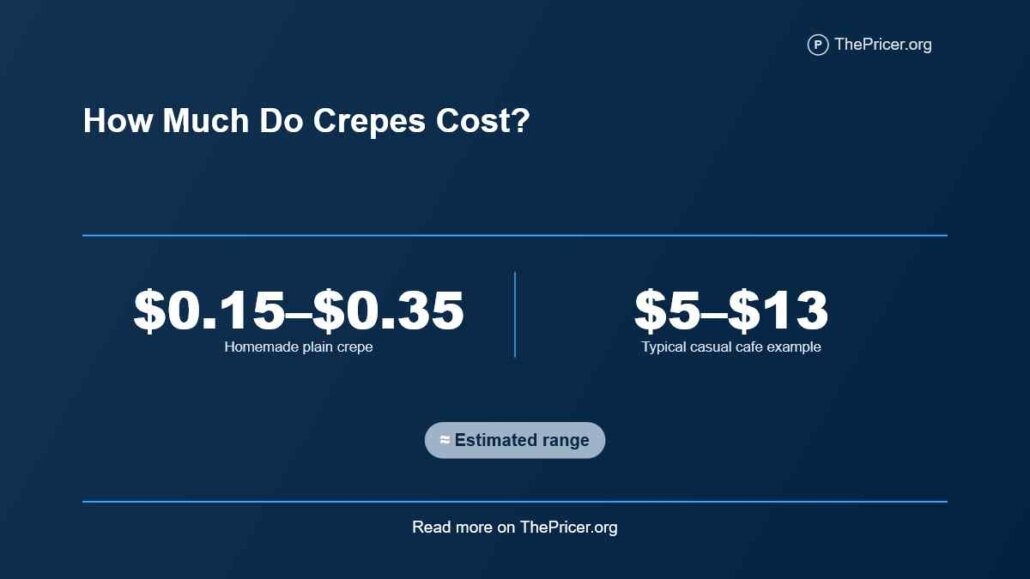
Crepes typically cost $5 to $13 each at casual U.S. cafes, while substantial savory crepes and elaborate dessert combinations can reach $15 to $22 or more. Making them at home is considerably cheaper. A basic homemade crepe can cost approximately $0.15 to $0.35 in batter ingredients, before fillings, cooking energy, and equipment.
The biggest price difference comes from what is served inside the crepe and where it is prepared. A plain crepe, a Nutella-and-strawberry dessert, and a full-size chicken-and-cheese meal are different purchases. Restaurant preparation, fresh produce, portion size, and service costs also matter.
Current online menus provide better comparisons than the older assumption that virtually every street crepe costs only a few dollars. Several U.S. restaurants now list even simple filled crepes near or above $9.
Article Highlights
Jump to sections
- Basic homemade crepe batter can cost approximately $0.15 to $0.35 per crepe, using ordinary supermarket ingredients and a medium-size recipe.
- Documented U.S. menus list plain or minimally filled crepes from approximately $4.49 to $8.99.
- Nutella, banana, and strawberry crepes commonly appear in the examined menus around $8 to $13.
- Substantial savory restaurant crepes can cost $10 to $22, depending on fillings and included sides.
- A 12-crepe homemade batch can cost approximately $2.50 in measured batter ingredients under the grocery-price example below.
- French menu examples range from €3.50 for a simple sweet crepe to more than €16 for certain savory restaurant dishes.
How Much Do Crepes Cost?
There is no single national crepe price. Restaurants sell everything from thin, nearly plain pancakes to large meals filled with vegetables, cheese, meat, sauces, and eggs. These menu examples illustrate the spread without treating a handful of establishments as a representative U.S. average.
| Crepe type | Illustrative U.S. price | What the price buys |
|---|---|---|
| Plain crepe | $4.49 to $5 | Basic cooked crepe with few or no toppings |
| Simple sweet crepe | $5.74 to $10 | Chocolate spread, cinnamon sugar, or fruit |
| Loaded dessert crepe | $10 to $15 | Multiple fruits, toppings, sauces, or specialty fillings |
| Basic savory crepe | $6.25 to $11 | Cheese, egg, ham, or vegetables |
| Full savory meal | $12 to $22 | Meat, seafood, premium cheese, sauces, and sometimes sides |
Our Crepes & More in Wilmington, North Carolina, lists plain crepes at $4.49, Nutella crepes at $5.74, Nutella-and-strawberry crepes at $7.99, and several elaborate desserts at $11.99 to $12.99. Its published ordering menu also lists cheese crepes at $6.25 and ham-and-cheese crepes at $8.99.
Yumi Bar offers a different comparison. Its sweet and savory selection includes a chocolate crepe for $9.99, a Nutella-and-banana crepe for $10.99, a ham-and-cheese crepe for $9.99, and a specialty Dubai crepe for $14.99. Those are individual menu prices, not a nationwide price schedule.
What Goes Into a Crepe?
A traditional crepe is a thin pancake made by spreading liquid batter across a heated pan. Basic recipes combine flour, eggs, milk or water, butter, and salt. Sweet variations can include sugar or vanilla, while savory versions depend on the filling and the style of batter.
Crepes differ from fluffy American pancakes in both structure and serving style. Their thin texture makes them suitable for folding around fillings rather than stacking under toppings. One crepe may be a light dessert, while another is substantial enough to serve as lunch or dinner.
The difference is especially important for savory preparations. French-style buckwheat galettes often contain combinations of eggs, cheese, ham, and vegetables. A filled restaurant galette is not directly comparable to a plain wheat-flour crepe sold from a takeaway counter.
The distinction also affects home cooking. A crepe made from inexpensive pantry ingredients may remain economical until the cook adds premium cheese, smoked salmon, fresh berries, or several chocolate toppings. Portion size changes the calculation further because a recipe yielding small crepes cannot be priced per piece against an oversized cafe crepe without adjusting for size.
Homemade Crepe Costs
Homemade crepes have a low ingredient cost because the batter relies on everyday groceries. The main mistake in the original pricing model was combining the cost of a large grocery package with the amount actually consumed. Buying five pounds of flour does not mean the entire bag belongs in one batch.
The King Arthur Baking crepe recipe yields twelve 10-inch crepes from two cups of flour, four eggs, one and a half cups of milk, four tablespoons of butter, and salt. That provides a reproducible starting point for a household calculation.
For the ingredient-price model, Target listed a five-pound flour bag at $2.69, a dozen large eggs at $1.49, a gallon of whole milk at $2.99, and a pound of butter at $3.19. Prices depend on store, location, and availability.
| Ingredient | Amount used | Calculated batch cost |
|---|---|---|
| All-purpose flour | 240 grams | $0.28 |
| Eggs | 4 large | $0.50 |
| Whole milk | 1.5 cups | $0.28 |
| Butter | 4 tablespoons | $0.40 |
| Salt and extra pan grease | Small allowance | $0.10 |
| Total | 12 crepes | $1.56 |
This calculation produces an estimated batter cost of approximately $0.13 per crepe. It assumes a full usable batch, the stated grocery prices, and only a small allowance for salt and additional cooking fat. Electricity, labor, fillings, failed crepes, and cookware are excluded.
For practical household budgeting, approximately $0.15 to $0.35 per plain crepe allows more room for ingredient variation and cooking losses. It is an estimate rather than an observed national average.
One useful comparison concerns the eggs. Increasing their purchase price from $1.49 to $3.99 per dozen would increase the cost of four eggs by about $0.83 per batch, or only around $0.07 per crepe. Changing the filling can have a larger effect than this substantial difference in egg prices.
Sweet Crepes at Cafes
Sweet crepes are priced according to their fillings and finishing. A simple sugar-and-butter crepe requires less preparation than one assembled with Nutella, several kinds of fresh fruit, whipped cream, chocolate drizzle, and ice cream.
Fenton Cafe in Silver Spring, Maryland, lists a Nutella-and-banana crepe at $9.50, Nutella and strawberries at $9.75, and Nutella with strawberries and bananas at $11.50. Its extensive dessert crepe menu also includes numerous fruit, jam, ricotta, honey, and chocolate combinations.
The difference between its Nutella-and-banana crepe and the three-ingredient Nutella, strawberry, and banana version is $2. For two people ordering the upgraded combination, that becomes $4 more before tax. This is a genuine price comparison within one establishment, rather than an assumed topping surcharge applied across restaurants.
Piquant in Tampa provides another reference point. Its listed sweet crepe with Nutella, fresh bananas, and strawberries costs $12. Comparable ingredient descriptions can produce different final prices between cafes, even before considering presentation and serving size.
A customer buying crepes regularly should pay particular attention to how restaurants package combinations. A fixed dessert with three toppings may be less expensive than ordering a plain crepe and paying separately for each addition. The reverse can also be true when the customer wants only a small amount of fruit or chocolate.
Savory Crepe Prices
Savory crepes have a broader meal-price range because fillings can include proteins, cooked vegetables, cheese, eggs, and sauces. A cheese crepe is closer to a snack, while a steak or seafood crepe may be sold as a full restaurant entree.
Fenton Cafe lists grilled chicken crepes at $11.70 and ham-and-cheese crepes at $9.50. At the upper end, Break’n Eggs Creperie in Amherst lists a chicken, bacon, apple, and cheddar crepe at $16.95, a filet mignon crepe at $21.50, and a seafood crepe at $20.50, according to its published savory menu.
That upper price includes a different type of dining experience. The Amherst menu describes several crepes accompanied by mixed greens and house-made dressing, so the customer receives more than a pancake containing an inexpensive filling. Comparing such dishes against a small takeaway cheese crepe without acknowledging the included food would be misleading.
For home cooking, the same distinction applies. A ham-and-cheese crepe can use a modest portion of two fillings, while a smoked-salmon version may require a relatively expensive package for only a few servings. Shoppers should calculate the actual quantity used rather than charging the entire grocery package to one crepe.
Those considering crepes as an alternative restaurant meal can also compare the portions against other breakfast dishes. A substantial savory crepe might replace a sandwich or omelet, while a small sweet crepe is closer to a bakery treat than to a complete lunch.
Crepe Prices in France
France offers both inexpensive sweet crepes and more elaborate restaurant galettes. The assumption that every French crepe costs only €3 to €5 overlooks the difference between a simple dessert and a sit-down savory meal.
One Paris creperie menu updated in February 2026 lists a sugar-or-jam crepe at €3.50, a Nutella crepe at €4.50, and a Nutella-and-banana crepe at €6.50. The same Paris restaurant menu lists a turkey-ham, egg, cheese, and mushroom galette at €9.50 and a salmon variation at €11.
Another establishment, Crêpolog’, lists a butter, brown-sugar, and lemon crepe at €6.50, while its ham, cheese, and egg preparation costs €13.90. Several more elaborate dishes on its 2026 creperie menu exceed €15.
These examples illustrate two distinct purchasing decisions. Someone seeking a simple sweet crepe can find a lower-priced choice than a diner ordering a complete savory galette. Tourist neighborhoods, premium dining rooms, and takeaway counters may use different pricing structures, but the examined menus do not establish a reliable universal street-vendor average.
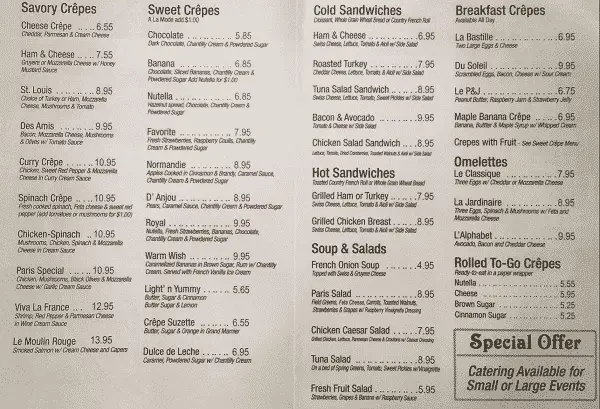
The older menu image above is retained as a historical reference. Its prices should not be treated as a verified current menu or used to calculate today’s restaurant costs.
Hidden Crepe Expenses
Restaurant menu prices are usually starting food prices, not necessarily the amount a diner ultimately pays. Applicable sales taxes, optional tips, beverages, additional toppings, and delivery charges can increase the bill. These extras vary by establishment and ordering method, so a universal percentage would be misleading.
Consider an illustrative purchase of four $9.50 restaurant crepes. The food subtotal is $38. If the bill is subject to an assumed 8% sales tax and the customer voluntarily leaves an 18% tip calculated on the pretax subtotal, the calculation is $38 + $3.04 + $6.84 = $47.88. The effective bill becomes $11.97 per person, before drinks or delivery. The tax and gratuity percentages are scenario assumptions, not fees claimed for a particular cafe.
Home preparation has a different hidden expense. A shopper may use only $1.56 of ingredients while needing to purchase whole packages of flour, eggs, milk, and butter. Using the four grocery listings above, buying those packages from scratch would require approximately $10.36, before extra fillings. The unused ingredients retain value for future meals, so the full shopping receipt should not be confused with the cost consumed by one batch.
Cooking time matters as well. The referenced King Arthur recipe allows 45 minutes of total preparation time, including cooking, although active work and waiting time depend on the cook. Assigning an illustrative $15 hourly value to 30 minutes of active effort adds a noncash time cost of $7.50 to the batch. That is useful for comparing convenience, not an amount the household must actually pay.
For an alternative dessert at an event, a funnel cake may have a different serving size and topping structure. Comparing the final decorated dessert rather than just its batter ingredients gives a fairer spending comparison.
Making Crepes for a Group
Crepes become economical for groups when one batch serves several people and the ingredients are already available. A recipe producing twelve crepes can supply two crepes each to six people or three each to four people, depending on how substantial the fillings are.
Consider a homemade breakfast for four people. Start with the previously calculated $1.56 batter batch. Add an illustrative $4 for bananas and chocolate spread, $1.50 for other toppings, and $0.50 for cooking energy. The modeled total is $7.56 for twelve filled crepes, equivalent to $1.89 per person for three crepes each.
Compare that with purchasing four restaurant Nutella-and-banana crepes at Fenton Cafe’s listed $9.50 price. The restaurant food subtotal would be $38. The homemade scenario saves $30.44 in cash before restaurant tax or gratuity. It also provides twelve smaller home-prepared crepes rather than four restaurant portions, so the comparison concerns feeding four people, not identical products.
There is a useful second calculation for households considering how often to cook crepes. If the modeled $7.56 home breakfast replaces a $38 restaurant order twice per month, the illustrative cash difference over twelve months is $730.56. This excludes differences in serving size, time, transport, and any purchased kitchen equipment. It is a repeat-purchase scenario, not a prediction of actual household savings.
Home cooking makes sense when the group enjoys several crepes and can use leftover ingredients. Restaurant purchasing can make more sense for an occasional treat, for customers seeking specialist fillings, or when preparation time has greater value than the cash difference.
Choosing the Better Value
The least expensive crepe is not necessarily the most useful purchase. A plain takeaway crepe may be ideal for a quick dessert, while a savory entree can substitute for a larger meal. Buyers should compare portion size, filling quantity, included sides, and the final bill.
A low menu price can also become poor value when toppings are charged individually. Before ordering, compare an existing menu combination with a custom-built crepe. For homemade cooking, use ingredients already purchased for other meals and divide batch costs by the number of crepes actually eaten.
Makes sense if
- You prepare several crepes at home and can use the remaining groceries.
- You select a menu combination that includes the toppings you actually want.
- A savory crepe replaces a more expensive full meal rather than acting as an additional snack.
- You compare similar portion sizes before deciding which cafe offers better value.
Does not make sense if
- You buy expensive ingredients for one small homemade batch and cannot use the leftovers.
- You select premium toppings without checking their additional price.
- You compare a plain street crepe with a restaurant entree as though they contain the same amount of food.
- You focus only on the listed menu price while ignoring delivery charges, tax, and optional gratuity.
For parties, a different pastry may offer simpler portion control. Individually priced baklava pieces can be easier to distribute, while crepes provide more flexibility in choosing fillings for each guest.
What We Verified
- The original article’s assumption that a standard homemade batch produces 50 crepes is inconsistent with the twelve-crepe recipe used for the new cost model.
- Multiple U.S. restaurant menus show ordinary filled crepes priced above the original article’s lowest restaurant estimates.
- Current French menu examples distinguish inexpensive sweet crepes from higher-priced savory galettes.
- The homemade calculation separates the ingredients consumed from the cost of buying complete grocery packages.
- The original Crepes Inc image is preserved, but its historical prices are not represented as current.
Answers to Common Questions
How much does one homemade crepe cost?
A plain homemade crepe can cost approximately $0.15 to $0.35 in batter ingredients, depending on the recipe, local grocery prices, and cooking losses. Filled crepes cost more. Equipment, labor, and cooking energy are separate expenses.
How much does a Nutella crepe cost?
In the examined U.S. menus, Nutella crepes range from approximately $5.74 for a basic version to about $10 to $13 for fruit-filled or elaborate versions. Specific restaurants may charge outside this sample.
How much are crepes in Paris?
The examined 2026 Paris menus include simple sweet crepes from €3.50, filled sweet versions costing several euros more, and restaurant savory galettes reaching €15 or more. These are documented restaurant examples rather than a citywide average.
Are savory crepes more expensive than sweet crepes?
Substantial savory crepes often cost more than simple sweet versions because they contain meat, seafood, cheese, or multiple cooked fillings. Elaborate dessert crepes with several premium toppings can approach or exceed some savory prices.
Can crepes be made ahead of time?
Yes. Unfilled crepes can be prepared in advance, wrapped, and refrigerated or frozen according to the recipe’s storage instructions. Preparing a larger batch can reduce repeated cooking effort, although fillings that release moisture are usually better added near serving time.
Disclosure: Educational content, not financial advice. Prices reflect public information as of the dates cited and can change. Confirm current rates, fees, taxes, and terms with official sources before purchasing. See our methodology and corrections policy.