
How Much Does It Cost to Build a Concrete Trash or Dumpster Enclosure?
Updated on | Written by Alec Pow
This article was researched using 12 sources. See our methodology and corrections policy.
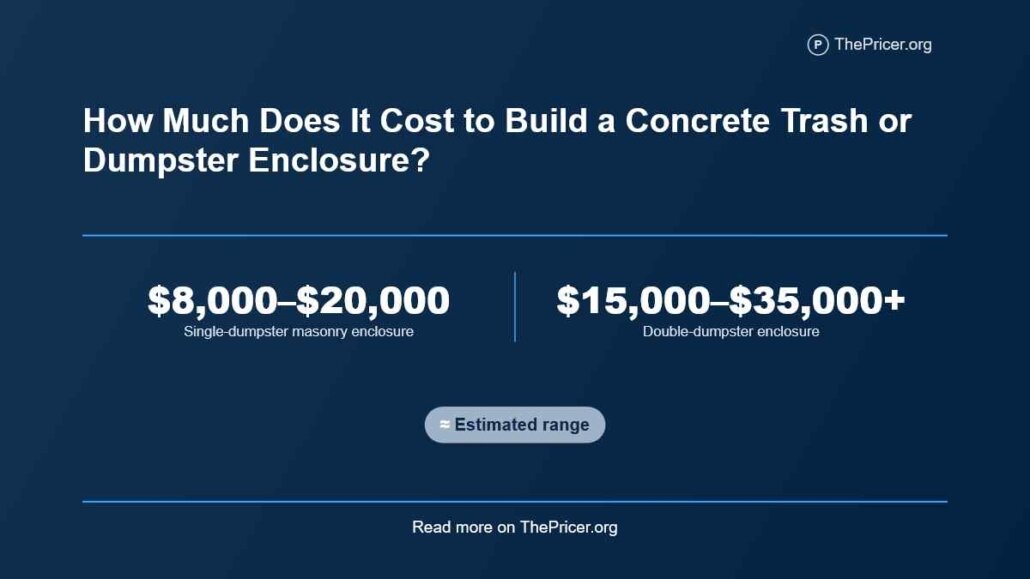
A commercial concrete or masonry dumpster enclosure typically costs about $8,000 to $20,000 for a single-dumpster installation and roughly $15,000 to $35,000 or more for a larger two-dumpster enclosure. A simpler chain-link or wood-screened enclosure built on an existing slab may cost closer to $3,000 to $8,000, while a heavily reinforced CMU enclosure with a new structural slab, custom steel gates, bollards, architectural finishes, and difficult site work can exceed $30,000.
The biggest mistake is pricing only the concrete pad. The slab is usually only one piece of the project. A complete commercial enclosure can require excavation, reinforced concrete, footings, CMU or poured walls, steel gates and posts, protective bollards, drainage work, an approach apron, engineering, permits, and sometimes finishes that match the building.
Article Highlights
Jump to sections
- A typical single-dumpster masonry enclosure costs about $8,000–$20,000 all-in.
- A larger two-dumpster enclosure often costs $15,000–$35,000+.
- A basic screened enclosure using chain link or wood may run $3,000–$8,000 when heavy structural work is limited.
- Standard concrete slabs average roughly $4–$12 per square foot, but dumpster pads are often thicker and more heavily reinforced.
- Installed reinforced CMU walls average around $15–$30 per square foot of wall area.
- Manual steel gates commonly add $1,000–$4,500+, with custom commercial gates potentially higher.
- Bollards, gate posts, drainage, approach pavement, permits, and engineering can add several thousand dollars beyond the visible enclosure.
- There is no universal national enclosure size or 50-foot setback rule. Local zoning, sanitation, fire, and public-works standards control the design.
How Much Does It Cost to Build a Concrete Trash or Dumpster Enclosure?
There is no single national price database dedicated specifically to dumpster enclosures, so the most useful estimate comes from combining current prices for the components contractors actually install.
| Dumpster Enclosure Type | Typical Planning Cost |
|---|---|
| Basic chain-link or wood enclosure, existing pad | $3,000–$8,000 |
| Single-dumpster reinforced CMU enclosure | $8,000–$20,000 |
| Double-dumpster masonry enclosure | $15,000–$35,000+ |
| Architectural enclosure with premium finish, drainage, utility work, or difficult access | $25,000–$50,000+ |
These are planning ranges rather than fixed contractor quotes. Local labor rates, soil, frost depth, building-code reinforcement, enclosure size, gate design, drainage requirements, and the distance to the collection truck route can move the price considerably.
Concrete Pad Cost
A dumpster cannot normally sit on the same lightweight slab used for a patio. Collection vehicles and loaded commercial dumpsters put much larger loads on the pavement.
Nationally, a standard new concrete slab currently averages roughly $4 to $8 per square foot according to Angi’s 2026 concrete slab data, while HomeGuide places typical installed slabs around $6 to $12 per square foot.
A commercial dumpster slab can cost more because municipal plans frequently call for extra thickness, structural reinforcement, compacted aggregate below the slab, and a heavy-duty approach area.
For example, a municipal commercial dumpster detail from South Lake Tahoe specifies an 8-inch concrete pad over an 8-inch compacted aggregate base with reinforcement. Other jurisdictions use 6-inch reinforced slabs.
That means the old assumption that $15 to $35 per square foot represents the entire foundation cost everywhere is too broad. A simple pad may cost less, while a small reinforced commercial pour often has a high per-square-foot price because excavation, forms, reinforcement, mobilization, and minimum concrete-delivery charges are spread across a relatively small area.
Wall Cost
Reinforced concrete masonry units, commonly called CMU or concrete block, are one of the most common commercial enclosure materials.
A current HomeGuide CMU cost analysis puts installed block walls at approximately $15 to $30 per square foot of wall surface. That estimate includes typical foundation, concrete reinforcement, and rebar.
For a simple three-sided enclosure measuring 12 feet wide by 12 feet deep with 6-foot walls, there would be approximately:
(12 + 12 + 12) × 6 = 216 square feet of wall
At $15 to $30 per square foot:
216 × $15 = $3,240
216 × $30 = $6,480
That gives a reasonable planning range of roughly $3,200 to $6,500 for the masonry portion before the gate, slab, bollards, engineering, or site work.
Gate Cost
The gate is one of the most underestimated parts of a dumpster enclosure.
A commercial gate has to be wide enough for the waste hauler, strong enough to survive daily use and wind, and mounted to posts capable of supporting large gate leaves without sagging.
Current gate pricing from HomeGuide places manual steel gates at about $500 to $4,500, depending on size and construction. Twelve-foot manual gates alone can range from roughly $300 to $3,400 in materials before a custom heavy commercial design, posts, footings, hinges, latches, and installation are considered.
Dumpster gates commonly use welded steel tube frames with wood, metal, composite, or opaque infill. A two-leaf gate also needs drop rods, heavy hinges, stops, and enough clearance to swing completely out of the collection path.
For budgeting, a substantial commercial dumpster gate assembly often deserves an allowance of roughly $1,500 to $5,000+.
Bollards
Bollards protect the enclosure from the dumpster itself. Without them, a collection truck pushing a container backward can transfer the impact directly into an expensive masonry wall.
Municipal drawings frequently specify 6-inch steel pipe filled with concrete. Brownwood, Texas, for example, requires two rear bollards per dumpster in its commercial enclosure standard.
Commercial bollard hardware varies enormously. A current 6-inch steel bollard from Grainger can cost several hundred dollars before installation, concrete, excavation, and finishing. Purpose-built heavy bollards can exceed $1,000 each.
A realistic allowance for two to four installed protective posts is therefore roughly $1,000 to $4,000+, depending on whether the contractor fabricates ordinary concrete-filled pipe or installs manufactured commercial bollards.
Worked Example
Consider a reinforced 12-by-12-foot single-dumpster enclosure with three 6-foot CMU walls and a 12-foot steel double gate.
| Component | Example Budget |
|---|---|
| 144-sq.-ft. heavy concrete pad and base | $2,000–$3,500 |
| 216 sq. ft. reinforced CMU walls | $3,240–$6,480 |
| Steel double gate and posts | $1,500–$4,000 |
| Bollards | $1,000–$2,500 |
| Permit, drawings, miscellaneous site work | $1,000–$3,000 |
| Planning total | $8,740–$19,480 |
Rounded for estimating, that puts an ordinary reinforced single enclosure around $9,000 to $20,000.
This example also explains why quoting only the slab cost is misleading. Even using a $2,500 slab allowance, the concrete floor represents only about 13% to 29% of an $8,740-to-$19,480 enclosure project.
Double Enclosures
A two-dumpster enclosure does not simply cost twice as much because some components are shared. There is still one mobilization, one set of plans, and commonly one large entrance.
However, the slab becomes larger, walls get longer, the gate opening often widens, and additional protective bollards may be required.
A current 2025 standard drawing from American Fork, Utah, for example, requires a minimum 12-foot enclosure width, heavy-duty concrete, bollards, opaque gates, drainage control, and a minimum 6-foot screen.
For a larger two-container commercial installation, $15,000 to $35,000 is a more realistic planning range than simply multiplying a generic concrete cost by the slab area.
Hidden Costs
The enclosure itself is not always the largest surprise. The truck approach can be.
Garbage trucks are heavy and need room to line up with, lift, and return the dumpster. A site with insufficient pavement may need a reinforced concrete apron or approach lane beyond the enclosure itself.
That can add hundreds of square feet of heavy pavement to the project.
Other easily missed expenses include grading, stormwater control, demolition of old asphalt, utility conflicts, excavation in rock, frost-depth footings, architectural finishes, drainage connections, painting, masonry caps, locks, signage, and replacing landscaping displaced by the enclosure.
A gate that has to match an upscale retail center can also cost much more than a basic painted steel frame with wood slats.
Permits and Plans
A dumpster enclosure frequently requires a building, zoning, or site-development permit, but this is not universal enough to state as one national rule.
For example, North Miami expressly requires a building permit and property survey for a dumpster enclosure.
Engineering may also be necessary where the enclosure includes reinforced masonry, substantial footings, structural gate posts, retaining conditions, or unusual wind loads.
The cost can range from a few hundred dollars for a simple permit to several thousand dollars once engineered drawings, survey updates, plan review, and inspections enter the project.
Local Rules
There is no national rule saying every dumpster enclosure must be 19 feet by 14 feet, 8 feet tall, or 50 feet from a building.
Local requirements differ significantly.
Binghamton, New York, for example, requires a nonresidential dumpster enclosure to be at least 12 feet by 12 feet and at least five feet inside applicable lot lines under its current zoning rules.
Hialeah, Florida, has a different standard. Its dumpster enclosure ordinance requires masonry enclosure walls and gates to be at least six inches higher than the dumpster and never less than six feet high, while the paved base must extend beyond the dumpster.
Other jurisdictions allow chain link, require landscaping, regulate drainage, or require wall materials to match the principal building.
The correct sequence is therefore to obtain the waste hauler’s container and truck requirements first, then check the city planning, public works, fire, and building requirements before drawing the enclosure.
Truck Access
Truck access can determine both the enclosure dimensions and where it can be built.
A front-load dumpster remains onsite while a truck approaches, lifts the container over the cab, empties it, and replaces it. That requires unobstructed vertical clearance and a reasonably straight approach.
A roll-off container works differently because the entire container is loaded onto a truck. Permanent masonry enclosures are therefore less common for temporary construction dumpsters unless the site is specifically designed to accommodate roll-off operations.
Sioux Falls’ current Dumpster Enclosure Planning Guide specifically treats container size, collection frequency, location, accessibility, screening, and gates as interconnected design issues rather than giving every project one standard enclosure dimension.
Inspection Risk
Reinforcement details matter because a failed inspection can create a very expensive rework.
A useful real-world example comes from the City of Tucson. In 2026, inspectors approved a commercial trash-enclosure footing before concrete was poured, later found that required vertical reinforcing did not continue properly through the masonry, and required correction before the enclosure ultimately passed inspection.
The city’s inspection record illustrates why reinforcing, footing, slab, and approach details should be inspected at the required stages rather than covered before approval.
Demolishing newly built masonry to correct missing reinforcement can quickly eliminate any savings from choosing the cheapest contractor.
Material Options
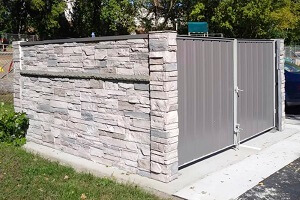
CMU masonry is durable, impact resistant, visually solid, and easy to finish to match a commercial building. It is also among the more expensive options.
Poured concrete provides excellent durability but requires forms and substantial site preparation. Current poured wall pricing can be comparable to or higher than masonry depending on the design.
Brick is commonly used as a veneer or architectural finish rather than as the least expensive structural solution.
Wood can reduce upfront cost but generally requires more maintenance and may not satisfy local commercial screening or fire requirements.
Chain link with privacy slats is inexpensive and practical where permitted, but some municipalities specifically prohibit it while others actively allow it. This is another reason to check the local ordinance before choosing materials.
Ways to Spend Less
If an existing commercial slab is structurally adequate and correctly located, reusing it can remove a major part of the project cost.
A simpler opaque gate infill also costs less than architectural steel, masonry veneer, or custom decorative panels.
Another major saving comes from designing the enclosure correctly before construction begins. Moving a wall, widening a gate, relocating bollards, or repouring an inadequate truck approach after the waste hauler rejects the layout is far more expensive than coordinating the dimensions at the plan stage.
For disposal alternatives and related costs, see our guides to Bagster pickup, 1-800-GOT-JUNK services, and monthly household garbage service.
What We Verified
We checked current construction-cost data for concrete slabs, reinforced CMU walls, and steel gates, then compared those costs with actual municipal dumpster-enclosure details.
We also verified that municipal construction standards differ substantially. Some cities require 6-inch or 8-inch reinforced pads, some allow chain-link screening, others require masonry, and enclosure dimensions depend on the local container and truck requirements.
Answers to Common Questions
How much does a concrete dumpster enclosure cost?
A reinforced single-dumpster masonry enclosure typically costs around $8,000 to $20,000. Larger double enclosures often cost $15,000 to $35,000+.
How much does just the concrete pad cost?
Standard concrete slabs generally run about $4 to $12 per square foot, but commercial dumpster pads can cost more because they may require 6 to 8 inches of concrete, reinforcement, thick aggregate bases, excavation, and heavy-duty approach pavement.
How thick should a dumpster pad be?
There is no universal thickness. Municipal details commonly show 6-inch or 8-inch reinforced slabs, but the required design depends on soil, dumpster size, truck loads, and local public-works specifications.
Does a dumpster enclosure need bollards?
Many commercial standards require or strongly favor protective bollards behind or beside dumpsters. They prevent the container from striking the masonry wall during collection.
Do I need a permit?
Often, yes, particularly for a permanent masonry enclosure, but the exact permitting process is local. Check the city building, zoning, sanitation, and public-works requirements before construction.
How far does a dumpster need to be from a building?
There is no universal 50-foot rule. Required separation depends on local fire code, dumpster construction, enclosure design, building materials, and municipal zoning. Obtain the local standard rather than using a national rule of thumb.
How large should a dumpster enclosure be?
The required size depends on container dimensions, number of dumpsters, gate opening, bollard clearances, and the collection vehicle. A 12-by-12-foot enclosure appears in some municipal standards for a single container, but it is not a universal national size.
Disclosure: Educational content, not financial advice. Prices reflect public information as of the dates cited and can change. Confirm current rates, fees, taxes, and terms with official sources before purchasing. See our methodology and corrections policy.