
How Much Does a Czechoslovakian Wolfdog Cost?
Updated on | Written by Alec Pow
This article was researched using 14 sources. See our methodology and corrections policy.
A Czechoslovakian Vlciak puppy currently costs about $2,800 to $4,000 through the U.S. breeder marketplace reviewed. Also called the Czechoslovakian Wolfdog, it is a recognized dog breed rather than a present-day wolf hybrid. Scarcity, health-tested breeding stock, training, containment, insurance, and import rules can push ownership costs far above the puppy price.
Importing can look cheaper because European puppies may be advertised for much less. One current Czech listing is €1,000, yet the U.S. requires imported dogs to be at least six months old. That rule can create months of overseas care before transport even begins, which makes the advertised puppy price a poor stand-in for the landed U.S. total.
Article Highlights
Jump to sections
- Current U.S. breeder-market pricing is about $2,800 to $4,000 (at $30 per hour, earning that amount would take about 2.3 to 3.3 full-time workweeks, before taxes).
- One current Czech breeder listing advertises FCI puppies at €1,000, before U.S. import costs.
- A domestic first-year core scenario comes to about $4,328 to $5,653 before many optional or medical costs.
- A 51 to 75 pound adult food scenario works out to about $543 to $668 per year.
- One current 10-by-10-foot kennel example costs about $580.
- The current CDC six-month minimum age can keep a young European puppy abroad for roughly four months after a breeder would normally release it.
How Much Does a Czechoslovakian Vlciak Cost?
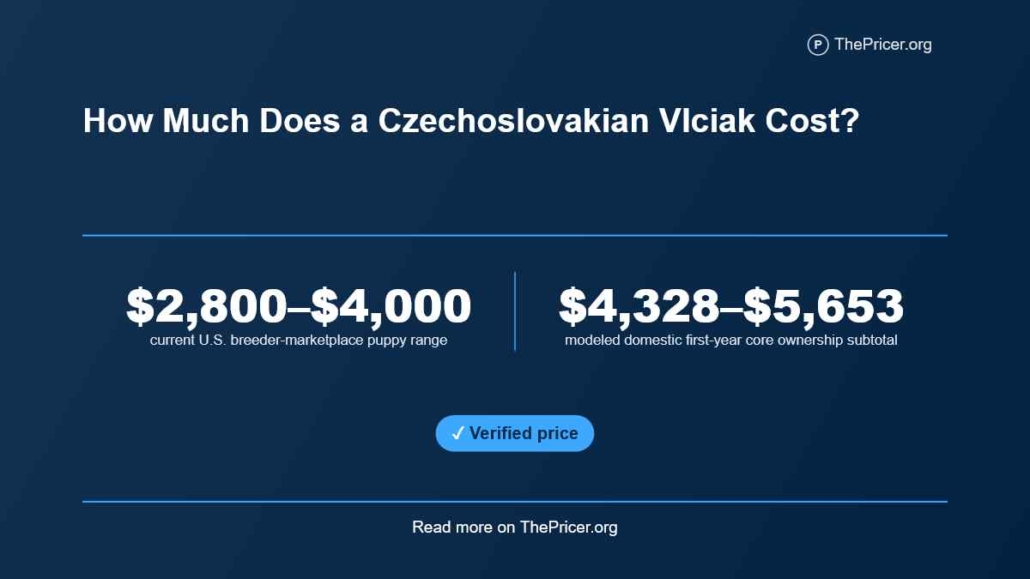
Good Dog currently places the national breeder price range at $2,800 to $4,000 (about 2.3 to 3.3 full-time workweeks at $30 per hour). That is a stronger current U.S. anchor than older marketplace figures near $1,000 to $1,500.
A March 2026 Czech listing offers FCI puppies at €1,000. The listing says the puppies are microchipped, vaccinated, dewormed, supplied with an EU pet passport, and available for international transport. That price is a European advertised purchase price. It is not the cost of delivering a legally eligible dog to a U.S. home.
| Purchase route | Current price signal | Scope |
|---|---|---|
| U.S. breeder marketplace | $2,800 to $4,000 | Expected national puppy range |
| Czech breeder listing | €1,000 | Advertised puppy price before U.S. import expenses |
The U.S. and European figures should not be averaged. They describe different markets, currencies, delivery paths, and regulatory burdens. A cheaper overseas puppy can become more expensive once age rules, care abroad, transport, documents, and destination requirements enter the plan. The purchase route also changes what is included and when the dog can come home.
This Is a Recognized Dog Breed
The Czechoslovakian Vlciak was developed from German Shepherd Dog and Carpathian wolf crossings during a Czechoslovak military breeding program that began in the 1950s. Those historic crossings created the foundation of the breed. They do not make every modern registered Vlciak the legal equivalent of a recent wolf-dog hybrid.
AKC describes the Czechoslovakian Vlciak as a breed in the Miscellaneous Class and explicitly distinguishes it from a wolf. Its profile emphasizes high intelligence, independence, activity, and the tendency to lose interest in repetitive tasks. Those traits matter when budgeting for training and daily management.
That identity matters financially. Generic internet advice for privately bred wolf hybrids can send a buyer toward the wrong legal assumptions, feeding claims, or housing expectations. A registered Vlciak still requires careful local checks because a landlord, insurer, municipality, or animal-control rule may use its own definitions.
The buyer should read the actual local wording rather than assuming the breed is either automatically banned or automatically exempt everywhere in the United States.
The same distinction matters when comparing other active working dogs. A current Blue Heeler cost page may help with ordinary working-dog ownership expenses, but it does not carry the Vlciak’s rarity, import constraints, or breeder-pool issues.
What the Breeder Price Should Buy
The breed club’s current health-clearance recommendations go well beyond a routine puppy examination. The listed breeding checks include degenerative myelopathy, pituitary dwarfism, hips, elbows, cardiac evaluation, dentition, and participation in the DNA repository. Eye examination is also recommended. A buyer paying several thousand dollars should ask for identifiable results for both parents rather than accept a generic statement that the litter is health tested.
The small U.S. breeding population makes those records more valuable. Limited breeding stock can raise pressure on genetic diversity, so parentage and mating decisions matter alongside the puppy’s appearance. A low price is not proof of poor breeding, and a high price is not proof of strong breeding. The records are what make the difference visible.
A contract should also identify registration, any health guarantee, return terms, spay or neuter conditions when applicable, and what veterinary work has already been completed. Those inclusions can change the first-year bill. Buyers should avoid paying twice for a service that the breeder has already provided.
This is one place where the old price-first article was too thin. The financially useful question is not only how much the puppy costs. It is what evidence and services arrive with that price, and which costs remain with the buyer after pickup.
Importing
Current U.S. import rules create a major hidden cost. The CDC requires every dog entering the United States to be at least six months old, appear healthy, have a detectable microchip, and travel with a CDC Dog Import Form receipt. Dogs that were in a high-risk rabies country during the prior six months face extra documentation and arrival requirements.
The current Czech litter shows the timing problem in concrete terms. Those puppies were born February 18, 2026 and advertised as ready for new homes in the second half of April. Under the six-month U.S. minimum, a puppy from that litter could not enter before about August 18. That creates roughly four additional months between normal breeder release and U.S. eligibility.
That delay has a cost.
Food, housing, socialization, veterinary care, and breeder or boarding arrangements continue while the dog remains abroad. The exact amount depends on the breeder and country, so assigning a universal monthly boarding price would be false precision. The owner should obtain a written quote covering care through the legal travel date, transport, veterinary paperwork, crate requirements, and any destination-state rules.
Dogs with recent time in a high-risk rabies country can face extra documentation and arrival steps. The old flat $500 to $2,000 (about 0.4 to 1.7 full-time workweeks at $30 per hour) import allowance is too crude because the actual route depends on age, rabies history, country history, transport, care abroad, and destination requirements.
Food and Routine Care
Food cost should come from a real feeding model rather than a generic “wolfdog diet.” Purina’s adult feeding chart gives 317 to 390 grams per day for a 51 to 75 pound dog. Chewy currently lists the matching 35-pound bag at $74.48.
A 35-pound bag contains about 15.9 kilograms. At 317 grams per day, annual use is about 7.3 bags, or roughly $543 per year. At 390 grams per day, annual use is about nine bags, or roughly $668 per year. This is a product-specific scenario for an adult within that weight band. A lighter female, larger male, different food, treats, wet food, or a veterinary diet will change the result.

The coat does not automatically create a large professional-grooming bill. The breed has a straight double coat with a strong seasonal undercoat. Regular brushing and home coat care can handle much of the routine work, while owners who use a groomer will add local bath, deshedding, and nail-service rates.
Routine care still belongs outside the food calculation. Puppy examinations, vaccines, parasite prevention, dental care, and later wellness visits depend on age, prior records, region, and lifestyle. The first-year model below leaves those charges out rather than inventing one veterinary package that every puppy will receive.
First-Year Cost
A domestic first-year scenario can be reproduced from current published inputs. Start with the $2,800 to $4,000 puppy range. PetSmart currently charges $149 for a six-week class. Add the food model established above at $543 to $668 and the latest U.S. average accident-and-illness dog insurance premium of $836 per year.
The low calculation is $2,800 + $149 + $543 + $836 = $4,328. The high calculation is $4,000 + $149 + $668 + $836 = $5,653. This is a calculated first-year scenario, not a national all-in average. It excludes veterinary visits, vaccines, parasite prevention, crate, bed, bowls, leash, licensing, spay or neuter, emergency care, travel, and secure-containment upgrades.
Containment can move the number again. A current 10-by-10-foot outdoor kennel at Home Depot is $579.99. Adding that product example moves the modeled first year to about $4,908 to $6,233. Existing fencing may make that purchase unnecessary.
The kennel is an example, not a breed requirement. Property layout, digging, climbing, gates, local codes, and the individual dog’s behavior determine what secure containment actually costs.
Training and Secure Containment
Training deserves more weight here than professional grooming. AKC describes the Vlciak as intelligent, self-thinking, active, persistent, and easily bored by repetitive work. The breed club ownership warnings also discuss separation difficulty, caution around strangers, and escape behavior. A cheap purchase does not remove the need for structured handling and early socialization.
The $149 six-week retail class used in the first-year calculation is only a baseline. It covers ordinary foundation work rather than severe fear, separation distress, escape behavior, or one-on-one behavior modification. Owners who need private instruction can expect a different bill. Current dog training costs provide a broader comparison between group and private formats.
Containment also needs to match the dog rather than a generic yard. The kennel example above costs about $580 before site work, anchors, flooring, roof changes, fencing extensions, or labor. A kennel is not a substitute for exercise. It is one possible physical-control layer.
The economic connection is easy to miss. An owner comparing a $2,800 puppy with a $4,000 puppy may focus on the $1,200 purchase gap while overlooking several hundred dollars for one containment product before site work. Housing readiness can matter as much as negotiating a modest discount on the puppy.
Insurance, Health, and Local Rules
The $836 per year insurance figure used in the first-year model is a national dog benchmark, not a Vlciak-specific quote. Age, ZIP code, deductible, reimbursement level, annual limit, and carrier underwriting can move an individual premium. The buyer should confirm that the carrier will insure the dog under the breed name shown on its records.
Insurance does not replace breeder health screening. Degenerative myelopathy, pituitary dwarfism, hip and elbow disease, and cardiac findings have different treatment paths. Pre-existing-condition rules can limit later claims. Current pet insurance costs explain how policy settings change the owner’s share.
Emergency planning belongs in the same budget. Current emergency vet pricing shows how a bill can expand after imaging, stabilization, hospitalization, or surgery. Private housing rules, homeowners insurance, municipal ordinances, or state laws can also use their own breed definitions.
Makes sense if
- You can verify parent health records and registration rather than relying on appearance or ancestry claims.
- You have a realistic training and secure-containment budget before the puppy arrives.
- You can carry recurring food, veterinary, and insurance costs after the purchase.
- You have checked housing, insurance, and local animal rules under the breed’s actual registered name.
Does not make sense if
- Your budget ends with the breeder’s asking price.
- You assume a €1,000 European puppy can be imported at eight or ten weeks old.
- You are treating generic wolf-hybrid advice as automatically applicable to this recognized breed.
- You expect ordinary group training to solve every escape, fear, or separation problem.
Verification checks
- Checked the breed club’s breeder code requirements and confirmed its minimum breeding age, CHIC expectation, DNA profile, hip, elbow, and hereditary-disease provisions.
- Confirmed the official breed size standard uses minimum weights rather than the old article’s fixed 45 to 65 pound range.
- Cross-referenced current state entry guidance and confirmed destination-state animal requirements can apply in addition to federal import rules.
Answers to Common Questions
How much does a Czechoslovakian Vlciak puppy cost in the United States?
The current U.S. breeder-market range reviewed is about $2,800 to $4,000.
Is a Czechoslovakian Vlciak a wolf hybrid?
It is a recognized dog breed developed from historic German Shepherd Dog and Carpathian wolf crossings. Local laws and private policies can use their own definitions, so buyers should check the wording that applies where they live.
Can I import a young puppy from Europe?
Not into the United States before six months of age under current CDC dog-import rules. Other documentation can also apply based on the dog’s travel and rabies history.
How much can the first year cost?
The domestic core scenario calculated here is about $4,328 to $5,653 before veterinary care, supplies, emergency care, and optional containment upgrades.
How much does food cost per year?
The product-specific adult scenario used here is about $543 to $668 per year for a 51 to 75 pound dog, with actual feeding needs varying by dog and product.
Disclosure: Educational content, not medical advice. Pricing varies by provider, location, and insurance. Confirm eligibility, coverage, and out-of-pocket costs with a licensed clinician and your insurer. See our methodology and corrections policy.