
How Much Does a Dollar General Franchise Cost?
Updated on | Researched and reviewed by Alec Pow, Founder & Pricing Investigator
Prices, claims, and calculations checked against 9 cited sources. See our research methodology and corrections policy.
You cannot currently buy a Dollar General franchise. Dollar General does not sell conventional retail franchises to individual operators, so there is no official franchise fee, royalty rate, minimum cash requirement, or franchise investment range for opening your own Dollar General store.
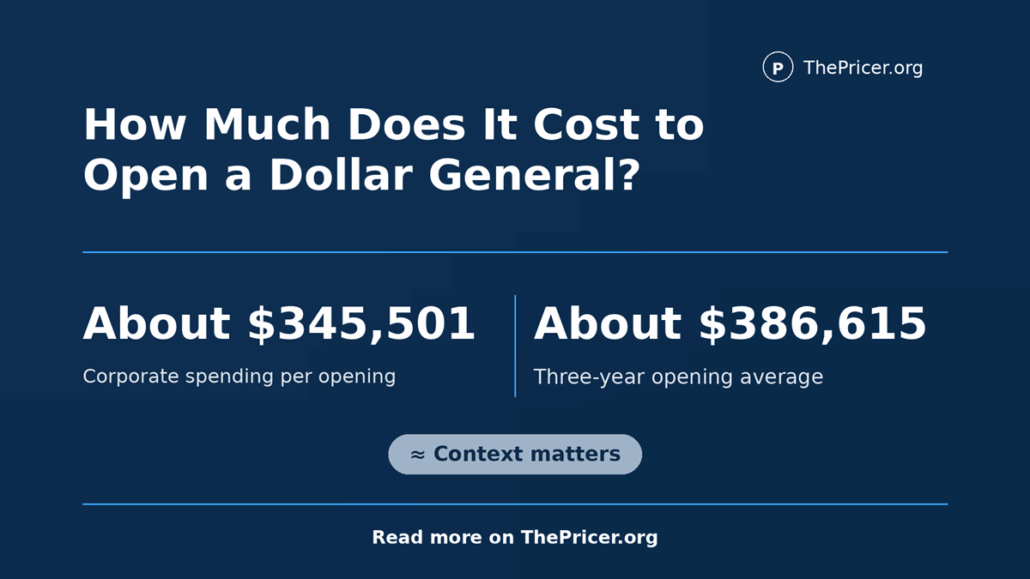
There is still a useful cost number. Dollar General spent $203.5 million on new-store capital expenditures during fiscal 2025 while opening 589 stores. Dividing those figures gives about $345,501 per opening as a same-year corporate capital-spending indicator. That is not the full cost of one store and is not an amount an entrepreneur can pay to become a Dollar General owner. The spending category primarily covers leasehold improvements, fixtures, and equipment.
Dollar General expands through company-operated stores and leased real estate rather than selling stores to franchisees. Property owners and developers can propose sites to the company, and investors can own real estate leased to Dollar General, but the retailer itself operates the store, hires the employees, supplies the merchandise, and keeps the retail profit or loss.
Article Highlights
Jump to sections
- There is no Dollar General franchise fee because the company does not sell conventional store franchises.
- Claims of a $40,000 franchise fee or 5% royalty do not describe a current Dollar General offering.
- Dollar General spent $203.5 million on its new-store capital expenditure category in fiscal 2025 while opening 589 stores.
- That equals about $345,501 per opening as a calculated corporate spending indicator, not a full store-development price.
- Dollar General operated 21,055 stores in the U.S. and Mexico as of May 1, 2026.
- Most Dollar General stores occupy leased premises, with many new-store leases running up to 15 years before renewal options.
- Fiscal 2025 net sales reached $42.7 billion, but consolidated net margin was only about 3.54%, not the 15%-25% franchise-owner margin sometimes claimed online.
Is Dollar General Actually a Franchise?
No. Dollar General is a publicly traded retailer whose stores are operated inside its corporate structure. A 2025 report quoting Dollar General directly notes that the chain does not franchise its stores. Dollar General’s own corporate filings describe retail stores, store managers, distribution centers, leases, company capital spending, and corporate expansion rather than a network of independent franchisees.
This distinction changes the answer to every normal franchise-cost question. There is no current Dollar General Franchise Disclosure Document offering a store to an outside buyer, no legitimate initial franchise fee, no franchise royalty schedule, and no published franchisee earnings statement.
The Federal Trade Commission requires a franchisor selling a covered U.S. franchise to provide prospective buyers with a Franchise Disclosure Document before taking money or signing the franchise agreement. If someone claims to sell an official Dollar General franchise, ask for the current FDD and verify the offer directly with Dollar General before sending money.
What Dollar General Spends on New Stores
Dollar General’s corporate spending gives us a better cost signal than made-up franchise estimates. Its fiscal 2025 Form 10-K reports $203.5 million in capital expenditures for new stores, primarily leasehold improvements, fixtures, and equipment. The company opened 589 stores during the year.
| Fiscal year | New-store capital spending | Stores opened | Calculated spending per opening* |
|---|---|---|---|
| 2023 | $390.2 million | 987 | About $395,339 |
| 2024 | $295.9 million | 725 | About $408,138 |
| 2025 | $203.5 million | 589 | About $345,501 |
*These calculations divide the company’s new-store capital expenditure category by same-year openings. Dollar General warns that the timing of openings and property purchases can differ, so these figures should be read as scale indicators rather than the exact cost of an individual store.
Across those three fiscal years, Dollar General reported approximately $889.6 million in this new-store capital category while opening 2,301 stores. Dividing those totals gives a three-year indicator of about $386,615 per opening.
$345,501 Is Not the Full Build Cost
The $345,501 fiscal 2025 calculation does not mean a complete Dollar General building costs $345,501. The company’s disclosed category is primarily for leasehold improvements, fixtures, and equipment rather than every economic cost attached to the land and building.
Most Dollar General stores are in leased premises. The company says many locations, including a significant share of new stores, have primary lease terms of up to 15 years with renewal options. A landlord or commercial developer may therefore own the underlying property while Dollar General spends corporate capital outfitting the retail space.
There are also costs elsewhere in the corporation that should not be stuffed into one store-opening figure. Distribution centers, transportation, information technology, inventory systems, corporate staff, training, logistics, and supply-chain infrastructure support thousands of stores simultaneously.
This is why a third-party page cannot take an estimated building price, add a supposed franchise fee, and call the result the cost of a Dollar General franchise. No such retail franchise package is currently being sold.
How Dollar General Opens Stores
Dollar General chooses markets, negotiates real estate, builds or leases locations, hires employees, stocks stores, and operates them through its corporate network. Its current business overview describes a small neighborhood-store model focused on frequently purchased household products and a limited merchandise assortment.
Dollar General’s existing stores average about 7,500 square feet of selling space. Its primary new-store format now averages roughly 8,500 square feet. About 80% of existing stores are in towns with populations of 20,000 or fewer, which is one reason the company’s real estate model differs from a large supermarket or big-box retailer.
The expansion is still active. Dollar General’s May 2026 quarterly SEC filing reported 21,055 stores as of May 1, 2026. For fiscal 2026, management plans roughly 450 new stores in the United States and about 10 in Mexico, alongside thousands of remodel projects.
Can You Own the Building Instead?
Real estate is the most direct business route for someone who wants to participate in Dollar General’s physical expansion. The company’s official Store Growth and Real Estate team accepts recommendations for potential sites and lists regional real estate contacts.
That relationship is different from franchising. A developer might acquire land, develop a suitable property, and lease it to Dollar General under negotiated terms. Dollar General then operates the retail business. The property owner earns rent rather than taking a percentage of store sales as a franchisee.
Case 1, would-be franchise buyer: Someone with $500,000 cannot simply submit that money to Dollar General and purchase a store franchise. There is no current franchise package to buy.
Case 2, property owner: Someone who controls a promising commercial parcel can submit it for consideration through Dollar General’s real estate process. Development cost, financing, rent, lease structure, taxes, construction, and eventual property value are real-estate questions rather than franchise fees.
Case 3, retail operator: Someone who wants to run a Dollar General location personally can pursue corporate store-management employment. Dollar General’s retail careers structure includes sales associates, assistant store managers, store managers, district managers, and regional directors. Those are company jobs, not ownership positions.
Dollar General’s Actual Margins
The old franchise estimates often claim a Dollar General owner can earn net margins of 15% to 25% and returns of 20% to 50%. There is no Dollar General franchisee population from which those numbers could be measured.
Dollar General’s actual fiscal 2025 corporate results provide a reality check. The company’s full-year earnings release reported $42.724 billion in net sales, $13.100 billion in gross profit, and $2.204 billion in operating profit.
That translates to a gross margin of about 30.66% and an operating margin of about 5.16%. Fiscal 2025 net income was $1.512 billion, equal to roughly 3.54% of sales.
Corporate margins cannot be used as the exact profit margin of one location because company accounts contain costs and income from the whole network. They do show why a claim that a typical Dollar General franchisee automatically keeps 15% to 25% of revenue as net profit is unsupported.
The Fake Franchise Numbers
Several figures have circulated online for years even though Dollar General does not sell the corresponding franchise product. These include a supposed $40,000 franchise fee, a 5% royalty, a 10-year franchise agreement, franchisee training programs, and initial investments ranging from several hundred thousand dollars to more than $1 million.
Those amounts can look plausible because real franchises often do charge entry fees and royalties. Plausibility is not evidence. A genuine franchise cost table should trace back to the franchisor’s current FDD or another direct company disclosure.
The FTC’s Franchise Rule requires franchisors to disclose 23 categories of information to prospective franchisees. Those disclosures include startup costs, fees, contractual obligations, litigation, franchisee information, and other material terms. A random estimate cannot replace an FDD for a franchise that is supposedly available.
What the Company Is Worth
Buying Dollar General stock and buying a franchise would also be two very different investments. Dollar General is publicly traded under the ticker DG, so shareholders can own a small financial interest in the corporation. They do not own an individual store and do not receive the store’s local profit.
The company is also not debt-free. At January 30, 2026, Dollar General reported approximately $1.139 billion in cash and cash equivalents and $4.6 billion in consolidated outstanding debt. Claims that it has no debt and billions of dollars of excess cash should not be used to justify a franchise investment.
This article therefore does not rate Dollar General shares as a good or bad investment. Stock valuation involves earnings expectations, market price, debt, competition, interest rates, growth, and investor risk tolerance. It is separate from answering whether a Dollar General store can be franchised.
If You Actually Want a Franchise
Someone who wants business ownership rather than Dollar General employment or real-estate exposure needs a company that genuinely franchises. Before comparing costs, confirm that the brand is accepting applicants and obtain the current FDD.
The distinction is visible in other retail and consumer brands. Walmart also uses corporate ownership rather than selling normal Walmart store franchises, which we explain in our Walmart franchise cost guide. Starbucks uses a licensing-heavy model rather than ordinary U.S. individual franchising, covered in our Starbucks franchise cost guide.
For a business that actually offers franchised units, compare the investment structure with a The UPS Store franchise or a Popeyes franchise. Their startup ranges, royalty structures, cash requirements, and FDD disclosures are the relevant type of information a prospective franchise buyer should expect.
What We Verified
- No retail franchise offering: Dollar General continues to operate through company-controlled stores rather than selling conventional store franchises.
- Latest store count: Dollar General reported 21,055 stores as of May 1, 2026.
- Corporate new-store spending: fiscal 2025 new-store capital expenditures were $203.5 million while 589 stores opened.
- Real estate structure: most stores occupy leased premises, and many leases for new locations can run up to 15 years before renewal options.
- Financial reality: fiscal 2025 consolidated net margin was about 3.54%, not the 15%-25% franchisee margin previously attributed to hypothetical owners.
Answers to Common Questions
How much does it cost to buy a Dollar General franchise?
You cannot currently buy one. Dollar General does not offer conventional retail franchises, so there is no official franchise fee or franchise investment range.
Is the Dollar General franchise fee $40,000?
No current Dollar General corporate disclosure supports a $40,000 retail franchise fee. The company does not currently sell individual Dollar General store franchises.
How much does Dollar General spend to open a store?
Dollar General spent $203.5 million in its new-store capital expenditure category while opening 589 stores in fiscal 2025. Dividing those figures produces about $345,501 per opening, but this is only a corporate capital-spending indicator and not the complete economic cost of a store.
Can I buy land and lease a store to Dollar General?
Potentially. Dollar General has an active real estate operation that evaluates proposed store locations. A landowner or developer can contact the company’s regional real estate team, but acceptance of a site is not guaranteed.
Can I own an existing Dollar General store?
Not as a normal franchisee. Dollar General operates its stores corporately. An investor may be able to own real estate occupied by Dollar General, but ownership of the building is separate from ownership and operation of the retail store.
Disclosure: Educational content, not financial advice. Prices reflect public information as of the dates cited and can change. Confirm current rates, fees, taxes, and terms with official sources before purchasing. See our methodology and corrections policy.
I would like to open a Dollar General store in my area
I would like information
I would like more information to open a store
Who do i need to talk to about the Dollar General start up