
How Much Does an English Bulldog Cost?
Updated on | Written by Alec Pow
This article was researched using 16 sources. See our methodology and corrections policy.
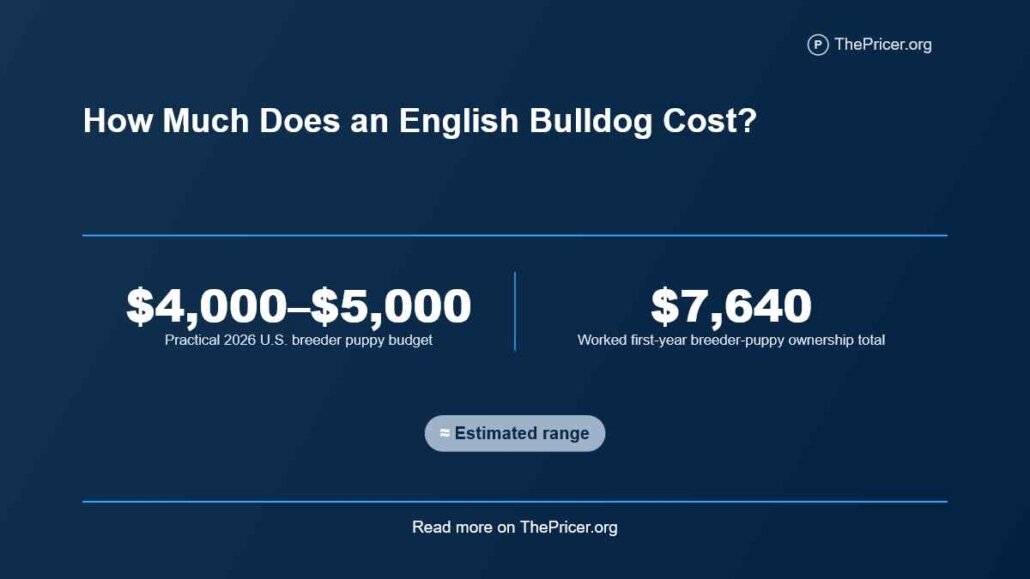
A U.S. buyer should budget about $4,000-$5,000 in 2026 for an English Bulldog puppy from a health-focused breeder. That is a planning range, not a national average. Two current Bulldog Club of America Marketplace listings with health testing are advertised at $4,600 for a health-tested litter and $5,000 for another health-tested litter.
A rescue Bulldog can cost far less to acquire, but purchase price is only the opening bill. Food, insurance, preventive care, skin and airway problems, heat management, dental care, training, and emergencies can make the English Bulldog one of the more expensive companion breeds to own.
The AKC breed name is Bulldog, while English Bulldog is the name many buyers use when searching. The biggest financial difference is not coat color or a flashy pedigree. It is whether the dog comes from health-conscious breeding and how much medical care the individual Bulldog needs through life.
Article Highlights
Jump to sections
- A responsibly bred English Bulldog puppy is a sensible 2026 budget item at about $4,000-$5,000.
- Bulldog rescue fees can run about $500-$1,500, with younger purebred dogs often at the upper end.
- A worked first-year breeder-puppy scenario totals about $7,640 before boarding, major illness, or optional services.
- A basic recurring budget can exceed $2,200 per year before dental work, training, boarding, or a major medical event.
- Airway surgery can add four figures. One current surgical practice lists combined stenotic-nares and soft-palate surgery at $1,907-$2,244.
- A 10-year planning scenario can reach roughly $25,010-$55,385, depending on annual spending and without assuming a major Bulldog-specific operation.
How Much Does an English Bulldog Cost?
For a family companion from a breeder who documents health testing, about $4,000-$5,000 is a practical 2026 starting budget. Current BCA Marketplace examples sit inside that band at $4,600 and $5,000. Prices below that level exist, but a low asking price does not show whether the parents were screened, how much veterinary care the litter received, or what support the breeder provides after placement.
Rescue changes the acquisition bill sharply. New Orleans Bulldog Rescue currently publishes English Bulldog adoption fees of $500-$800, with young English Bulldogs at $1,000-$1,500. Rescue fees may cover veterinary work already completed, but inclusions vary. Ask what has been done before comparing an adoption fee with a breeder price.
| Route | Current price evidence | Scope |
|---|---|---|
| Health-focused breeder budget | $4,000-$5,000 | ThePricer planning range for a responsibly bred pet puppy |
| Current BCA litter | $4,600 | Health-tested B-Loved Bulldogs listing |
| Current BCA litter | $5,000 | Health-tested BTS Bulldogs listing |
| Bulldog rescue | $500-$1,500 | Published rescue fee range |
A breeder fee and a rescue fee do not buy the same package. A breeder puppy may still need sterilization, a microchip, later vaccine doses, training, and supplies. A rescue dog may arrive with several of those items completed. Compare the unpaid work that remains, not the entry fee alone.
Why Bulldog Puppies Cost More
Bulldog reproduction can require much more veterinary involvement than reproduction in many other breeds. A 2026 study using Danish Kennel Club records found an 80% caesarean-section rate in English Bulldogs. That does not mean every U.S. Bulldog litter has the same experience, but it shows why a responsible breeding program can carry unusually high reproductive costs. Prenatal monitoring, emergency access, surgical delivery, neonatal care, health screening, and small numbers of puppies can all push the cost per surviving puppy upward.
Health testing is another real input. A breeder who screens breeding dogs, keeps records, uses veterinary reproductive care, socializes puppies, and supports buyers has costs that a high-volume seller may skip. The purchase decision should focus on documented health work, the parents, the contract, and the breeder’s practices rather than assuming that a high price proves quality. Expensive puppies can still be poorly bred.
This is also why rare-color marketing deserves caution. A surcharge tied to a fashionable color is not the same thing as a surcharge tied to documented health work. The Bulldog Club of America focuses its Marketplace on dogs bred to the AKC Bulldog standard. Buyers paying several thousand dollars should ask for the health-test records that justify confidence in the breeding program.
First-Year Bulldog Budget
The puppy price is only part of year one. Rover’s 2026 research places startup costs of $1,195-$4,650, with $300-$800 for spay or neuter, $30-$80 for microchip and ID, $80-$180 for an initial exam, $180-$300 for vaccinations, $75-$175 for initial preventatives, and $260-$1,125 for essential supplies. Its annual puppy-food range is $575-$4,775, reflecting large differences in diet and dog size.
Insurance can become another monthly bill. Lemonade’s current English Bulldog page shows an average quoted premium of $55-$60 per month at age one. That is one insurer’s pricing, not a national Bulldog average. Location, deductible, reimbursement level, policy limits, and exclusions can change the quote.
A worked first-year example
Take a $4,600 breeder puppy. Use $550 for sterilization, $55 for microchip and ID, $130 for the initial exam, $240 for vaccinations, $125 for initial preventatives, $500 for supplies, an illustrative $720 food budget, and $720 of insurance at $60 per month.
The total is $4,600 + $550 + $55 + $130 + $240 + $125 + $500 + $720 + $720 = $7,640. It excludes training, boarding, daycare, dental work, and unexpected treatment. A rescue fee of $500-$1,500 lowers the acquisition line by $3,100-$4,100 against this $4,600 breeder example, before crediting any veterinary services already included by the rescue.
Annual Ownership Costs
Routine veterinary spending needs its own budget even in a healthy year. CareCredit’s 2025-2026 national veterinary-cost research lists a routine dog visit at $56-$129, flea and tick prevention at $36 per month, heartworm prevention at $23 per month, and routine dental cleaning at $379. Its dog testing figures include $104 for a CBC, $164 for a chemistry panel, $296 for skin allergy testing, $483 for an ultrasound, and $172 for two to three X-ray views.
A basic annual model uses $720 for food, $720 for insurance, $708 for twelve months of the cited flea, tick, and heartworm preventatives, plus a rounded $100 routine exam. The total is $2,248 per year before dental cleaning, training, boarding, replacement gear, or illness. Adding the cited dental figure produces $2,627. Dental care can move the annual total higher.
Insurance is one way to shift part of a large covered bill, while a cash reserve is another. Coverage terms matter because hereditary or congenital conditions, waiting periods, deductibles, and pre-existing conditions can change reimbursement. Our pet insurance cost guide explains those policy variables in more detail.
The Hidden Medical Bill
English Bulldogs carry a higher medical-risk profile than many dogs. Royal Veterinary College research comparing 2,662 English Bulldogs with 22,039 other dogs found Bulldogs had more than twice the disorder risk during a single year. They showed higher risk for 24 of the 43 common disorders studied. Breathing, skin, ear, and eye problems were among the concerns.
Brachycephalic obstructive airway syndrome can become a four-figure bill. Veterinary Surgical Solutions in Austin lists stenotic-nares surgery at $1,209-$1,519 and combined nares plus soft-palate surgery at $1,907-$2,244. A North Carolina practice publishes lower airway procedure prices of $600 for nares only and $1,450 for the combined procedure. These are practice-specific prices, not a national average.
Heat adds another breed-specific exposure. RVC research reports that English Bulldogs have about 14 times the heat-related-illness risk of Labrador Retrievers. Air-conditioned indoor space, careful travel, exercise timing, and access to emergency care all belong in ownership planning. A low-cost boarding option can become a false economy if it cannot safely manage a flat-faced dog in hot weather.
One healthy year cannot define the lifetime budget. Airway, eye, orthopedic, dermatology, and emergency care can change the total quickly.
Food and Daily Care
Bulldogs do not need a blanket “grain-free” diet. The FDA investigated reports of canine dilated cardiomyopathy associated with certain diets, many marketed as grain-free and high in peas, lentils, other pulses, or potatoes. The agency also said the available reports did not establish a simple causal relationship. Its canine DCM diet investigation is a better basis than a breed-wide grain-free rule.
Choose a complete diet with your veterinarian based on life stage, body condition, allergies, gastrointestinal response, and diagnosed disease. Some Bulldogs may need a prescription diet or supervised food trial. Our dog food cost guide covers package and feeding costs separately.
Daily care also has a labor cost even when no groomer is paid. Skin folds need to stay clean and dry, nails need trimming, ears need monitoring, and weight control can affect mobility and breathing. Home care can reduce paid grooming visits, but new skin, ear, eye, or breathing problems need veterinary assessment.
Readers comparing breed budgets can also review the American Bully cost, Cairn Terrier cost, and Miniature Pinscher cost. Compare lifetime care and medical exposure, not puppy price alone.
Lifetime Cost Scenarios

The American Kennel Club lists the Bulldog lifespan at about 10-12 years. One breed-wide lifetime average would hide too much variation. Insurance, location, boarding, food, age, and major medical events can move the result by thousands of dollars.
Start with the worked first-year figure of $7,640. Rover’s already-cited adult-dog range is $1,930-$5,305 per year. A 10-year scenario is $7,640 + 9 × $1,930 = $25,010 at the low end and $7,640 + 9 × $5,305 = $55,385 at the high end. Over 12 years, the same method gives $28,870-$65,995.
These are planning scenarios, not English Bulldog averages. The first year uses a current Bulldog breeder example and selected startup assumptions, while later years use a broad adult-dog range. Airway surgery, chronic dermatology treatment, eye surgery, prescription food, specialist visits, or an uncovered emergency can push spending higher.
A flat $100,000+ lifetime claim is too broad to present as normal without a documented model. Budgeting only the puppy price plus food makes the opposite error by ignoring the bills most capable of changing this breed’s total.
Is Your Budget Ready?
The financial test is whether the household can absorb predictable costs and a bad medical year without delaying care. Paying $4,600 for a puppy is only the first step. The purchase fee should sit beside an annual care plan and a separate plan for a four-figure emergency.
Rescue can make acquisition much less expensive, but future care can still be costly. An adult rescue may provide useful medical history about breathing, skin, eyes, joints, and established treatment needs. Ask for records, completed procedures, current medications, and expected follow-up.
Makes sense if
- You can pay the acquisition cost without spending the money reserved for routine veterinary care.
- You can fund insurance, an emergency reserve, or both.
- You have reliable air conditioning and can manage exercise and travel around heat.
- You are prepared for recurring skin-fold, ear, weight, dental, and breathing care.
Does not make sense if
- The puppy price would consume the cash needed for the first year of care.
- A surprise $2,000-$4,000 veterinary bill would force you to postpone treatment.
- Your housing or schedule makes heat-safe indoor care difficult.
- You are choosing a puppy mainly because it is cheaper than health-tested breeder options.
Verification checks
- Checked the BCA breeder-referral requirements and its advice to put breeder promises and guarantees in writing.
- Confirmed that the OFA respiratory grading program applies to Bulldogs and grades BOAS signs from 0 through III.
- Cross-referenced the WSAVA nutrition guidance on veterinary nutritional evaluation and body-condition assessment.
Answers to Common Questions
Why are English Bulldogs so expensive?
Responsible breeding can involve health screening, reproductive veterinary care, surgical delivery, neonatal care, and high cost per puppy. Current health-tested BCA examples list at $4,600 and $5,000.
How much is an English Bulldog from a rescue?
Bulldog-specific rescue fees can run about $500-$1,500. Some medical care may already be included.
How much should I budget per year?
The basic model above comes to $2,248 per year before dental care, training, boarding, replacement supplies, and illness.
Does an English Bulldog need pet insurance?
Insurance is optional. Compare premiums, deductibles, reimbursement limits, hereditary and congenital coverage, waiting periods, and pre-existing-condition rules. A cash reserve can be used instead of, or alongside, insurance.
How much can an English Bulldog cost over its lifetime?
The 10-year planning scenario above is about $25,010-$55,385. The 12-year version is about $28,870-$65,995, before assuming a major Bulldog-specific medical event.
Disclosure: Educational content, not medical advice. Pricing varies by provider, location, and insurance. Confirm eligibility, coverage, and out-of-pocket costs with a licensed clinician and your insurer. See our methodology and corrections policy.