
How Much Do Graceland Portable Buildings Cost?
Updated on | Written by Alec Pow
This article was researched using 7 sources. See our methodology and corrections policy.
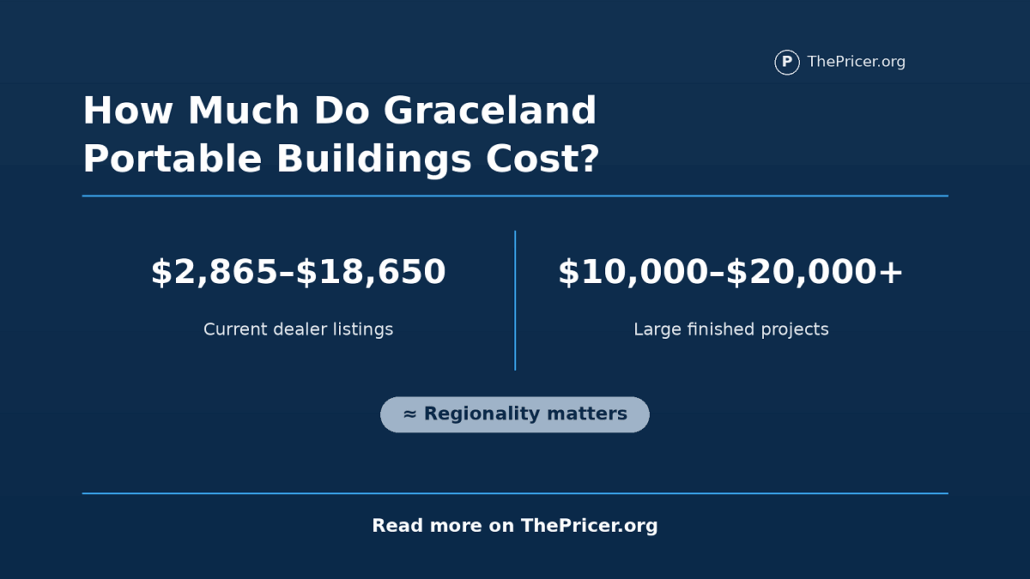
Graceland portable buildings currently cost about $2,865 to $18,650 for dealer-listed sheds, cabins, barns, and garages. Smaller economy buildings commonly fall between $3,000 and $5,000, while 10×16 and 10×20 sheds often cost $5,000 to $8,500. Large garages, lofted barns, cabins, and 16×40 buildings can cost $10,000 to $20,000+ before site preparation, permits, utilities, insulation, and interior finishing.
Graceland usually sells a portable building shell rather than a move-in-ready home or fully finished office. The listed price may include delivery, setup, leveling, and anchoring within the company’s qualifying delivery area, but it does not automatically include a gravel pad, concrete foundation, electrical service, plumbing, HVAC, drywall, cabinetry, or approval for residential occupancy.
The real buyer decision is not only which building size to choose. It is whether to pay the cash price, use rent-to-own, buy a pre-owned unit, or purchase a basic shell and complete the interior later.
Article Highlights
Jump to sections
- Current dealer inventory ranges from about $2,865 to $18,650 (at $30 per hour, earning that amount would take about 0.6 to 3.6 months of full-time work, before taxes).
- An 8×12 economy shed is listed around $3,510.
- Current 10×16 sheds commonly cost $5,000 to $7,000.
- A 10×20 garage is listed around $8,315.
- A 12×24 lofted barn garage is listed around $11,192.
- Graceland advertises free delivery and setup within 50 miles of the local dealer when site conditions qualify.
- Rent-to-own can cost far more than the cash price when payments continue for the full contract term.
How Much Do Graceland Portable Buildings Cost?
| Current dealer-listed building | Cash or sale price | Advertised monthly payment |
|---|---|---|
| 8×12 Econo | $3,510 (about 2.9 full-time workweeks at $30 per hour) | $121.03 plus tax |
| 8×12 Lofted Barn | $4,217.75 | $145.44 plus tax |
| 8×12 Utility Shed | $4,240.60 | $146.23 plus tax |
| 10×16 Barn | $5,005.28 | $172.60 plus tax |
| 10×16 Garden Shed | $5,275 | $181.90 plus tax |
| 8×16 Cabin | $5,803.20 | $200.11 plus tax |
| 10×20 Garden Shed | $6,810 | $234.83 plus tax |
| 10×20 Urban Shed | $7,765 | $267.76 plus tax |
| 10×20 Garage | $8,315 | $286.72 plus tax |
| 12×24 Lofted Barn Garage | $11,191.60 | $385.92 plus tax |
| 16×40 Utility Shed | $18,646.40 | $642.98 plus tax |
Graceland Buildings of Brusly currently lists more than 50 new, sale, and repossessed buildings from $2,865 to $18,647. Its inventory includes economy sheds, garden sheds, utility sheds, lofted barns, cabins, garages, side-lofted barns, and porch models. These are current Louisiana dealer prices rather than a fixed national price sheet, so another dealer may quote different amounts for the same nominal size.
The listed price can also change with windows, doors, porch configuration, siding, roofing, lofts, electrical work, local sales tax, and whether the unit is new or repossessed. Buyers should compare the serial-numbered building on the lot rather than assuming every 10×16 model has the same equipment.
What the Price Includes
A standard Graceland building is a completed wood-framed structure transported to the property on a custom tilt-bed trailer. Graceland uses a portable hydraulic Mule to move the building from the trailer to its final position. It is not normally delivered as a flat-packed kit or assembled from modular wall panels in the buyer’s yard.
Published construction features include treated runners and floor joists, reinforced doors, ridge ventilation, galvanized ring-shank nails, and a soffit ventilation system. Some product lines use 5/8-inch treated plywood siding and wall studs spaced 16 inches on center, although Graceland warns that certain specifications are not available in every area. The current features are described on the company’s building specifications page.
A portable cabin may resemble a small house from the outside, but the purchase price should not be compared with the cost of a finished dwelling. The shell may lack insulation, finished walls, permanent heating, plumbing, kitchen facilities, smoke alarms, code-compliant exits, and a residential foundation.
Delivery Can Be Included
Graceland states that qualifying purchases receive free delivery for up to 50 miles from the local dealer, along with setup, leveling, and anchoring when the site is inside the required service zone. The company describes these terms in its delivery and setup FAQ.
Free delivery does not make every property delivery-ready. The route must have enough width, height, turning room, and load-bearing ground for the trailer and building. Fences, branches, gates, septic systems, soft lawns, steep slopes, utility lines, and narrow driveways can block access. A dealer may decline the original placement, require site work, or charge more when the address is beyond the included radius.
Moving the building later is a separate expense. A local relocation may start in the hundreds of dollars, while a large building, difficult access, or a long-distance move can cost several thousand. The building’s dimensions and route limitations are covered in the guide to shed moving costs.
The Rent-to-Own Markup
Graceland offers rent-to-own terms of up to 60 months, generally without a traditional credit check and with the first monthly payment required at the start. The company also says there is no prepayment penalty. These features can make the monthly entry price look accessible, but rent-to-own is not the same as paying the cash price in installments.
The official purchase-options page does not publish one universal total for every contract. Buyers need the number of payments, payment amount, taxes, early-purchase terms, late fees, reinstatement rules, and total cost in writing before signing.
Current inventory provides a useful ThePricer comparison. A 10×20 Garden Shed is listed at $6,810 (about 5.7 full-time workweeks at $30 per hour) cash or $234.83 per month plus tax. Dividing the cash price by the monthly payment gives 29 payments. The 30th payment pushes the nominal amount paid above the cash price. If payments continued for 36 months, they would total $8,453.88 before tax, which is $1,643.88 above cash. At 60 payments, the nominal total would reach $14,089.80, more than twice the cash price. Those longer totals are scenarios, not a claim that this specific listing uses either term.
The same pattern appears on the 12×24 Lofted Barn Garage. Its $11,191.60 cash price divided by the advertised $385.92 monthly payment also equals about 29 payments. Paying for 36 months would total $13,893.12, while 60 months would total $23,155.20, before tax and contract charges.
The Shell-to-Office Cost Gap
A 10×16 shed provides 160 square feet of floor area, but converting it into a comfortable office requires far more than a desk and extension cord. The work may include a foundation or pad, insulation, vapor control, electrical service, outlets, lighting, drywall or paneling, finished flooring, heating and cooling, permits, steps, and internet access.
Suppose the building costs $5,800. A realistic scenario adds $1,500 for site preparation, $3,500 for insulation and interior walls, $2,500 for electrical work, $2,000 for flooring and paint, and $2,500 for a mini-split. The finished office totals $17,800, or about $111.25 per square foot. Furniture, permits, internet trenching, and landscaping remain outside the total.
Electrical service becomes more expensive when the shed is far from the house or the existing panel lacks capacity. Underground conduit, trenching, a subpanel, grounding, disconnects, and inspection can turn a simple lighting request into a larger utility project. Long runs share some of the same cost pressures discussed in the guide to burying electrical lines.
A Cabin Is Not Yet a Tiny Home
Graceland markets cabin-style buildings for storage, recreation, workshops, offices, and possible living-space projects. Its portable cabin page offers new, pre-owned, basic, and highly optioned shells with rent-to-own availability. That marketing does not establish that every cabin can legally be occupied as a home.
Residential conversion depends on zoning, minimum dwelling size, foundation requirements, structural loads, energy codes, sanitation, water service, electrical approval, emergency exits, smoke and carbon-monoxide alarms, and local rules for accessory dwelling units. Some jurisdictions will not approve a portable shed as a residence regardless of the interior finish.
A buyer should not compare a $10,000 cabin shell with a $100,000 finished tiny house. A legal dwelling may need a foundation, septic or sewer connection, water line, bathroom, kitchen, electrical service, insulation, HVAC, plans, engineering, permits, and inspections. Utility installation on undeveloped property can become one of the largest expenses, as shown in the article on getting utilities onto land.
Site Work Before Delivery
A level, well-drained site helps the doors operate correctly and limits settling. Some properties need only compacted gravel and concrete blocks. Others require excavation, drainage, retaining work, a concrete slab, piers, or a frost-protected foundation specified by the local building department.
Site preparation should match the building’s size, soil, drainage, intended use, and local frost depth. A storage shed on treated runners is not the same project as a garage supporting a vehicle or a cabin intended for occupancy. Buyers considering a raised permanent base can compare the scope with current pier-and-beam foundation costs.
Assume a 10×20 Garden Shed costs $6,810. Add a $1,600 gravel pad, $350 permit, $500 for tree and fence access work, and $250 for steps and a ramp. The installed storage total becomes $9,510. The building sticker accounts for about 72% of the completed project.
Permits Depend on Use
Graceland advises buyers to check permits before purchasing because requirements vary by location and building size. Its pre-purchase guidance also tells buyers to examine delivery access, customization, intended use, and durability.
A small detached storage shed may be exempt from a building permit in one city but still subject to setback, lot-coverage, flood-zone, height, and homeowners association rules. A larger garage, wired office, plumbing installation, or habitable cabin can trigger separate building, zoning, electrical, mechanical, and plumbing reviews.
There is no defensible national permit price for a Graceland building. Ask the local permitting office which rules apply to the exact address, size, foundation, and use. Obtain the answer before paying a nonrefundable deposit or preparing a site that may not meet the required setback.
Garage and Barn Comparisons
A portable 10×20 garage currently listed at $8,315 is a different product from a site-built two-car garage or agricultural barn. The portable model has a compact footprint and can arrive as one completed shell, while a larger permanent garage may require plans, excavation, concrete, framing, roofing, electrical work, and inspections.
A buyer who needs equipment storage, livestock space, tall doors, or more than 400 square feet should compare the portable option with the cost of a conventional pole barn kit. A basic Graceland lofted barn can be useful for yard equipment and seasonal storage, but it should not be priced as a substitute for an engineered agricultural building without matching size, floor load, wind rating, doors, foundation, and intended use.
New, Sale, and Repo Buildings
Dealer inventory may include standard-price units, sale buildings, and repossessed structures. A current 12×24 garage with electrical work was listed as a repo at $9,575.02, down from $10,522. Another 16×40 Utility Shed was marked down from $20,090 to $18,646.40.
A repo discount can be worthwhile, but inspect the floor, runners, doors, roof, siding, windows, wiring, moisture exposure, and evidence of previous movement. Ask whether the normal warranty transfers, whether delivery is included, and whether the building has modifications that affect permitting or future relocation.
Sale discounts in the current inventory are often only $100 to $300. The larger savings may come from accepting an existing color and configuration, choosing an older unit, or paying cash instead of completing a long rent-to-own contract.
When a Graceland Building Fits
Makes sense if:
- The property has a clear delivery route and a level approved location.
- The building will be used mainly for storage, a workshop, or another use allowed by local rules.
- The buyer can pay cash or use an early-purchase option rather than carrying rent-to-own for years.
- The selected inventory unit already has the doors, windows, loft, and layout needed.
- The project budget includes site work, permits, utilities, and interior finishing.
Does not make sense if:
- The purchase depends on treating an unfinished cabin as an automatically legal home.
- The property has no safe trailer access or approved building location.
- The monthly payment is affordable only when the total rent-to-own price is ignored.
- The buyer needs a large permanent garage or agricultural structure that exceeds portable-building dimensions.
- Finishing the shell will cost more than a purpose-built office, garage, or dwelling.
What We Verified
- Checked current building and monthly-payment examples against the named Brusly Graceland dealer inventory.
- Confirmed delivery, setup, leveling, anchoring, and the 50-mile condition through Graceland’s published FAQ.
- Cross-referenced the up-to-60-month rent-to-own term with the company’s official purchase-options page.
- Verified current listed construction and warranty features through Graceland’s specifications page.
- Checked the manufacturer’s warning that permit requirements vary by location and building size.
Answers to Common Questions
How much is a 10×16 Graceland building?
Current 10×16 dealer listings run from about $5,000 to $7,000, depending on whether the building is a barn, garden shed, utility shed, or lofted model.
Does Graceland include delivery?
Graceland advertises free delivery and setup up to 50 miles from the local dealer when the location and site meet its conditions. Longer distances or difficult access may cost extra.
How much does Graceland rent-to-own cost?
The total depends on the monthly payment, contract length, tax, and early-purchase terms. Current monthly listings exceed their cash prices after about 29 payments, so completing a longer contract can cost far more than paying cash.
Can a Graceland cabin be used as a home?
Only when the property, foundation, utilities, construction, and finished building satisfy local residential codes and zoning. Buying a cabin shell does not grant permission to occupy it as a dwelling.
How long is the Graceland warranty?
Graceland currently advertises a limited lifetime warranty on qualifying wood products and a seven-year craftsmanship warranty, with coverage varying by building and region. Read the written warranty for the exact unit before purchase.
Disclosure: Educational content, not financial advice. Prices reflect public information as of the dates cited and can change. Confirm current rates, fees, taxes, and terms with official sources before purchasing. See our methodology and corrections policy.