
How Much Does A Helium Tank Cost?
Updated on | Written by Alec Pow
This article was researched using 9 sources. See our methodology and corrections policy.
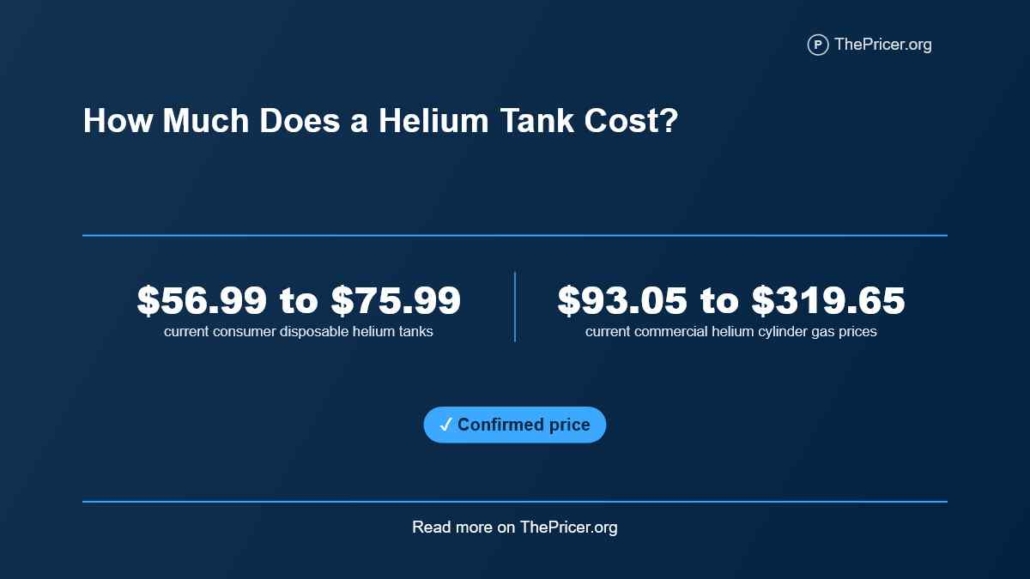
A disposable helium tank currently costs about $57 to $76 for common consumer sizes, while a commercial balloon-helium cylinder can cost roughly $93 to $320 for the gas in one current local rental example, plus a refundable cylinder deposit. Balloon Time currently lists its 8.9-cubic-foot Medium tank at $56.99 and its 14.9-cubic-foot Jumbo tank at $75.99. Commercial-cylinder prices vary by supplier and location, so larger tanks are often quote-priced rather than sold at one national rate.
The number of balloons matters more than the tank’s marketing name. The current Medium tank can supply the same gas volume used by a kit rated for up to 30 9-inch latex balloons or 16 12-inch balloons. The Jumbo can fill up to 50 9-inch balloons or only 25 12-inch balloons. That means a larger balloon can roughly double the helium cost per finished balloon.
Consumer party tanks and commercial cylinders are also different products. Balloon Time’s portable tanks contain a helium-and-air mixture with at least 80% helium and are non-refillable. Commercial cylinders can hold many times more gas, use separate regulators, and are commonly rented, exchanged, or supplied against a refundable deposit.
Article Highlights
Jump to sections
- Balloon Time’s current Medium helium tank costs $56.99 (at $30 per hour, earning that amount would take about 1.9 hours of work, before taxes) and contains 8.9 cubic feet of helium-air mixture.
- The current Jumbo costs $75.99 and contains 14.9 cubic feet.
- The Jumbo fills up to 50 9-inch latex balloons but only 25 12-inch balloons.
- That works out to about $1.52 per 9-inch balloon or $3.04 per 12-inch balloon for helium alone.
- A current local commercial supplier lists 40-cubic-foot helium at $93.05 and 291-cubic-foot helium at $319.65, with a $450 refundable deposit.
- A 40-cubic-foot cylinder contains enough gas for roughly 80 11-inch latex balloons using Airgas’s 0.5-cubic-foot-per-balloon planning figure.
- Disposable consumer cylinders should not be refilled. Commercial cylinders should be handled according to the gas supplier’s instructions.
How Much Does a Helium Tank Cost?
| Helium option | Current published price | Capacity or output |
|---|---|---|
| Consumer Medium tank | $56.99 | 8.9 ft³ helium-air mixture |
| Consumer Jumbo tank | $75.99 | 14.9 ft³, up to 50 9-inch or 25 12-inch latex balloons |
| 40 ft³ commercial rental cylinder | $93.05 (about 3.1 hours of work at $30 per hour) | Current local supplier price, with refundable cylinder deposit |
| 125 ft³ commercial rental cylinder | $216.65 | Larger event and decorating jobs |
| 291 ft³ commercial rental cylinder | $319.65 | High-volume balloon work |
| Airgas Size 300 balloon-helium cylinder | Local quote required | Approximately 292 ft³ |
The commercial prices in the table come from a current Florida helium supplier that charges no time-based cylinder rental fee but collects a $450 refundable deposit. Those numbers are useful as a real market example, not a nationwide price schedule. A gas supplier in another city may use a different gas price, deposit, delivery fee, regulator charge, or cylinder-lease structure.
What You’re Actually Buying
A small party tank is a convenient disposable package designed for a household event. The current Medium contains 8.9 cubic feet of helium-air mixture. Its matching Medium kit output guide rates that gas volume for up to 30 9-inch latex balloons, 16 12-inch latex balloons, or 15 18-inch foil balloons.
The Jumbo contains 14.9 cubic feet and is rated for up to 50 9-inch latex balloons, 25 12-inch latex balloons, 27 18-inch foil balloons, or four 36-inch foil number balloons. Actual output can fall when balloons are overfilled, gas escapes during inflation, or balloon dimensions differ from the stated size.
A commercial cylinder is a different purchase. The cylinder itself may remain the gas company’s property while the customer pays for the gas, exchange, rental, or deposit. A regulator or balloon inflator may be included or charged separately. Airgas’s current balloon guide uses commercial sizes of 50, 111, 219, and 292 cubic feet, far above the 8.9 to 14.9 ft³ found in the consumer tanks above.
The 50-Balloon Label
The Jumbo tank’s “up to 50 balloons” claim applies to 9-inch latex balloons. Many party balloons are 12 inches, and the same tank is rated for only 25 of those.
At the current $75.99 (about 2.5 hours of work at $30 per hour) tank price, the helium cost is:
$75.99 ÷ 50 = about $1.52 for each 9-inch latex balloon.
$75.99 ÷ 25 = about $3.04 for each 12-inch latex balloon.
The balloon diameter rises by only one-third, from 9 to 12 inches, but the helium cost per finished balloon roughly doubles. Volume grows much faster than diameter, which is why balloon size can matter more to the event budget than choosing between two nearby tank prices.
The Medium shows the same pattern. Using the current $56.99 price and the published kit capacities, 30 9-inch balloons work out to about $1.90 each, while 16 12-inch balloons work out to about $3.56 each.
Commercial Cylinders
Disposable tanks trade a higher unit cost for convenience. The Jumbo’s $75.99 divided by 14.9 cubic feet equals about $5.10 per cubic foot of its helium-air mixture. That is not a pure-helium commodity price because the manufacturer states the mixture contains at least 80% helium.
The current 40-cubic-foot ProCylinder example costs $93.05, or about $2.33 per cubic foot. The 291-cubic-foot option is $319.65, or about $1.10 per cubic foot. The unit price falls by about 52.8% between that supplier’s 40- and 291-cubic-foot sizes.
Airgas’s balloon cylinder reference guide estimates that one 11-inch latex balloon uses about 0.5 cubic foot of gas. Apply that planning factor to the 40-cubic-foot example and the cylinder contains enough gas for roughly 80 such balloons. At $93.05, that is about $1.16 of helium per 11-inch balloon before delivery, losses, and any nonrefundable fees.
That lower unit cost is why balloon decorators and larger events often move to commercial cylinders. The catch is the deposit, regulator, transport, cylinder handling, and supplier access that a disposable party tank avoids.
Three Event Budgets
Small birthday with 16 12-inch balloons: one Medium tank is rated for up to 16 and costs $56.99. The helium budget is about $3.56 per balloon before buying the balloons themselves.
Party with 50 12-inch balloons: one Jumbo fills only about 25, so the planning quantity is two tanks. 2 × $75.99 = $151.98. That equals about $3.04 per balloon for the helium tanks. Buying two Medium tanks would cost $113.98 but would only cover about 32 12-inch balloons at the published capacity, leaving the event short.
Larger 80-balloon decorating job: Airgas’s 0.5-ft³ planning figure means 80 11-inch balloons need about 40 cubic feet. The current ProCylinder 40-ft³ example costs $93.05, or about $1.16 per balloon, with a separate $450 refundable deposit. Travel, delivery, and actual inflation losses can change the final number.

Rent, Exchange, or Buy?
For a one-time home party, a non-refillable tank is usually the simplest transaction because the nozzle is built in and there is no commercial cylinder to return. The current Medium and Jumbo can also be stored after partial use if the valve is closed tightly.
A commercial cylinder becomes more attractive when balloon volume grows or the buyer fills balloons repeatedly. Supplier arrangements differ. Some charge cylinder rent by day or month. Others use an exchange system. The current ProCylinder example has no time-based rental fee but requires the $450 refundable deposit.
Ask for four numbers before comparing a commercial quote with a disposable tank: the gas charge, refundable deposit, regulator or nozzle charge, and pickup or delivery cost. Do not count a refundable deposit as a permanent helium expense unless there is a realistic risk that the cylinder will not be returned according to the supplier’s terms.
The comparison resembles other compressed-gas purchases more than an ordinary party-supply product. Readers pricing a propane tank refill or an acetylene refill will see the same distinction between paying for gas and paying for, renting, or exchanging the container. A hot air balloon, despite the name, uses a completely different lifting and fuel system and should not be part of the helium-tank budget.
Safe Storage and Disposal
Consumer and commercial tanks should not be treated the same after use. Balloon Time states that its portable cylinders are non-refillable. Its current storage guidance says a Medium or Jumbo tank can be kept for up to one year from manufacture when the valve is closed tightly. There is no need to refrigerate the tank.
When a disposable cylinder is empty, follow the manufacturer’s current disposal instructions and local solid-waste rules. Do not attempt to refill a tank sold as non-refillable.
Commercial compressed-gas cylinders require more controlled handling. The Compressed Gas Association’s safety guidance says cylinders should be secured during use and storage, handled with the correct equipment, and used with the proper valve connection. OSHA likewise instructs covered workplaces to keep compressed-gas cylinders secured and upright under applicable rules.
Helium is nonflammable, but inhaling it is not a safe use of balloon gas. The hazard is oxygen displacement, and high-pressure cylinders add pressure-related injury risks. Follow the tank label and supplier instructions rather than using helium for voice-changing stunts.
When Each Option Makes Sense
Disposable party tank makes sense if:
- You need only a few dozen balloons for one home event.
- You want a portable tank with its own dispensing nozzle and no cylinder return.
- A commercial-gas supplier is inconvenient or requires a large deposit.
- You value simple storage more than the lowest gas cost per cubic foot.
Commercial cylinder makes sense if:
- You need dozens or hundreds of larger balloons.
- You decorate events repeatedly and can return or exchange cylinders reliably.
- The supplier’s delivery, deposit, and regulator terms still leave the total below multiple disposable tanks.
- You have a suitable way to transport, secure, and store the cylinder according to supplier guidance.
What We Verified
- Checked: current consumer prices of $56.99 for the 8.9-ft³ Medium and $75.99 for the 14.9-ft³ Jumbo.
- Confirmed: the Jumbo’s published output of up to 50 9-inch latex balloons or 25 12-inch latex balloons.
- Cross-referenced: Airgas’s commercial reference sizes of 50, 111, 219, and 292 cubic feet and its approximate balloon outputs.
- Verified: current local commercial-cylinder pricing from $93.05 for 40 ft³ to $319.65 for 291 ft³, with a refundable deposit.
- Confirmed: consumer Balloon Time cylinders are non-refillable and can be stored in a cool, dry place with the valve tightly closed rather than refrigerated.
Answers to Common Questions
How much does a small helium tank cost?
A current 8.9-cubic-foot consumer tank costs $56.99. It can supply roughly the same volume used to fill up to 30 9-inch or 16 12-inch latex balloons.
How much does a larger party helium tank cost?
The current 14.9-cubic-foot Jumbo costs $75.99 and is rated for up to 50 9-inch or 25 12-inch latex balloons.
How much helium do I need for 50 12-inch balloons?
Using the current Jumbo rating, you need about two tanks. That costs $151.98 at the current $75.99 price before the cost of the balloons.
Can a disposable helium tank be refilled?
Not if the manufacturer labels it non-refillable. Balloon Time specifically states that its consumer tanks are non-refillable. Commercial cylinders use a different rental, refill, or exchange system.
Is a commercial helium cylinder cheaper than disposable tanks?
It can be much cheaper per cubic foot when the event is large enough. Deposits, regulators, delivery, transport, and unused gas still need to be included when comparing the final cost.
Disclosure: Educational content, not financial advice. Prices reflect public information as of the dates cited and can change. Confirm current rates, fees, taxes, and terms with official sources before purchasing. See our methodology and corrections policy.