
How Much Does A Horse Farrier Cost?
Updated on | Written by Alec Pow
This article was researched using 7 sources. See our methodology and corrections policy.
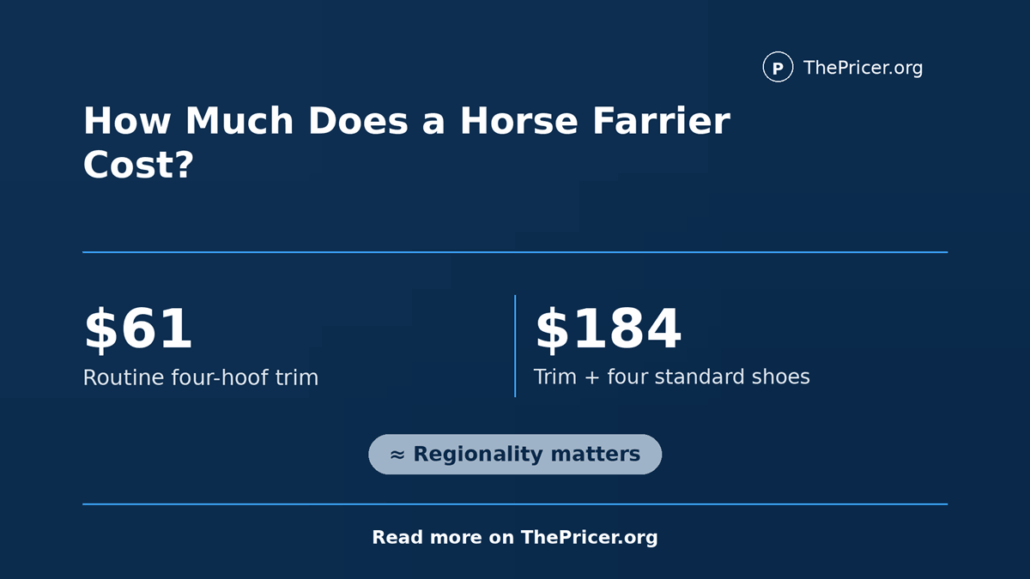
A horse farrier currently costs about $61 for a routine trim of all four hooves and about $184 for a trim plus four standard keg shoes, based on the 2026 American Farriers Journal Benchmark Survey. Regional averages run from roughly $54-$75 for a trim and about $166-$208 for standard four-hoof shoeing. Specialty work costs more, with four aluminum shoes averaging about $226 and four glue-on shoes around $375.
The per-visit price is only part of the horse owner’s budget. Many horses need farrier care about every 6-8 weeks during faster periods of hoof growth. At seven visits per year, a barefoot horse receiving routine trims would cost about $427 annually, while seven standard four-shoe appointments at the current national average would total about $1,288 per year.
Farrier bills can also include barn-call or mileage charges, pads, hoof crack repairs, therapeutic shoes, lost-shoe visits, and more frequent appointments for horses with hoof disease or conformational problems. Not every horse needs shoes, so the correct budget starts with the individual horse rather than automatically assuming four shoes.
Article Highlights
Jump to sections
- The 2026 national average for trimming all four hooves is $61 (at $30 per hour, earning that amount would take about 2 hours of work, before taxes).
- Trimming and applying four standard keg shoes averages $184.
- Resetting four standard shoes averages $178, only $6 less than a new standard set.
- Two front standard shoes average $131, while two front aluminum shoes average $158.
- Four aluminum shoes average about $226.
- Four glue-on shoes average about $375.
- A common barn-call, mileage, or fuel charge can add roughly $30-$35 to the visit.
How Much Does a Horse Farrier Cost?
| Farrier service | 2026 average or benchmark | Typical use |
|---|---|---|
| Trim all four hooves | $61 (about 2 hours of work at $30 per hour) | Routine barefoot maintenance |
| Trim + 4 standard keg shoes | $184 | Basic full shoeing |
| Trim + reset 4 keg shoes | $178 | Reusing suitable shoes |
| 2 front keg shoes | $131 | Front-shod horse |
| 2 front aluminum shoes | $158 | Lighter front shoe option |
| 4 aluminum shoes | $226 | Performance or specialty needs |
| 4 handmade shoes | $192 | Custom-fabricated shoeing |
| 4 glue-on shoes | $375 | Special hoof or performance situations |
| Moderate hoof crack repair | $69 | Repair beyond routine trimming |
| 2 pads + packing | $45 | Added hoof protection/support |
The strongest current benchmark comes from the 2026 American Farriers Journal pricing survey, which reports a national average of $61 for a four-hoof trim and $184 for trimming and applying four standard keg shoes.
A Routine Trim
A healthy barefoot horse requiring ordinary maintenance is currently the least expensive common farrier scenario.
The national average is approximately $61 (about 2 hours of work at $30 per hour) for trimming all four hooves. Regional averages range from about $54 in the Central states to roughly $75 in the Far West.
That makes a practical routine-trim budget of about $50-$75 per visit more useful than the older $30-$150 range.
A trim commonly involves evaluating hoof balance and growth, removing excess hoof wall, shaping the foot, and checking for cracks, bruising, infection, abnormal wear, or other conditions that may need attention.
The University of Minnesota notes in its horse hoof-care guidance that not every horse needs shoes. Hoof quality, workload, footing, conformation, and rate of wear all influence whether a barefoot program is appropriate.
Four Standard Shoes
A horse wearing shoes on all four feet currently costs about three times as much per visit as a routine barefoot trim.
The 2026 national average for trimming and applying four standard keg shoes is $184.
Compared with a $61 trim:
$184 – $61 = $123 more per appointment
Regional averages also show a noticeable spread. Current survey figures put standard four-shoe work around $166 in the Central region, approximately $197 in the Far West, and about $208 in the Northeast.
A horse owner should therefore treat $165-$210 as a useful regional planning band for ordinary four-hoof shoeing rather than expecting one universal national price.
Front Shoes
Some horses wear shoes only on the front feet while remaining barefoot behind.
American Farriers Journal’s current farrier business survey data puts two front standard keg shoes at approximately $131.
Two front aluminum shoes average about $158.
The aluminum difference is:
$158 – $131 = $27
That is approximately 21% more than the standard front-shoe benchmark.
Whether a horse should wear two shoes, four shoes, or remain barefoot is a hoof-care decision rather than simply a way to choose the lowest bill.
Resetting Shoes
Horse owners may assume that reusing an existing set of shoes will cut the farrier bill dramatically. Current national averages show a much smaller difference.
Trim plus four new standard keg shoes:
$184
Trim plus resetting four standard keg shoes:
$178
Difference:
$184 – $178 = $6
Much of the farrier’s work remains even when the shoes themselves can be reused. The horse still needs to be evaluated and trimmed, the existing shoes need to be removed and inspected, and each shoe may need to be reshaped before being nailed back onto the hoof.
A reset can still be worthwhile when the shoes remain suitable, but current survey data shows why it should not be treated as half-price shoeing.
Glue-On Shoes
Specialty shoeing creates some of the largest routine farrier bills.
Current national survey data places four glue-on shoes at approximately $375, compared with $184 for four standard keg shoes.
Difference:
$375 – $184 = $191
Ratio:
$375 ÷ $184 = about 2.04 times
In other words, the current glue-on benchmark is approximately twice the price of standard four-hoof shoeing.
Four aluminum shoes currently average around $226, while four handmade shoes average about $192. The shoe material alone does not determine the bill. Preparation, fabrication, fitting method, horse behavior, hoof condition, and time required also matter.
Cracks, Pads and Therapeutic Work
A routine trim or standard set can become more expensive when the hoof requires additional work.
The current American Farriers Journal survey puts a moderate hoof crack repair around $69 and two pads with packing around $45.
Those charges may be added to another trim or shoeing service rather than representing the complete visit price.
Horses with laminitis, significant hoof distortion, injuries, thin soles, or other medical problems may need therapeutic or veterinary-directed farriery. Those cases cannot be reduced to one reliable national surcharge because the work can range from modified trimming to complex fabricated or glued shoeing packages.
For a horse receiving veterinary treatment, the veterinarian and farrier may work together on the hoof-care plan.
A Barn Call
Farriers operate mobile businesses, so travel is one of the easiest extra costs to overlook.
American Farriers Journal’s farrier business data has reported common travel-related charges around $33-$34, depending on whether the farrier describes the charge as mileage, a fuel surcharge, or a barn call.
Consider a barefoot horse receiving a $61 trim with a $33 barn call:
$61 + $33 = $94
The travel charge increases that single-horse visit by about 54%.
If four horses at one barn share the same $33 call:
$33 ÷ 4 = $8.25 per horse
That is why organizing several horses at the same location can reduce the effective travel cost without cutting the farrier’s actual service price.
How Often Will You Pay a Farrier?
Many horses are trimmed or shod approximately every 6-8 weeks during periods of faster hoof growth. The ideal interval is not identical for every horse or every season.
University of Minnesota guidance says summer schedules are commonly around 6-8 weeks, while some horses may stretch to 6-12 weeks during slower winter growth.
A horse with therapeutic shoeing, abnormal hoof growth, or a condition requiring close monitoring may need shorter intervals.
This makes annual budgeting more useful than converting every farrier price into a generic monthly number.
A Barefoot Horse Can Cost About $427 Per Year
Using the current national trim average of $61, seven appointments per year cost:
$61 × 7 = $427 per year
Eight appointments cost:
$61 × 8 = $488 per year
A horse consistently maintained barefoot can therefore have a basic annual farrier budget around $425-$490 at current national-average pricing before barn calls, crack repairs, emergency visits, or other extras.
Converted only for household budgeting, the seven-visit example averages:
$427 ÷ 12 = about $35.58 per month
The owner does not actually pay $35.58 every month. The real cash expense arrives in larger farrier appointments throughout the year.
A Shod Horse
Using the current $184 standard four-shoe national average:
Seven visits:
$184 × 7 = $1,288 per year
Eight visits:
$184 × 8 = $1,472 per year
The seven-visit figure works out to an average household budget of:
$1,288 ÷ 12 = about $107.33 per month
This demonstrates why describing the “average farrier cost” as one monthly dollar figure is misleading. A barefoot horse and a fully shod horse can differ by hundreds of dollars per year even before therapeutic work is considered.
Glue-On Shoes Can Reach $3,000 Per Year
A horse needing four glue-on shoes at the current $375 national benchmark can create a much larger annual hoof-care budget.
Seven visits:
$375 × 7 = $2,625 per year
Eight visits:
$375 × 8 = $3,000 per year
That is more than six times the seven-visit barefoot trim budget of $427.
This comparison is not a reason to avoid a specialty shoeing method when the horse needs it. It shows why hoof-care requirements can materially change the annual cost of horse ownership.
A Farrier’s Cost and Your Bill
An older figure of $151.85 is sometimes repeated online as an “average monthly farrier cost.” That is not what the original American Farriers Journal material said.
The publication’s farrier business-cost analysis discussed one Kentucky farrier who calculated that it cost him approximately $151.85 to trim and fully shoe a horse based on his own business expenses.
That was the farrier’s calculated cost of performing the work, not a nationwide customer average and not a monthly membership-style charge.
The fresh 2026 survey figure of $184 for a trim plus four standard shoes is the much more useful current consumer benchmark.
What Certification Tells You
The United States does not have one national government license that every working farrier must hold. Training and qualifications therefore deserve more attention than simply asking whether someone is “licensed.”
The University of Minnesota’s farrier selection guidance recommends evaluating education, experience, communication, professionalism, and ability to work safely with the horse rather than choosing solely by price.
The American Farrier’s Association offers voluntary certification. Its certification program includes Certified Farrier and Certified Journeyman Farrier credentials involving written and practical examinations.
A highly experienced or specialized farrier may charge more, but there is no defensible rule saying experienced professionals universally cost exactly 20%-50% more.
Three Annual Farrier Budgets
Case 1: barefoot pleasure horse. Seven standard trims at $61 each equal $427 per year. If four horses at the barn share a hypothetical $33 travel charge each visit, this horse’s share would be about $57.75 annually, bringing the illustrative total to approximately $484.75.
Case 2: horse wearing four standard shoes. Seven appointments at $184 each total $1,288 per year. A moderate hoof crack repair at the current $69 benchmark would bring one illustrative year to $1,357.
Case 3: horse using four glue-on shoes. Seven visits at $375 each equal $2,625 per year. Eight visits would increase the annual total to $3,000 before travel or other specialty work.
What We Verified
- Checked: the fresh 2026 national average is $61 for trimming all four hooves.
- Confirmed: trim plus four standard keg shoes currently averages $184.
- Cross-referenced: specialty shoeing ranges substantially higher, with four aluminum shoes around $226 and four glue-on shoes around $375.
- Verified: the frequently repeated $151.85 figure was a farrier’s calculated cost of providing a full shoeing service, not the average monthly cost paid by horse owners.
Related Horse Costs
Hoof care is only one part of a horse owner’s equipment and maintenance budget. Our guide to the cost of a horse saddle covers prices for new, used, synthetic, leather, and custom saddles.
Another recurring care expense is dental maintenance. See our guide to the cost of horse teeth floating for current veterinary and equine dental pricing.
If you are still budgeting for the horse itself, our guide to the cost of an Akhal-Teke horse looks at one of the more unusual and expensive breeds.
Answers to Common Questions
How much does a farrier charge to trim a horse?
The 2026 national average is approximately $61 for trimming all four hooves. Regional averages currently range from roughly $54-$75.
How much does it cost to put four shoes on a horse?
Trimming and applying four standard keg shoes currently averages about $184. Regional averages are roughly $166-$208, while specialty shoes can cost more.
How much does it cost to shoe only the front hooves?
Two standard front shoes currently average approximately $131. Two aluminum front shoes average around $158.
Is resetting horseshoes cheaper?
Usually, but the difference can be smaller than expected. The current national average is $178 for trimming and resetting four standard shoes compared with $184 for a new standard four-shoe job, a difference of only $6.
How often does a horse need a farrier?
Many horses are seen about every 6-8 weeks during faster hoof-growth periods. Some horses can go longer during slower winter growth, while therapeutic cases may require more frequent appointments.
Does every horse need horseshoes?
No. Some horses remain comfortable and sound barefoot with regular trimming. Workload, terrain, hoof quality, conformation, wear, and veterinary or farrier recommendations all influence whether shoes are useful.
How much should I budget per year for a farrier?
At seven visits per year, current national averages produce about $427 annually for a barefoot horse receiving routine trims and about $1,288 annually for a horse receiving four standard shoes at every visit. Specialty shoeing can push annual costs above $2,500-$3,000.
Do farriers charge a travel or barn-call fee?
Some do. Current industry data supports travel-related charges around $30-$35 in common examples. The effective cost per horse can be lower when several horses are scheduled at the same barn.
Disclosure: Educational content, not medical advice. Pricing varies by provider, location, and insurance. Confirm eligibility, coverage, and out-of-pocket costs with a licensed clinician and your insurer. See our methodology and corrections policy.