
How Much Do Kunekune Pigs Cost?
Updated on | Written by Alec Pow
This article was researched using 15 sources. See our methodology and corrections policy.
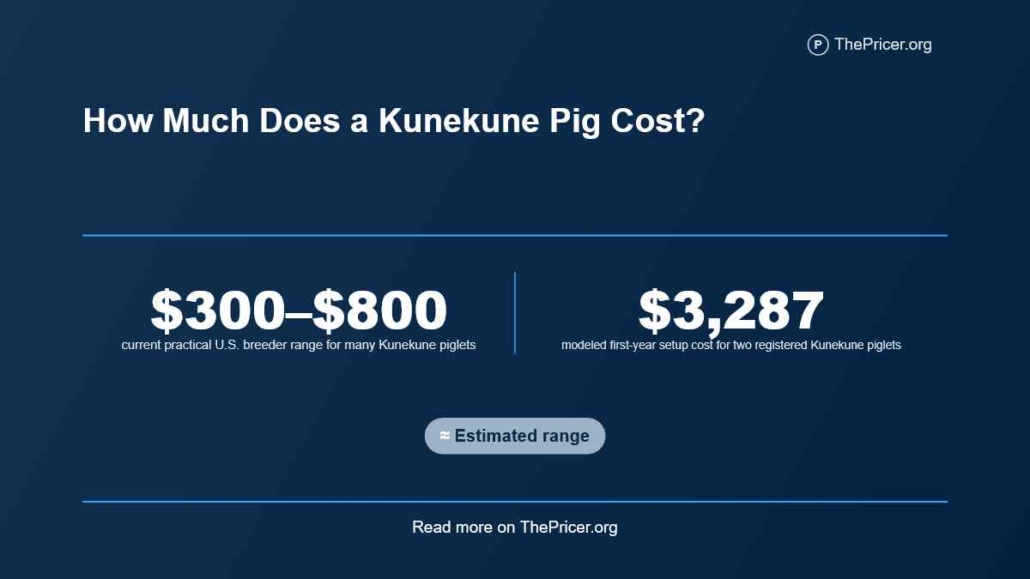
A Kunekune piglet from a U.S. breeder currently costs about $300 to $800 in many public listings, while pet barrows can start near $200 and selected registered gilts can reach about $950. That is a practical current budget, not a national average. Registration, breeding rights, conformation, age, sex, transport, and the seller’s package can all change the quote.
The bigger ownership question is how many pigs you are buying. Kunekunes are social animals, and breed-management guidance favors pairs or groups. A new owner with no existing pig may need to budget for two animals from the start. Feed, fencing, shelter, veterinary care, hoof care, and interstate transport can then cost more than the piglets themselves during the first year.
Article Highlights
Jump to sections
- Many current Kunekune piglet listings fall around $300 to $800 (at $30 per hour, earning that amount would take about 1.3 to 3.3 full-time workdays, before taxes), with some pet barrows near $200 and selected registered gilts near $950.
- Two $400 registered piglets create an $800 acquisition bill before housing, feed, or veterinary care.
- A modeled first-year setup for two registered piglets totals about $3,287 before land, labor, long-distance transport, and emergencies.
- A mature pair receiving daily pellet supplementation can use roughly $708 to $1,062 of a current commercial feed example per year.
- AKKPS full registration requires parentage DNA verification and permanent identification.
- Kunekunes are medium-sized grazing pigs, not micro pigs.
How Much Does a Kunekune Pig Cost?
Current breeder pages show a broad but readable market. Stephenson Farms, whose page was updated September 8, 2026, lists current piglet price ranges of $275 to $400 (about 1.1 to 1.7 full-time workdays at $30 per hour) for pet barrows or gilts and $400 to $800 for registered breeding-stock piglets. Its registered pigs include microchipping, care instructions, starter food, and breeder support.
Ball Farms publishes a wider registered pricing schedule. Barrows are listed at $200 to $350, registered boar piglets at $250 to $450, and registered gilt piglets at $500 to $950. The farm says it waits until piglets are old enough to judge suitability before setting final breeding or companion status. That helps explain why age alone does not create a reliable price tier.
Mature animals can also cost less than the old article implied. One current farm downsizing listing shows registered adult pigs at $400 to $600, including mature sows and a proven boar. A mature breeder is not automatically more expensive than a carefully selected young gilt.
| Current market example | Published price | What the price represents |
|---|---|---|
| Pet barrow or gilt | $275 to $400 | Stephenson Farms pet piglets |
| Registered breeding piglet | $400 to $800 | Stephenson Farms breeding stock |
| Registered gilt piglet | $500 to $950 | Ball Farms listed range |
| Mature registered adult | $400 to $600 | Current downsizing examples |
A Kunekune Is Not a Micro Pig
The American KuneKune Pig Society describes the Kunekune as a medium-sized grazing heritage breed and explicitly says it is not a mini or micro pig. The society’s official breed overview also emphasizes docile temperament and grazing ability. Those traits make the breed attractive to small farms, but they do not turn it into a tiny household animal.
The Smithsonian breed profile places mature females around 120 to 200 pounds and males around 200 to 300 pounds. It also gives a usual lifespan of about 15 to 20 years. Modern North American lines can be heavier, which is one reason buyers should ask about mature parents rather than estimating adult size from an eight-week piglet.
That difference matters. A 250-pound grazing pig needs livestock fencing, shade, clean water, winter shelter, transport planning, and a veterinarian willing to treat swine. Kunekunes are smaller than many commercial hog breeds, but their cost structure is still livestock cost.
They also mature slowly, so early size is a poor basis for deciding how large the enclosure, gate, trailer, or shelter should be. Adult body size also changes loading space, gate strength, and routine handling equipment.
Two Pigs Change the Budget
The New Zealand Kunekune Association says pigs are social animals and are happier kept in pairs or groups. Its social management guidance also notes that established groups develop a hierarchy and that unfamiliar pigs may need time before accepting each other. A buyer starting with no pigs should plan around companionship rather than treating one animal as the default unit.
Using Stephenson’s current prices, two pet piglets at $275 to $400 (about 1.1 to 1.7 full-time workdays at $30 per hour) each create an acquisition range of $550 to $800. Two registered breeding-stock piglets at $400 to $800 each cost $800 to $1,600. Those totals appear before any fence panel, shelter, feed, veterinary visit, or transport charge.
Companionship and breeding are separate questions. Two littermates may work as companions, but a buyer assembling breeding stock has to examine pedigree relationships and coefficient of inbreeding before choosing a pair. Sex also changes management. A barrow cannot serve the same purpose as an intact boar, and a pet gilt may be sold under different reproductive terms from a fully registered breeding gilt.
One current breeder goes further and requires customers without existing pigs to buy a companion. That kind of placement policy is a useful warning against building a budget around a single pig just because the advertised price is shown per head.
Feed and Pasture Economics
Kunekunes can use pasture efficiently, but pasture quality determines how much purchased feed remains necessary. The New Zealand association’s published feeding guidance says adults can maintain body condition on good-quality pasture and gives a supplemental pellet rate of about 1 to 1.5 kilograms per adult per day when supplementation is needed. Young pigs receive smaller amounts while growing.
A current Purina feed listing prices a 50-pound bag of Nature’s Match Sow and Pig Complete Feed at $21.99. At the published adult supplementation rate, two pigs consume about 1,609 to 2,414 pounds of pellets in one year. That equals roughly 32 to 48 full bags, or about $708 to $1,062 at the current bag price.
This is a feeding scenario, not a claim that every Kunekune pair costs that much to feed. Productive pasture can reduce purchased feed. A dry lot, winter weather, poor forage, pregnancy, lactation, or a growing pig can increase the need for supplemental nutrition. Hay, produce, minerals, and pasture maintenance can add other costs.
The economic advantage of the breed is strongest when the property has useful forage. A buyer without pasture should not assume a grazing breed will create the same low-feed economics found on a well-managed paddock.
First-Year Cost for Two
A first-year scenario shows why the pair matters. Start with two registered piglets at $400 each, or $800 total. For a small starter pen, eight 16-foot panels cost $359.92 using the current hog-panel listing of $44.99 each, before posts, a gate, fasteners, or labor.
Add an assumed $300 for posts, gate hardware, and related fencing materials, $600 for a basic weatherproof shelter project, and $250 for feeders, water equipment, bedding, and initial supplies. Those are planning allowances rather than national market averages. A farm that already owns livestock infrastructure could spend much less.
Feed can be modeled from the published age rates. For a pair purchased around eight weeks old, use about 0.5 kilogram per pig per day until four months, 0.75 kilogram through nine months, and 1 kilogram thereafter through the end of the first ownership year. That adds to about 595 kilograms, or 1,312 pounds, across the pair. At the cited $21.99 feed price, about 26.2 bags cost roughly $577. Add a chosen $400 routine veterinary, parasite-management, and hoof-care allowance.
The ThePricer first-year scenario totals about $3,287. The calculation is $800 plus $359.92 plus $300 plus $600 plus $250 plus $577 plus $400, or $3,286.92 before rounding. It excludes land, labor, pasture establishment, major emergencies, long-distance hauling, breeding fees, and equipment already owned by the buyer. The piglets account for only about 24% of this defined starting budget.
Fencing, Shelter, and Health Care

Good fencing is a core ownership cost. The starter-panel calculation above covers only the metal panels. Posts, gates, electric strands, chargers, repairs, and larger paddocks can raise the bill. The New Zealand management guidance also warns that Kunekunes can root when soil is soft or grubs are present, even though the breed is known for being gentler on pasture than many pigs.
Heat management matters too. Kunekunes need shade or a ventilated shelter during hot weather, and access to a wallow can help with cooling. Cold-weather housing needs dry bedding and protection from wind and rain. Shelter capacity should be based on every pig in the group rather than one animal.
Veterinary access deserves attention before purchase. Swine care is not available at every companion-animal clinic. Hoof condition, parasites, reproductive care, injuries, vaccination decisions, and emergency treatment may require a livestock or pig-experienced veterinarian. Costs vary too much by region and procedure to use one national annual veterinary fee responsibly.
Buyers should also separate ordinary care from emergencies. A $400 routine-care allowance in the worked example is a chosen budget line, not a promise that all medical needs fit inside it. An unexpected surgery or serious illness can move spending well beyond that amount.
Registration and Breeding Value
Registered breeding stock carries a different evidence trail from a pet pig sold without breeding rights. AKKPS registration help guides require parentage DNA verification through UC Davis for full registration, plus a permanent identification method such as a microchip, ear tag, or tattoo. The affiliated parentage test currently costs $40 per animal.
That test verifies parentage. It does not take an unknown pig and prove that it is a pure Kunekune. Full registration also depends on registered parents and breeder processing. This makes documented registration materially different from a seller simply describing an animal as purebred.
Breeding value also depends on structure. The AKKPS breed standard covers feet, legs, back, body, snout, teat number, temperament, wattles, and other conformation traits. A higher price for breeding stock makes more sense when the seller can explain those traits, pedigree, parentage, and reproductive suitability.
Coefficient of inbreeding belongs in the breeding decision too. Two individually registered pigs are not automatically a good mating. Buyers building a breeding pair should check the pedigree relationship and current COI before treating two attractive piglets as a matched breeding package.
Before You Buy
Transport can change both cost and paperwork. USDA APHIS says interstate swine rules require official identification for interstate movement in most ordinary cases, with state entry requirements layered on top of federal rules. A destination state may also require health documentation or other conditions. Get the movement requirements and hauling quote before paying a nonrefundable deposit.
Local land-use rules matter as well. Kunekunes are livestock-sized pigs, so zoning, HOA rules, landlord terms, manure management, fencing, and neighbor distance can be more consequential than the piglet price. Buyers comparing smaller-pig options can also review teacup pig costs, while the capybara cost page covers a very different exotic-animal ownership model.
Makes sense if
- You have suitable outdoor space, livestock fencing, shade, water, and shelter.
- You can budget for a companion pig or already keep compatible pigs.
- You understand whether you are buying a pet, harvest animal, or registered breeding pig.
- You have access to a veterinarian willing to treat swine.
Does not make sense if
- Your budget covers only the advertised per-pig purchase price.
- You expect a Kunekune to stay the size of a micro pig.
- You are buying breeding stock without checking registration, pedigree, and COI.
- Your property cannot legally or practically support livestock pigs.
Verification checks
- Checked a current breeder companion policy that requires buyers without pigs to purchase a second pig.
- Confirmed through AKKPS registration answers that an unknown pig cannot be DNA-tested into breed registration.
- Cross-referenced the AKKPS weight chart, which shows that adult North American Kunekunes can be substantially heavier than many small-pig buyers expect.
Answers to Common Questions
How much does a Kunekune pig cost?
Many current U.S. breeder listings place Kunekune piglets around $300 to $800. Pet barrows can start near $200, while selected registered breeding gilts can reach about $950.
Do I need to buy two Kunekune pigs?
Kunekunes are social pigs and are happier in pairs or groups. A buyer who does not already keep compatible pigs should plan for the cost and space of at least two animals.
How much does it cost to feed two Kunekunes?
Using the published adult supplementation rate and the current feed example above, a mature pair can use about $708 to $1,062 of pellets per year. Good pasture can reduce purchased feed, while poor forage or higher nutritional needs can increase it.
How big do Kunekune pigs get?
They are not micro pigs. Smithsonian lists mature females around 120 to 200 pounds and males around 200 to 300 pounds, while current AKKPS data shows some North American adults can be heavier.
Does AKKPS registration prove a pig is purebred?
AKKPS registration documents pedigree through registered parents and parentage verification. There is no standalone DNA test that turns an unknown pig into a registered pure Kunekune.
Disclosure: Educational content, not medical advice. Pricing varies by provider, location, and insurance. Confirm eligibility, coverage, and out-of-pocket costs with a licensed clinician and your insurer. See our methodology and corrections policy.