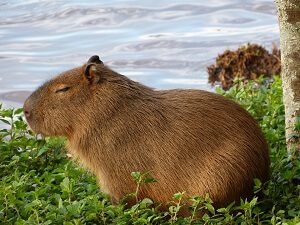
How Much Does a Capybara Cost?
Updated on | Written by Alec Pow
This article was researched using 4 sources. See our methodology and corrections policy.
A captive-bred capybara can cost about $2,000 to $6,500 or more in the United States, but purchasing one animal is rarely an adequate ownership plan. Capybaras are highly social, so a prospective owner should normally budget for at least two compatible animals. That puts the likely purchase cost near $4,000 to $13,000 before transport, permits, veterinary examinations, fencing, shelter, or a permanent swimming area.
A properly prepared first-year setup for a pair can cost about $15,000 to $40,000+. The largest expenses are usually a secure outdoor habitat, double-gated fencing, a pool with safe entry and drainage, heated shelter, specialist veterinary access, transport, and enough food for two large grazing rodents.
Capybaras are not domesticated house pets or oversized guinea pigs. They are semiaquatic South American mammals with complex social, environmental, dietary, and veterinary needs. Ownership may be prohibited or permit-controlled by state, county, municipal, zoning, agriculture, and wildlife rules.
Article Highlights
Jump to sections
- One captive-bred capybara may cost $2,000 to $6,500+ (at $30 per hour, earning that amount would take about 1.7 to 5.4 full-time workweeks, before taxes).
- Two compatible animals may cost $4,000 to $13,000 before transport.
- A suitable habitat and pool can add $8,000 to $25,000+.
- A realistic first-year budget for a pair is about $15,000 to $40,000+.
- Recurring care can cost approximately $4,000 to $8,000 per year.
- Capybaras require dietary vitamin C and continuous access to appropriate forage.
- Legality must be verified with state and local authorities before paying a breeder.

How Much Does a Capybara Cost?
| Capybara expense | Planning price | What changes the cost |
|---|---|---|
| One captive-bred capybara | $2,000 to $6,500+ (about 1.7 to 5.4 full-time workweeks at $30 per hour) | Age, sex, training, breeder, location, health records, and availability |
| Compatible pair | $4,000 to $13,000+ | Whether the animals are already bonded and altered |
| Transport and travel | $500 to $2,500+ | Distance, crates, vehicle, permits, health certificate, and specialist carrier |
| Secure enclosure and gates | $3,000 to $10,000+ | Perimeter, fence strength, terrain, drainage, and professional labor |
| Permanent pool or water feature | $4,000 to $20,000+ | Excavation, liner or concrete, filtration, plumbing, heating, and fencing |
| Insulated shelter | $2,000 to $8,000+ | Climate, heating, ventilation, electricity, and size |
| Initial veterinary care | $500 to $2,000+ | Examinations, testing, sedation, travel, and reproductive planning |
| Food for two animals | $1,500 to $4,000+ per year | Pasture access, hay prices, waste, pellets, produce, and climate |
| Total first year | $15,000 to $40,000+ | Animal price, habitat complexity, climate, and veterinary access |
Public breeder prices are difficult to verify because many specialist breeders use waiting lists and private quotes. A current exotic-animal marketplace listing asked $6,500 for a three-year-old female in Texas. Marketplace listings are asking prices, not evidence that the animal sold for that amount or that the seller is reputable.
The old article’s claim that capybaras imported from South America cost only $520 to $1,100 is not useful for a U.S. pet buyer. International acquisition could involve veterinary documentation, wildlife and agriculture rules, approved transport, brokerage, quarantine-related requirements, and substantial animal-welfare concerns. A legal domestic captive-bred animal is the more responsible benchmark.
What You Are Actually Buying
The capybara, Hydrochoerus hydrochaeris, is the world’s largest living rodent. It is native to South America and is closely related to guinea pigs and other caviomorph rodents. Regional names include capivara, carpincho, chigüire, and ronsoco.
An adult can weigh well over 100 pounds. Its body is adapted to life around rivers, marshes, ponds, and flooded grasslands. Eyes, ears, and nostrils sit high on the head, and partially webbed feet aid movement through water.
A purchase price does not buy an animal that can simply move into a spare room. The owner is taking responsibility for a grazing herd animal that needs compatible companions, water deep enough for normal behavior, secure outdoor space, temperature protection, specialist nutrition, and an exotic-animal veterinarian.
The Association of Zoos and Aquariums publishes expert-reviewed animal care manuals intended for professional facilities. These standards illustrate how far appropriate capybara husbandry extends beyond the supplies normally purchased for a small rodent.
Budget Should Start With Two
Capybaras naturally live in social groups. Housing one alone because it is cheaper can create chronic stress and place unrealistic pressure on human interaction to replace normal relationships with its own species.
A prospective owner should ask the breeder whether two animals are already bonded, how they have been socialized, and whether their sexes and reproductive status are compatible. Buying two unfamiliar adults does not guarantee that they will immediately accept one another.
A mixed-sex pair can reproduce unless one or both animals are appropriately sterilized. Two intact males may also develop conflict as they mature. There is no universal rule that every owner should choose two females, two males, or one of each. Group planning should involve an experienced breeder and a veterinarian familiar with capybara behavior, anesthesia, and reproductive management.
The claim that a male “must” be neutered between six and nine months is too rigid. Surgical timing depends on maturity, health, social circumstances, veterinary experience, and anesthesia planning.
Legal Ownership
It is false that capybaras are legal only in Pennsylvania and Texas. It is equally risky to publish a broad list of supposedly legal states without checking current statutes and local rules.
Depending on the location, ownership may involve:
- A wildlife possession or import permit
- A captive-wildlife or exotic-animal license
- A certificate of veterinary inspection
- Local zoning approval
- Minimum enclosure or setback rules
- Restrictions on breeding, sale, or public exhibition
- Approval from an animal-control, agriculture, or health authority
State exotic-animal laws can place species into allowed, prohibited, permit-controlled, or unclassified categories. A general overview of private exotic-animal possession laws shows how much the regulatory approach differs among states, but it cannot replace an official determination for a specific address.
Before paying a deposit, request written answers from the state wildlife agency, state agriculture department, county animal-control office, and local zoning authority. Confirm that importation, possession, breeding, and the planned enclosure are all allowed. A breeder’s statement that ownership is legal is not sufficient.
Habitat and Pool Costs

A $500 (about 2.1 full-time workdays at $30 per hour) backyard pen is not a responsible finished habitat for two adult capybaras. The enclosure must prevent escape, exclude predators and unauthorized visitors, tolerate digging and chewing, and allow the animals to move between pasture, shade, shelter, and water.
A suitable setup may need:
- Strong perimeter fencing secured at ground level
- A double-gate entry or safety vestibule
- Separate holding space for illness or introductions
- Shade and protection from sun exposure
- An insulated, heated shelter in cold climates
- Safe flooring and mud control
- A large pool with gradual entry or stable ramps
- Drainage, filtration, and a cleaning plan
- Protected storage for hay, pellets, tools, and medication
A basic residential fence installation does not automatically meet exotic-animal containment standards. Height, mesh spacing, buried barriers, gate hardware, terrain, and local inspection requirements can raise the cost.
The water feature also needs more planning than an inflatable children’s pool. Capybaras use water for swimming, thermoregulation, resting, social interaction, and escape behavior. A permanent structure should let more than one animal enter and leave without being trapped by the other.
A professionally built swimming pool can be expensive, but a smaller purpose-built animal pool may still require excavation, a liner or concrete shell, plumbing, filtration, electricity, heating, fencing, and seasonal maintenance. An owner in a freezing climate may spend substantially more than one in a warm region.
Food and Vitamin C Costs
Capybaras are grazing herbivores. Their diet should be built around safe pasture or good-quality grass hay, with other foods selected under professional guidance. A small 40-ounce pet-store hay bag is not a meaningful supply for one adult, much less a pair.
Annual food expenses can include:
- Grass hay during seasons without safe grazing
- Appropriate fortified pellets
- Leafy greens and selected produce
- Vitamin C management
- Browse and edible enrichment
- Feed storage and pest control
- Waste caused by rain, contamination, or trampling
Capybaras cannot synthesize enough vitamin C internally. A published study of captive animals found that a suitable dietary supply was necessary to prevent scurvy. The finding is summarized by the National Library of Medicine.
Another zoo study linked inadequate dietary vitamin C with skin, hair, and weight problems and reported improvement after dietary correction. That research does not create one universal supplement dose for privately owned animals. Diet and supplementation should be planned with a veterinarian or zoo nutrition professional rather than copied from an online guinea-pig feeding chart.
Veterinary Care
Many dog-and-cat clinics will not examine a capybara. Before buying one, the owner should find a veterinarian who confirms in writing that the practice can provide routine treatment, diagnostics, sedation, surgery, and emergency support.
Potential medical expenses include:
- Pre-purchase examinations
- Parasite and fecal testing
- Bloodwork and diagnostic imaging
- Dental and incisor problems
- Skin, foot, or nutritional disease
- Trauma and bite wounds
- Reproductive care
- Sedation or anesthesia
- Transport to a distant specialty hospital
A mobile or distant specialist may charge travel fees in addition to the examination. Emergency transport for a 100-pound animal also requires an appropriate crate, vehicle, loading method, and staff able to handle it safely.
A prospective owner should keep at least $2,000 to $5,000 available for veterinary emergencies. That reserve is not a prediction of one procedure. It recognizes that unusual species often require more travel, planning, and specialized treatment than common companion animals.
Three Capybara Ownership Scenarios
Warm-climate property with an existing pond
Two young capybaras cost $3,000 each, or $6,000. Secure fencing and a double-gate system cost $5,000. The owner already has suitable water but spends $2,000 improving banks, drainage, and containment. Transport, examinations, shelter, and first-year food add $4,000.
The first-year total reaches $17,000.
Suburban property requiring a complete habitat
A bonded pair costs $8,000. Transport and veterinary documentation add $1,500. Fencing costs $6,000, a purpose-built pool costs $9,000, and an insulated shelter with power costs $4,000. First-year food, veterinary preparation, permits, and equipment add $3,500.
The first-year total is $32,000.
Cold-climate property
Two animals cost $10,000. The owner spends $8,000 on secure fencing, $12,000 on a heated pool and drainage system, and $7,000 on an insulated indoor shelter with ventilation and backup heat. Transport, electrical work, veterinary preparation, and food add $6,000.
The first-year total reaches $43,000.
These are planning scenarios rather than breeder or contractor quotes. They show why the purchase price is often less than one-third of the initial commitment.
Worked Lifetime Cost Example
Assume a pair costs $7,000 and the habitat costs $18,000. Transport, veterinary preparation, and the first food order add $3,000. The initial investment is $28,000.
Annual recurring care is estimated as follows:
- Hay, pellets, produce, and supplements: $2,500
- Pool water, filtration, heating, and electricity: $1,200
- Routine veterinary and testing reserve: $800
- Repairs, bedding, and enrichment: $700
- Emergency-fund contribution: $1,000
- Annual total: $6,200
Ten years of recurring costs equal $62,000. Adding the $28,000 initial investment produces an illustrative lifetime commitment of $90,000, before a major medical emergency, pool replacement, or extensive fence repair.
When Capybara Ownership Makes Sense
Makes sense if:
- Ownership and the planned enclosure are confirmed legal in writing.
- The property can support at least two compatible animals.
- A permanent swimming area and secure outdoor habitat are already funded.
- An experienced exotic-animal veterinarian has agreed to provide care.
- The owner can sustain several thousand dollars in annual expenses for a decade.
Does not make sense if:
- The plan is to keep one capybara mainly indoors.
- An inflatable pool is the only water access.
- The owner is relying on a normal dog-and-cat clinic.
- The animals would be left alone for long periods without their own species.
- The buyer expects to rehome them easily if circumstances change.
Capybaras may become accustomed to people, handling, routines, and feeding, but they remain large nondomesticated animals. Friendly behavior in online videos does not predict how every adult will behave around children, visitors, dogs, food, or unfamiliar handling.
What We Verified
- Checked current public asking prices reaching $6,500 for one adult capybara.
- Confirmed that capybaras are social animals requiring social management.
- Cross-referenced their need for swimming access and a complex habitat.
- Verified through published research that captive capybaras require dietary vitamin C.
- Confirmed that exotic-animal laws differ by state and may be supplemented by local rules.
- Checked that a breeder’s statement alone cannot establish legality at the buyer’s address.
Related Exotic-Pet Costs
Capybara ownership is far more demanding than caring for smaller rodents. Readers can compare the cost of a gerbil, a pet hedgehog, or a chinchilla to see how sharply enclosure, food, and veterinary needs increase with a capybara.
The habitat may require a professional fence installation and a purpose-built water feature. The broader cost of a swimming pool gives context for excavation, plumbing, filtration, electrical work, drainage, and maintenance.
Answers to Common Questions
How much does one capybara cost?
A captive-bred animal may cost about $2,000 to $6,500 or more. Availability is limited, and public asking prices do not guarantee breeder legitimacy or legal ownership.
Do capybaras need to be kept in pairs?
They are highly social animals and should normally live with compatible members of their species. A solitary-animal plan should not be adopted merely to reduce costs.
Are capybaras legal pets in the United States?
Rules differ by state and locality. Ownership may be allowed, prohibited, or permit-controlled. Obtain written confirmation for the exact address before paying a seller.
Can a capybara live in an apartment?
An apartment is generally unsuitable. Capybaras need substantial secure space, swimming access, companions, outdoor grazing or forage, and specialized sanitation.
How much does a pair cost each year?
A reasonable recurring-care allowance is about $4,000 to $8,000 per year, excluding major veterinary emergencies or habitat replacement.
Disclosure: Educational content, not medical advice. Pricing varies by provider, location, and insurance. Confirm eligibility, coverage, and out-of-pocket costs with a licensed clinician and your insurer. See our methodology and corrections policy.