
How Much Do Rucci Rims Cost?
Updated on | Written by Alec Pow
This article was researched using 6 sources. See our methodology and corrections policy.
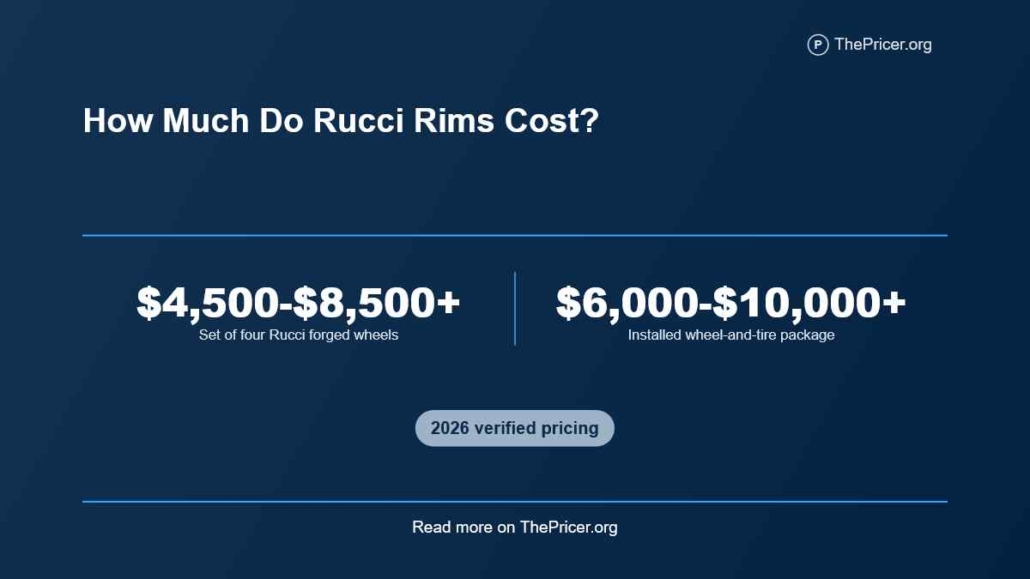
Rucci forged wheels typically cost about $4,500 to $8,500 for a set of four, based on current retailer pricing. Smaller 20- and 22-inch sets often start around $4,600 to $5,300, while 24-inch wheels are commonly around $5,800+, 26-inch sets around $6,700 to $6,900, and 28-inch configurations can reach roughly $8,300 or more.
Those figures are for premium custom forged wheels, not ordinary cast aftermarket rims. Rucci makes its wheels to order with vehicle-specific specifications and offers combinations of chrome, brushed aluminum, black, gold finishes, custom colors, staggered widths, deep lips, and specialty center caps. Tires, mounting, balancing, TPMS work, suspension modifications, and body-clearance work can push the finished project substantially higher.
Article Highlights
Jump to sections
- A set of Rucci forged wheels currently costs roughly $4,500 to $8,500+ (at $30 per hour, earning that amount would take about 3.8 to 7.1 full-time workweeks, before taxes).
- 20-inch sets can start around $4,640, while current 22-inch examples are around $5,100 to $5,300.
- 24-inch Rucci wheel sets commonly list around $5,750 to $5,875.
- 26-inch sets are frequently around $6,700 to $6,850.
- Current 28-inch sets can cost about $8,300.
- Custom gold finishes, large center caps, unusual widths, deep lips, and other made-to-order details can increase the price.
- Tires, mounting, balancing, TPMS sensors, alignment, and vehicle modifications can add thousands to the finished wheel package.
How Much Do Rucci Rims Cost?
Rucci does not publish a simple fixed retail price beside each model on its main website. Instead, the company describes its wheels as custom and made to order and asks buyers to choose the wheel, size, stagger, finish, center cap, and other specifications before requesting an order.
Current retail inventory gives us a much clearer picture of what buyers are actually paying.
| Rucci Wheel Size | Current Set Price |
|---|---|
| 20-inch | About $4,600+ (about 3.8 full-time workweeks at $30 per hour) |
| 22-inch | About $5,100-$5,300+ |
| 24-inch | About $5,750-$5,900+ |
| 26-inch | About $6,700-$6,900+ |
| 28-inch | About $8,300+ |
| 30-inch / highly customized | Quote required / potentially $8,000+ |
For example, current Rucci inventory from DUBS and TIRES includes a 20-inch Rucci Banks set starting around $4,640, several 22-inch configurations around $5,100 to $5,260, 24-inch sets around $5,750 to $5,875, and 26-inch setups around $6,700 to $6,850.
The same retailer currently lists a 28-inch Rucci setup around $8,300. That makes the old $700 to $900 estimate far too low if it was intended to describe a complete set of four genuine custom Rucci forged wheels.
Current Examples
| Example | Size | Current Listed Price |
|---|---|---|
| Rucci Banks | 20-inch | From $4,640 (about 3.9 full-time workweeks at $30 per hour) |
| Rucci Glock | 22-inch | About $5,100 |
| Rucci One Way | 22-inch | About $5,260 |
| Rucci Pack | 24-inch | About $5,875 |
| Rucci Capo | 24-inch | About $5,875 |
| Rucci Milli Cap | 26-inch | About $6,700 |
| Rucci Game | 26-inch | About $6,850 |
| Rucci 223 | 28-inch | About $8,300 |
These are current retailer examples rather than a universal Rucci price sheet. Since the wheels are custom-built, the price can change with diameter, width, lip depth, finish, bolt pattern, and vehicle application.
The official Rucci Forged website confirms that its wheels are made to order and customized to the buyer’s specifications rather than sold only as fixed off-the-shelf configurations.
Why They Cost So Much
Rucci competes in the custom forged-wheel market rather than the inexpensive cast-wheel market.
Forging starts with a solid aluminum billet or forging blank that is subjected to pressure and then machined into its final form. This manufacturing method is more involved than casting molten aluminum into a mold and is commonly used for premium custom wheels.
A current Rucci dealer listing for the Rucci Strappo describes the wheel as manufactured from 6061-T6 forged aluminum, made to order in the U.S., CNC-machined for the customer’s application, and compatible with OE TPMS and lug hardware where applicable.
Rucci also offers much more customization than an ordinary shelf-stock wheel. Its current order form allows buyers to specify wheel size, staggered or square fitment, finish, color matching, and center-cap design.
Current finish choices include chrome, brushed, black, 18K brushed gold, 18K gold, 24K brushed gold, and 24K gold on selected models.
Size Changes Price
Diameter is one of the clearest price drivers.
A larger wheel requires more material and more machining, while large custom barrels and deep lips add further cost. Current retail pricing rises from roughly $4,600 for a 20-inch Rucci set to more than $8,000 for some 28-inch sets.
Rucci also currently promotes specialty 24×14 and 26×14 barrels with 8- or 9-inch lips. These unusually wide configurations are intended for highly customized builds and are priced by quote.
The company has produced wheels in several large diameters, including 20, 22, 24, 26, 28, and 30 inches, depending on design and application.
Bigger does not automatically mean better for every car. Tire availability, brake clearance, overall tire diameter, suspension geometry, fender clearance, vehicle weight, and driving conditions all need to be considered.
Finish Costs
The wheel finish is another meaningful cost variable.
A straightforward brushed or black finish can be less expensive than a complex combination involving chrome lips, gold surfaces, contrasting accents, or body-color matching.
Rucci’s current catalog includes chrome, brushed, black, and several gold options. Retail inventory also shows combinations such as brushed faces with chrome lips, liquid rose gold, brushed gold, colored outlines, and contrasting rivets.
Custom finish work is particularly relevant on multi-piece forged wheels because different components can receive different treatments.
The practical rule is to get the finish priced as part of the original order. Refinishing forged wheels later can itself become an expensive project. Our guide to the cost to chrome rims shows what aftermarket refinishing can add.
Two-Piece and Three-Piece
Multi-piece wheel construction also influences price.
Rather than machining the entire wheel as one piece, modular designs combine separate wheel centers and barrels, allowing greater control over width, lip depth, offset, and finish combinations.
Rucci’s own inventory documentation has included two-piece and other custom forged configurations. Current specialist forged-wheel pricing outside the Rucci brand also shows how expensive modular construction becomes as diameter increases.
For comparison, current custom forged-wheel pricing from one European specialist places a 24-inch two-piece forged set around €5,700, a 26-inch set around €6,000, and a 28-inch setup around €6,750. A three-piece configuration reaches similar or slightly higher levels.
That broader forged-wheel market supports the several-thousand-dollar pricing seen on current Rucci sets.
The Hidden Price
The price of the four wheels is not necessarily the price of putting them on the car.
The largest extra is usually tires. A driver moving from a stock 18- or 20-inch wheel to a 24-, 26-, or 28-inch setup may need four specialty low-profile tires at the same time.
Those tires can cost well into the hundreds of dollars each, meaning a $6,000 set of Rucci wheels can become an $8,000 to $10,000+ wheel-and-tire package before any suspension or body changes.
Mounting and balancing also matter. Discount Tire notes that aftermarket tire installation requires professional mounting and balancing, with charges varying by tire and region.
TPMS is another possible expense. If the original sensors cannot be transferred or the owner wants to keep the factory wheels complete, four new tire-pressure sensors may need to be purchased, programmed, and installed.
Large diameter or extreme-width setups can require further changes, including suspension adjustments, fender clearance work, steering stops, spacers, different lug hardware, or alignment.
None of these should be assumed to be included in the advertised wheel price.
Worked Example
Consider a customer building a 26-inch Rucci package for a large sedan.
| Item | Example Cost |
|---|---|
| 26-inch Rucci wheel set | $6,850 |
| Four matching tires | $1,600 |
| Mounting and balancing | $200 |
| Four TPMS sensors / programming | $300 |
| Alignment / fitment adjustments | $200 |
| Installed package | $9,150 |
The $6,850 wheel price becomes an approximately $9,150 installed package. Tires and supporting installation work add $2,300, or roughly 34% on top of the wheel price.
A more extreme build could go considerably higher if it requires suspension work, fender modifications, custom steering clearance, or more expensive tires.
At earnings of $30 per hour, a $5,000 wheel set represents about 167 hours of gross earnings. A $7,000 set equals roughly 233 hours, while a $9,000 completed wheel-and-tire package represents about 300 hours.
Fitment Matters
A wheel should not be selected by diameter alone.
Tire Rack’s fitment process checks bolt pattern, center bore, suspension clearance, brake clearance, wheel load capacity, lug hardware, and other dimensions before identifying a wheel as compatible with a vehicle.
Bolt pattern determines whether the mounting holes line up correctly with the vehicle’s wheel studs or bolts.
Center bore determines how the wheel interfaces with the hub. Depending on the design, a centering ring may be used when the wheel’s center bore is larger than the hub.
Offset describes how the wheel’s mounting surface sits relative to the centerline of the wheel. Changing it moves the wheel inward or outward.
Backspacing is another way of describing wheel position, measuring from the mounting surface to the rear edge of the wheel.
Width has to work with both the tire and the vehicle. There is no safe universal rule that the wheel should simply be two or three inches narrower than the tire. Tire manufacturers specify approved rim-width ranges for each tire size.
Load capacity is especially important on large cars, SUVs, and trucks.
Load Rating
Style should never take priority over wheel load capacity.
Aftermarket wheel-installation guidance published through NHTSA states that the wheel’s maximum load rating must not be exceeded. The required capacity is determined using the vehicle’s gross axle weight rating.
The same guidance advises installers to test-fit wheels before mounting tires and verify brake clearance, suspension clearance, offset, mounting surfaces, and load ratings.
NHTSA’s tire guidance also recommends using the vehicle manufacturer’s original tire size or another specifically recommended size because changes can affect handling, braking, stability, and other vehicle systems.
This becomes particularly important with the very large diameter and low-profile tire combinations commonly paired with custom Rucci wheels.
Large Wheels
A 26- or 28-inch wheel can transform the appearance of a vehicle, but there are tradeoffs beyond cost.
Maintaining a similar overall tire diameter usually requires a shorter tire sidewall as wheel diameter increases. Less sidewall means less rubber available to absorb pothole impacts.
Large wheels and tires may also weigh more than the original package. Additional unsprung and rotational mass can affect acceleration, ride quality, steering feel, and braking response depending on the exact setup.
NHTSA documentation warns that using different wheel and tire sizes can affect braking, ride, handling, stability, rollover characteristics, ABS, traction control, and electronic stability-control operation when the replacement setup is not properly engineered.
That does not mean large aftermarket wheels are inherently unsafe. It means the entire wheel-and-tire package needs to be correctly matched to the vehicle rather than selected on appearance alone.
Damage Costs
 A several-thousand-dollar wheel deserves more attention around potholes and curbs than an ordinary inexpensive cast rim.
Low-profile tires provide less impact cushioning, and cosmetic damage to a highly polished, chrome, brushed, or gold-finished wheel can be expensive to correct.
Minor cosmetic damage may be repairable rather than requiring a completely new wheel. Our guide to the cost of curb-rash repair covers typical wheel-refinishing costs.
Severe bending, cracking, or structural damage should be professionally assessed rather than treated as a cosmetic issue.
If you’re comparing Rucci with more conventional wheels first, our broader guide to the cost of car rims shows just how far into the premium end of the aftermarket Rucci pricing sits.
Mini Cases
20-inch build: A set starts around $4,640. Adding $1,000 of tires and roughly $400 of installation and TPMS work creates an approximately $6,000 package.
24-inch build: The wheels cost about $5,875. Four specialty tires, TPMS, mounting, and alignment add approximately $1,800, bringing the real cost close to $7,700.
28-inch show-car build: A $8,300 Rucci set requires $2,000 in tires and another $1,000 of installation, clearance, and suspension work. The project reaches roughly $11,300.
These are illustrative budgets rather than Rucci quotes, but they show why wheel-only pricing understates the amount required for a complete large-diameter conversion.
Before You Order
Start with the exact year, make, model, trim, brake package, and suspension setup. A wheel that fits one trim of a vehicle may not clear the larger brakes fitted to another.
Confirm the diameter, width, front and rear offset, bolt pattern, center bore, load rating, and recommended tire sizes in writing.
If the setup is staggered, remember that the rear wheels and tires are wider than the fronts. NHTSA notes that vehicles using different front and rear tire sizes may not permit conventional tire rotation, which can affect tire-life planning.
Ask whether the quoted price is for four wheels only, wheels and tires, or a fully mounted package. Current retailer listings can contain both wheel-only and wheel-and-tire configurations, so the title and specification sheet should be checked before comparing prices.
Also confirm production time. Rucci states that its wheels are custom and made to order, which means the buyer should not assume they will ship like ordinary warehouse-stock cast wheels.
What We Verified
We checked Rucci’s current manufacturer site, current wheel inventory, current retailer pricing, specialist forged-wheel pricing, fitment guidance, and federal tire and wheel safety information.
The old $700 to $900 headline price is not representative of a current set of genuine Rucci custom forged wheels. Current retail examples place 20-inch sets around $4,640, 22-inch sets near $5,100 to $5,260, 24-inch sets around $5,750 to $5,875, 26-inch sets around $6,700 to $6,850, and 28-inch sets around $8,300.
We also removed unsupported claims that Rucci wheels automatically improve handling or braking. Vehicle performance depends on the total wheel-and-tire package, including weight, dimensions, tire construction, suspension geometry, and correct fitment.
Answers to Common Questions
How much is a set of Rucci rims?
A current set of Rucci forged wheels typically costs around $4,500 to $8,500+. Smaller 20- and 22-inch sets sit closer to the lower end, while 26- and 28-inch wheels commonly cost $6,700 to more than $8,000.
How much are 24-inch Rucci wheels?
Current retail examples put several 24-inch Rucci sets around $5,750 to $5,875. Custom finishes, unusual widths, deep lips, or other options can increase the price.
How much are 26-inch Rucci rims?
Current 26-inch Rucci wheel listings are commonly around $6,700 to $6,850 for a set. Tires and installation are additional unless the listing specifically states that they are included.
How much are 28-inch Rucci rims?
A current 28-inch Rucci retail example is around $8,300. The finished wheel-and-tire package can easily exceed $10,000 after adding specialty tires, TPMS, mounting, and any required fitment work.
Are Rucci rims forged?
Yes. Rucci currently markets itself as Rucci Forged and describes its wheels as true forged, custom, made-to-order products. Dealer specifications for models such as the Strappo identify 6061-T6 forged aluminum construction.
Do Rucci wheels come with tires?
Not automatically. Some retailers sell wheels alone, while others advertise complete wheel-and-tire packages. Confirm exactly what the listing includes before comparing prices because four large specialty tires can add $1,000 to $2,000 or more to the project.
Disclosure: Educational content, not financial advice. Prices reflect public information as of the dates cited and can change. Confirm current rates, fees, taxes, and terms with official sources before purchasing. See our methodology and corrections policy.