
How Much Do Zeppoles Cost?
Updated on | Researched and reviewed by Alec Pow, Founder & Pricing Investigator
Prices, claims, and calculations checked against 10 cited sources. See our research methodology and corrections policy.
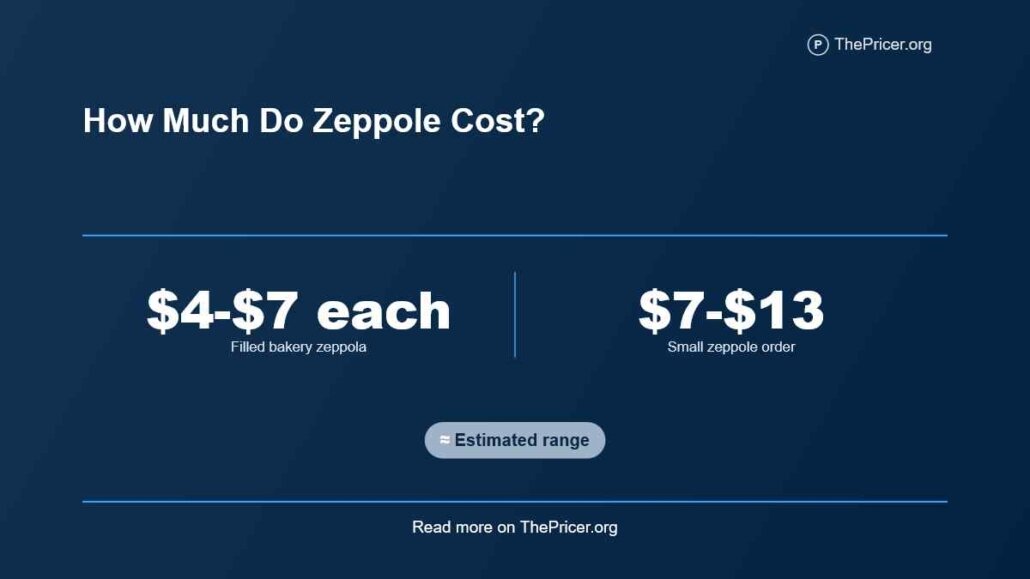
Zeppole typically cost about $4 to $7 each for a large filled St. Joseph pastry from an Italian bakery, while an order of several small fried zeppole at a pizzeria or restaurant usually costs around $7 to $13. Plain festival-style fried dough can be cheaper per piece, while premium versions filled with custard, ricotta, Nutella, or specialty cream can reach $6 to $8 or more for one large pastry.
That wide range exists because “zeppole” can refer to noticeably different desserts. In Italian-American pizzerias, the name often means several small balls of fried dough covered in powdered sugar. Around St. Joseph’s Day, bakeries commonly sell a much larger choux-pastry ring filled or topped with pastry cream and finished with an amarena cherry. The latter is closer to an individual premium pastry and is priced accordingly.
Article Highlights
Jump to sections
- A large filled St. Joseph zeppola generally costs about $4-$7 each.
- Small plain zeppole are often sold as a restaurant order rather than individually, with servings commonly around $7-$13.
- A half-dozen small zeppole can cost roughly $8-$15, depending on the restaurant and toppings.
- Custard, ricotta, Nutella, pistachio, chocolate, and amarena-cherry versions cost more than plain powdered-sugar dough.
- Homemade zeppole can cost well under $1 per small piece in ingredients, but frying oil and premium fillings materially change the calculation.
- March 19, St. Joseph’s Day, is the most important seasonal period for filled zeppole in Italian and Italian-American bakeries.
How Much Do Zeppole Cost?
For a traditional bakery-style zeppola filled with cream, a realistic 2026 budget is about $4 to $7 each.
Current examples support that range. DeLuise Bakery in Rhode Island currently lists its zeppole at $5.95 each. Miller’s Bakery in Tenafly, New Jersey, lists a St. Joseph zeppole at $4. Mercato Italiano currently sells a Zeppola di San Giuseppe for $6.99. DiSorbo’s Italian Bakery lists vanilla, chocolate, and ricotta zeppole for $5 each.
| Type of Zeppole | Typical Price |
|---|---|
| Small plain fried zeppole | $1-$3 equivalent per piece |
| Restaurant order of several small zeppole | $7-$13 |
| Large St. Joseph zeppola | $4-$7 each |
| Premium filled zeppola | $5-$8+ |
| Homemade small zeppole | Often under $1 each |
Size creates an important pricing difference. Nonna Vita Trattoria currently lists St. Joseph zeppole in three sizes at about $2 small, $4 medium, and $6 large, while its standard restaurant zeppole dessert is $7.95.
Two Different Products
Before comparing prices, buyers need to know which type of zeppole they are looking for.
Small fried zeppole are pieces of dough fried until golden and usually dusted heavily with powdered sugar. American pizzerias and Italian festivals frequently sell them in groups rather than individually.
Zeppole di San Giuseppe are larger pastries traditionally associated with St. Joseph’s Day on March 19. They are usually made from choux pastry and topped or filled with pastry cream, then finished with powdered sugar and an amarena cherry.
The official tourism site Turismo Roma describes the closely related Roman St. Joseph pastry as either fried or baked, filled with pastry cream, and traditionally eaten around March 19.
Visit Italy likewise describes the Neapolitan version as choux-style dough with pastry cream, powdered sugar, and syrup-preserved cherries.
These pastries contain substantially more ingredients and labor than a small ball of fried pizza-style dough, which is why comparing the two by “price per zeppole” can be misleading.
Bakery Prices
Filled St. Joseph zeppole now sit in roughly the same price category as other premium individual Italian pastries.
DeLuise Bakery currently lists a zeppole for $5.95. Its other individual desserts sit in a similar range, demonstrating that the zeppola is being treated as a full pastry rather than inexpensive fried dough.
DiSorbo’s Italian Bakery sells vanilla, chocolate, and ricotta versions for $5 each.
At Mercato Italiano, a traditional Zeppola di San Giuseppe is currently listed at $6.99.
That makes roughly $24-$42 for six large bakery zeppole a more realistic modern range than the old $10-$15 half-dozen estimate.
Restaurant Orders
Pizzerias frequently sell zeppole as a plate or bag of several small pieces.
Public Pizza Italian Kitchen currently lists its zeppole dessert at $8.
Other dessert shops sell larger or more elaborate portions around $10-$13. This does not necessarily mean each small zeppola costs $10. The listed menu price usually covers a multi-piece serving.
For example, a $12 order containing six fried pieces works out to:
$12 ÷ 6 = $2 per zeppola
An $8 order containing eight smaller pieces would cost:
$8 ÷ 8 = $1 each
This is why shoppers should compare the number and size of pieces rather than the menu price alone.
Filled Versions
Fillings are one of the largest price drivers.
Plain zeppole need little more than dough, frying oil, and powdered sugar. A filled St. Joseph zeppola can require eggs, butter, milk, vanilla, cornstarch or flour, powdered sugar, pastry cream, ricotta, chocolate, pistachio paste, or amarena cherries.
At La Cornetteria in Montreal, a Nutella and ricotta zeppola currently costs $5. Other current bakery menus put custard-filled versions around $4.50-$6.
Premium fillings can therefore raise the price by several dollars compared with a small plain fried piece.
Cost Per Ounce
A larger St. Joseph pastry can also look expensive when compared with a small fried zeppola simply because it contains much more food.
A current Italian professional cost analysis estimates a finished Zeppola di San Giuseppe at approximately 160-170 grams, or about 5.6-6 ounces, with around 70 grams of choux pastry and 80 grams of pastry cream.
A $6 pastry weighing 6 ounces therefore costs roughly:
$6 ÷ 6 oz = $1 per ounce
By comparison, a small $2 fried dough piece weighing only 1.5 ounces costs:
$2 ÷ 1.5 oz = $1.33 per ounce
The apparently cheaper item can actually cost more relative to the amount of pastry received.
Homemade Cost
Making zeppole at home is significantly cheaper because flour, sugar, eggs, and water are inexpensive relative to bakery labor and retail overhead.
A traditional choux-style recipe from Food Network uses one cup of flour, four eggs, butter, sugar, water, and frying oil and produces multiple servings.
For a simple home batch, the approximate ingredient structure might look like this:
| Flour | $0.30-$0.60 |
| Eggs | $1.00-$2.00 |
| Butter | $0.75-$1.25 |
| Sugar | $0.20-$0.50 |
| Allocated frying oil | $1-$3 |
| Basic batch | About $3.25-$7.35 |
If that batch produces 20 small pieces, direct ingredients work out to about:
$3.25 ÷ 20 = $0.16 each at the low end
and:
$7.35 ÷ 20 = $0.37 each at the higher end.
Real household cost is somewhat higher once energy, oil disposal, vanilla, toppings, and waste are counted, but plain homemade zeppole can still remain well below $1 per piece.
Filled St. Joseph zeppole cost more because pastry cream, cherries, ricotta, chocolate, or specialty ingredients must be added.
The Hidden Cost
 For a bakery, the hidden cost is labor rather than flour.
Choux pastry must be cooked, cooled to the proper consistency, piped into individual shapes, fried or baked, cooled again, filled with pastry cream, garnished, dusted with sugar, refrigerated when necessary, packaged, and sold quickly enough to maintain quality.
That makes a $5 zeppola fundamentally different from a factory-produced doughnut that can be manufactured in enormous volume.
Frying oil is another cost. Oil must be purchased, filtered or replaced, safely stored, and eventually disposed of. Bakery equipment, refrigeration, rent, utilities, packaging, insurance, payment-processing fees, and unsold pastries also need to be covered by the final price.
This is why calculating the cost of flour and eggs alone badly understates what it costs a bakery to sell one zeppola.
Worked Example
Suppose an Italian bakery sells a filled St. Joseph zeppola for $6.
Assume direct ingredients and packaging cost approximately $1.25 and direct production labor allocated to the pastry adds another $1.
| Retail price | $6.00 |
| Ingredients and packaging | -$1.25 |
| Allocated direct labor | -$1.00 |
| Remaining contribution | $3.75 |
That $3.75 is not profit. The bakery still has to pay rent, utilities, insurance, equipment, credit-card fees, management labor, cleaning costs, taxes, waste, and other overhead.
The example explains how a pastry whose raw ingredients may cost around a dollar can reasonably retail for $5-$7.
St. Joseph’s Day
March 19 is the most important date on the zeppole calendar.
The Campania regional government describes Zeppola di San Giuseppe as a traditional March 19 pastry made from choux dough and finished with cream, cherries, and powdered sugar.
Demand rises sharply around the holiday, and Italian-American bakeries often advertise special production runs or encourage preorders. That can affect availability and the mix of sizes offered.
What we could not verify was the old claim that bakeries routinely impose a fixed 20%-30% holiday markup. Some bakeries may change prices from year to year, but there is no reliable national rule that zeppole suddenly become a specific percentage more expensive for St. Joseph’s Day.
Food Inflation
Current food inflation also helps explain why older $1-$3 bakery estimates have aged badly.
The USDA Economic Research Service reports that food-away-from-home prices in August 2026 were 3.4% higher than a year earlier and forecasts restaurant and foodservice prices to rise approximately 3.5% for 2026 overall.
Eggs, fats, oils, labor, rent, and utilities have all experienced changing costs over time. A zeppola price published years ago therefore should not be treated as a current benchmark.
How to Save
Buying several small zeppole rather than large individually filled pastries is usually the cheapest way to enjoy the dessert.
For example, two people splitting an $8 restaurant serving spend only:
$8 ÷ 2 = $4 per person
Buying two large $6 filled pastries instead costs $12.
Home preparation produces the lowest direct cost if you already own the required cookware and are comfortable deep-frying. Another option is to buy zeppole directly from the bakery rather than through a delivery app, where menu prices, delivery charges, service fees, and tips can increase the final bill.
For large St. Joseph’s Day orders, ask the bakery whether half-dozen or dozen pricing is available. Some shops provide quantity pricing even when their online menu only lists the individual pastry.
Readers comparing similar sweets may also want our guides to the cost of donuts, Crumbl Cookies, and Girl Scout Cookies.
Answers to Common Questions
How much does one zeppole cost?
A large filled St. Joseph zeppola usually costs about $4-$7 each. Small plain fried zeppole are generally sold in multi-piece orders and work out to roughly $1-$3 per piece.
How much are six zeppole?
Six small fried zeppole may cost roughly $8-$15. Six large filled bakery zeppole can cost approximately $24-$42.
Why are bakery zeppole expensive?
Large bakery zeppole contain choux pastry, pastry cream, fillings, cherries, and garnishes and require substantial hands-on production. Their selling price also covers labor, refrigeration, rent, utilities, packaging, and unsold-product risk.
Are zeppole the same as doughnuts?
Not exactly. Small American-style zeppole resemble fried dough or doughnut holes, but traditional Zeppole di San Giuseppe are usually made from choux pastry and filled or topped with pastry cream.
When are zeppole traditionally eaten?
Zeppole di San Giuseppe are particularly associated with March 19, St. Joseph’s Day, which is also Father’s Day in Italy.
Are zeppole fried or baked?
Both versions exist. Traditional recipes frequently call for frying, while baked St. Joseph zeppole are also common in modern bakeries.
How much does it cost to make zeppole at home?
A basic batch can cost only several dollars in ingredients. Depending on recipe, oil use, and batch size, small plain homemade pieces may cost around $0.20-$0.60 each. Filled versions cost more.
Are filled zeppole more expensive?
Yes. Custard, ricotta, Nutella, pistachio cream, chocolate, and amarena cherries add both ingredient and labor costs. Large filled pastries commonly sell for $4-$7 or more.
For most buyers in 2026, the simplest rule is to budget $4-$7 for one large Italian-bakery zeppola or about $7-$13 for a restaurant order of several small fried zeppole. Homemade versions remain dramatically cheaper, while premium fillings and delivery fees push the final price higher.
Disclosure: Educational content, not financial advice. Prices reflect public information as of the dates cited and can change. Confirm current rates, fees, taxes, and terms with official sources before purchasing. See our methodology and corrections policy.