
How Much Does a DealDash Bid Cost?
Updated on | Researched and reviewed by Alec Pow, Founder & Pricing Investigator
Prices, claims, and calculations checked against 14 cited sources. See our research methodology and corrections policy.
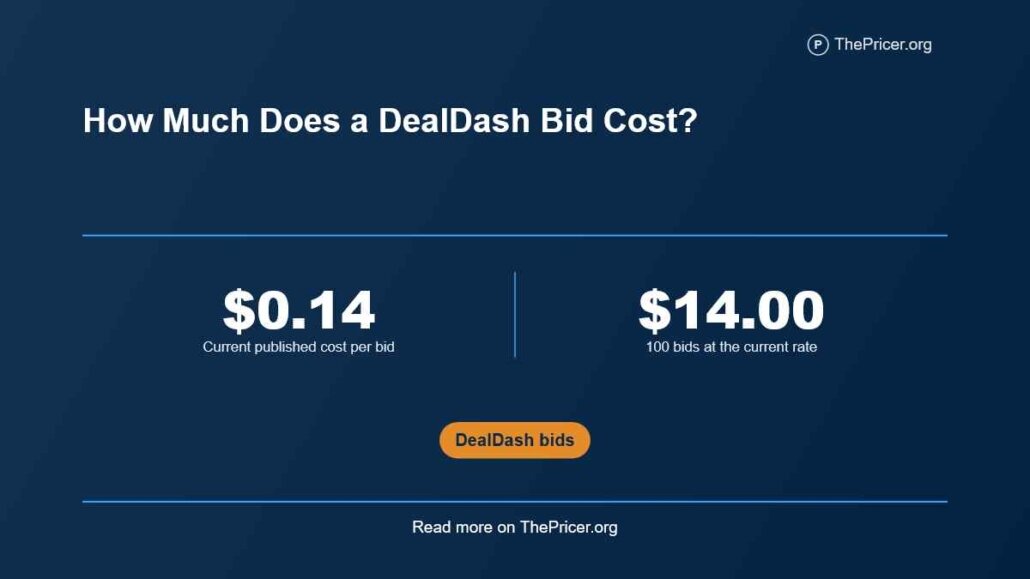
A DealDash bid currently costs 14¢ according to DealDash’s live auction help pages, though active offers can change the price. Joining is free and there is no subscription. Users buy bids, spend them in auctions, and winners also pay the closing price plus applicable sales tax. Losing bidders can use Buy It Now on eligible auctions to pay the listed price and have their used bids returned to the account.
The closing price is not the winner’s full cost. Winning at $12 after using 120 purchased bids at 14¢ means $16.80 in bid spending plus $12 for the item, or $28.80 before tax.
Article Highlights
Jump to sections
- Current bid price. 14¢ per bid.
- Auction increment. Each bid adds $0.01.
- No subscription. Creating an account is free.
- Winning cost. Bids used + final price + applicable tax.
- Buy It Now. Eligible losing bidders can buy the item and recover the used bids to their account.
- First-pack protection. A 90-day money-back guarantee applies.
- Bid expiration. Bids can expire after 365 days.
How Much Does a DealDash Bid Cost?
DealDash’s current auction guide states that bids are currently 14¢ each. The price is not permanently fixed. Its separate bid pack rules say the bid price can change daily according to active offers. The site sells bids in packs, and one bid is deducted from your account each time you place a bid in an auction.
At a 14¢ unit price, the cash equivalent of a bid balance is easy to calculate. These figures are spending equivalents at the present 14¢ rate, not a promise that DealDash currently sells every pack size shown.
| Bid quantity | Cost at 14¢ per bid |
|---|---|
| 100 bids | $14.00 |
| 220 bids | $30.80 |
| 500 bids | $70.00 |
| 1,000 bids | $140.00 |
| 2,000 bids | $280.00 |
| 4,000 bids | $560.00 |
The old article’s 15¢ to 25¢ range is no longer the best headline answer. The live page now shows 14¢, while DealDash also says daily discounts can move pricing lower. DealDash’s legal terms still reference a nominal 60¢ per bid “full price” for refund accounting, but that number should not be mistaken for today’s ordinary checkout price. Readers comparing virtual-unit pricing may find a similar distinction between pack price and effective unit cost in TikTok Rose pricing.
What a Win Really Costs
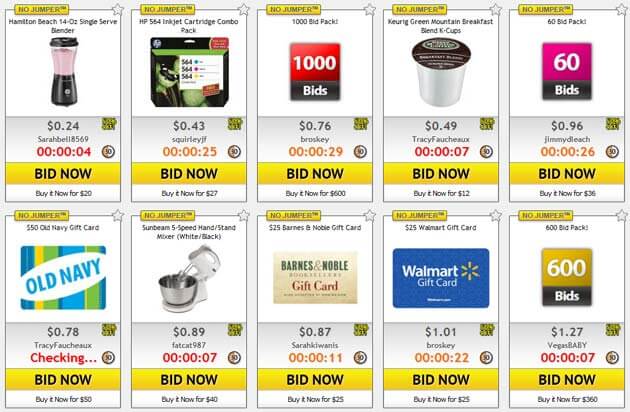
Every DealDash auction starts at $0.00. Each paid or free bid raises the displayed price by $0.01, and the current auction guide says the countdown resets to nine seconds. When the clock reaches zero, the final bidder wins and pays the displayed auction price. Bids already spent are not credited against that purchase price. The winner’s cash cost is the amount paid for the bids used, plus the final auction price, plus any required sales tax.
Consider a $100 item. Assume a bidder uses 120 purchased bids at 14¢ and wins when the auction closes at $12.
- 120 bids × $0.14 = $16.80
- Final auction price = $12
- Total before tax = $28.80
The math changes fast. That total is well below the assumed $100 value, but the same auction can turn expensive if the bidder stays too long.
A second scenario shows the break-even point. If the same $100 item closes at $25, a bidder using 500 purchased bids spends $70 on bids and $25 on the item, for $95 before tax. At the 14¢ bid price, 535 purchased bids would cost $74.90, making the combined total $99.90. Bid number 536 would push the combined amount to $100.04. Under those assumptions, 535 bids is the maximum that keeps the winner below the $100 reference price before tax.
Buy It Now Economics
Buy It Now changes the risk of losing, but it does not convert past bid spending into a cash refund. DealDash’s Buy It Now explanation says a losing bidder can buy the same item at the listed Buy It Now price and receive every bid used in that auction back into the account. The returned bids can then be used again. The cash originally paid for those bids remains spent. That difference matters.
Suppose a bidder uses 300 purchased bids at 14¢ on an item with a $100 Buy It Now price and loses. The bid purchases represent $42. Using Buy It Now requires another $100 before tax, so total cash outlay has reached $142. The account then gets 300 bids back. Economically, the bidder now owns the product and still holds a 300-bid balance, but the bank account is down $142 before tax. Calling the item itself a $100 purchase would ignore the earlier cash committed to bids.
This feature works best when you were already willing to buy the item at the posted Buy It Now price and can use the returned bids later. It is less useful if the Buy It Now price is higher than a competitive retailer’s price or if you do not want to keep bidding. A traditional marketplace such as eBay uses a different fee model, covered in our article on eBay seller fees, so a low DealDash closing price should not be compared with an eBay auction price without adding DealDash bid spending.
Free Bids and Promotions
Not every bid used in an auction has to come from a newly purchased Bid Pack. DealDash’s highest-bidder rewards grant progress while a user remains the highest bidder, with completed progress levels paying free bids. DealDash also runs daily rewards, challenges, badges, coupons and Royalty benefits. These rewards lower the user’s effective cash cost per bid, but they also make it impossible to infer DealDash’s exact cash revenue from the number of bids visible in an auction.
The arithmetic still reveals how the auction model works. Since every bid raises the displayed price by one cent, a $1 increase requires 100 bids. If all 100 were purchased at 14¢, those bids would represent $14 of bidder spending for each $1 added to the auction price. A $10 increase would correspond to 1,000 bids and $140 of purchased-bid spending under the same assumption. This is a ThePricer scenario, not a claim about DealDash’s actual revenue from a specific auction, because some bids may have been free, returned, exchanged or bought at another promotional rate.
Promotions also alter the winner’s side of the bill. The promotion rules include discounted-win auctions, one-cent wins, runner-up Buy It Now discounts and other formats. Read the label on the specific auction rather than applying one promotion to the whole site.
Rules That Change Your Cost
The most important auction rule beyond bid price is the No Jumper limit. DealDash says most auctions stop accepting new bidders once the displayed price passes a limit that is usually $5.00. If you intend to participate, you need to place a qualifying bid before that point. Some auction formats add No Re-Entry, Duel, Early Bird, Overload or One Per User conditions. Those rules can change who remains eligible to bid and how long a contest lasts.
Booked Bids can also change spending behavior. Users can reserve a number of bids in advance and let DealDash place them automatically in rotation. Unused booked bids return to the account, but every Booked Bid that is actually placed uses one bid just like a manual click. Automation removes the need to sit in front of the timer, yet it can also make it easier to commit hundreds of bids without feeling each 14¢ deduction individually. Setting a pre-auction bid ceiling is one way to keep the total tied to the item’s Buy It Now or outside retail value.
A separate cost rule appears in the frequently asked questions. DealDash says registration is free, there is no subscription fee, and users pay for the bids they buy and auctions they win. Shipping is free on ordinary fulfilled orders. Sales tax is a separate charge, so a winning price should still be treated as a pre-tax amount.
Refunds, Taxes, and Expiration
The strongest refund protection applies to a user’s first Bid Pack. DealDash’s published Terms of Use, last updated July 2, 2026, state that the first Bid Pack qualifies for a 100% money-back guarantee when the user requests it within 90 days. The guarantee is limited to one refund per person. The terms also describe separate refund accounting for later unused bids and distinguish the nominal 60¢ full-price basis from discounted promotional bids.
Bids are not permanent account property. The same terms say bids held in an account must be used within 365 days from the date they entered the account through purchase, item exchange or an auction win. Bids that reach the deadline expire and are removed. That makes a large returned or purchased balance less valuable to someone who stops using the platform for a long period.
DealDash’s payment rules add another line to the final bill. Sales tax may apply to the final auction price or the Buy It Now price where required by law. Payment can be made by supported credit cards, debit cards, PayPal and Apple Pay where available. A bidder who wins must separate cash spent acquiring bids, the final auction payment and applicable tax.
DealDash vs Regular Auctions
DealDash is an all-pay bidding-fee auction rather than a conventional auction where unsuccessful bidders normally leave without paying for the right to bid. The purchase of bids is what makes a tiny closing price possible. A final price of $8 does not mean the winner or the bidder population spent only $8. The bid charges sit outside that displayed total.
This difference is why comparing DealDash directly with a normal online auction can be misleading. On a conventional auction, a buyer mainly tracks the winning bid, buyer fees, shipping and tax. On DealDash, a serious bidder must track bid consumption as a separate running cost before adding the final price. The site can still produce a lower all-in number for an individual winner, but a low screen price by itself does not establish savings.
The same unit-cost problem appears in other digital spending systems where a small virtual unit hides the cash total. A single TikTok gift can cost only a few cents or dollars, yet repeated virtual purchases accumulate quickly. DealDash differs because the virtual unit also controls whether you remain in competition for a physical product. The useful comparison is not “pennies versus retail.” It is your all-in DealDash spending versus the price you could pay to obtain the same or a comparable product elsewhere.
Is DealDash Worth Using?
DealDash is a real operating company, but that does not mean every auction is good value. The September 2026 Penny Hoarder review makes the same practical distinction. The site operates as a penny auction, and the displayed closing price can look much lower than the bidder’s full spend when bid costs are omitted. Judge an auction from your own bid cost, number of bids used and the price of the same item elsewhere.
BBB’s complaint record displayed 148 complaints over the prior three years when checked in September 2026. BBB advises readers to weigh complaint volume against company size and responses. Complaints are customer allegations and experiences, not findings that every claim is correct. BBB accreditation itself is a separate paid program, explained in our article on BBB accreditation costs.
A 2017 class action accused DealDash of false advertising and alleged that its model amounted to an illegal lottery. The case was voluntarily dismissed in January 2018. The filing describes allegations, not a court judgment. DealDash has real products and published rules, but its pay-to-bid structure can make a long or unsuccessful auction costly.
Makes sense if
- You know your cost per bid before the auction.
- You set a bid ceiling tied to outside retail value.
- You were already willing to use Buy It Now.
Does not make sense if
- You judge the deal only by the closing price.
- You keep bidding after all-in spending nears retail.
- You do not want the item at the Buy It Now price.
Answers to Common Questions
How much does one DealDash bid cost?
DealDash currently lists bids at 14¢ each. Active promotions can change the price, so use the amount shown in your account before buying.
Do you pay for DealDash bids if you lose?
Yes. Used bids are consumed. If you use Buy It Now after losing an eligible auction, those used bids return to your account.
Does DealDash charge a monthly fee?
No. Registration is free and DealDash says there is no subscription fee.
Can you get a DealDash Bid Pack refunded?
The first Bid Pack has a 100% money-back guarantee when requested within 90 days. Later bid refunds have narrower terms.
Is the DealDash winning price the total cost?
No. Add purchased-bid spending, the final auction price and applicable tax.
Disclosure: Educational content, not financial advice. Prices reflect public information as of the dates cited and can change. Confirm current rates, fees, taxes, and terms with official sources before purchasing. See our methodology and corrections policy.