
How Much Does a Ferris Wheel Cost?
Updated on | Written by Alec Pow
This article was researched using 10 sources. See our methodology and corrections policy.
A commercial Ferris wheel can cost from about $40,000 for a small children’s or portable model to $900,000 or more for a fully delivered and installed 35-to-50-meter park wheel in 2026. Larger 55-to-80-meter city wheels can require roughly $1.2 million to $5 million before substantial surrounding development, while landmark observation-wheel projects can reach tens or even hundreds of millions of dollars.
The biggest pricing mistake is comparing a factory quote for the steel ride with the total development cost of an attraction such as the London Eye or Singapore Flyer. Shipping, foundations, installation, enclosed cabins, utilities, permitting, inspections, plazas, terminals, retail space, landscaping, and roads can make the finished project several times more expensive than the wheel equipment itself.
Article Highlights
Jump to sections
- Mini or children’s Ferris wheel: $25,000–$130,000 (at $30 per hour, earning that amount would take about 0.4 to 2.1 years of full-time work, before taxes) installed
- Portable 10–20 meter wheel: $50,000–$150,000 installed
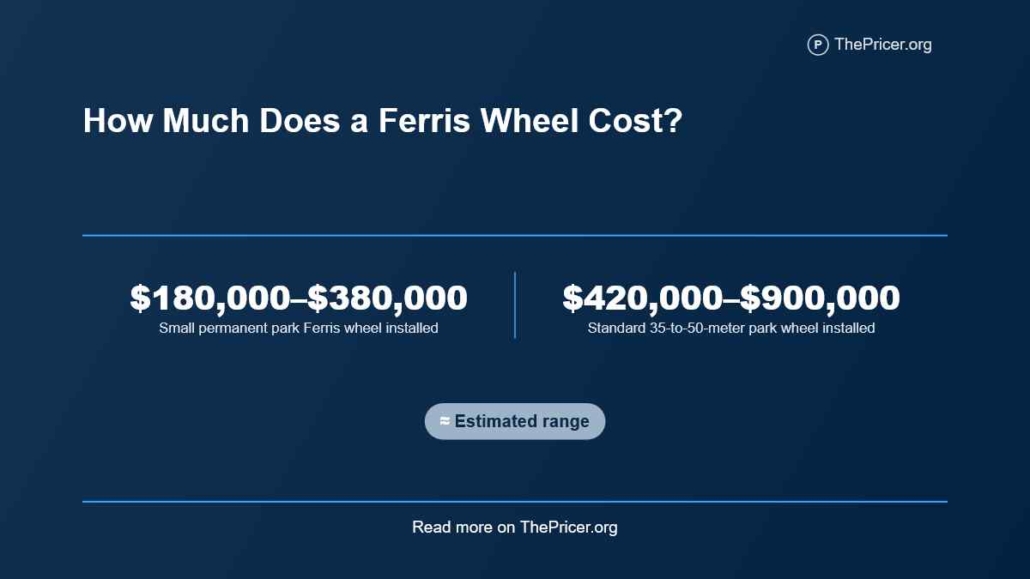
- 20–30 meter small park wheel: $180,000–$380,000 installed
- 35–50 meter standard park wheel: $420,000–$900,000 installed
- 55–80 meter large park/city wheel: $1.2 million–$5 million
- 85–120 meter landmark observation wheel: roughly $6 million–$40 million+ before major surrounding development
- London Eye: approximately £75 million
- Singapore Flyer: approximately S$240 million
- Ain Dubai: estimated at approximately AED 1 billion, or $270 million
How Much Does a Ferris Wheel Cost?
Manufacturer pricing shows why a blanket “$200,000 to $20 million (about 3.2 to 321 years of full-time work at $30 per hour)” answer is not very useful.
A current 2026 pricing guide from Sinorides separates the equipment price from the more realistic landed cost:
| Ferris Wheel Type | Equipment Price | Estimated Installed/Landed Cost |
|---|---|---|
| 8–15 m children’s wheel | $25,000–$90,000 | $40,000–$130,000 |
| 10–20 m portable wheel | $35,000–$120,000 | $50,000–$150,000 |
| 20–30 m small park wheel | $120,000–$250,000 | $180,000–$380,000 |
| 35–50 m standard park wheel | $280,000–$600,000 | $420,000–$900,000 |
| 55–80 m large park/city wheel | $800,000–$3.5 million | $1.2–$5 million |
| 85–120 m+ landmark wheel | $4–$25 million+ | $6–$40 million+ |
Those figures are useful as planning ranges, but a real project quote still depends on country, site conditions, certification requirements, cabin design, freight, and foundations.
Factory vs Finished Cost
A factory price is only the beginning.
DINIS Amusement currently quotes approximately:
- 30-meter wheel: $65,000–$120,000 (about 1 to 1.9 years of full-time work at $30 per hour) equipment price
- 42-meter wheel: $150,000–$300,000
- 50-meter wheel: $280,000–$550,000
The same supplier notes that a 50-meter wheel can reach approximately $400,000 to $750,000+ as an overseas project after installation-related costs are included.
That difference illustrates one of the most important numbers in this article.
If a $400,000 wheel ultimately costs $650,000 to open:
$650,000 – $400,000 = $250,000
The project costs outside the wheel itself add 62.5% to the factory price.
30-Meter Wheels
A 30-meter, or roughly 98-foot, wheel is a practical commercial amusement-park size rather than a tiny carnival kiddie ride.
Current 2026 public quotations put these wheels roughly around $65,000 to $150,000+ at the equipment level depending on configuration.
A buyer should budget more for:
- Ocean or ground freight
- Import duties
- Concrete foundation
- Electrical service
- Crane work
- Assembly
- Testing
- Local inspection
- Site paving
A realistic opening-day budget can therefore approach $180,000 to $380,000 even when the ride equipment costs much less.
42-Meter Wheels
The 42-meter class is where Ferris wheels begin to function as strong visual landmarks for parks, resorts, waterfront developments, and shopping destinations.
DINIS currently estimates a standard 42-meter wheel around $150,000 to $300,000 for equipment, with upgraded cabins, air conditioning, lighting, international installation, and certification potentially pushing the wider project toward approximately $220,000 to $420,000+.
A separate current manufacturer listing for a 42-meter wheel shows a $160,000 factory price, helping confirm that this class is generally in the low-to-mid six figures before site work.
50-Meter Wheels
A 50-meter wheel, about 164 feet tall, represents a substantial permanent attraction.
Current manufacturer pricing clusters around $280,000 to $550,000 for equipment.
These wheels may carry 30 or more cabins and around 100 to 130 passengers per cycle depending on configuration.
A realistic overseas installed budget of $400,000 to $900,000 is more useful than the factory quote when deciding whether the attraction is financially viable.
Observation Wheels
There is no precise technical line where a Ferris wheel becomes an “observation wheel,” but the term is generally used for very large permanent attractions designed around panoramic sightseeing rather than carnival thrills.
Observation wheels usually add:
- Large enclosed capsules
- Air conditioning
- Accessible loading
- Long rotations
- High passenger capacity
- Premium lighting systems
- Hospitality experiences
- Major foundation structures
At this point, the attraction begins to resemble a building and transportation project as much as an amusement ride.
London Eye Cost
The London Eye is one of the clearest examples of why landmark-wheel costs cannot be compared with factory ride prices.
The attraction’s own official history says the London Eye cost up to £75 million to build.
Architect and co-designer Julia Barfield later described the overall project at about £80 million, including approximately £50 million in construction costs.
The wheel stands 135 meters, or 443 feet, high and uses 32 enclosed capsules, each capable of carrying up to 25 passengers.
The earlier $25 million estimate dramatically understates the project.
Singapore Flyer Cost
The 165-meter Singapore Flyer cost approximately S$240 million.
Channel NewsAsia reported that figure when covering the attraction’s operating history.
The Flyer has 28 air-conditioned capsules capable of carrying 28 passengers each.
The project also includes a three-story terminal development, which is another reminder that the published capital cost represents much more than its steel wheel.
High Roller Cost
The Las Vegas High Roller needs a particularly important clarification.
The frequently quoted $550 million number was for The LINQ development as a whole, not a verified standalone construction cost for the wheel.
Caesars Entertainment described the 550-foot High Roller as the centerpiece of the $550 million retail, dining, and entertainment development.
SEC filings likewise combine the observation wheel with broader LINQ capital expenditures rather than providing a clean independent price for the wheel.
It would therefore be misleading to write “the High Roller cost $550 million.”
What can be verified is its scale: the wheel reaches approximately 550 feet, uses 28 spherical cabins, and each cabin can hold up to 40 passengers.
Ain Dubai Cost
Ain Dubai operates on an even more extreme engineering scale.
The wheel is approximately 250 meters, or 820 feet, tall, not 210 meters.
A project supplier involved in its construction reports that Ain Dubai was estimated to cost approximately AED 1 billion, or $270 million.
The GMA project account notes that more than 9,000 tonnes of steel were involved in the structure.
At that scale, the comparison with a $300,000 theme-park wheel stops being meaningful.
Famous Wheel Comparison
| Wheel | Height | Documented Project Cost |
|---|---|---|
| London Eye | 135 m / 443 ft | Up to £75 million |
| Singapore Flyer | 165 m / 541 ft | S$240 million |
| High Roller | 168 m / 550 ft | Standalone wheel cost not publicly separated; LINQ project was $550 million |
| Ain Dubai | 250 m / 820 ft | About AED 1 billion / $270 million |
These should be considered destination-development benchmarks rather than prices for ordinary Ferris wheels.
Foundation Cost
Foundation work is one of the largest hidden variables because the wheel transfers enormous structural loads into a very small footprint.
Foundation design depends on:
- Wheel height
- Wind loading
- Soil strength
- Groundwater
- Seismic requirements
- Local building codes
A small portable wheel may require little permanent civil work. A fixed observation wheel can require major reinforced-concrete foundations and extensive geotechnical engineering.
This is why a supplier cannot give an accurate all-in project price from wheel diameter alone.
Cabins
Cabins can materially change the purchase price.
Open gondolas are much cheaper than fully enclosed observation capsules.
Premium cabins can include:
- Air conditioning
- Heating
- Audio systems
- Video
- Lighting
- VIP interiors
- Accessibility systems
- Custom glazing
Sinorides estimates that enclosed climate-controlled capsules can cost several times more per unit than simple open gondolas.
Multiply that premium across 20, 28, or 32 cabins and it becomes a major capital expense.
Lighting
A modern wheel is often a nighttime billboard for the entire attraction.
Current manufacturer pricing from YOTO Amusement puts optional LED packages on some commercial wheels at approximately $10,000 to $39,000.
Dynamic addressable lighting costs more than basic static illumination but can create animated patterns, sponsorship displays, holiday themes, and synchronized shows.
Freight and Installation
A large Ferris wheel does not arrive on one truck.
Steel rim sections, supports, gondolas, drive equipment, controls, and electrical systems may require numerous shipping containers or oversized loads.
The destination then needs cranes, erection crews, electrical contractors, commissioning, load testing, and inspections.
Sinorides estimates that total landed/opening-day costs for many imported wheels end up around 30% to 50% above the factory equipment quote, although difficult projects can exceed that.
Worked Example
Consider a hypothetical 42-meter permanent park wheel quoted at $250,000 from the manufacturer.
| Wheel equipment | $250,000 |
| Freight and customs | $45,000 |
| Foundation and site work | $70,000 |
| Crane and installation | $45,000 |
| Electrical and lighting | $25,000 |
| Engineering, permits, testing | $20,000 |
| 15% contingency on project work | $31,000 |
| Estimated opening-day cost | $486,000 |
The actual wheel represents only:
$250,000 ÷ $486,000 = 51.4%
Almost half of the project’s capital cost is outside the manufacturer’s equipment price.
Cost per Rider
Capacity matters when deciding whether the capital cost makes sense.
Suppose a $600,000 installed Ferris wheel carries 96 riders per full cycle and completes four loaded cycles per hour.
Maximum theoretical hourly capacity:
96 × 4 = 384 riders
If the average ticket is $8 and actual load factor averages 60%:
384 × 60% = 230 riders per hour
Hourly ticket revenue would be approximately:
230 × $8 = $1,840
That is gross revenue, not profit. Labor, insurance, maintenance, electricity, lease expense, taxes, downtime, and marketing still have to be paid.
Operating Costs
The capital price is only the first part of ownership.
Operators also need to budget for:
- Ride attendants
- Maintenance technicians
- Electricity
- Insurance
- Annual inspections
- Lubricants and wear components
- Painting and corrosion protection
- Lighting repairs
- Cabin HVAC maintenance
- Control-system maintenance
For a mid-size wheel, Sinorides estimates annual operating costs around $80,000 to $190,000, depending heavily on staffing, insurance, climate, and operating schedule.
A wheel costing $700,000 to open but requiring $120,000 per year to operate would consume another:
$120,000 × 10 = $1.2 million
over its first decade, before financing and major refurbishment.
Safety and Inspection
A commercial Ferris wheel is regulated equipment, not simply a steel structure that can be assembled and opened to riders.
The current ASTM F770-26 standard establishes procedures covering amusement-ride operation, maintenance, inspection, and staff training.
ASTM Committee F24 standards collectively cover design, manufacture, testing, operations, quality assurance, maintenance, and inspection.
Local and state requirements differ, but buyers should budget for engineering documentation, commissioning, inspections, permits, and ongoing compliance rather than treating certification as an optional accessory.
Portable Wheels
Portable wheels serve fairs, carnivals, festivals, and traveling operators.
They are engineered to be erected, dismantled, and transported repeatedly rather than permanently anchored as city landmarks.
Current manufacturer planning prices put many 10-to-20-meter portable units around $35,000 to $120,000 factory price, with approximately $50,000 to $150,000 representing a more complete landed budget.
Transportability saves permanent construction expense but creates recurring trucking, assembly, inspection, crew, and setup costs.
The Indoor-Wheel Myth
Several famous wheels are sometimes incorrectly described online as indoor Ferris wheels.
Cosmo Clock 21 is outdoors at Yokohama’s waterfront.
Disney California Adventure’s Pixar Pal-A-Round, formerly Mickey’s Fun Wheel, is also outdoors.
These are not examples of climate-controlled indoor Ferris wheels.
Indoor wheels certainly exist, particularly inside shopping and entertainment complexes, but enclosure adds an entirely separate building cost that should not be confused with the ride price itself.
Ferris Wheel History
The famous Ferris Wheel debuted at Chicago’s World’s Columbian Exposition in 1893.
Smithsonian records that engineer George Washington Gale Ferris Jr. proposed the attraction after exposition organizers sought an American engineering answer to the Eiffel Tower.
The original wheel measured approximately 250 feet in diameter and had 36 passenger cars.
Each car could hold 60 people, giving the wheel a theoretical load of:
36 × 60 = 2,160 passengers
More than 1.4 million people rode it during its 19-week run at the fair.
Modern observation wheels retain Ferris’ basic idea but replace open railcar-style cabins with lighter steel structures, cable-supported rims, enclosed capsules, sophisticated drives, and computerized controls.

Hidden Costs
The most dangerous budgeting mistake is buying the wheel before costing the site.
A low factory quote may exclude:
- Engineering
- Geotechnical testing
- Foundations
- Crane rental
- Import taxes
- Customs brokerage
- Utility upgrades
- Drainage
- Queue construction
- Ticketing facilities
- ADA access
- Fire and emergency systems
- Inspection
- Insurance
- Spare parts
A $200,000 wheel installed on a difficult site can therefore become a $350,000-to-$450,000 project surprisingly quickly.
Ways to Spend Less
Choose a standard model. Custom structural geometry, cabins, theming, and lighting all raise engineering and fabrication cost.
Use open gondolas. Climate-controlled observation capsules add substantial expense.
Prepare the site first. Soil and utility problems discovered after purchase can destroy the budget.
Compare landed prices. A $150,000 supplier quote is not necessarily cheaper than a $200,000 quote that includes more freight, engineering, or installation.
Match capacity to demand. Oversizing the wheel produces more capital and maintenance cost without generating revenue if the cabins remain empty.
Budget spare parts upfront. Downtime during a busy season can cost more than stocking common wear components.
If you are comparing amusement attractions, see our guides to the cost of a mechanical bull, dunk tank rental, and a day at Six Flags.
What We Verified
Current 2026 manufacturer data place basic commercial Ferris-wheel equipment far below the multimillion-dollar figures often associated with landmark observation wheels. Standard 30-to-50-meter park wheels generally fall in the low-to-mid six figures for equipment, while shipping, foundation work, installation, electrical systems, and inspection can raise opening-day cost by roughly 30% to 50% or more.
We separately checked landmark projects. The London Eye’s official history lists a cost of up to £75 million, Singapore’s Flyer cost approximately S$240 million, and Ain Dubai has been estimated at approximately AED 1 billion, or $270 million.
We also verified that the widely reported $550 million High Roller figure refers to the broader LINQ development, not a publicly separated standalone cost for the observation wheel.
Current ASTM amusement-ride standards also confirm that inspection, maintenance, training, testing, and operational procedures continue after installation, making ongoing compliance part of the ownership cost.
Answers to Common Questions
How much does a Ferris wheel cost?
A commercial wheel can cost from about $25,000 for basic small equipment to several million dollars for a large city wheel. Standard 35-to-50-meter wheels commonly cost roughly $420,000 to $900,000 once normal installation expenses are included.
How much does a small Ferris wheel cost?
Small children’s or portable units can cost approximately $25,000 to $120,000 for equipment, with a broader installed budget around $40,000 to $150,000.
How much does a 50-meter Ferris wheel cost?
Current factory pricing is roughly $280,000 to $550,000, while a complete imported and installed project can reach approximately $400,000 to $900,000.
How much did the London Eye cost?
The London Eye’s official site says it cost up to £75 million to build.
How much did the Singapore Flyer cost?
The Singapore Flyer cost approximately S$240 million.
Did the High Roller cost $550 million?
Not as a standalone wheel. The $550 million figure refers to Caesars Entertainment’s broader LINQ retail, dining, entertainment, and High Roller development.
How much did Ain Dubai cost?
The 250-meter observation wheel has been estimated at approximately AED 1 billion, or $270 million.
Why does installation cost so much?
Commercial wheels require engineered foundations, heavy transport, cranes, electrical service, erection crews, commissioning, inspections, and site infrastructure. Those costs can add 30% to 50% or more above the equipment quote.
How much does a Ferris wheel cost to operate?
A mid-size commercial wheel can require roughly $80,000 to $190,000 per year for staffing, maintenance, electricity, inspections, insurance, and related operating costs, although actual expenses vary greatly by location and operating schedule.
Disclosure: Educational content, not financial advice. Prices reflect public information as of the dates cited and can change. Confirm current rates, fees, taxes, and terms with official sources before purchasing. See our methodology and corrections policy.