
How Much Does it Cost to Rent a Dunk Tank?
Updated on | Written by Alec Pow
This article was researched using 14 sources. See our methodology and corrections policy.
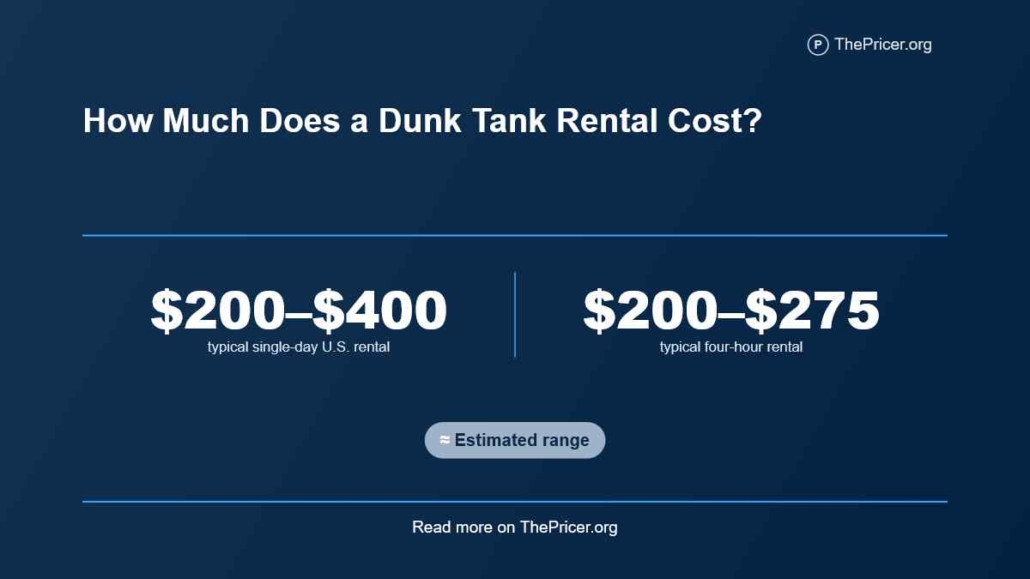
A dunk tank rental usually costs $200 to $400 for a single-day event in the United States in 2026, based on current 2026 rental cost data. A four-hour rental commonly falls around $200 to $275, while a six-to-eight-hour booking is often $250 to $400. Delivery, setup, longer rental periods, staffing, permits, and venue requirements can push the final bill above $400.
The rental price is not driven by tank capacity alone. Current 500-gallon units can rent for less than some 350-gallon units because transportation, rental time, service level, location, and event rules change what the customer is buying. The best comparison is the total price for the same rental length with the same delivery and setup scope.
Article Highlights
Jump to sections
- Current national cost data places a single-day dunk tank rental around $200 to $400 (at $30 per hour, earning that amount would take about 0.8 to 1.7 full-time workdays, before taxes).
- Four-hour rentals commonly run $200 to $275, while six-to-eight-hour rentals are often $250 to $400.
- A current pickup-versus-delivery example rises from $170 to $250, an $80 increase.
- Many commercial tanks hold about 350 to 500 gallons, but capacity does not set the rental price by itself.
- The renter commonly supplies the water source, and large tanks can take roughly 40 to 90 minutes to fill.
- Public parks may require permits or insurance, and some parks prohibit dunk tanks completely.
How Much Does a Dunk Tank Rental Cost?
Live provider prices show why a national range is only a planning figure. Self-tow equipment can sit below the common single-day range, while delivered commercial units can cost more because transportation, setup, rental time, and local service conditions are bundled differently.
The table uses advertised prices that were available during this review. These offers come from different local markets and are not a national average. They show how a self-tow unit, a delivered unit, and a longer commercial rental can have very different prices even when the tanks hold a similar amount of water.
| Current rental example | Advertised price | Rental scope |
|---|---|---|
| Longeneckers 500-gallon tank | $125 (about 4.2 hours of work at $30 per hour) | 48-hour self-tow rental |
| Leo’s customer pickup | $170 | Pickup on event day, return next morning |
| DFW 500-gallon rental | $275 | Up to eight hours, 7% per extra hour, $75 overnight |
| Phoenix 350-gallon tank | $349 | Starting price for a five-hour residential rental |
Using the table’s cited offers, one current 500-gallon unit costs $125 for a self-tow 48-hour rental, another costs $275 for up to eight hours, and a 350-gallon Phoenix unit starts at $349. Geography and included service differ, so those figures cannot be turned into a gallon-based national rate.
What the Rental Price Includes
A dunk tank rental pays for a mechanical event attraction built around a water tank, elevated seat, target, release mechanism, protective frame, and throwing balls. The current provider sample in the table spans 350 to 500 gallons. The person on the seat drops into the water when a throw hits the target, then climbs back to the seat for the next round.
The listed price may cover very different services. Some companies deliver, position, set up, and collect the tank. Others offer a towable pickup rental. Hose and ball supply also vary. A low equipment-only price is not comparable with a quote that includes transportation and setup.
Water is another boundary. Many companies require a usable outdoor spigot near the setup area. Some handle filling with the renter’s water connection, while others leave that step to the customer. A quote that includes delivery, setup, filling, balls, and pickup is not comparable with equipment-only pricing.
Ask what the quoted price covers before comparing providers. The useful checklist is rental hours, delivery, setup, pickup, balls, hose, water filling, supervision, and taxes. If one quote includes five of those items and another includes only the tank, the sticker prices do not describe the same service.
Pickup vs Delivery
Transportation can change the bill by a large percentage because commercial dunk tanks are bulky. Some fold for transport, while many 500-gallon models ride on a dedicated trailer. A customer-pickup offer may require a suitable hitch, tow vehicle, wide access route, and confidence moving the unit. Delivery can remove that work but adds truck time and labor.
Using the Leo’s offer cited in the table, delivery with setup adds $80 (about 2.7 hours of work at $30 per hour) to the $170 customer-pickup rate, bringing the advertised price to $250. The calculation is $80 divided by $170, or about 47%. In this matched offer, paying for delivery raises the advertised price by nearly half.
The product itself is unchanged, so the calculation isolates the service difference. A renter with the right towing equipment may save the $80. Someone without a suitable vehicle cannot use the cheaper option, and delivery distance may create another charge outside the normal service area.
Pickup also uses fuel, travel time, and towing equipment. Compare the delivered total with the real cost and effort of collecting and returning the tank rather than treating the base pickup rate as automatic savings.
Rental Time
Rental periods range from short event blocks to overnight, weekend, and multi-day bookings. Current providers use several models. Some charge one price for a broad block of hours, some add a fixed amount for each extra hour, and others price a second day at a discount. This is why the old claim that dunk tanks are rented for no more than six hours should be removed.
Using the DFW offer cited in the table, $275 for up to eight hours works out to about $34.38 per event hour if all eight hours are used. The same listing sets extra hours at 7% of the base rate and overnight use at $75. The hourly figure is arithmetic on this one offer, not a national hourly rate.
Kingsland AquaBoom gives another useful duration example. Its current Easy Dunker rates are $300 for one day or eight hours and $500 for two days. The second day adds $200, rather than another full $300. A multi-day carnival can have a lower effective daily equipment cost than two separate one-day rentals.
Event length should be matched to actual use. A four-hour school carnival does not need a weekend package. A two-day fundraiser should not be priced from a half-day rate either. Check the return deadline, overnight charge, second-day rate, and whether pickup happens immediately after the event or the following morning.
Water, Fill Time, and Access
Water access can decide whether a site works at all. A 500-gallon tank needs a nearby source and enough time to fill before participants can use it. A-1 Rentals says a household garden hose can take more than an hour to fill its 500-gallon dunk tank. Water pressure and hose flow can change the actual fill time.
This creates a scheduling cost even when the water itself is cheap. Delivery at the event start time can leave the attraction unusable while the tank fills. Arrange setup early enough to finish filling before guests arrive, and ask who handles filling and draining.
Access width matters too. Inflatable Party Magic says its trailer-mounted unit needs a double gate or open access. Folding designs may need less room. Measure gates, side yards, driveways, setup space, and hose reach before paying a deposit. A front-yard setup may be the only workable choice when a trailer cannot reach the backyard. At a park or school, confirm that the available spigot can be used for the event and that drainage is permitted at the selected location.
Park and Event Costs
Public venues can add costs or block the rental completely. Fairfax County, Virginia requires a park use application for events that include a dunk tank, moon bounce, carnival ride, or similar attraction. The application fee is $25. That fee belongs in the event budget even though it is paid to the park rather than the dunk tank company.
Local rules are not uniform. Saint Paul, Minnesota states in its current park regulations that dunk tanks are not allowed in city parks. In that case, no rental price makes the proposed park setup workable. The event needs a different venue or a different water attraction.

Insurance and staffing can create another layer. Party On Air lists a base rental starting at $259.99 for two through six hours and a $369.99 daily rate, while stating that delivery, staffing, fuel, permits, inspections, regulatory fees, taxes, and other event charges are excluded from the advertised base price. Those exclusions show why a cheap online number may not be the payable event total.
Before booking a park, school, church, or corporate site, ask the venue about outside-vendor approval, insurance certificates, vehicle access, water use, drainage, supervision, and operating hours. Do that before paying a nonrefundable reservation fee.
Dunk Tank vs Splash Alternatives
A full dunk tank is not the only target-triggered water game. Splash or flush attractions keep the participant seated while water falls from above instead of dropping the person into a deep tank. They can use far less water, fit through smaller access points, and work at venues that are uncomfortable with a trailer-mounted 350-to-500-gallon tank.
Current pricing shows that the alternative can also be cheaper. Fun Services in Minnesota lists its classic dunk tank at $250 for four hours plus delivery, while its Flush Um water game is $75 per day. The dunk tank requires delivery, a customer-provided garden hose, about an hour to fill, and an adult attendant whenever water is in the tank. The Flush Um uses a constant hose flow but does not require a person to drop into a large tank.
A splash game should still be priced as a separate product rather than a discounted dunk tank. It can suit tight access, lower water use, or a venue that rejects a full tank, but the participant experience is different and the rental package may include different equipment.
The experience is different. A fundraiser built around dunking a principal may need the traditional seat drop. A children’s event may care more about the splash than the plunge. Match the attraction to the people and venue before choosing by price.
Which Rental Setup Fits?
A normal backyard or school event can start with the headline equipment budget, then add delivery or venue charges not already included. Self-tow can cost less, while full-service delivery transfers transportation and setup work to the rental company.
Using the cited Kingsland rates, the eight-hour rental is $300, local delivery with pickup is $50, and setup plus breakdown is $50. Choosing all three produces a $400 advertised total before any deposit or venue expense. Delivery and setup account for one-quarter of that scenario.
Makes sense if
- Your venue has usable water and enough fill time.
- The delivery path fits the rented tank.
- The participant rules fit your event.
- The quote defines setup, supervision, drainage, and pickup.
Does not make sense if
- Your venue prohibits full dunk tanks.
- You cannot supply the required water or access.
- You are comparing self-tow with full-service delivery as equal offers.
- A splash game would meet the goal with simpler setup.
For a broader event budget, compare the cost to rent a bounce house or add a mechanical bull rental. Fundraisers can also price cotton candy as a separate concession.
Answers to Common Questions
How much does it cost to rent a dunk tank for a day?
A standard single-day rental commonly costs about $200 to $400. Self-tow offers can cost less, while delivery, setup, permits, staffing, and longer rental periods can raise the total.
Does the rental company fill the dunk tank?
Policies vary. Many companies require the renter to provide a nearby outdoor water source and hose, while some providers supply a hose or handle the filling process during setup.
How long does a dunk tank take to fill?
A 500-gallon commercial tank can take roughly 40 to 90 minutes with a garden hose, depending on the tank and water pressure. Start filling well before the scheduled opening time.
Do dunk tanks need electricity?
Traditional mechanical dunk tanks do not require electricity for the target and seat mechanism. The main site requirement is usually water, plus a flat setup area and suitable access.
Can a dunk tank be used at a public park?
It depends on the park. Some jurisdictions allow dunk tanks with permits or insurance requirements, while others prohibit them. Check the exact venue rules before reserving the equipment.
Disclosure: Educational content, not financial advice. Prices reflect public information as of the dates cited and can change. Confirm current rates, fees, taxes, and terms with official sources before purchasing. See our methodology and corrections policy.