
How Much Does a Jazz Funeral Cost?
Updated on | Written by Alec Pow
This article was researched using 11 sources. See our methodology and corrections policy.
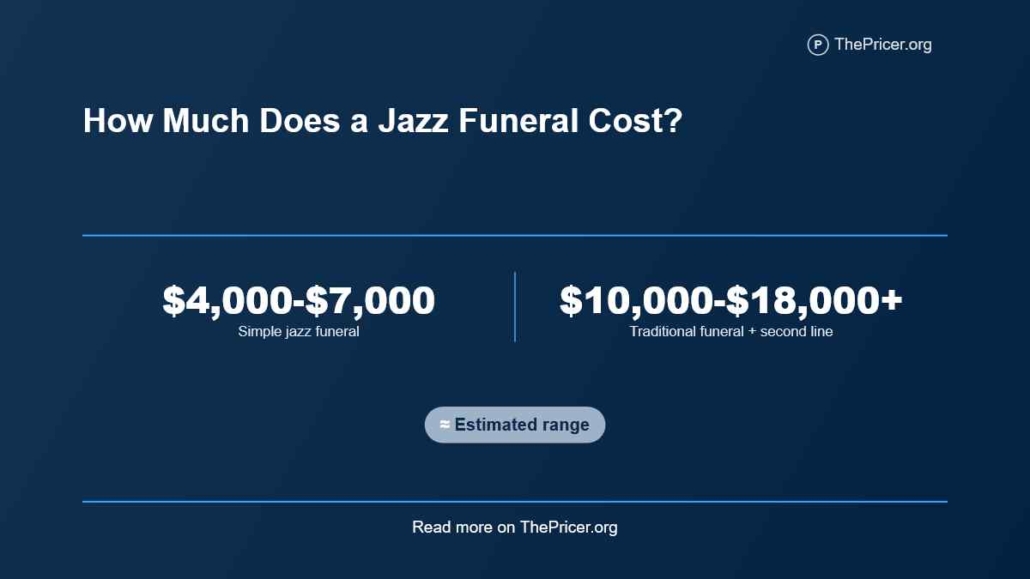
A New Orleans jazz funeral can cost roughly $4,000 to $15,000+, but there is no single package price. The jazz funeral itself is really an added musical procession layered onto whatever funeral arrangements the family chooses.
A relatively simple cremation or memorial arrangement with a brass-band second line might stay around $4,000 to $7,000. A traditional funeral with viewing, burial, casket, cemetery expenses, brass band, street procession, and police escort can more realistically reach $10,000 to $20,000 or more.
The important distinction is that the band is only one part of the bill. Funeral-home services, burial or cremation, cemetery charges, the second-line permit process, required police escort, transportation, flowers, printed materials, and optional cultural performers can all change the final cost.
Article Highlights
Jump to sections
- A simple jazz-funeral arrangement may cost around $4,000-$7,000 (at $30 per hour, earning that amount would take about 3.3 to 5.8 full-time workweeks, before taxes).
- A traditional burial with a jazz procession can more realistically cost $10,000-$20,000+.
- Current New Orleans brass bands advertise rates from roughly $400-$800 for shorter/basic appearances to $1,500-$3,500+ for more complete productions.
- A New Orleans street second line requires a parade permit, police escort, and city permitting fee.
- The City does not publish one universal police price because staffing depends on the route and parade size.
- Current New Orleans direct cremation prices start around $1,200-$2,500 at many providers, while traditional funeral and burial arrangements can exceed $10,000.
- Cemetery property, interment, vaults, flowers, obituary charges, and musician extras may sit outside the funeral home’s advertised package.
How Much Does a Jazz Funeral Cost?
For budgeting purposes, it helps to think of a jazz funeral as two overlapping expenses:
1. The underlying funeral or memorial, which may involve cremation, a traditional burial, viewing, casket, funeral director, transportation, cemetery, and related services.
2. The New Orleans jazz-funeral component, including the brass band, second-line procession, permit, police escort, and optional additions such as a grand marshal, umbrellas, Mardi Gras Indians, or other performers.
| Jazz-funeral scenario | Realistic planning range |
|---|---|
| Direct cremation + small memorial + short band appearance | $3,000-$6,000 (about 2.5 to 5 full-time workweeks at $30 per hour) |
| Cremation memorial + traditional second line | $5,000-$10,000 |
| Traditional funeral + burial + second line | $10,000-$18,000+ |
| Elaborate funeral with premium band, cemetery and extras | $15,000-$25,000+ |
These are planning ranges, not fixed packages. One family may already own cemetery property and choose a small local band, while another may buy a casket, burial space, vault, premium flowers, extended procession, and additional performers.
The Brass Band
The brass band is the element that makes a jazz funeral immediately recognizable, but the old assumption that the band itself automatically costs $2,000 to $4,000 (about 1.7 to 3.3 full-time workweeks at $30 per hour) is too narrow.
Current New Orleans booking listings show much broader pricing. A local Second Line Band listing currently advertises approximately $500 to $3,000 per event, depending on the booking. Other local bands advertise starting prices around $400 to $650, while larger or more involved events can run much higher.
C Hosey Productions currently lists a basic five- to six-piece brass-band experience starting around $800. Its more involved Signature packages run roughly $1,500 to $3,500, while large-scale productions reach $4,000 to $7,500+.
The key is that these are not identical services. A 20- or 30-minute appearance with five musicians is different from a longer procession with six to ten musicians, coordination, formal attire, cultural performers, and additional event production.
The band quote can change according to the number of musicians, length of performance, travel, funeral timing, route, rehearsal or special music requests, and whether the group helps handle permit logistics.
Band Size Math
Suppose a five-musician group quotes $800 for a short appearance. That works out to an effective:
$800 ÷ 5 = $160 per musician
before considering travel, booking fees, coordination, preparation, and the fact that the musicians cannot usually book another engagement during the same window.
If an eight-piece group costs $1,800, the effective amount is:
$1,800 ÷ 8 = $225 per musician.
This helps explain why increasing a funeral band from four or five players to a large traditional brass ensemble can add hundreds or thousands of dollars even when the actual procession lasts less than an hour.
Permit and Police
A legal second line through New Orleans streets involves more than simply hiring musicians and beginning to walk.
The City of New Orleans states that a permit is required for a parade, motorcade, second line, or race. A parade permit, police escort, and city permitting tax or fee are required for events parading through public streets.
The City also says the route and size of the procession determine the number of police officers required. The Special Events Commander determines the required escort and other details.
That is why quoting a universal “$100 to $500 second-line permit” is misleading. The administrative permit is only one part of the public-street expense. Police staffing can create the larger variable cost.
New Orleans currently requires parade applications to be submitted at least 15 days before the planned event, along with the proposed route, parade size, and map.
Families arranging a funeral on a much shorter timeline should therefore coordinate immediately with a funeral director, band, or event professional experienced with funeral second lines rather than assuming a normal private-event application timeline will fit.
Funeral Home Costs
The underlying funeral can easily cost more than the jazz component.
A 2025 Greater New Orleans survey by Wake, compiled from funeral-home General Price Lists, found substantial differences among local providers. Direct cremation examples ranged from roughly $1,475 to $2,500 among several providers surveyed, while direct burial costs were higher and often excluded the casket.
More recent local listings show the same variation. New Orleans Funeral & Cremation Service currently lists direct cremation around $1,195, while Greenwood Funeral Home lists approximately $2,475. Across published New Orleans providers tracked in September 2026, the median starting direct-cremation price was approximately $1,755.
Traditional funeral expenses rise much faster because the family may pay separately for the funeral director, removal of remains, embalming, viewing, ceremony, hearse, casket, and cemetery arrangements.
One current New Orleans provider’s published prices include roughly $1,595 for basic services, $875 for embalming, $690 for a funeral ceremony, $430 for a hearse, and additional charges for other services. Those figures are before cemetery property and many merchandise choices.
National Funeral Benchmark
The National Funeral Directors Association reports that the most recent national median for an adult funeral with viewing and burial is $8,300.
That figure includes a $2,500 metal casket but does not include cemetery interment, grave property, a monument, or various cash-advance expenses. Adding a typical burial vault raised the NFDA figure to approximately $9,995.
This is an important reality check. If the underlying conventional funeral is already close to $10,000 before cemetery property and the family then adds a $1,500 brass band plus second-line logistics, the total can cross $12,000 very quickly.
A $13,000 Example
Consider a realistic traditional arrangement:
| Funeral home, viewing and ceremony | $5,500 |
| Casket | $2,500 |
| Cemetery/interment-related costs | $2,000 |
| Brass band | $1,500 |
| Second-line permit/police/logistics allowance | $700 |
| Flowers and programs | $800 |
| Estimated total | $13,000 |
This is not a quote from one provider. It is an itemized planning model showing why the old idea of a $3,000 to $7,000 “average jazz funeral” can be misleading.
In this example, the $1,500 band represents only about 11.5% of the $13,000 total. The underlying funeral remains the dominant expense.
A Lower-Cost Version
A jazz funeral does not require a traditional casketed burial.
Suppose the family chooses direct cremation at $1,500, holds a $1,000 memorial service, hires a $900 brass band for a shorter second-line tribute, spends $600 on permit, escort, and coordination, and uses another $500 for flowers, printed materials, and miscellaneous costs.
The total becomes:
$1,500 + $1,000 + $900 + $600 + $500 = $4,500.
That demonstrates how a meaningful musical farewell can fall near the lower end of the overall range without eliminating the brass-band tradition.
If keeping costs under control is important, our broader guide to funeral costs can help separate essential services from optional purchases. You can also compare expenses for a grave blanket or a mausoleum when those are relevant to the family’s plans.
The Tradition
 A jazz funeral is much more than hiring a band to play at a funeral.
The National Park Service traces the second-line tradition to New Orleans African American mutual-aid and benevolent societies. These organizations helped members with needs such as sickness and burial at a time when Black residents often had limited access to commercial insurance and other institutions.
The processions developed their own musical and community traditions, with the official organization and contracted musicians forming the first line and community participants following behind as the second line.
The Historic New Orleans Collection documents organized brass-band funeral processions among local benevolent societies in the nineteenth century. The tradition became deeply connected with African American neighborhood life and the development of New Orleans brass-band culture.
According to the Louisiana State Museum, the procession traditionally moves toward burial with mournful music. After the deceased is laid to rest, the musical character changes and the second line becomes an energetic celebration of life.
How the Procession Works
New Orleans & Company describes the traditional procession as beginning at a church or funeral home and moving toward the cemetery while the brass band plays slow, mournful music.
After burial, the mood changes. The band moves into upbeat New Orleans music and participants dance, celebrate, and follow behind.
The National Museum of Funeral History similarly describes the family, hearse, band, and parade leader as the first line, while the people joining behind make up the second line.
Anyone can request a jazz funeral, but families unfamiliar with the tradition should work with New Orleans musicians and funeral professionals who understand its cultural meaning rather than treating the procession simply as novelty entertainment.
Hidden Costs
Cemetery costs may be completely separate from the funeral-home package. Burial space, opening and closing, vaults, crypt fees, and cemetery administration can add thousands of dollars.
Police escort charges vary with the route and number of officers required. A larger procession or complicated route can therefore cost more than a short, simple one.
Musician overtime can matter if the funeral service or burial runs late. Confirm whether the quoted band price covers waiting time.
Transportation may include a hearse, family vehicles, limousines, or other arrangements beyond the procession itself.
Cultural additions such as a grand marshal, special performers, decorated umbrellas, Mardi Gras Indians, custom banners, or extra musicians can push a simple second line into a much more expensive production.
Flowers, obituary notices, programs, food, and reception expenses are often overlooked because they may not appear in the funeral home’s basic package price.
Use the Price List
The Federal Trade Commission requires funeral homes to provide consumers with itemized price information under the Funeral Rule.
Families have the right to select individual funeral goods and services, subject to limited required charges, instead of being forced to purchase every optional item in a package.
This is especially useful when building a jazz funeral because the family’s priority may be the procession and music rather than expensive merchandise.
Ask for the funeral home’s General Price List and compare the same items across several providers. A $1,000 difference in the underlying funeral matters more financially than saving $150 on the band.
Where to Save
The easiest way to lower the total is usually to simplify the underlying funeral rather than stripping the music out of the ceremony.
A shorter procession requires less musician time and may simplify escort logistics. A five- or six-piece local brass band can also cost less than booking a famous group or large ensemble.
Cremation can significantly reduce the overall budget where it fits the deceased’s and family’s wishes. Current New Orleans published direct-cremation starting prices cluster around $1,200-$2,500 at many providers, while full traditional arrangements can be several times higher.
Families can also reduce spending on caskets, floral displays, limousines, printed materials, and reception expenses while preserving the elements of the jazz funeral that carry the greatest cultural and emotional meaning.
What We Verified
We checked current New Orleans city permit requirements, 2026 brass-band booking rates, Greater New Orleans funeral-home price data, published local cremation prices, national funeral-cost statistics, and multiple authoritative sources on the history of jazz funerals and second lines.
The largest correction is the total price. $3,000-$7,000 should not be presented as the normal cost of a complete traditional New Orleans jazz funeral. That amount is possible for a simpler cremation or memorial arrangement, but a casketed funeral with burial plus the jazz-funeral procession can easily reach $10,000-$20,000+.
We also removed the old fixed $100-$500 permit estimate. New Orleans requires a parade permit, police escort, and city fees, but the City states that the route and procession size determine required police staffing. Families need an event-specific quote rather than relying on a flat number.
Finally, we verified that brass-band pricing has a much wider range than the old $2,000-$4,000 estimate. Current local advertisements begin around $400-$800 for smaller or shorter engagements, while more involved second-line and event-production packages run $1,500-$3,500 and can exceed $4,000.
Answers to Common Questions
How much does a New Orleans jazz funeral cost?
A realistic overall range is roughly $4,000 to $15,000+. Simple cremation-based arrangements may fall near the bottom, while traditional burial funerals with cemetery costs and an elaborate second line can exceed $20,000.
How much does a brass band cost for a jazz funeral?
Current local rates can start around $400-$800 for shorter or smaller appearances. A fuller second-line band or coordinated package commonly costs around $1,000-$3,500+.
Do you need a permit for a jazz funeral in New Orleans?
Yes, when the procession uses public streets. The City of New Orleans requires a parade permit, police escort, and city permitting fee for second lines and similar street processions.
How much is the second-line permit?
There is not one dependable all-in flat figure. Police requirements depend on the route and parade size, so the total permit-and-escort cost must be calculated for the specific procession.
Can you have a jazz funeral after cremation?
Yes. A jazz-funeral or second-line tribute does not require a traditional casketed burial. Families can hold a memorial and musical procession following cremation if that better fits their wishes and budget.
Can anyone have a jazz funeral?
Yes, but it is an African American New Orleans cultural tradition with deep historical roots. Families should work with musicians and funeral professionals who understand the tradition and approach it respectfully.
What is the difference between a jazz funeral and a second line?
The jazz funeral is the broader funeral tradition. The second line is the procession of participants following the first line, which traditionally includes the family, brass band, hearse, and parade leaders.
Disclosure: Educational content, not financial advice. Prices reflect public information as of the dates cited and can change. Confirm current rates, fees, taxes, and terms with official sources before purchasing. See our methodology and corrections policy.