
How Much Does A Kangaroo Cost?
Updated on | Written by Alec Pow
This article was researched using 14 sources. See our methodology and corrections policy.
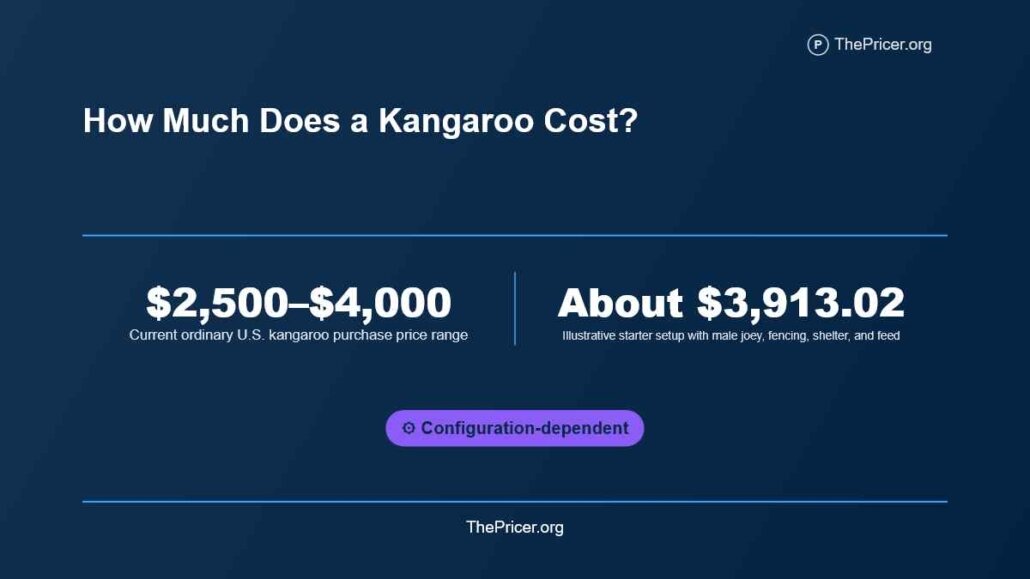
A pet kangaroo currently costs about $2,500 to $4,000 in ordinary U.S. breeder and classified examples, while unusual coloration can push asking prices far higher. One Texas breeder currently lists bottle-raised red kangaroo joeys at $2,950 for a male and $3,950 for a female. A current classified listing asks $20,000 for an albino eastern grey female.
The purchase price is only one part of the commitment. Kangaroos are large, social grazing marsupials that need outdoor space, secure fencing, weather shelter, species-appropriate feed, access to an exotic-animal veterinarian, and legal clearance where required. For someone starting without a suitable enclosure, the first-year cash outlay can exceed the animal price before veterinary care, transport, land, gates, labor, and permits are added.
Article Highlights
Jump to sections
- Current ordinary U.S. examples put a red kangaroo at roughly $2,500 to $3,950 before transport and setup costs.
- A current specialist breeder charges $2,950 for a male red joey and $3,950 for a female.
- A rare albino eastern grey is currently advertised at $20,000.
- A basic enclosure can add hundreds or thousands of dollars before posts, gates, labor, land, and maintenance.
- A current specialty macropod feed example costs $45.99 per 40-pound bag.
- State rules vary sharply, so legality must be checked for the exact animal and location before money changes hands.
How Much Does a Kangaroo Cost?
The useful 2026 budget for a normally colored red kangaroo is about $2,500 to $4,000 based on current public U.S. offers, not the much wider range created by mixing old listings with rare animals. Janda Exotics currently advertises a male bottle-raised red joey for $2,950 and a female for $3,950. The same breeder lists kangaroo feed at $18.99 and joey milk replacer at $85.
| Current example | Advertised price | What changes the comparison |
|---|---|---|
| Male red kangaroo joey | $2,950 | Bottle-raised breeder animal |
| Female red kangaroo joey | $3,950 | Same breeder, female premium |
| Two male kangaroos from a petting-zoo downsizing | $2,500 each | Adult rehoming-style classified offer |
| Albino eastern grey female | $20,000 | Rare coloration and different species |
The current classifieds show why a simple national average would be misleading. Two male kangaroos are advertised at $2,500 each, while an albino eastern grey female is listed at $20,000. That rare-color asking price is about 6.8 times the current $2,950 male red-joey price. It is useful as proof that color and scarcity can distort the market, not as a normal pet-kangaroo budget.
Why Prices Move
Sex, age, species, coloration, handling, reproductive value, and seller type all affect the asking price. At the current Janda prices, the female red joey costs $1,000 more than the male, a premium of about 34%. That does not prove females always cost more. It shows that sex can materially affect one current breeder’s pricing and should be checked rather than assumed.
Size also needs careful wording. The red kangaroo is the largest living marsupial. The Australian Museum reports males with body lengths up to 1.4 meters and weights up to 92 kilograms, while females are much lighter. Those differences change fencing, handling, transport, and veterinary logistics even when two young joeys initially look similar.
Bottle-raised animals can command a premium because the seller has invested labor, feed, and time, but a bottle baby also transfers specialized care to the buyer if it has not been fully weaned. Rare color should be treated separately from ordinary red or grey pricing. A white or albino animal can attract a collector-style premium that says little about the cost of a normally colored kangaroo. Ask for species, sex, age, weaning status, health history, legal paperwork, and what is included before comparing two prices.
What the First Year Can Cost
A first-year budget becomes much larger once the animal, fencing, shelter, and feed are combined. Take a chosen 50-by-50-foot paddock as an illustrative scenario, not a universal minimum. Its 200-foot perimeter would require two 100-foot rolls of six-foot welded wire. A current heavy 12.5-gauge example costs $158.52 per 100-foot roll, making the wire alone $317.04.
A basic 12-by-12-foot livestock shelter currently costs $599.99. Add the current $2,950 male red joey and one 40-pound bag of specialty macropod feed at $45.99, and the visible starter subtotal becomes $3,913.02. The arithmetic is $2,950 + $317.04 + $599.99 + $45.99.
That figure is deliberately incomplete. It excludes fence posts, a gate, anchors, installation labor, land, water equipment, bedding, shade improvements, veterinary work, transport, permit fees, taxes, and ongoing feed. It also assumes the property already has a suitable outdoor area. The calculation shows a cost relationship that the animal price hides. In this basic scenario, even a low-specification enclosure and shelter add almost $1,000 before many of the difficult costs appear, and a professionally installed enclosure could move the total much higher.
The Enclosure Is the Big Expense
Kangaroos need space to move and a barrier designed for large macropods. A short backyard fence should not be assumed adequate simply because a young joey cannot clear it yet. Victoria’s wildlife-management guidance says kangaroo exclusion fencing should be at least 1.8 meters high, close to six feet, because kangaroos can attempt near-vertical jumps. A private captive enclosure also needs secure gates, safe wire spacing, shade, dry shelter, and surfaces that do not create injury traps.
Material price is only the beginning. The illustrative two-roll fence above covers 200 linear feet, but posts, bracing, gates, corners, ground conditions, and contractor labor can cost as much as or more than the mesh. Larger paddocks scale quickly. Doubling a square paddock from 50 by 50 feet to 100 by 100 feet quadruples its area, but doubles the perimeter from 200 to 400 feet, which doubles the wire quantity from two rolls to four in this simplified example.
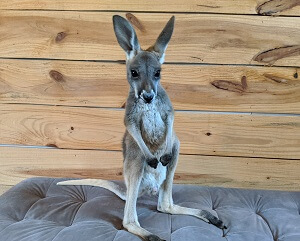
A kangaroo also needs protection from extreme weather. A prefabricated livestock shelter can be a starting component rather than a complete habitat. Owners in cold climates may face insulated shelter, heated-water, drainage, and winter-management costs that do not appear in warm-climate breeder advertisements. Property zoning and local animal rules may affect where an enclosure can be placed.
Food Costs Add Up
Red and grey kangaroos are grazing marsupials, not omnivorous novelty pets. A current commercial macropod ration gives a concrete feed benchmark. Mazuri lists its 40-pound Macropod LS Diet at $45.99. The product is designed to complement pasture and hay rather than replace forage entirely.
The recurring total depends on access to suitable pasture, animal size, climate, hay quality, waste, and the feeding plan set with an experienced veterinarian or keeper. That makes the old claim of exactly $10 per day or $3,000 to $3,500 per year too confident without consumption records. Two properties can have very different cash feed bills if one has productive pasture and the other must buy most forage.
Fresh produce should not become the main ration. Kangaroos are foregut fermenters adapted to fibrous plant material. Poorly balanced captive diets can contribute to obesity, dental trouble, and nutritional disease. The practical budgeting approach is to price the local forage supply, specialty pellets, seasonal pasture shortfalls, storage losses, and water, then add a buffer for months when grass quality or availability drops. Feed storage also needs to keep hay and pellets dry and protected from pests.
Joey Care, Vets, and Transport
A bottle-raised joey can create costs that an already-weaned animal does not. Macropod hand-rearing is stage-specific. Veterinary guidance for hand-rearing macropods describes changes in milk composition as joeys develop, specialized nipples, controlled pouch temperatures, and multiple daily feeds. That makes a bottle baby a poor place to improvise with generic calf, puppy, or human infant formula.
Veterinary access is another hidden constraint. A kangaroo may need a practitioner experienced with zoo, wildlife, or exotic hoofed and marsupial patients rather than a standard dog-and-cat clinic. Travel distance can matter as much as the examination fee if the nearest suitable veterinarian is hours away. Sedation, imaging, dental treatment, trauma care, and emergency transport can create bills that dwarf a routine office visit.
Transport has a real current price ladder. Janda Exotics lists $79 within 49 miles, $179 for 50 to 99 miles, and $299 for 100 to 250 miles, with longer routes quoted individually. Its delivery price includes a transport enclosure, travel food, water, and comfort items. Adding the $299 tier to the earlier $3,913.02 starter scenario raises that buyer’s subtotal to $4,212.02 before veterinary care, permits, posts, gates, labor, and continuing feed.
Legality Changes by State
The old claim that kangaroos are legal in exactly 13 states is too rigid for publication. States classify captive wildlife differently, and city or county rules can be stricter than state law. Florida has a Class III personal-pet permit system, with a no-cost permit category for qualifying Class III wildlife. Importation can require separate approval depending on the animal and circumstances.
California takes a much stricter approach to restricted wildlife. The California Department of Fish and Wildlife says restricted-species permits are not issued for pet purposes. A prospective kangaroo owner should confirm the exact species classification directly with the department before arranging a purchase or transport rather than relying on an old online list.
A permit in one jurisdiction does not make a kangaroo legal everywhere else. The same animal can face separate rules for possession, importation, transport, breeding, exhibition, and commercial sale. County zoning or city animal codes may add another layer even when state wildlife law allows private possession. The safest buying sequence is to verify the exact species with the state wildlife agency, state veterinarian or agriculture authority, and local government before placing a deposit. Get the answer in writing when possible, especially before arranging interstate transport.
Is a Kangaroo Practical?
A kangaroo can fit a specialized private facility with substantial land, strong fencing, experienced keepers, a compatible social arrangement, and veterinary access. It is poorly matched to an ordinary suburban pet setup. The adult animal’s size changes the risk profile. Adult male size alone can make casual handling impractical, and behavior can change with maturity and breeding condition.
Kangaroos are social animals that naturally live in groups, so companionship and group management deserve planning before purchase. A buyer who acquires one young joey because it appears tame still needs a long-term plan for adult housing and social needs. That can mean more land, another compatible macropod, altered fencing, and higher feed and veterinary bills later.
Readers comparing unusual large animals can also look at the cost of a camel, giraffe, or elephant. Those animals are very different, but the same budgeting lesson applies: the purchase price is often smaller than the infrastructure and long-term care commitment.
Makes sense if
- You have suitable land and can build a secure large-animal enclosure.
- You have confirmed possession and transport rules before paying.
- You already have access to a veterinarian who will treat the animal.
- You can fund long-term feed, fencing maintenance, shelter, and emergency care.
Does not make sense if
- You are budgeting only for the $2,500 to $4,000 animal price.
- You expect a standard backyard fence to contain an adult kangaroo.
- You want an animal that can be handled like a dog as it matures.
- You have not planned for the animal’s social and space requirements.
Answers to Common Questions
How much does a baby kangaroo cost?
Current bottle-raised red kangaroo examples are $2,950 for a male and $3,950 for a female from one specialist breeder. Other sellers and rehoming listings can differ.
Why can some kangaroos cost $20,000?
Rare coloration can create a collector-style premium. A current albino eastern grey female is advertised at $20,000, far above ordinary red kangaroo examples.
How much does a basic kangaroo setup cost?
One illustrative starter calculation using a $2,950 male joey, two rolls of six-foot fencing, a simple livestock shelter, and one bag of specialty feed reaches $3,913.02. Posts, gates, labor, land, veterinary care, transport, permits, and continuing feed are excluded.
Can I legally own a kangaroo in the United States?
There is no single national pet-ownership rule that settles the question for every buyer. State wildlife rules, animal-health requirements, local ordinances, and the purpose of possession can all matter.
How long can a red kangaroo live?
Red kangaroos can live for many years in managed care, with zoo sources reporting animals reaching their early twenties. Long lifespan makes enclosure maintenance, food, and veterinary access a long-term financial commitment.
Disclosure: Educational content, not medical advice. Pricing varies by provider, location, and insurance. Confirm eligibility, coverage, and out-of-pocket costs with a licensed clinician and your insurer. See our methodology and corrections policy.