
How Much Does a Legal Separation Cost?
Updated on | Researched and reviewed by Alec Pow, Founder & Pricing Investigator
Prices, claims, and calculations checked against 14 cited sources. See our research methodology and corrections policy.
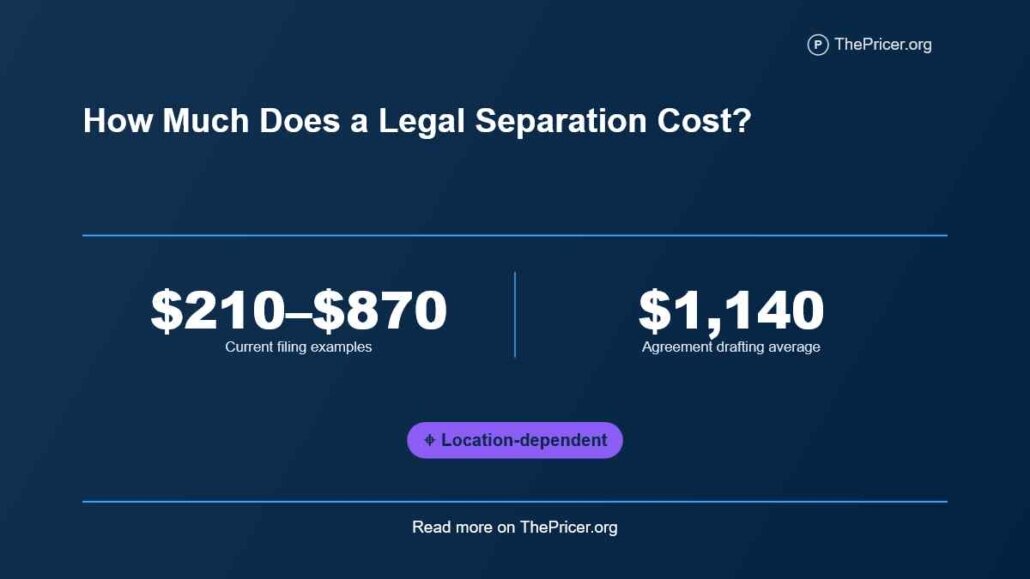
A legal separation can cost only a few hundred dollars in court fees when spouses handle a cooperative case themselves, while lawyer-assisted or contested cases can cost several thousand to $50,000+. Current court examples include a $210 New York County filing path, a $230 Colorado petition, a $261 Arizona petition, and an $870 California joint petition that covers both petitioners. Attorney work can cost much more than filing.
There is no reliable national flat price because legal separation is created differently from state to state. Some states use a court decree, New York permits a properly executed separation agreement route, and Texas does not recognize legal separation as a formal status. The practical budget depends on the state, whether both spouses agree, property and debt issues, children, support, and how much legal work each spouse buys. This is cost information, not legal advice.
Article Highlights
Jump to sections
- Current initial court fees reviewed range from $210 to $870, depending on the state and filing structure.
- Arizona charges $261 for a legal-separation petition and $172 for a response.
- Colorado charges $230 for the petition and $116 for a response.
- A current legal marketplace reports about $1,140 to have a lawyer draft a separation agreement and $510 to review one.
- Contested cases can reach $5,000 to $50,000+ when substantial attorney time is required.
- Legal separation is not available as a formal status in every state.
How Much Does Legal Separation Cost?
The court is usually the smallest predictable part of the bill. Arizona’s current Superior Court fee schedule lists $261 for a petition for legal separation and $172 for a response or initial appearance. If both fees apply, the opening court cost is $433 before service, copies, mediation, expert work, or attorneys.
Colorado’s domestic-relations fee schedule lists $230 for a legal-separation petition and $116 for a response. That produces $346 in initial court charges when one spouse petitions and the other formally responds. New York County uses a different structure. Its court help center says an agreed separation agreement can be filed by purchasing a $210 index number after both spouses sign and notarize the agreement.
Attorney involvement changes the budget much faster than the filing fee. Oregon Law Help states that a legal separation costs about the same as a divorce and gives lawyer costs around $300 per hour, with cases potentially running from $5,000 to $50,000+ depending on complexity. That is not a national average. It shows how quickly a contested court process can outgrow the government filing charge.
Legal Separation Is State-Specific
Legal separation does not mean the same procedure everywhere. Arizona describes it as a process that determines spouses’ legal rights and responsibilities without ending the marriage. Its family-law filing guidance says separation cases can address child custody, parenting time, child support, spousal support, community property, and debt. A decree is the end product in that court-based model.
New York can work differently when both spouses agree. The New York Courts help center explains that a written separation agreement must state the spouses’ intent and terms, be signed by both parties, and be notarized. Filing it in New York County requires a $210 index number. This is where the old article’s statement about notarization came from, but that rule cannot be projected onto the whole country.
Texas supplies the opposite warning. Texas Law Help states that Texas has no legal separation. Couples may use other legal tools, such as temporary orders in a divorce case, but they cannot buy a formal legal-separation decree simply by paying a filing fee. A national cost range is meaningless unless the reader first checks whether the state recognizes the status and which procedure it uses.
State Filing Fee Examples
Official court materials show that a separation filing commonly costs a few hundred dollars, but the units are not identical. California now allows spouses who agree on all final terms to start a divorce or legal separation together through a joint petition. The 2026 joint-petition fee is $870 and covers both petitioners. That figure should not be compared as though it were one person’s filing fee.
| State or path | Initial court amount | What the figure represents |
|---|---|---|
| New York County agreement filing | $210 | Index number to file an agreed notarized separation agreement |
| Colorado petition | $230 | Petition for legal separation |
| Arizona petition | $261 | Petition for legal separation |
| California joint petition | $870 | Joint filing covering both petitioners |
The table also shows why the old $50 to $500 filing range is no longer a good national answer. One current California route alone exceeds it. At the same time, a person should not conclude that California is four times as expensive as New York from these entries. One number covers two joint petitioners, another covers an index number for an agreed contract path, and Arizona and Colorado list one petitioner’s court filing.
Fee waivers can reduce court costs for qualifying filers. They do not make lawyer fees or disputed property issues disappear. A waiver changes the government’s filing charge, not the legal complexity of the separation.
Agreement Drafting and Review
Couples who agree on the major terms may spend more on the agreement than on the courthouse. ContractsCounsel’s September 2026 data reports an average flat drafting fee of $1,140 and an average review fee of $510 based on recent separation-agreement projects. Those are marketplace figures, not mandatory legal rates.
The difference creates a useful budget choice for a cooperative case. Paying for review instead of having a lawyer draft the agreement from scratch is $630 less using those current averages. That is about 55% below the drafting fee. The cheaper route is only comparable when the spouses already have a usable draft and the reviewing lawyer does not need to rebuild it.
New York makes this distinction especially relevant because the court does not supply a preprinted separation agreement. The court describes the agreement as a contract that may address property, maintenance, custody, and child support, and warns that preparation can be complex. A lawyer who represents one spouse does not automatically represent the other spouse. Independent advice can create a second legal bill.
Drafting cost also rises when the document must handle real estate, a business, retirement assets, tax questions, unusual debt, support formulas, or detailed parenting provisions. A short agreement between spouses with few assets is not the same legal project as a settlement governing a house, pensions, custody, and years of support payments.
Children, Property, and Support
A legal separation can require much of the same financial work as a divorce even though the marriage remains intact. Parenting time, legal custody, child support, spousal support, property, and debt may all need enforceable terms. When the spouses already agree, those issues can be written into a settlement. When they disagree, lawyer hours, motions, hearings, mediation, and expert work can grow.
Arizona’s court system publishes separate legal-separation packets for cases with children and without children. The children case packet includes a parenting plan, child-support materials, an affidavit regarding minor children, and parent-education requirements. That extra work explains why the headline filing fee cannot predict the full cost.
A custody dispute can also create spending outside the separation lawyer’s invoice. A parent may need separate advice about support or parenting issues. The cost of a child support lawyer becomes relevant when support is disputed, while a cooperative couple may resolve the same subject inside a broader agreement.
Property can produce the same effect. A house may need valuation, retirement benefits may need specialized orders, and privately held businesses can require accountants or appraisers. The legal-separation filing fee does not include those professionals. The more issues the court must decide, the less useful a simple filing-fee estimate becomes.
Hidden Costs After Filing
 The first court payment is rarely the only possible court-related expense. Service of process may be required when spouses do not file together. Copies, certified records, motions, parenting programs, mediation, and post-judgment changes can create extra charges. Exact amounts depend on the state and local court. A self-represented case can still accumulate smaller administrative bills even without an attorney.
There is also a possible second-stage cost if legal separation later becomes divorce. Colorado permits a party to ask the court to convert a legal-separation decree to dissolution after the required period. That means separation should not be treated as a discounted divorce merely because the couple is postponing the final end of the marriage. Future legal work can matter to the lifetime cost of the choice.
Mediation may reduce litigation when spouses disagree but can still add professional fees. A separate look at divorce mediator costs is useful because the same property, parenting, and support disputes can arise in separation. Court-sponsored options may differ sharply from private mediation.
Fee relief is another hidden variable in the opposite direction. California’s courts allow qualifying people in legal-separation cases to seek waivers for filing, response, and certain order-request fees. A fee waiver can shrink hundreds of dollars of court charges, but it does not waive private attorney, appraisal, accounting, or mediation bills.
Three Cost Scenarios
A cooperative New York agreement offers a useful first scenario. Suppose one spouse pays the current marketplace average of $1,140 for a lawyer to draft the agreement, the other pays the $510 average for independent review, and the couple uses the $210 New York County filing path. The calculated total is $1,860 before notarization, copies, tax advice, or any extra negotiation.
- Agreement drafting $1,140
- Independent agreement review $510
- New York County index number $210
- Calculated documented-cost stack $1,860
This is an illustrative ThePricer calculation, not a quoted package. It combines separately documented current inputs to show why an agreed case can move past $1,000 without becoming contested.
An Arizona self-represented case has a different structure. If one spouse files the $261 petition and the other pays the $172 response fee, the documented initial court total is $433. Attorney fees, service, parenting requirements, and later motions are excluded. A Colorado petition-and-response pairing similarly totals $346 from the published $230 and $116 charges.
The third case is contested separation. Oregon Law Help’s current guidance puts attorney billing around $300 per hour and says lawyer costs may reach $5,000 to $50,000+. A case involving contested custody, support, property, or complex assets can move into that tier even though the courthouse fee remains only a few hundred dollars.
Legal Separation vs Divorce
Legal separation is not automatically cheaper than divorce. Arizona charges the same $261 petition fee for dissolution and legal separation, while Colorado lists $230 for either petition. California’s $870 joint-petition route also applies to divorce or legal separation. For those matched filing methods, the base court-fee difference is $0.
The larger cost question is what the spouses need resolved and whether divorce may follow. Property, custody, support, and debt can require much of the same work in either case. A reader planning to end the marriage should compare the broader cost of divorce rather than treating separation as a discounted substitute.
Makes sense if
- Your state recognizes legal separation and you need enforceable orders while staying married.
- You need orders for property, support, or parenting but are not seeking dissolution now.
- You have checked any benefit or insurance issue tied to marital status with the relevant plan or professional.
Does not make sense if
- Your state does not offer the legal status you need.
- Your only reason is an assumption that filing fees are lower than divorce.
- You expect a near-term divorce that may duplicate legal work.
Answers to Common Questions
How much does it cost to file for legal separation?
Current examples include $210 for a New York County agreement-filing path, $230 for a Colorado petition, and $261 for an Arizona petition. California’s 2026 joint-petition route costs $870 and covers both petitioners.
How much does a separation agreement cost?
One current legal marketplace reports an average of $1,140 for lawyer drafting and $510 for lawyer review. Complex negotiations can cost more.
Is legal separation cheaper than divorce?
Not necessarily. Arizona, Colorado, and California use the same base fee for the matched divorce and legal-separation filing methods reviewed here. Attorney time and disputed issues usually matter more than the label on the case.
Do both spouses need lawyers for a legal separation?
Not in every case. Self-representation is permitted in many courts, but one lawyer cannot simply be assumed to represent both spouses’ separate interests. Complex property, custody, support, or tax issues can make independent legal advice valuable.
Can every married couple file for legal separation?
No. State law controls the available legal status and process. Texas does not recognize legal separation as a formal status.
Disclosure: Educational content, not financial advice. Prices reflect public information as of the dates cited and can change. Confirm current rates, fees, taxes, and terms with official sources before purchasing. See our methodology and corrections policy.