
How Much Does an Abstract of Title Cost?
Updated on | Written by Alec Pow
This article was researched using 12 sources. See our methodology and corrections policy.
An abstract of title can cost $200 to $850 for selected title reports and abstract continuation services, while preparing a completely new residential abstract may cost $1,300 to $2,500 or more. These figures come from published Iowa abstracting company prices, where formal abstracts remain an important part of real estate transactions. They are not nationwide averages for every title search.
The distinction matters because an abstract of title is not necessarily the same product as a preliminary title report, a title search, or title insurance. An abstract documents the recorded history affecting a property. Its price depends on the records examined, whether an existing abstract can be updated, and the work required to establish a reliable ownership history. Buyers and sellers should also check whether the quoted price includes title examination, recording, lien searches, and post-closing updates.
Article Highlights
Jump to sections
- An Iowa title report can cost $200, while a preliminary abstract continuation may cost $550 to $850.
- A new residential root-of-title abstract can cost $1,300 to $2,500, according to a published Iowa provider estimate.
- Final abstract continuations are advertised at approximately $175 to $200 by several providers.
- Pre-closing and post-closing searches can add $50 to $75 each.
- Abstracts document property records but do not provide the financial protection of title insurance.
- Recording fees, title examination, and title insurance should be distinguished from the abstract preparation charge.

How Much Does an Abstract of Title Cost?
An abstract of title is a written or electronic summary of recorded matters affecting ownership of a specific property. It may include deeds, mortgages, easements, liens, judgments, taxes, and court proceedings.
Iowa provides some of the clearest published prices because its real estate title system continues to rely extensively on formal abstracts. The Iowa administrative rules effective June 17, 2026 define an abstract by reference to the records affecting a parcel and the applicable abstracting standards.
The following examples come from publicly posted provider schedules. They represent different services and should not be treated as interchangeable prices for one standard abstract.
| Abstract or title service | Published price | Provider |
|---|---|---|
| Residential root abstract | $1,300–$2,500, commonly | Story County |
| Preliminary abstract continuation | $550–$850 | Story County |
| Final abstract continuation | $175 | Story County |
| Residential title report | $200 | Story County |
| Lien search or title report | $200 | Abstract Associates |
| Pre-closing search | $50–$75 | Selected Iowa providers |
| Final abstract after closing | $200 | Abstract Associates |
Abstract & Title Services of Story County publishes its preliminary continuation range and separate charges for final updates, title reports, and pre-closing searches.
Abstract Associates of Iowa lists $200 for a lien search or title report and $250 when the service includes a follow-up title report after closing. Its new abstracts and preliminary continuations require individual quotes.
Russell Abstract & Title publishes a $175 final continuation and a $150 single-owner lien report on its service pricing schedule. Root abstracts are individually priced.
New Abstract vs Continuation
The largest price difference often comes from whether the property already has a usable abstract.
New root-of-title abstract
A new abstract is prepared when an adequate existing abstract is unavailable or when a new property description requires fresh title documentation. Research may include multiple transfers, mortgages, estates, court cases, and historical encumbrances.
Story County’s service descriptions state that most newly prepared residential root abstracts cost $1,300 to $2,500, although some cost less and others substantially more.
The provider also explains that a new root abstract can take up to three weeks, with many completed in under two weeks. The time depends on record volume and complexity.
Preliminary continuation
A continuation updates an existing abstract from its previous certification date to the present. It avoids reconstructing the entire historical record when the earlier abstract remains reliable and available.
At the same Story County provider, preliminary continuations are advertised at $550 to $850. The actual price depends on the number and type of entries requiring examination.
An estate transfer, foreclosure, or series of recorded liens can make an update more involved than a straightforward property sale.
Final continuation
After closing, an abstract may need another update documenting the newly recorded deed, mortgage, releases, and other relevant instruments.
Published final continuation charges include $175 from Story County and Russell Abstract & Title, while Abstract Associates lists $200.
The final continuation is a separate stage of the title-documentation process. A buyer comparing quotes should ask whether the preliminary and final work are included together or billed individually.
What Does an Abstract Include?
An abstract organizes the recorded history affecting a property into a form suitable for professional title examination. Its purpose is to identify the documents and legal matters relevant to ownership.
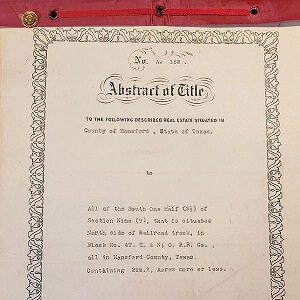
Iowa’s Title Guaranty guidance explains that participating abstractors search the public records and compile material documents affecting the property. An attorney then examines the abstract to determine the condition of title.
Depending on the property and transaction, the abstract may summarize deeds, easements, mortgages, recorded judgments, property restrictions, probate proceedings, and other instruments.
The records examined are determined by applicable title standards and the requested service. A root abstract does not necessarily reproduce every document recorded since the property first existed.
Abstract Associates’ service definitions describe a root-of-title abstract covering the most recent 40 years under the relevant marketable title standards, rather than automatically searching back to the original land grant.
That corrects a misleading claim in the old article that every abstract must investigate the property’s entire recorded history without a time limit.
Ownership problems can also arise during inheritance or divorce. Readers dealing with family property transfers may find the separate guides to estate planning costs and legal separation costs useful for understanding associated legal expenses.
Abstract vs Title Search
An abstract, title search, and preliminary title report are closely related, but they are not identical products.
A title search is the process of examining records. A title report summarizes the findings needed for the transaction, often focusing on current ownership, recorded liens, and exceptions.
An abstract typically provides a more structured record history suitable for examination under the applicable jurisdiction’s abstracting standards.
The article on preliminary title report costs covers the narrower search-and-report service. Basic residential preliminary reports can cost substantially less than preparing a new formal abstract.
Arizona law illustrates the legal distinction. Under Arizona Revised Statutes Section 20-1562, an abstract of title is a representation of documents affecting the chain of title, and the statute explicitly distinguishes it from a title insurance policy.
Neither a short title report nor a full abstract automatically cures a defect in the ownership record. They document matters that may need investigation or corrective action.
Abstract vs Title Insurance
Title insurance provides financial protection against certain covered title problems. The abstract supplies historical information that can be used to examine ownership and identify risks before the transaction closes.
The Consumer Financial Protection Bureau explains in its title service fee guidance that mortgage closing charges can include title searches, lender’s insurance, and other services connected with issuing title coverage.
A mortgage lender generally requires a lender’s title policy, while an owner’s policy protects the purchaser’s ownership interest against covered claims.
The CFPB’s owner’s title insurance explanation distinguishes these protections and recommends considering the combined cost when purchasing both policies.
Unlike an abstract, a title insurance policy contains contractual coverage provisions, exclusions, limits, and procedures for handling claims.
In Iowa, the public Title Guaranty program performs a role comparable to title insurance arrangements elsewhere, but its certificates and abstracting services are separately defined.
The amount charged for the abstract therefore should not be mistaken for the full cost of obtaining title protection.
Additional Fees
Some abstract providers publish low prices for basic searches but charge separately for related work. Those charges may be appropriate, yet they make quotations difficult to compare unless the scope is identical.
At Story County’s published rates, a pre-closing search costs $75, a post-closing search costs another $75, and a final continuation costs $175.
Abstract Associates advertises $50 for its pre-closing search, $50 for a post-closing Title Guaranty Form 901, and $200 for final abstract work.
The charges are for distinct services. They should not all be added automatically to every closing invoice.
Recording fees are another separate expense. They are paid to the relevant government office for recording documents such as deeds or mortgages, rather than to compensate the abstractor for preparing the ownership history.
Our guide to property deed transfer costs explains how recording fees and transfer taxes differ from document preparation and title services.
There can also be additional costs when a search reveals an unreleased mortgage, judgment lien, incorrect legal description, or unresolved ownership transfer. A title professional or attorney may need to obtain releases or prepare corrective documents.
The hidden-price issue is that the cheapest abstracting quote may exclude the final update and supplemental searches needed to complete the transaction.
A Worked Abstract Cost Example
Consider an illustrative residential sale in Iowa where an existing abstract is available and the provider performs services at Story County’s published prices.
The buyer and seller agree to purchase the preliminary abstract continuation, perform searches before and after closing, and obtain a final continuation.
- Preliminary abstract continuation: $650, an assumed amount within the published range.
- Pre-closing search: $75.
- Post-closing search: $75.
- Final continuation: $175.
The combined illustrative abstracting bill is $650 + $75 + $75 + $175 = $975.
The preliminary continuation represents approximately 66.7% of that total. The remaining $325 covers separate searches and the final update.
This calculation does not include title examination, title guaranty or insurance premiums, deed recording, settlement charges, attorney work, or taxes.
Now consider a different property requiring a new root abstract. At the provider’s published $1,300 to $2,500 range, the initial abstract alone could cost between $650 and $1,850 more than the assumed preliminary continuation in the first scenario.
That difference demonstrates why confirming whether an existing abstract is available can be more important than comparing small administrative fees.
Who Pays for the Abstract?
Responsibility for abstract fees depends on state practice, the purchase agreement, and negotiated terms between the buyer and seller. There is no universal U.S. rule requiring sellers to pay every abstracting charge.
The CFPB’s closing-service shopping guidance explains that many title-related services can be compared among providers and that costs vary by location.
In some transactions, sellers supply an existing abstract and pay for an update. Buyers may be responsible for examination, title coverage, or other closing expenses. Different contract arrangements can shift those obligations.
For financed home purchases covered by the federal disclosure rules, the lender generally must provide a Closing Disclosure at least three business days before closing. The CFPB’s disclosure guidance explains the timing.
Review page two of the disclosure for title services and the sections identifying who pays the charges. The full guide to home closing costs places these expenses alongside appraisal, lender, recording, and settlement fees.
The CFPB also warns that the itemization used by the title company may differ from the presentation on the Closing Disclosure. Compare total title-related costs before concluding that an item was charged twice.
How to Compare Abstract Quotes
A fair comparison begins by establishing the exact service required. An inexpensive lien report cannot replace a formal abstract when the lender or title examiner requires a certified ownership history.
Makes sense if
- Request a continuation when a usable existing abstract is available.
- Order a new root abstract when required documents are missing or the existing abstract cannot be relied upon.
- Ask for separate prices covering preliminary work, final updates, and supplemental searches.
- Check whether the provider follows the applicable jurisdiction’s abstracting standards.
Does not make sense if
- Paying for a complete new abstract without checking whether a continuation is sufficient.
- Assuming a basic title report provides identical documentation to a formal abstract.
- Treating an abstracting fee as though it includes owner’s title insurance.
- Comparing quotes without checking the recording, search, certification, and post-closing services included.
Ask the abstractor for a written estimate identifying the property, time period searched, certification standards, turnaround, included services, and potential extra charges.
What We Verified
- Checked current published Iowa prices for root abstracts, preliminary continuations, final updates, and lien reports.
- Reviewed the Iowa abstracting definition and current Title Guaranty framework.
- Compared abstract preparation with title searches, preliminary reports, and insurance coverage.
- Verified federal guidance on closing disclosures and shopping for title services.
- Preserved the original article image and relevant ThePricer links while adding further contextual links.
- Separated actual provider prices from illustrative calculations and avoided treating a selected-provider range as a national average.
Answers to Common Questions
How much does a new abstract of title cost?
A published Iowa provider estimate places many new residential root abstracts at $1,300 to $2,500. Updating an existing abstract can cost considerably less, depending on the records involved.
How long does it take to prepare an abstract?
An uncomplicated continuation can be completed relatively quickly, while a new root abstract may take one to three weeks. Record complexity, staffing, and document access affect timing.
Does an abstract prove clear title?
No. It documents recorded matters affecting the property. A qualified examiner evaluates the records, and unresolved problems may require corrective action before closing.
Is an abstract required when selling a home?
Not in every jurisdiction or transaction. Requirements depend on local title practices, the lender, and the purchase agreement. Many transactions instead use title searches, commitments, and title insurance.
Can an abstract replace title insurance?
No. The abstract provides historical ownership documentation. Insurance or title guaranty coverage provides separate financial protection under its specific contractual terms.
Disclosure: Educational content, not financial advice. Prices reflect public information as of the dates cited and can change. Confirm current rates, fees, taxes, and terms with official sources before purchasing. See our methodology and corrections policy.