
How Much Does An Indycar Cost?
Updated on | Written by Alec Pow
This article was researched using 13 sources. See our methodology and corrections policy.
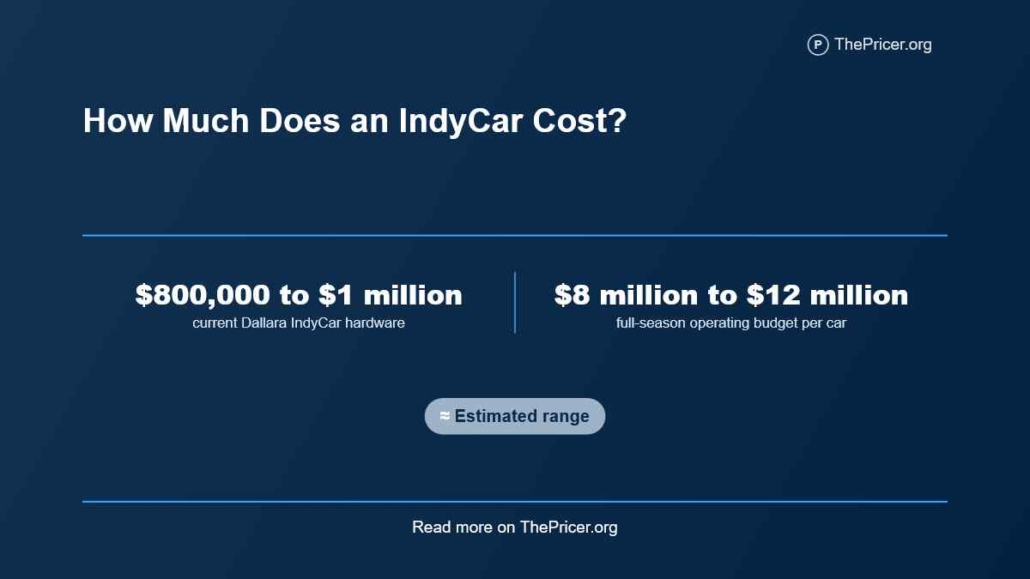
A current IndyCar costs roughly $800,000 to $1 million for the Dallara car hardware before the annual engine lease, hybrid-system costs, tires, crew, travel, crash spares, and race operations. The much larger number is what it costs to actually compete: current paddock reporting puts a full-season IndyCar operating budget at about $8 million to $12 million per car.
The engine is not normally purchased with the car. Chevrolet and Honda supply engines under a 2026 lease capped at $1.45 million per entry, covering four 2.2-liter twin-turbo V6 engines intended to provide 10,000 combined miles. A separate hybrid energy-recovery system also carries a lease cost.
This distinction explains why estimates for “an IndyCar” can differ by millions of dollars. Roughly $800,000 to $1 million describes the physical racing machine. Roughly $8 million to $12 million describes the people, leases, equipment, tires, logistics, repairs, testing, and race weekends needed to campaign that machine for a season.
Article Highlights
Jump to sections
- A new current-generation Dallara IndyCar is valued by teams at roughly $800,000 to $1 million (at $30 per hour, earning that amount would take about 12.8 to 16 years of full-time work, before taxes).
- A competitive full-season entry now costs about $8 million to $12 million per car.
- The 2026 Chevrolet or Honda engine lease costs up to $1.45 million per entry and covers four engines.
- The latest public full-season hybrid lease estimate was roughly $225,000 to $250,000 per car.
- Current magnesium wheels cost about $1,650 each, or $6,600 per four-wheel set.
- Teams commonly carry 10 to 12 wheel sets, creating roughly $66,000 to $79,200 of wheel inventory before tires.
- Current reporting describes the Firestone tire commitment for a full season as another seven-figure expense per entry.
How Much Does an IndyCar Cost?
| IndyCar expense | Current cost or planning figure | What the number represents |
|---|---|---|
| Current Dallara car/chassis package | $800,000 to $1 million (about 12.8 to 16 years of full-time work at $30 per hour) | Team estimate for a new current-generation car |
| 2026 engine lease | Up to $1.45 million | Four Chevrolet or Honda engines covering about 10,000 miles |
| Hybrid ERS lease | $225,000 to $250,000 | Latest publicly reported full-season team estimate |
| One set of magnesium wheels | $6,600 | Four wheels at about $1,650 each |
| 10 to 12 wheel sets | $66,000 to $79,200 | Typical beginning-of-season wheel inventory |
| Annual Firestone tire commitment | Seven figures | Current reporting does not publish one precise 2026 figure |
| Full-season operating budget | $8 million to $12 million | One current competitive entry, including much more than the car |
| 2026 Leaders Circle payment | $1.645 million | Guaranteed series payment for qualifying charter entries |
| 2028 Dallara IR-28 | About $800,000 to $1 million+ | Team planning estimate before the changeover is complete |
The $800,000 to $1 million current-car estimate comes from teams surveyed about the replacement Dallara IR-28. IndyCar told owners it intends to keep the new chassis close to the price of today’s DW12-based cars, and those owners placed the current car in the same $800,000 to $1 million range.
What You’re Actually Buying
A modern IndyCar is a single-seat, open-wheel racing machine built around a standardized Dallara carbon-fiber safety cell and body package. The current platform traces its chassis to the IR-12/DW12, with the IR-18 aerodynamic package and later additions such as the aeroscreen and hybrid power unit.
Chevrolet and Honda supply the 2.2-liter twin-turbo V6 engines. Firestone supplies the race tires. Teams work within tightly controlled technical regulations but retain meaningful freedom in areas such as setup, dampers, engineering, strategy, and preparation.
The current INDYCAR car guide identifies Dallara as the standardized chassis supplier. Buying a chassis does not give a private owner a complete route into an NTT INDYCAR SERIES race. A competitive entry also needs approved powertrain supply, tires, personnel, equipment, series eligibility, and the infrastructure of a professional race team.

The current car is far quicker than the old article’s 320 km/h figure suggests. Alex Palou’s 2026 Indianapolis 500 pole run averaged 232.248 mph, according to the official Indy 500 qualifying results.
On road and street circuits, the current hybrid system can be combined with push-to-pass. INDYCAR says the combination can make about 800 horsepower, versus the old article’s generic “700+ hp” description, as detailed in its hybrid competition specifications.
The Car Is $800K-$1M
The old idea of buying an IndyCar engine for $80,000 to $140,000 (about 1.3 to 2.2 years of full-time work at $30 per hour) is incorrect. Teams lease their engines from Chevrolet or Honda.
For 2026, current paddock reporting puts the series-capped lease at $1.45 million per entry. The package provides four 2.2-liter twin-turbo V6 engines intended to cover about 10,000 combined miles. The extra Freedom 250 race was expected to fit inside that mileage allocation rather than force another engine charge, according to the 2026 engine-lease reporting.
The hybrid Energy Recovery System is another leased component. Teams paid $90,000 for the partial 2024 introduction. Ahead of the first complete hybrid season, teams told RACER they expected a full-season charge of about $225,000 to $250,000 per car, according to the latest detailed hybrid-cost reporting. A newer exact public 2026 ERS invoice has not been disclosed, so that figure should be treated as the most recent public planning range rather than a guaranteed 2026 tariff.
At the midpoint, a $1.45 million engine lease plus a $237,500 hybrid lease equals $1,687,500. Against a $10 million season budget, powertrain access alone represents about 16.9% of the year’s spending before the team buys fuel, tires, wheels, parts, or pays anyone.
Wheels, Tires, Spares, and Crash Damage
The old article’s $10,000 to $25,000 estimate for a “complete set of tires and wheels” does not reflect how professional teams stock parts.
Current magnesium IndyCar wheels cost about $1,650 each, or $6,600 per four-wheel set. Teams commonly begin a year with 10 to 12 sets for each car, according to current IndyCar wheel-cost reporting.
That makes the opening wheel inventory roughly $66,000 for 10 sets or $79,200 for 12 sets. Crashes can destroy wheels, so teams replenish that inventory during the season.
Tires are separate. January 2026 reporting on PREMA’s attempt to return to the championship described the Firestone commitment as another seven-figure outlay for a full-season entry. An exact public 2026 tire-lease amount was not disclosed.
Then come noses, wings, floors, suspension pieces, bodywork, uprights, gearboxes, radiators, brake components, electronics, and complete spare assemblies. Crash damage is one reason the physical car price cannot be multiplied by the number of races to estimate a team’s budget. Professional teams own inventories of replaceable components so an accident on Friday does not automatically end their weekend.
$8M-$12M Per Season
The car itself can be only a small part of the money needed to race it. On August 23, 2026, current paddock reporting put the annual operating budget at roughly $8 million to $12 million per car. The same report notes that the 2026 Leaders Circle payment is worth about $1.7 million toward those costs.
Penske Entertainment’s published 2026 Leaders Circle figure is $1.645 million for each of the 22 qualifying contracts. That payment can cover about 20.6% of an $8 million budget or about 13.7% of a $12 million budget. It helps, but it does not come close to funding the entry by itself.
The rest includes engineers, mechanics, strategists, fabricators, data staff, management, driver arrangements, shop facilities, transporters, freight, flights, hotels, meals, testing, pit equipment, tires, fuel, spare parts, damage, and specialized tools. Current reporting places the average operating requirement between $8 million and $12 million.
The newly added Washington race provides a useful marginal-cost example. Teams initially budgeted roughly $250,000 per car simply to add the Freedom 250 to a season that had originally been planned with one fewer event. One extra race can therefore cost as much as roughly one-quarter of the midpoint price of the physical car.
This is also why comparing an IndyCar with the cost of an F1 car needs care. Hardware prices and annual team spending are two different questions. The same distinction applies when comparing an IndyCar with a Top Fuel dragster or the much lower entry point of a racing go-kart.
Three IndyCar Cost Scenarios
New physical car: Using the midpoint of the current $800,000 to $1 million range gives a constructed hardware figure of about $900,000. That is the car-level answer, not a racing-season budget.
One full-season entry: A professionally staffed car running the championship needs roughly $8 million to $12 million under current team estimates. Using $10 million as a midpoint means the assumed $900,000 physical car represents only 9% of annual spending.
Two-car team: Applying the same operating range to two entries produces roughly $16 million to $24 million per season. A new organization can also need substantial capital for chassis inventory, spare cars, transporters, shop equipment, pit equipment, and facilities before the first season begins.
Worked example: getting one new car to the starting line
Start with a constructed $900,000 current-car midpoint. Add the $1.45 million 2026 engine lease. Add $237,500, the midpoint of the latest public hybrid lease estimate. Add 11 sets of wheels at $6,600 per set, or $72,600. Those four items total $2,660,100: $900,000 + $1,450,000 + $237,500 + $72,600 = $2,660,100.
That still excludes the seven-figure Firestone commitment, payroll, spares, crash damage, transport, travel, shop costs, testing, driver arrangements, and most of the operation. This is why a car that costs around $900,000 can require a $10 million annual program.
The 2028 IR-28 Cost Reset
The current car is approaching the end of its competition life. INDYCAR unveiled the Dallara IR-28 in July 2026 and plans to race it from 2028. The new car will be roughly 100 pounds lighter and use a new 2.4-liter twin-turbo V6 hybrid powertrain, according to the official IR-28 announcement.
Teams surveyed before the reveal were budgeting about $800,000 to $1 million per IR-28 chassis, while some 2026 planning reports say organizations are reserving upward of $1 million per car for the changeover.
The expensive part for established teams is not simply buying one chassis. A multi-car organization needs race cars, backup inventory, new gearboxes, bodywork, suspension parts, electronics, tools, and spares specific to the new design. Some current inventory will become obsolete after 2027.
The new engine also changes the equation. INDYCAR says the 2028 2.4-liter V6 will make up to 760 horsepower before hybrid contribution, while its new battery-based hybrid package will store about 14 times as much energy as the current supercapacitor system.
Who This Cost Makes Sense For
Makes sense if:
- You are evaluating the economics of a professional IndyCar entry rather than trying to buy a road-legal performance car.
- You separate one-time car and equipment purchases from recurring engine, tire, personnel, and travel costs.
- A sponsor, owner, or investor can support a multi-million-dollar annual racing operation.
- The organization has enough spare inventory to continue racing after normal component failures or crash damage.
Does not make sense if:
- You interpret the $800,000 to $1 million chassis figure as the amount needed to enter the championship.
- You assume an IndyCar engine can simply be purchased for $80,000 to $140,000.
- You budget for one set of wheels and tires rather than a season-long inventory.
- You ignore the upcoming 2028 changeover when valuing a current car for future competition.
What We Verified
- Checked the current INDYCAR technical description, which identifies the Dallara chassis, carbon-fiber construction, hybrid power unit, gearbox, and current configuration weights.
- Confirmed through 2026 team-supply reporting that Chevrolet and Honda engine contracts are capped at $1.45 million per car and that a full-season Firestone tire commitment is a seven-figure expense.
- Cross-referenced the first IR-28 validation test, confirming that the replacement chassis is already running on track ahead of its 2028 race debut.
- Verified the current $1.645 million Leaders Circle payment through Penske Entertainment funding reporting.
Answers to Common Questions
How much does a real IndyCar cost?
A new current-generation Dallara IndyCar is valued by teams at roughly $800,000 to $1 million before the annual engine lease and full racing operation.
How much does it cost to race an IndyCar for a season?
Current operating budgets run about $8 million to $12 million per car per season. Some teams operate near the low end while better-funded programs can spend toward the top of that range.
How much does an IndyCar engine cost?
Teams do not normally buy the current Chevrolet or Honda engine. The 2026 engine lease is capped at $1.45 million per entry and covers four engines intended for roughly 10,000 combined miles.
How much do IndyCar wheels cost?
Current magnesium wheels cost about $1,650 each, or $6,600 for four. A 10- to 12-set inventory represents about $66,000 to $79,200 before replacement wheels are needed.
How fast is an IndyCar?
Alex Palou’s 2026 Indianapolis 500 pole speed averaged 232.248 mph. Current cars can also produce about 800 horsepower when hybrid assist and push-to-pass are available together on road and street circuits.
Disclosure: Educational content, not financial advice. Prices reflect public information as of the dates cited and can change. Confirm current rates, fees, taxes, and terms with official sources before purchasing. See our methodology and corrections policy.